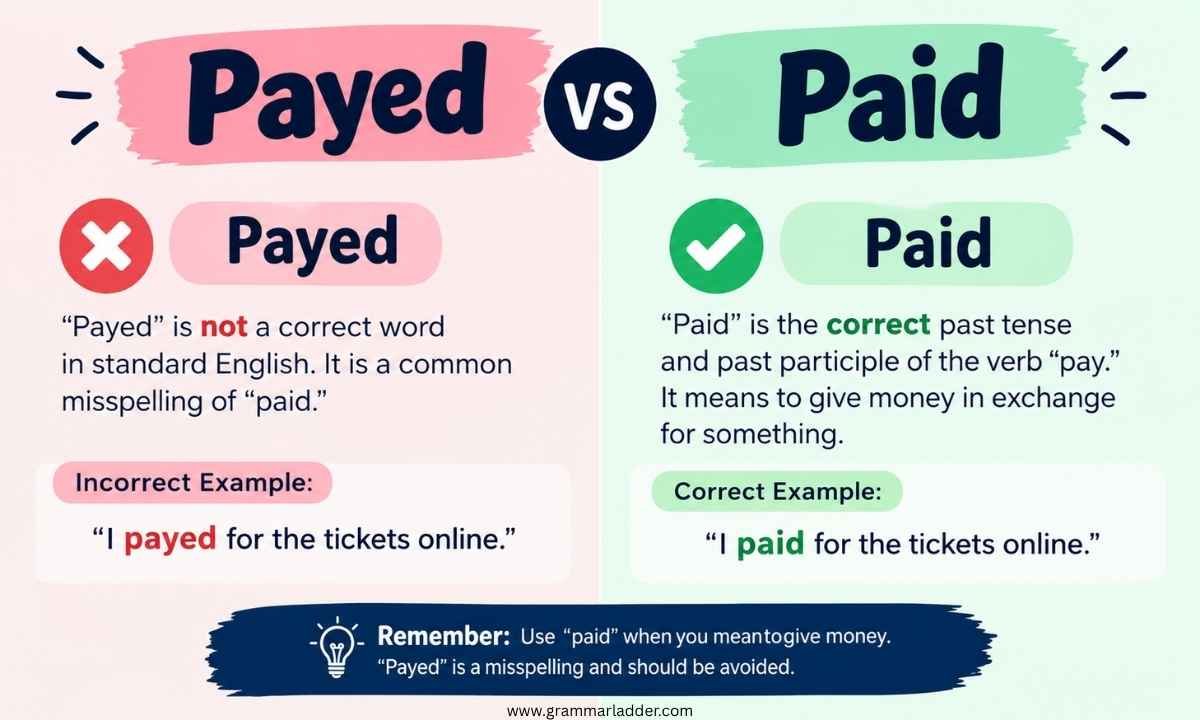
You are typing an email and stop. “I paid the invoice” or “I payed the invoice”? Many writers pause at this exact spot, and even careful ones second-guess it.
The confusion is understandable, because most English verbs add -ed in the past tense. But “pay” is irregular, and it follows its own pattern. This guide explains the difference between payed and paid, shows when each one is correct, and gives you simple tools to get it right every time.
Quick Answer
“Paid” is the correct past tense and past participle of “pay” in almost every situation. Use it for money, favors, attention, and consequences.
“Payed” is correct only in two narrow nautical senses. It means letting out a rope or cable, or coating a ship’s seams with tar or pitch.
If your sentence isn’t about boats, write paid.
What Does “Paid” Mean?
“Paid” is the standard past form of the verb “pay.” It describes giving money in exchange for goods or services. It also covers many figurative uses, such as giving attention, making amends, or settling a debt.
“Paid” works as both a simple past verb and a past participle. It can also act as an adjective, as in “paid leave” or “paid subscription.”
Examples of “Paid”
- She paid the electricity bill on Monday.
- We have already paid for the tickets.
- He paid close attention during the lecture.
- The company paid its employees on time.
- You will be paid after the project is approved.
- Their hard work finally paid off.
- Employees receive paid vacation every year.
Why “Paid” Is Correct
“Pay” belongs to a small group of irregular verbs. Instead of adding -ed, it changes its spelling: pay → paid → paid.
Dictionaries such as Merriam-Webster and Oxford list “paid” as the standard past form. Style guides like AP and Chicago follow the same rule. This is settled usage, not a matter of opinion.
What Does “Payed” Mean?
“Payed” is not a typo in every case. It survives in a specialized sailing vocabulary. Both uses come from an old verb related to the Latin picare, “to coat with pitch.” That verb is separate from the everyday “pay.”
1. To pay out a rope or cable. This means to slacken it and let it run out gradually.
- The crew payed out the anchor line slowly.
- She payed out more cable as the boat drifted.
2. To seal a seam with tar or pitch. Sailors used this method to waterproof wooden hulls.
- The shipwright payed the deck seams before the voyage.
Outside nautical writing, you will seldom need “payed.” Most modern writers go their whole lives without using it correctly on purpose.
Payed vs Paid Comparison Table
| Feature | Paid | Payed |
| Part of speech | Verb (past tense, past participle), adjective | Verb (past tense, past participle) |
| Main meaning | Gave money or made a payment | Let out a rope; sealed seams with pitch |
| Everyday use | Very common | Extremely rare |
| Typical context | Finance, work, bills, favors | Sailing and shipbuilding |
| Example | “I paid the rent.” | “They payed out the line.” |
| Safe to use? | Yes, in nearly all cases | Only in nautical contexts |
Why People Confuse Payed and Paid?
Several habits push writers toward the wrong spelling. Knowing the cause makes it easier to stop.
Regular Verb Assumption
Most English verbs form the past tense with -ed: walk → walked, play → played. Because “pay” ends in -ay just like “play” and “stay,” writers apply the same pattern. The logic feels natural, but “pay” is an exception. Compare these related irregular verbs:
- say → said
- lay → laid
- pay → paid
All three swap the y for an i.
Pronunciation Similarity
“Paid” and “payed” sound identical when spoken. Both are pronounced /peɪd/. Since the ear gives no clue, writers must rely on memory of the spelling instead.
Typing and Autocorrect Errors
Fast typing can produce “payed” by accident. Autocorrect may also leave it untouched, because “payed” is a real word and passes spell-check. Always proofread sentences about money, since an error there looks careless in invoices, resumes, and emails.
Payed vs Paid Worksheet
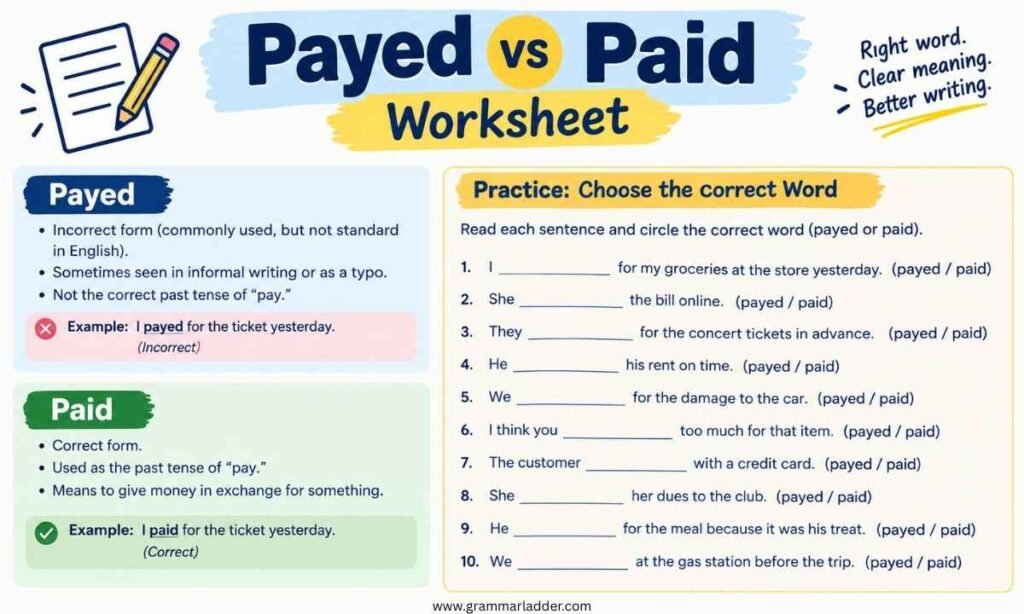
Choose the correct word for each sentence. Answers follow below.
- I (paid/payed) the bill yesterday.
- The sailors (paid/payed) out the rope.
- She has already (paid/payed) for dinner.
- The manager (paid/payed) us a bonus.
- He (paid/payed) the seams of the hull with tar.
- We (paid/payed) our taxes before the deadline.
- This is a (paid/payed) internship.
- You (paid/payed) a high price for that mistake.
Answer key: 1. paid, 2. payed, 3. paid, 4. paid, 5. payed, 6. paid, 7. paid, 8. paid.
Payed vs Paid Past Tense
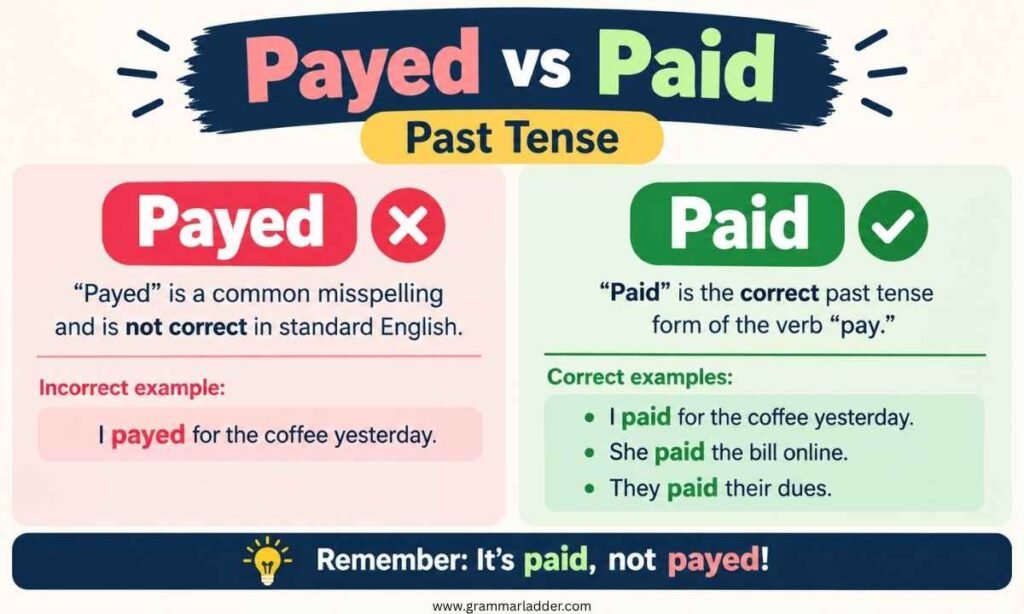
The simple past tense describes a finished action. For “pay,” the form is always paid, whatever the subject.
| Subject | Simple past |
| I | paid |
| You | paid |
| He / She / It | paid |
| We / They | paid |
Examples:
- Yesterday, I paid the delivery driver.
- They paid cash at the counter.
The only exception is the nautical sense: “The crew payed out the chain.”
Payed vs Paid Past Participle
The past participle is used with “have,” “has,” “had,” or “be.” Again, the standard form is paid.
- I have paid the fee.
- The invoice had been paid before the due date.
- All debts were paid in full.
Past participles also appear in the nautical sense, but only in sailing contexts: “The cable had been payed out.”
Payed vs Paid Sentences
Here is a quick set of sentences to help the rule stick.
Correct:
- He paid for the repairs himself.
- The team was paid weekly.
- She paid her respects at the memorial.
- They paid a visit to their grandparents.
- The sailors paid out the anchor chain.
Incorrect:
- ~~He payed for the repairs himself.~~
- ~~The team was payed weekly.~~
- ~~She payed her respects at the memorial.~~
Understanding the Grammar Rule
Here is the rule in plain terms:
- Default to “paid.” Any sentence involving money, attention, favors, or consequences uses “paid.”
- Use “payed” only for ropes or seams. The sentence must be about a vessel or sailing work.
- Check for “out.” In nautical writing, “payed” usually appears in the phrase “payed out.”
- When unsure, choose “paid.” You will be right more than 99 percent of the time.
A simple memory trick: the i in “paid” is the i in “I paid.” Money leaves your hands, so use the i spelling.
Note that “pay” also has nautical forms that are not about rope, such as “pay off,” which means to turn a ship’s bow away from the wind. In that sense, the past tense is “paid off.”
Common Mistakes With Payed vs Paid
Watch for these frequent errors:
- Using “payed” for money. This is the most common mistake. “I payed the rent” is always wrong.
- Writing “payed off” for a successful effort. The correct phrase is “paid off.”
- Writing “payed attention.” The correct form is “paid attention.”
- Mixing up “paid” and “pade” or “payd.” These are misspellings with no valid use.
- Trusting spell-check. Because “payed” is a legitimate word, software will often miss the error.
Placement and Grammar Rules Table
| Sentence position | Correct form | Example |
| After a subject (simple past) | paid | “She paid the fine.” |
| After “has/have/had” | paid | “They have paid in full.” |
| After “is/was/were/been” (passive) | paid | “The bill was paid today.” |
| Before a noun (adjective) | paid | “A paid subscription.” |
| In phrasal verbs about results | paid off / paid back / paid up | “Her effort paid off.” |
| Nautical: letting out rope | payed out | “The line was payed out.” |
| Nautical: sealing seams | payed | “The hull was payed with pitch.” |
American vs British English Differences
Good news: there is no spelling split here. American and British English both use paid as the standard past form, and both reserve payed for the nautical sense.
Some other word pairs do differ across the Atlantic, such as “color” and “colour.” But “paid” is not one of them. You can use it confidently in a US business email or a UK report.
Synonyms and Related Words
Using alternatives can add variety to your writing. Pick the one that fits the context.
| Word | Best used for |
| Settled | Debts and invoices |
| Compensated | Work, time, or loss |
| Reimbursed | Expenses repaid |
| Remunerated | Formal or legal wording |
| Covered | Costs taken on by someone |
| Cleared | Outstanding balances |
| Funded | Projects or purchases |
| Handed over | Informal payments |
Related phrases: paid in full, paid off, paid back, paid up, paid out, pay attention, pay a visit, pay the price, pay respects.
Frequently Asked Questions
Is “payed” ever correct?
Yes, but only in nautical writing, meaning to let out a rope or to seal a ship’s seams with pitch.
What is the past tense of “pay”?
The past tense is “paid.” It is the same form for every subject.
Is it “I payed” or “I paid”?
Write “I paid.” “I payed” is a spelling error outside sailing contexts.
What is the past participle of “pay”?
The past participle is “paid,” as in “has paid” or “was paid.”
Is “payed attention” correct?
No, the correct phrase is “paid attention.”
Do American and British English spell it differently?
No. Both use “paid,” and both keep “payed” for nautical meanings.
Why does spell-check not flag “payed”?
Because “payed” is a real word with a rare nautical use, so software treats it as valid.
How can I remember the difference?
Think “I paid.” The letter i in “paid” reminds you it’s the standard past form.
Conclusion
The payed vs paid question has a clear answer. “Paid” is the correct past tense and past participle of “pay” in everyday English, including finance, work, and common idioms. “Payed” belongs only to sailing, where it means to let out a rope or seal a hull’s seams.
Keep the “I paid” trick in mind, proofread any sentence about money, and don’t rely on spell-check alone. With that habit, you will never have to pause over this one again.

I am an English writer with over four years of experience in grammar and language education.
Through Grammar Ladder, I share clear explanations, practical examples, and helpful English tips.
My goal is to share my knowledge so others can benefit and improve their language skills.
I believe anyone can master English with proper guidance and consistent practice.