You are typing a sentence and stop. Is it title or tittle? The two words look almost identical, and one wrong letter can change your meaning or make you look careless.
The good news is that the difference is simple once you see it. In this guide, you will learn what each word means, how each works in a sentence, and when each one is right. You will also get clear examples and a few memory tricks.
Quick Answer
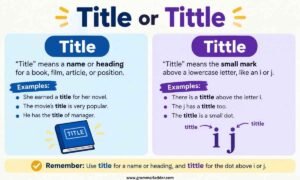
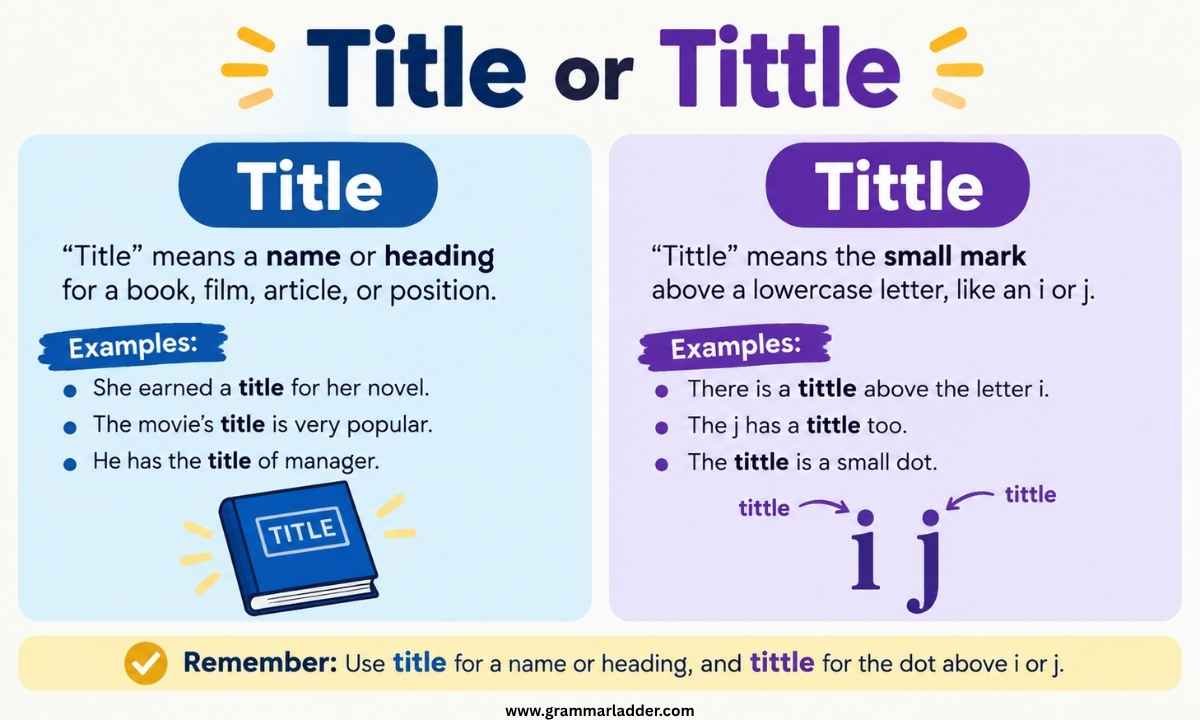
Use “title” in almost every situation. It means a name, heading, or rank, like a book title or a job title.
Use “tittle” only for something tiny. It is the dot over a lowercase i or j, and it appears in the phrase “every jot and tittle,” meaning every small detail.
Title or Tittle Meaning
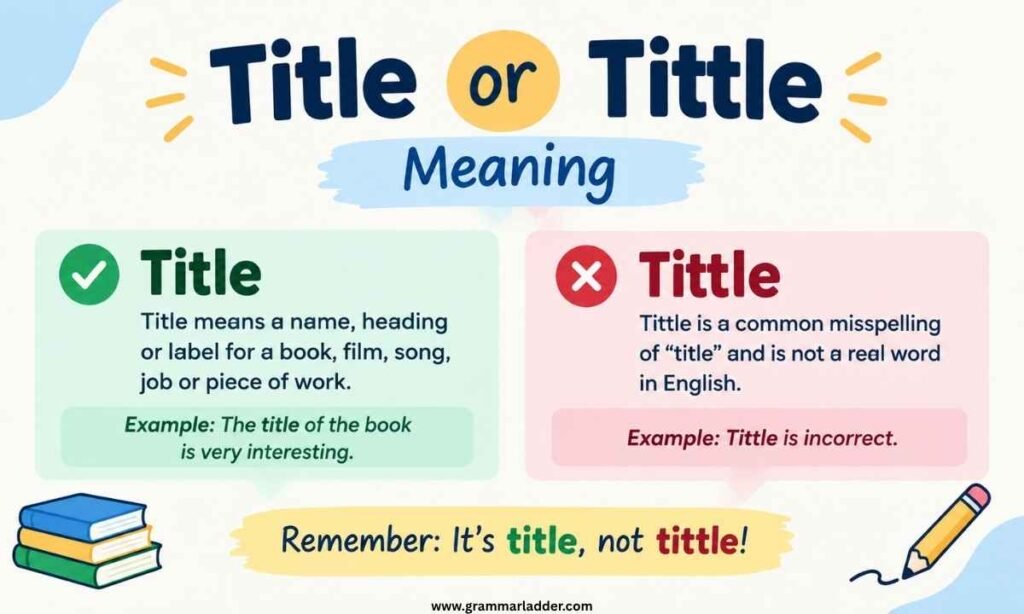
Both words share a root, which is one reason they look so alike. They come from the Latin word titulus, which meant an inscription or label. Over time, they split into two very different meanings.
What Does “Title” Mean?
“Title” has several common meanings:
- A name of a work: a book, film, song, or article
- A heading: the line at the top of a page or chapter
- A rank or honorific: Dr., Professor, Sir, Queen
- A job position: Marketing Manager, Senior Editor
- A championship: the league title, the world title
- A legal right of ownership: the title to a house or car
What Does “Tittle” Mean?
“Tittle” is far narrower. It means:
- The dot over a lowercase i or j. Typographers use this meaning.
- A tiny mark or accent in writing, such as a diacritic.
- A very small amount. This meaning appears mostly in the phrase “jot and tittle.”
You will rarely see “tittle” outside of language, typography, or older literary and religious writing.
Title or Tittle Grammar
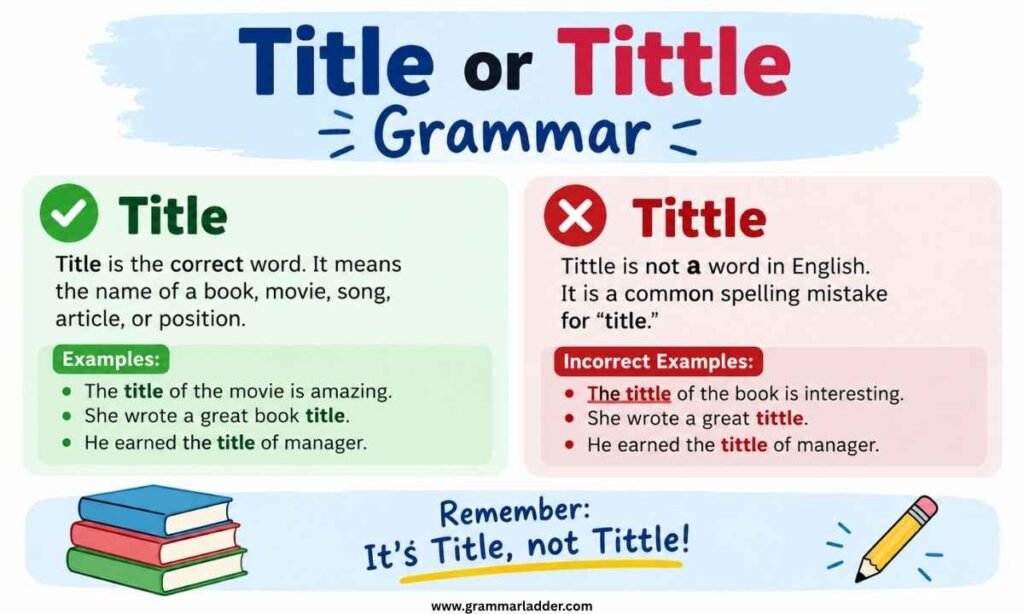
Both words are nouns, and both are countable. That means both can take a plural form.
- Title → titles
- Tittle → tittles
“Title” can also work as a verb, though this is less common. To title something means to give it a name. For example, she titled her essay “Small Towns, Big Dreams.”
“Tittle” is rarely used as a verb in modern English. Treat it as a noun only.
Here is how each word behaves in a sentence:
- Title as a noun: The title of the report is clear and direct.
- Title as a verb: He titled the chapter “A New Start.”
- Tittle as a noun: You forgot the tittle on the letter i.
Each word also has its own pronunciation. “Title” rhymes with vital (TY-tul), while “tittle” has a short i sound like little (TIT-ul).
Title or Tittle in English
In everyday English, “title” is the word you will use hundreds of times. “Tittle” is a specialist word you may use once in a while.
Here is how they compare in real-world frequency and context:
- Title appears in news, business, education, law, sports, and entertainment.
- Tittle appears in typography, linguistics, biblical translation, and idioms.
You may also run into “tittle-tattle,” an older and slightly playful phrase for idle gossip. It has the same root meaning of something small and trivial, as in small talk. It is still understood in British English and appears in some American writing as well.
Title vs Tittle: Key Differences
The simplest way to separate these words is by size and purpose. A title is something you read first. A tittle is something you might miss.
| Feature | Title | Tittle |
| Part of speech | Noun, verb | Noun |
| Core meaning | Name, heading, rank, ownership | Tiny dot or mark |
| Pronunciation | TY-tul | TIT-ul |
| Frequency | Very common | Rare |
| Typical setting | Everyday and professional writing | Typography, idioms, literary text |
| Plural | Titles | Tittles |
| Example | The title of the film | The tittle over the i |
If your sentence is about a name, label, position, or win, you want “title.” If it is about a tiny dot or a very small detail, you may want “tittle.”
Why People Confuse Title and Tittle
Confusion happens for a few understandable reasons.
- They look almost identical. The words differ by only one letter, and the swap happens quickly when typing.
- They sound alike when spoken fast. In casual speech, the vowel difference can blur.
- They share an origin. Both trace back to Latin titulus, so the similarity is not an accident.
- Autocorrect can get it wrong. Spellcheck may not flag “tittle” because it is a real word, even when you meant “title.”
- “Tittle” is unfamiliar. Many writers have never met the word, so their eyes slide right past a typo.
Because both words are valid English, a spellchecker will not always catch the mistake. A quick manual read-through is your best protection.
When to Use Tittle
“Tittle” has a small but genuine place in English. Use it in these situations.
1. Talking About Letters and Typography
Designers, editors, and teachers use “tittle” to name the dot above i and j. If you are explaining handwriting or type design, it is the precise term.
Example: The font has a round tittle instead of a square one.
2. Using the Idiom “Jot and Tittle”
This phrase means every tiny detail. It comes from older English translations of religious texts, where it described the smallest marks in written language.
Example: The contract was reviewed down to the last jot and tittle.
3. Writing About Gossip with “Tittle-Tattle”
This phrase is informal and a bit old-fashioned, but it is still in use.
Example: He had no patience for office tittle-tattle.
4. Expressing a Very Small Amount
Occasionally, “tittle” appears in literary writing to mean a trace or a speck. This use is rare, so only choose it if your audience will understand it.
Rule of thumb: If you are unsure and the sentence is not about a dot, a detail, or gossip, choose “title.”
Common Mistakes to Avoid
Even careful writers slip on these words. Watch for the following errors.
- Writing “tittle” for a name or heading.
❌ The tittle of her novel is striking.
✅ The title of her novel is striking. - Writing “title” for the dot on a letter.
❌ Dot the title on your lowercase j.
✅ Dot the tittle on your lowercase j. - Misquoting the idiom.
❌ Every jot and title
✅ Every jot and tittle - Trusting spellcheck. A correctly spelled wrong word will pass unnoticed.
- Overusing “tittle” to sound clever. If readers have to pause and wonder, a simpler word is better.
A Quick Proofreading Checklist
- Search your document for the word “tittle.”
- Ask: Am I talking about a tiny dot or a small detail?
- If not, replace it with “title.”
- Read the sentence aloud to confirm it makes sense.
Title or Tittle Examples
Examples of “Title”
- The title of the article should match the search intent.
- She earned the title of national champion.
- His job title is Senior Project Manager.
- Please title each section clearly.
Examples of “Tittle”
- A tittle sits above the lowercase i.
- The calligrapher placed each tittle with care.
- The editor checked every jot and tittle.
- Skip the tittle-tattle and focus on facts.
American vs British English Differences
There is no spelling difference here. American and British English both use “title” and “tittle.”
The only small difference is usage. “Tittle-tattle” is more familiar in British English, while American writers use it less often.
You do not need to change either word for your audience. Just pick the right word for your meaning.
Frequently Asked Questions
Is it spelled title or tittle?
Both are real words, but “title” is the common one for names, headings, and ranks. “Tittle” refers only to a tiny dot or mark.
What does tittle mean?
A tittle is a tiny dot or stroke, such as the dot over a lowercase i or j. It also means a very small detail.
What is the dot over the letter i called?
It is called a tittle. Some people also call it simply “the dot.”
Is it “jot and title” or “jot and tittle”?
The correct phrase is “jot and tittle.” It means every small detail.
Is “tittle” a real word?
Yes, it is a real English word found in major dictionaries. It is just uncommon in daily use.
How do you pronounce tittle?
It is pronounced TIT-ul, with a short i, like little. “Title” is pronounced TY-tul.
Can title be used as a verb?
Yes, to title means to give something a name. For example: She titled her speech “New Beginnings.”
Is there a spelling difference between US and UK English?
No, both varieties use the same spellings. Only the surrounding usage and idioms differ slightly.
How can I remember the difference?
Think “tiny tittle”: both start with T, and tittle is the tiny dot. “Title” is the bigger name at the top.
Conclusion
“Title” and “tittle” share a Latin root, but they serve very different jobs. Title names, labels, and ranks. Tittle points to a tiny dot or a small detail. In most writing, “title” is the word you need.
To avoid mistakes, remember three things. Use “title” for names, headings, positions, and wins. Use “tittle” only for the dot on i and j or the idiom “jot and tittle.” And always proofread, because spellcheck will not catch a correctly spelled wrong word.

I am an English writer with over four years of experience in grammar and language education.
Through Grammar Ladder, I share clear explanations, practical examples, and helpful English tips.
My goal is to share my knowledge so others can benefit and improve their language skills.
I believe anyone can master English with proper guidance and consistent practice.