If you’ve ever paused mid-sentence wondering whether to type “advise” or “advice,” you’re not alone. These two words trip up native speakers and English learners alike because they look nearly identical, sound almost the same, and relate to the same general idea. Yet using the wrong one can make your writing look careless in an email, an essay, or even a business proposal. This guide breaks down the difference in plain language, with examples, a comparison table, and simple memory tricks so you never mix them up again.
Quick Answer
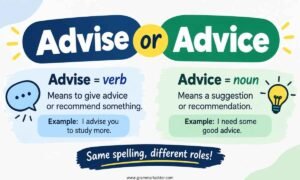
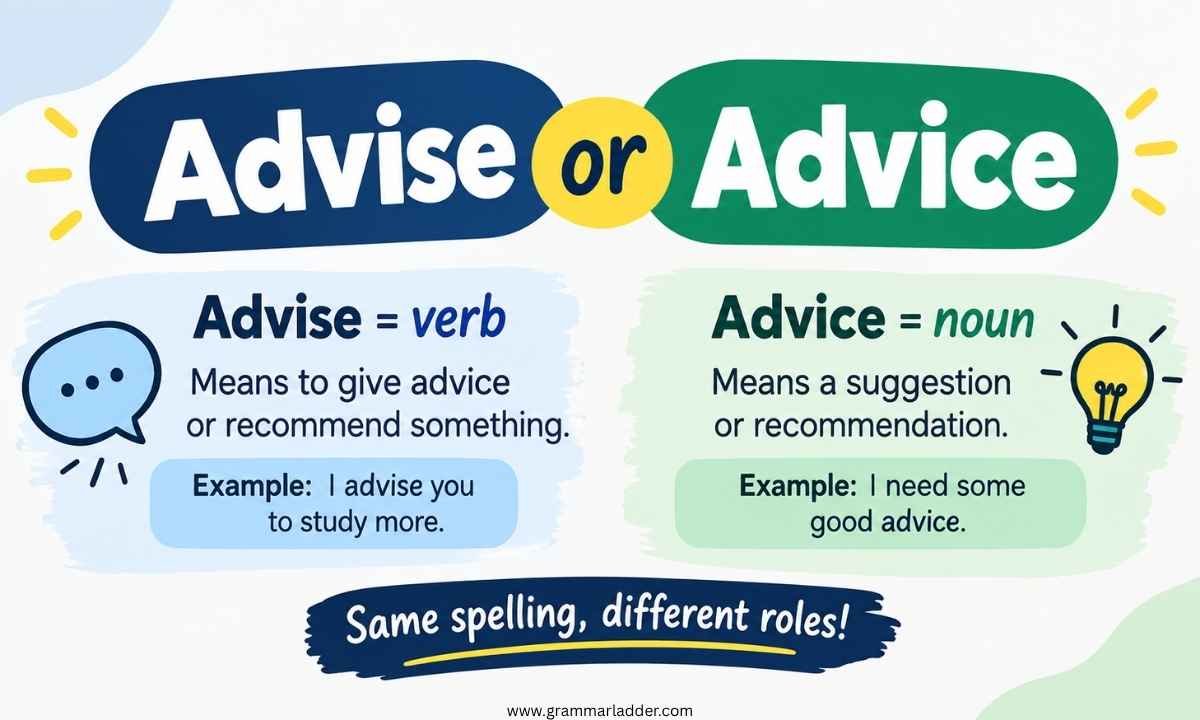
Advice is a noun — it’s the thing you give or receive (a suggestion, an opinion, a recommendation). Advise is a verb — it’s the action of giving that suggestion. In short: you give advice, but you advise someone.
- ✅ “She gave me good advice.”
- ✅ “She advised me to rest.”
- ❌ “She gave me good advise.”
- ❌ “She adviced me to rest.”
Simple Background
- English has many word pairs that differ by just one letter but belong to completely different grammatical categories — think “practice” vs. “practise” or “license” vs. “licence.”
- “Advice” and “advise” fall into this same family of commonly confused words.
- Both words share a root meaning (offering guidance), which adds to the mix-up.
- They are pronounced almost identically, with only a subtle difference in the ending sound.
- Since spoken English doesn’t always make that difference obvious, people often carry the same confusion into their writing.
Clear Explanation of the Difference
The easiest way to separate these two words is to remember their part of speech. One is a noun, one is a verb, and that single fact solves almost every mix-up.
What is “Advise”?
“Advise” is a verb. It means to recommend, suggest, or offer guidance on what someone should do. Because it’s an action word, it usually needs a subject (the person giving the recommendation) and often an object (the person receiving it).
Examples:
- “I advise you to double-check your contract before signing.”
- “The teacher advised her students to review chapter five.”
- “Please advise your manager of the schedule change.”
Notice that “advise” is pronounced with a soft “z” sound at the end — it rhymes with “prize” or “surprise.”
What is “Advice”?
“Advice” is a noun. It refers to the actual guidance, opinion, or recommendation being given. You can give, receive, ask for, or ignore it. It’s also an uncountable noun, which means you don’t say “an advice” — instead, you say “a piece of advice” or simply “some advice.”
Examples:
- “Thank you for the advice; it really helped.”
- “Can I give you some advice about job interviews?”
- “Her advice was to save more and spend less.”
“Advice” is pronounced with a soft “s” sound at the end — it rhymes with “ice” or “price.”
Comparison Table
| Feature | Advise | Advice |
| Part of speech | Verb | Noun |
| Meaning | To give a recommendation or suggestion | A recommendation or suggestion itself |
| Pronunciation | Ends in a “z” sound (rhymes with “prize”) | Ends in an “s” sound (rhymes with “ice”) |
| Countable? | N/A (verb) | Uncountable (use “piece of advice”) |
| Example sentence | “I advise you to see a doctor.” | “That’s good advice.” |
| Common phrase | “Please advise” | “Take my advice” |
Which One to Use and When
A simple test works almost every time: try replacing the word with “suggest” or “recommend.” If the sentence still makes sense, you need “advise.” If it doesn’t, and instead the word “suggestion” or “opinion” fits better, you need “advice.”
- “I advise you to leave early” → “I recommend you leave early.” ✅ Use advise.
- “Take my advice” → “Take my suggestion.” ✅ Use advice.
Simple Tip to Remember
Here’s a memory trick that sticks: “C” comes before “S” in the alphabet, and a noun comes before the action it describes. Or, even simpler:
- Advi-C-e is a thing (C for “concept” or “counsel” — a noun).
- Advi-S-e is something you say or do (a verb, an action).
Another popular trick: “Ice” is a noun (a thing), and “advice” rhymes with “ice,” so advice is a noun too.
Please Advise or Advice
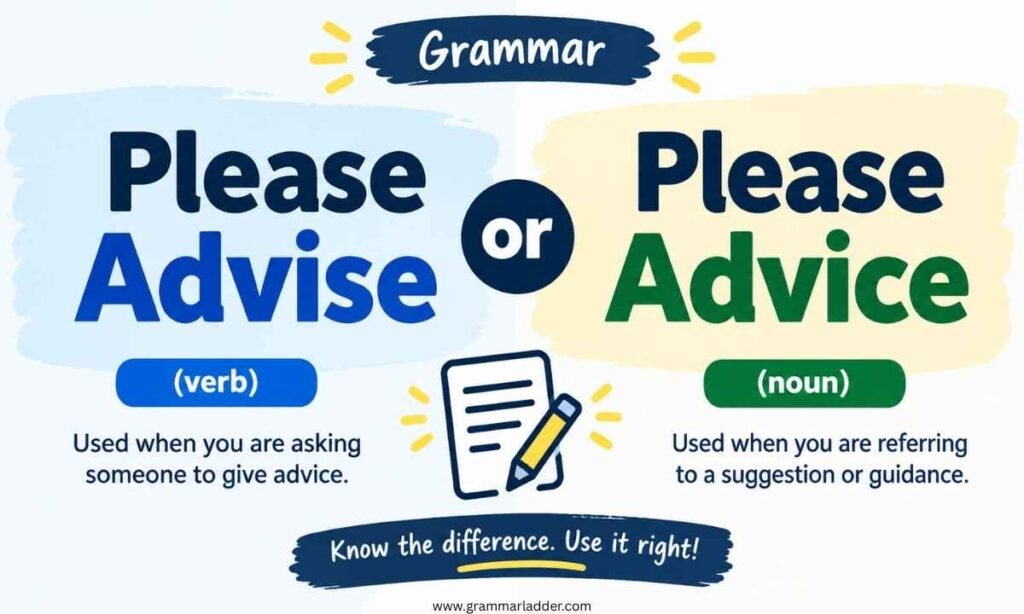
In professional emails, you’ll often see the phrase “please advise.” This is correct because “advise” here functions as a verb — you’re asking someone to give you guidance or information. “Please advice” is incorrect and is one of the most common mistakes seen in workplace communication.
- ✅ “Let me know your availability. Please advise.”
- ❌ “Please advice on the next steps.”
If you want an alternative that sounds a little less abrupt in emails, you can also write “please let me know” or “kindly advise me on this matter.”
Doctor Advice or Advise
This phrase depends entirely on context. If you’re talking about the recommendation itself, use “doctor’s advice” (noun). If you’re describing the action of a doctor giving guidance, use “advise” (verb).
- “Follow your doctor’s advice and take the medication as prescribed.” (noun)
- “The doctor will advise you on the correct dosage.” (verb)
A quick way to check: if you can put “the” or “your” in front of the word, you likely need “advice,” since nouns pair naturally with articles and possessives.
I will Advise or Advice Synonym
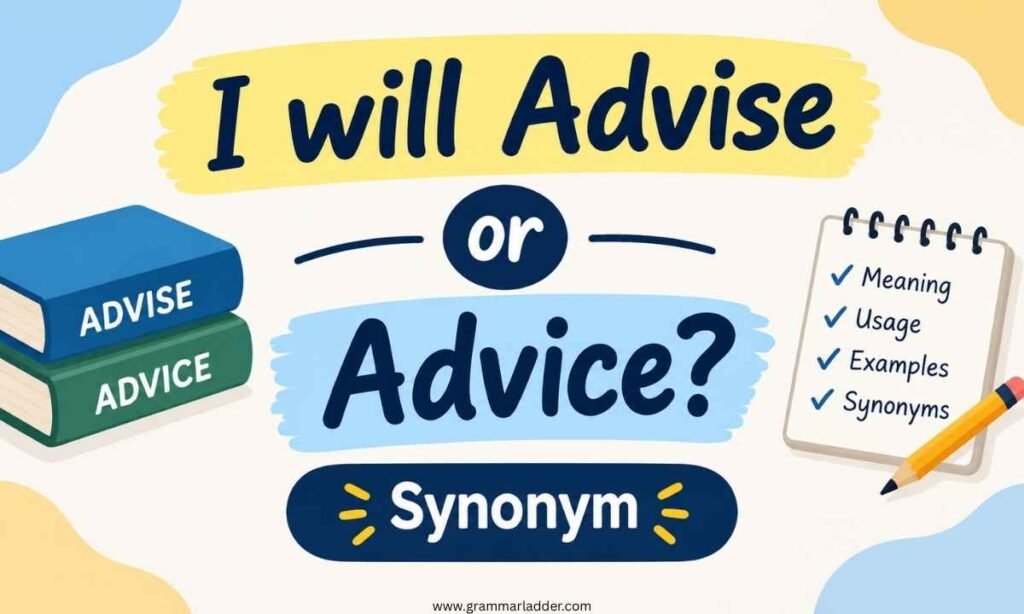
If you’re saying you plan to give someone a recommendation, the correct verb form is “I will advise,” not “I will advice.” Some natural synonyms you can swap in depending on tone:
- I will recommend…
- I will suggest…
- I will counsel…
- I will guide you on…
- I will inform you of…
For the noun form, when you need a synonym for “advice,” consider: guidance, counsel, recommendation, suggestion, tip, or input.
Common Mistakes People Make
1. Using “advice” as a verb
This is the most frequent error, especially in workplace writing. Sentences like “I will advice you tomorrow” or “she adviced me” are incorrect because “advice” cannot take a verb ending like “-d” or function as an action word.
- ❌ “I adviced him to wait.”
- ✅ “I advised him to wait.”
2. Using “advise” as a noun
The reverse mistake also happens, particularly when people mishear the word in speech. Writing “That’s good advise” instead of “That’s good advice” is grammatically incorrect since “advise” cannot function as a thing you give or receive.
- ❌ “Thanks for the advise.”
- ✅ “Thanks for the advice.”
3. Confusing pronunciation
Because the two words sound so close, many non-native speakers pronounce them identically, which reinforces the spelling confusion. Practicing the “s” versus “z” ending sound out loud can help train your ear to catch the difference, which in turn helps your writing.
Everyday Real-Life Examples
In Emails
Workplace emails often use “please advise” to request feedback or instructions. For example: “Attached is the revised proposal. Please advise if any changes are needed.” Here, “advise” functions correctly as a verb requesting action.
In School
Teachers frequently use both words in the same sentence: “I advise all students to review their notes; this advice will help you on the exam.” This is a great real-world sentence to study because it shows both words functioning correctly side by side.
On Social Media
You’ll often see captions like “Some advice for anyone starting a new job” (correct, noun) versus incorrect posts like “I advice you to try this” (should be “advise”). Social media is actually one of the most common places these mistakes appear because writing tends to be quick and unedited.
In Daily Life
A friend might say, “Can you advise me on which laptop to buy?” while another might say, “Thanks for the advice — I ended up getting the one you suggested.” Both sentences are correct and show the natural back-and-forth between the verb and the noun form.
Short Learning Section for Students
Step 1: Learn the roles
Understand that “advise” is always an action (verb) and “advice” is always a thing (noun). Write this rule at the top of your notes.
Step 2: Practice
Write five sentences using “advise” as a verb and five sentences using “advice” as a noun. Reading them aloud helps reinforce the pattern.
Step 3: Use a memory trick
Rely on the “C for concept, S for action” rule, or the “advice rhymes with ice” trick, whichever sticks better in your memory.
Step 4: Check your sentence
Before submitting any assignment or email, reread your sentence and ask: “Am I describing an action, or a thing?” This one question resolves almost every case.
Frequently Asked Questions
Is it “advise” or “advice” in an email?
Use “advise” when asking someone to act (e.g., “please advise”), and “advice” when referring to the guidance itself.
Can “advice” ever be a verb?
No, “advice” is always a noun and never changes form as a verb.
What is the past tense of “advise”?
The past tense is “advised,” as in “She advised me to wait.”
Is “advices” a correct word?
No, “advice” is uncountable, so the plural form “advices” is not standard English.
How do I remember the difference quickly?
Remember that advice rhymes with “ice” (a noun/thing), while advise rhymes with “prize” (a verb/action).
Is “please advice” ever correct?
No, it should always be “please advise” since it functions as a request for action.
Conclusion
The difference between “advise” and “advice” comes down to one simple rule: advise is what you do, and advice is what you give. Once you remember that advise is a verb and advice is a noun, the confusion disappears almost instantly. Use the memory tricks in this guide, practice with real sentences, and double-check your writing before hitting send — your emails, essays, and social posts will read more polished and professional as a result.

I am an English writer with over four years of experience in grammar and language education.
Through Grammar Ladder, I share clear explanations, practical examples, and helpful English tips.
My goal is to share my knowledge so others can benefit and improve their language skills.
I believe anyone can master English with proper guidance and consistent practice.