“To” and “too” look almost the same. They sound exactly alike. But they don’t mean the same thing at all.
Mixing them up is one of the most common writing mistakes out there. Even confident writers slip up sometimes. The good news? Once you learn the trick, you’ll never confuse them again.
Quick Answer
- “To” is a preposition or infinitive marker. It shows direction, purpose, or connection (e.g., “I want to go home”).
- “Too” is an adverb. It means “also” or “excessively” (e.g., “Can I come too?” or “It’s too cold”).
- The easiest trick: if you can replace the word with “also” or “excessively” and the sentence still works, use “too.” If not, use “to.”
I Would Love To or Too — Which One Is Correct?
Use “I would love to” when you’re agreeing to do something. It’s short for “I would love to [do that thing].”
- “Want to grab lunch?” “I would love to!”
Use “too” only when you’re adding yourself to someone else’s wish. For example: “I would love to go too” means you also want to go, just like someone else does.
So on its own, “to” is almost always right in this phrase.
Meaning and Definition of Each Word
“To”
“To” is small. But it does a lot of work. It can be:
- A preposition that shows direction, place, time, or connection (“drive to the store,” “count to ten”)
- An infinitive marker placed before a verb (“I want to eat,” “she likes to run”)
It never means “also.” It never means “too much.” Keep that in mind.
“Too”
“Too” is an adverb. It has two jobs:
- It means “also” or “as well” (“I’m coming too”)
- It means “excessively” or “more than needed” (“The coffee is too hot”)
Notice the double “o.” That’s a helpful clue. More on that below.
She Would Love To or Too
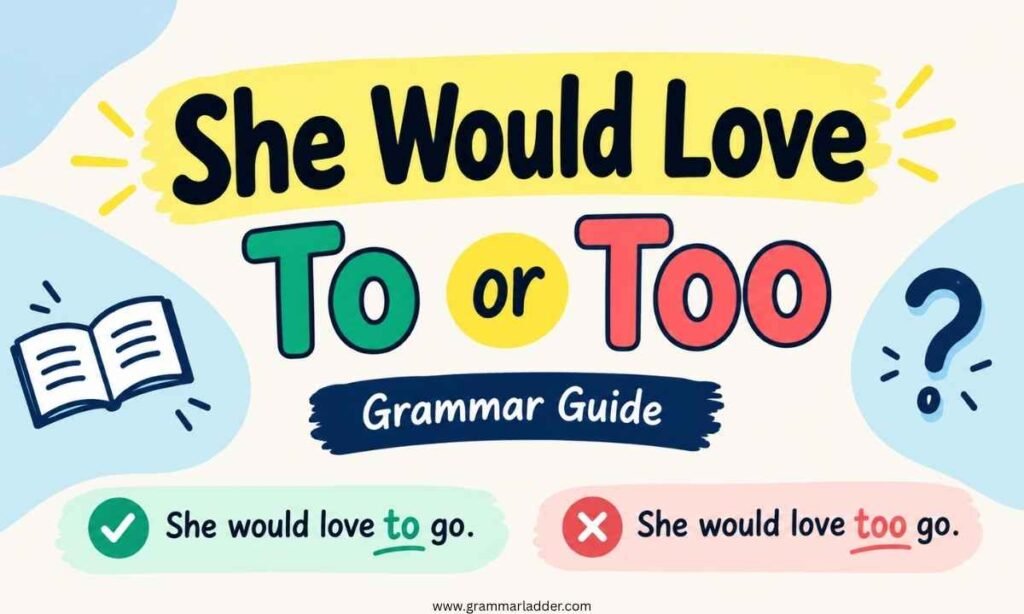
The same rule applies here. “She would love to” works when a verb is implied (“She would love to join us”). “She would love to, too” works when she agrees, in addition to someone else.
Quick Rule:
- Responding to an invitation with an implied verb → I/She would love to
- Adding yourself to someone else’s expressed desire → I/She would love to, too
Key Differences Between the Words
- Part of speech: “To” is a preposition or infinitive marker. “Too” is an adverb.
- Function: “To” connects or introduces a verb. “Too” adds emphasis or shows addition.
- Placement: “To” usually comes before a noun or verb. “Too” often sits at the end of a sentence.
- Replaceability: “Too” can be swapped for “also” or “excessively.” “To” cannot.
Comparison Table
| Feature | To | Too |
| Part of speech | Preposition / infinitive marker | Adverb |
| Meaning | Direction, purpose, connection | Also, excessively |
| Example | She walked to the office. | She walked too far. |
| Can replace with “also”? | No | Yes |
| Common position | Before a noun or verb | End of sentence or before an adjective |
Examples in Sentences
Using “I Would Love To”
- I would love to visit Japan someday.
- I would love to help you move this weekend.
- I would love to try that new restaurant.
Using “I Would Love To Too”
- My sister wants to travel to Italy. I would love to too.
- He’s learning to paint. I would love to too.
- Are you joining the book club? I would love to too.
Common Mistakes
Mistake 1: Using “to” instead of “too” for emphasis
❌ “This bag is to heavy to carry.”
✅ “This bag is too heavy to carry.”
Mistake 2: Using “too” instead of “to” before a verb
❌ “I want too go home.”
✅ “I want to go home.”
Mistake 3: Dropping one “o” out of habit
❌ “Can I come to?”
✅ “Can I come too?”
Mistake 4: Confusing “to,” “too,” and “two”
❌ “I have to books.”
✅ “I have two books.”
To or Too Late
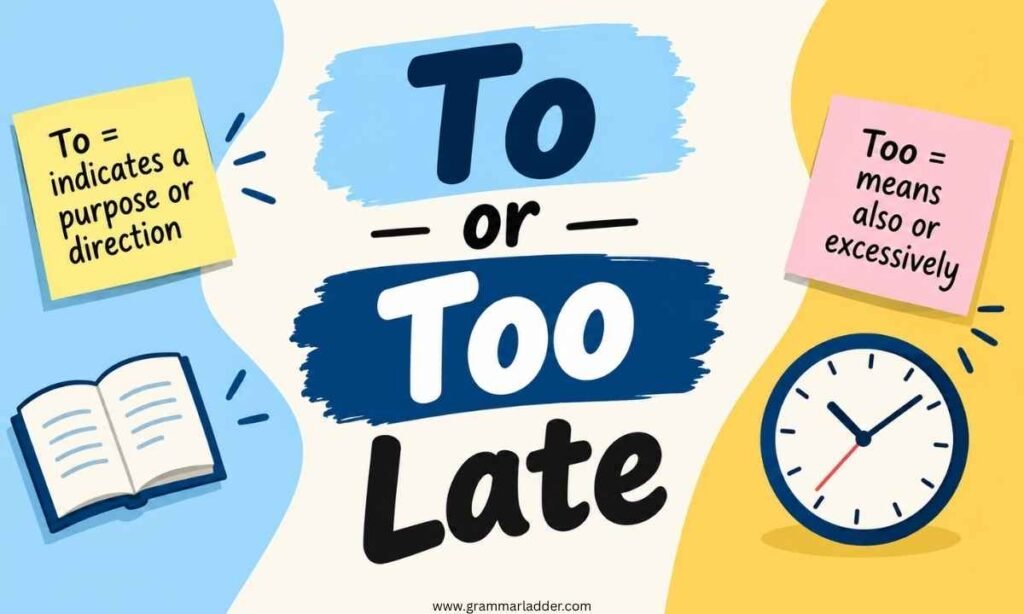
The correct phrase is “too late.” It means something happened after the right time.
- “We arrived too late to catch the train.”
- “It’s never too late to learn something new.”
“To late” is wrong here. “Late” is an adjective. It needs “too” to show emphasis.
How to Explain the Difference Between “To” and “Too” to a Child
Keep it short. Keep it visual.
- Say: “Too has too many O’s.” It’s greedy, so it means “extra” or “also.”
- Say: “To is short and simple.” It just points somewhere, like an arrow.
- Play a game. Read a sentence out loud. Ask them to guess the right word. Then count the O’s together.
- Practice with easy examples: “I want to go to the park, too!”
Kids remember the “extra O” trick fast. It’s simple. It’s easy to picture.
Tips to Remember the Difference
1. “Too” has an extra “O”
Extra letter, extra meaning. Think “too much” or “me too.”
2. “To” is simple
Fewer letters. Simpler job. It just points toward something.
3. Replace “too” with “also”
If the sentence still makes sense with “also,” you need “too.”
4. Check the sentence meaning
Ask yourself: is this word showing direction? Or is it showing emphasis? That answers your question.
When to Use Each Word
Use “I Would Love To” When:
- You’re responding to an invitation
- You’re expressing willingness to do something
- A verb is implied but not repeated
Use “I Would Love To Too” When:
- Someone else already said the same thing
- You’re agreeing along with them
- The sentence needs “also” to make sense
Grammar Rules
1. Infinitive Form
“To” pairs with a base verb. This forms an infinitive: to run, to eat, to learn. It shows purpose or intention.
- “She studies to improve her grades.”
2. Ellipsis (Omitting Words)
Sometimes we drop the verb after “to.” It’s still understood. This is called ellipsis.
- “Do you want to dance?” “I’d love to.” (The word “dance” is left out, but we know it’s there)
3. “Too” as an Adverb
“Too” changes the meaning of adjectives, adverbs, or whole sentences. It shows excess or addition.
- “He runs too fast for me to keep up.”
- “I like coffee too.”
Synonyms or Related Words
- For “to”: toward, into, unto (formal)
- For “too” (also): as well, in addition, likewise
- For “too” (excessively): overly, excessively, unduly
Frequently Asked Questions
Is it “me to” or “me too”?
It’s “me too.” It means “me also.”
Is it “to much” or “too much”?
It’s “too much.” “Much” needs the emphasis.
Is it “to good to be true” or “too good to be true”?
It’s “too good to be true.” This idiom uses the adverb “too.”
Can “to” ever mean “also”?
No. Only “too” means “also” or “excessively.”
Is there a simple trick to remember the difference?
Yes. “Too” has one extra letter for its “extra” meanings.
Are “to,” “too,” and “two” pronounced the same?
Yes. They’re homophones. That’s why people mix them up so often.
Conclusion
“To” and “too” sound the same. But they do very different jobs. “To” points and connects. “Too” adds emphasis or shows addition. Remember the “extra O for extra meaning” trick. Practice phrases like “I would love to” and “I would love to, too.” Soon, you won’t even have to think about it. You’ll just get it right.

I am an English writer with over four years of experience in grammar and language education.
Through Grammar Ladder, I share clear explanations, practical examples, and helpful English tips.
My goal is to share my knowledge so others can benefit and improve their language skills.
I believe anyone can master English with proper guidance and consistent practice.