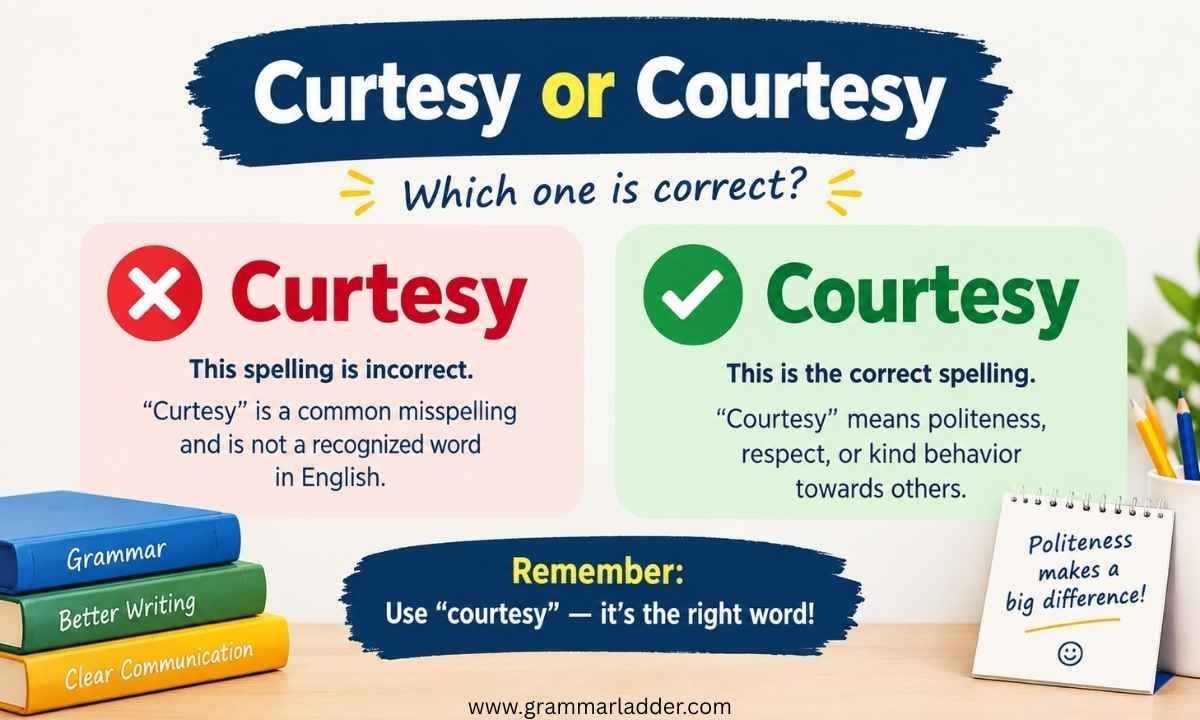
If you’ve ever paused mid-sentence wondering whether to write “curtesy” or “courtesy,” you’re not alone. These two words look almost identical, sound similar when spoken quickly, and trip up even experienced writers. The good news? The answer is simpler than you think — and by the end of this guide, you’ll never second-guess it again.
Quick Answer
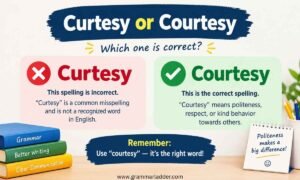
- Courtesy is the correct spelling for the everyday word meaning politeness, respect, or a kind gesture.
- “Curtesy” is not a common English word — it’s either a spelling mistake or, in rare legal contexts, an old common-law term related to inheritance rights.
- For 99% of writing situations in 2026, “courtesy” is the word you want.
Simple Origin or Background Explanation
- “Courtesy” traces back to the Old French curteisie, from curt/cort, meaning “court” — as in a royal court.
- In medieval times, behaving with courtesy meant acting the way a well-mannered person would in front of royalty: polite, respectful, refined.
- The spelling evolved through Middle English into modern “courtesy,” keeping the “our” that ties it back to “court.”
What about “Curtesy”?
- “Curtesy” isn’t just a modern typo — it has a genuine, if obscure, legal history.
- In old property law, curtesy (“estate by the curtesy”) referred to a widower’s legal right to a life interest in his deceased wife’s land, if the couple had a child.
- This usage has been abolished in most modern jurisdictions, including England and Wales, but still appears in historical documents and old legal texts.
- Outside that narrow legal context, “curtesy” is almost always a misspelling of “courtesy.”
Clear Explanation of the Difference
The core difference comes down to meaning, not just spelling:
- Courtesy = politeness, good manners, a respectful act or favor.
- Curtesy = a rare legal term for a husband’s historical property right, or an incorrect spelling of “courtesy.”
What does “Courtesy” mean?
Courtesy is a noun that describes polite, considerate, or respectful behavior. It can refer to:
- Good manners in general (“She treated everyone with courtesy.”)
- A specific polite act (“He extended the courtesy of calling ahead.”)
- Something given free of charge, often phrased as “courtesy of” (“Drinks courtesy of the hotel.”)
What does “Curtesy” mean?
Curtesy, in its narrow and now largely historical legal sense, referred to a husband’s right to use his late wife’s real estate for life if they had a child together. It has no connection to politeness or manners. In modern everyday writing, if you see “curtesy” used to mean “polite behavior,” it’s simply the wrong spelling.
Key Point
If you’re writing about manners, respect, kindness, or a free service — always choose courtesy. Reserve “curtesy” only for historical or legal discussions of old inheritance law.
Curtesy or Courtesy Synonym
Looking for alternatives to “courtesy”? Depending on context, you can use:
- Politeness
- Civility
- Respect
- Consideration
- Graciousness
- Good manners
There is no synonym list for “curtesy” because it isn’t a standard word — it doesn’t function as a substitute for any of the above.
Curtesy or Courtesy in English
In standard English — American, British, Canadian, or Australian — the accepted spelling for the polite-behavior word is courtesy. Major dictionaries, including Oxford and Merriam-Webster, list “courtesy” as the standard entry, while “curtesy” appears only under its legal definition or as a cross-reference.
Curtesy or Courtesy Call
A “courtesy call” is a polite, often formal visit or phone call made out of respect or protocol rather than necessity — for example, a diplomat paying a courtesy call on a foreign official. The correct spelling here is always courtesy call. “Curtesy call” is incorrect.
Curtesy or Courtesy Car
A “courtesy car” is a free vehicle provided temporarily by a dealership, hotel, or repair shop while your own car is being serviced. Again, the correct term is courtesy car — never “curtesy car.”
Comparison Table
| Feature | Courtesy | Curtesy |
| Common usage | Very common, everyday word | Rare, mostly historical/legal |
| Meaning | Politeness, respect, free favor | Old legal term for a husband’s estate right |
| Part of speech | Noun | Noun (legal term) |
| Correct in modern writing | Yes | Only in legal/historical context |
| Found in dictionaries | Yes, as primary entry | Yes, as legal term or cross-reference |
| Example | “Thank you for your courtesy.” | “He held the land by curtesy.” |
Which One to Use and When
Use “Courtesy” when:
- Talking about politeness or good manners
- Referring to a free service (courtesy car, courtesy shuttle)
- Describing a respectful gesture or visit (courtesy call, courtesy visit)
- Writing business emails, articles, or everyday communication
Do NOT use “Curtesy”
Avoid “curtesy” in almost all everyday, business, academic, or casual writing. It is not the accepted spelling for politeness-related content, and using it will read as a spelling error to most readers and editors.
Simple Rule
If the sentence is about being polite, kind, or respectful — spell it courtesy, with the “our” intact. If you’re not writing about medieval property law, you’ll never need “curtesy.”
Common Mistakes People Make
1. Spelling it as “Curtesy”
The most frequent error is simply dropping the “o,” turning “courtesy” into “curtesy.” This happens because the word is pronounced with a soft, quick first syllable that doesn’t clearly reveal the “our” spelling.
2. Pronunciation Confusion
Because “courtesy” is pronounced roughly as “KUR-tuh-see,” many writers spell it the way it sounds rather than the way it’s written, leading directly to the “curtesy” mistake.
3. Forgetting the “our”
Writers often remember that the word relates to “court” but forget the exact letter sequence, leaving out the “o” and writing “curtesy” instead of “courtesy.”
4. Typing quickly
Autocorrect doesn’t always catch this error because “curtesy” resembles a valid word (thanks to its legal meaning), so spellcheckers sometimes let it slide even when the intended meaning is “politeness.”
Everyday Real-Life Examples
In Emails
“As a courtesy, I wanted to let you know the meeting has been moved to 3 PM.”
In News
“The airline offered a courtesy upgrade to passengers affected by the delay.”
On Social Media
“Shoutout to the barista for the courtesy refill — didn’t even have to ask!”
In Daily Conversation
“He held the door open, which I thought was a nice courtesy.”
Incorrect Examples (for learning)
- ❌ “Thanks for your curtesy.” (Should be “courtesy.”)
- ❌ “It’s a curtesy car from the garage.” (Should be “courtesy car.”)
- ❌ “She showed great curtesy to the guests.” (Should be “courtesy.”)
Short Learning Section for Students and Beginners
Trick 1: “Our” Inside
Remember that “courtesy” contains the word “our” (c-our-tesy). If you can spot “our” in the middle, you’ve spelled it correctly.
Trick 2: Think of “Court”
Courtesy comes from “court” — think of royal courts and courteous behavior. If you can spell “court,” you can build “courtesy” from it.
Trick 3: One Safe Choice
When in doubt, always default to “courtesy.” It’s correct in virtually every everyday situation, while “curtesy” is correct in almost none.
Practice Sentences
- It was only out of ________ that she replied so quickly to my request. (courtesy)
- The hotel provided a ________ shuttle to the airport for all guests. (courtesy)
- Under old common law, a widower’s ________ right applied only if a child was born from the marriage. (curtesy)
- Please extend the same ________ to every customer, regardless of their order size. (Answer: For all Courtesy)
Frequently Asked Questions
Is “curtesy” ever correct?
Yes, but only in historical or legal writing referring to a husband’s old common-law right to his deceased wife’s land.
What is the difference between curtsy and courtesy?
Curtsy is a physical gesture of bowing or bending the knees; courtesy is the abstract quality of politeness and respect.
Why do people confuse curtesy and courtesy?
Because they sound alike when spoken and share the same word origin, making the spelling easy to mix up.
Is “curtesy” a real word in dictionaries?
Yes, but only as a legal term, not as a synonym for politeness.
What is the correct spelling for “courtesy car”?
“Courtesy car” is correct; “curtesy car” is a spelling mistake.
Is curtsy spelled with an “e” or “y” in the UK?
Both “curtsy” and “curtsey” are used in the UK, though Cambridge and Oxford dictionaries prefer “curtsy.”
Conclusion
In almost every modern context — emails, business writing, conversation, or social media — the correct spelling is courtesy, not “curtesy.” The confusion is understandable given their shared origin and similar sound, but remembering that “courtesy” contains “our” and relates to “court” makes the correct choice easy to lock in. Save “curtesy” for rare historical or legal discussions, and you’ll never misspell this common word again.

I am an English writer with over four years of experience in grammar and language education.
Through Grammar Ladder, I share clear explanations, practical examples, and helpful English tips.
My goal is to share my knowledge so others can benefit and improve their language skills.
I believe anyone can master English with proper guidance and consistent practice.