Have you ever paused before writing “13th”? Maybe you typed “13rd” instead, and something felt off. You’re not alone. This is one of the most common small mistakes in English writing.
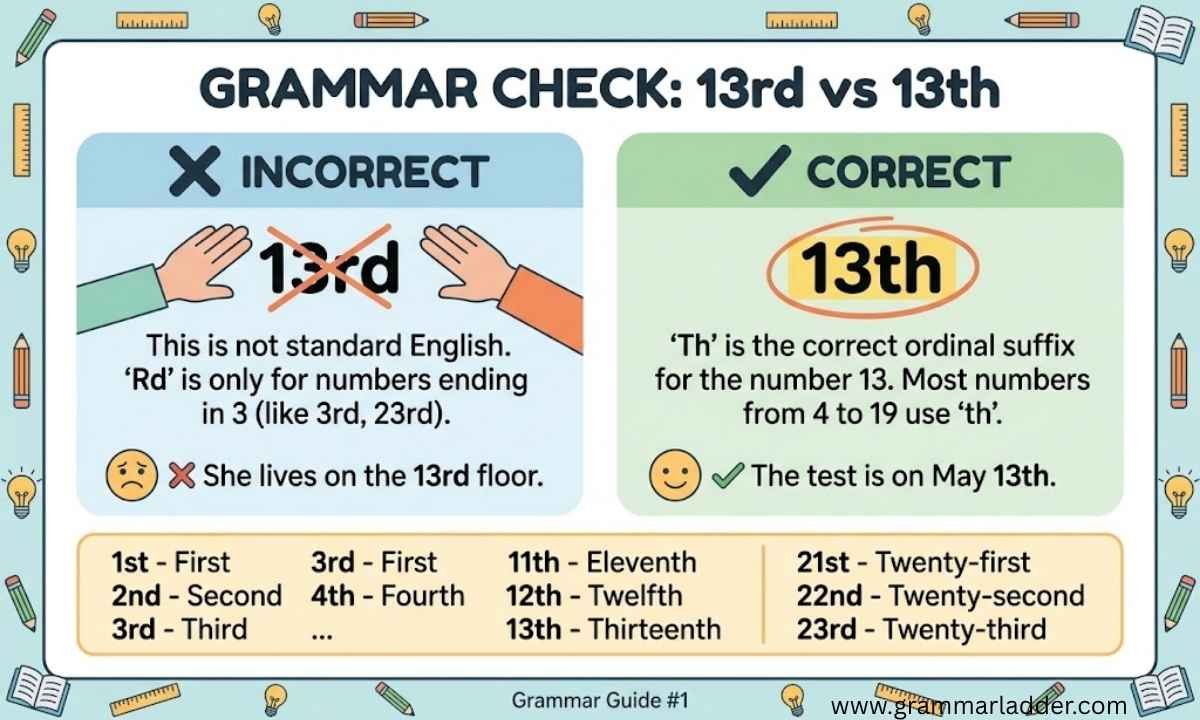
The good news is the rule is simple once you learn it. “13th” is always correct. “13rd” is never correct, no matter how you use it. In this guide, we’ll explain why and show you easy examples so you never mix it up again.
Quick Answer: 13rd vs 13th
“13th” is correct. “13rd” is a spelling mistake.
Whenever you’re writing an ordinal number for 13 — a date, an anniversary, a birthday, a floor number, anything — the correct form is 13th, never “13rd.” This holds in every context: formal writing, casual writing, American English, and British English.
What Does “13th” Mean?
Simple Definitions
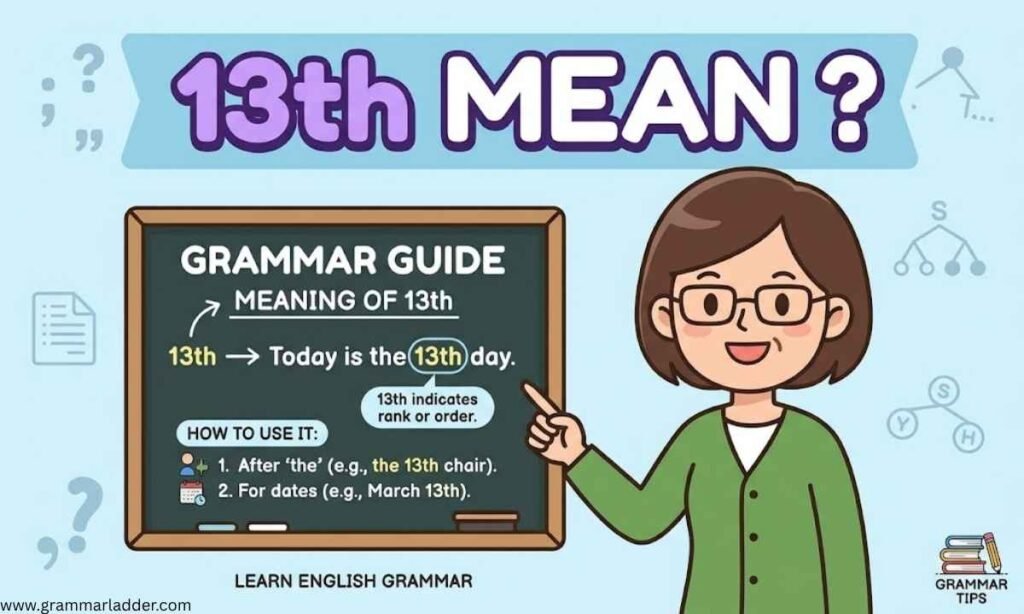
“13th” is the ordinal number form of 13. Ordinal numbers show position or order in a sequence (1st, 2nd, 3rd, 4th…), as opposed to cardinal numbers, which simply show quantity (1, 2, 3, 4…).
So while “13” tells you how many of something there are, “13th” tells you where something falls in a sequence — the 13th person in line, the 13th day of the month, the 13th time you’ve tried something.
Examples in Sentences
- She celebrated her 13th birthday on Saturday.
- Today is the 13th of October.
- He finished in 13th place in the marathon.
- This is the 13th episode of the season.
- Our office is on the 13th floor.
Why Do People Write “13rd”?
Common Reasons
People slip up and write “13rd” for a few understandable reasons:
- Pattern confusion with “3rd.” Since 13 ends in the digit 3, and 3 becomes “3rd,” it feels logical to assume 13 should follow the same pattern.
- Autocorrect and typing speed. Fast typing or muscle memory from typing “3rd” elsewhere can cause an accidental slip.
- Unfamiliarity with the 11th/12th/13th exception. Many people were never explicitly taught that 11, 12, and 13 break the normal ordinal pattern.
- Non-native English speakers translating ordinal rules from languages that don’t have this irregularity.
The Key Issue
The core issue is that English ordinal suffixes are usually based on the last digit of a number — but 11, 12, and 13 are exceptions to that rule. They always take “-th,” regardless of what looks logical based on their final digit.
13rd or 13th anniversary → 13th anniversary is correct. 13th or 13th, which one is correct? → “13th” is the only correct spelling; “13rd” isn’t a valid alternative. 13rd or 13th birthday → 13th birthday is correct.
Understanding the Correct Rule
Basic Pattern
For most numbers, the ordinal suffix depends on the last digit:
| Last Digit | Suffix | Example |
| 1 | -st | 1st, 21st, 31st |
| 2 | -nd | 2nd, 22nd, 32nd |
| 3 | -rd | 3rd, 23rd, 33rd |
| 0, 4–9 | -th | 4th, 5th, 10th, 20th |
Special Rule for 11, 12, 13
Here’s where the exception comes in: 11, 12, and 13 always use “-th,” no matter what number they’re part of. This applies even in larger numbers like 111, 112, 113, or 213.
| Number | Correct Ordinal |
| 11 | 11th (not 11st) |
| 12 | 12th (not 12nd) |
| 13 | 13th (not 13rd) |
| 111 | 111th |
| 112 | 112th |
| 113 | 113th |
Key Insight
The rule that matters most isn’t just “look at the last digit” — it’s “check whether the number ends in 11, 12, or 13 first.” If it does, use “-th.” Only if it doesn’t, do you fall back to the last-digit rule above.
13rd vs 13th: Comparison Table
| Form | Correct? | Notes |
| 13th | ✅ Correct | Standard, accepted ordinal form of 13 in all English variants |
| 13rd | ❌ Incorrect | Common typo/misconception; not recognized in any dictionary or style guide |
Common Mistakes to Avoid
- Writing “13rd” because 3 usually takes “-rd.” Remember: 13 is an exception.
- Assuming the exception only applies to “11” and “12.” It applies to 13 as well.
- Forgetting the rule in compound numbers. “113rd” and “213rd” are just as wrong as “13rd” — they should be “113th” and “213th.”
- Relying on autocorrect without double-checking. Some autocorrect tools won’t catch this error, especially in fast typing or texting.
- Mixing up ordinal and cardinal numbers. Use “13” for quantities (“13 apples”) and “13th” for position/order (“the 13th apple”).
More Examples of “13th” in Context
- The company celebrated its 13th anniversary with a company-wide event.
- Her novel is scheduled for release on the 13th of next month.
- He was born on the 13th of July, 1990.
- This marks the 13th consecutive win for the team.
- The meeting has been rescheduled to the 13th.
- She lives on the 13th floor of the apartment building.
American vs British English Differences
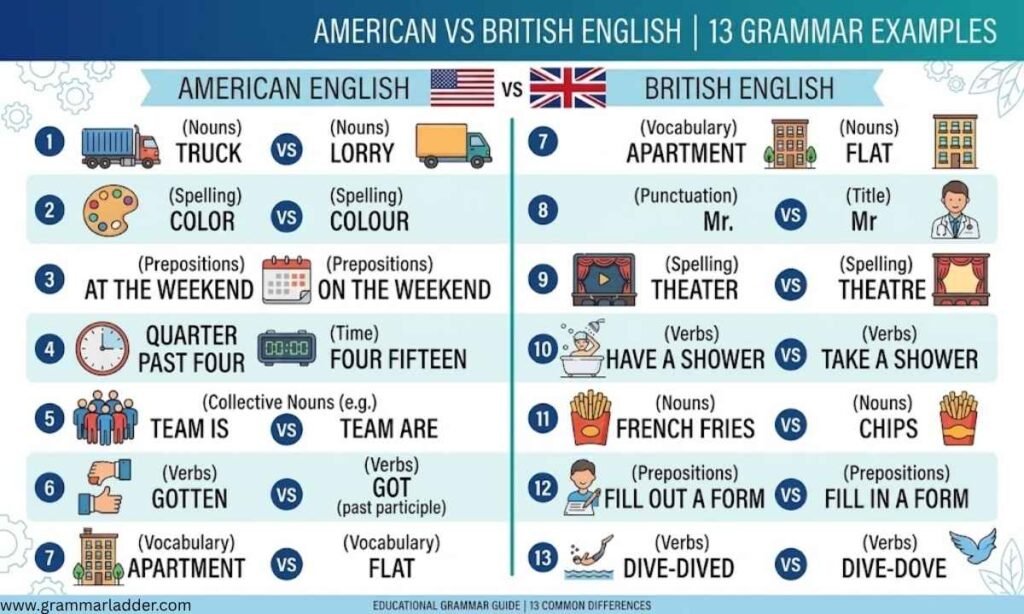
Good news: there’s no difference between American and British English when it comes to this rule. Both varieties of English treat 11, 12, and 13 as exceptions that always take “-th.”
The only stylistic differences you might see relate to date formatting, not the ordinal spelling itself:
- American English often writes dates as “October 13th” or “October 13” (month-day format).
- British English often writes dates as “13th October” or “13 October” (day-month format).
In both cases, when the ordinal suffix is used, it’s always “13th.”
Why Correct Usage Matters?
Getting this right matters more than it might seem:
- Professionalism. A typo like “13rd” in a resume, business email, or formal document can undermine credibility.
- Clarity. Readers pause on unfamiliar or incorrect spellings, which disrupts the flow of your writing.
- Consistency. If you’re writing dates, invitations, or reports regularly, consistent correct usage builds trust with your audience.
- SEO and content quality. For writers and marketers, incorrect grammar can affect how professional and reliable your content appears to readers and search engines alike.
Synonyms and Related Terms
While “13th” doesn’t have direct synonyms, related terms and concepts include:
- Ordinal number – a number indicating position (1st, 2nd, 3rd, etc.)
- Cardinal number – a number indicating quantity (1, 2, 3, etc.)
- Ordinal suffix – the letters added to a number to form its ordinal (-st, -nd, -rd, -th)
- Date ordinals – ordinal numbers specifically used in dates (the 1st, the 2nd, the 13th)
Easy Memory Trick
Here’s a simple way to remember the exception:
“Eleven, Twelve, Thirteen — Always Th, Never Seen” (as in, you’ll never see “11st,” “12nd,” or “13rd” in correct English.)
Or think of it this way: any number ending in 11, 12, or 13 gets “-th,” no exceptions — even if the number itself ends in a digit that would normally take a different suffix.
Frequently Asked Questions
Is “13rd” ever correct?
No. “13rd” is not correct in any context, dialect, or style guide. The only correct ordinal form of 13 is “13th.”
Why doesn’t 13 follow the same rule as 3?
Because 11, 12, and 13 are treated as exceptions in English ordinal number rules. They always take “-th,” regardless of their final digit.
Does this rule apply to 113, 213, and other numbers ending in 13?
Yes. Any number ending in 11, 12, or 13 takes “-th” — so 113th, 213th, 313th, and so on.
Is this different in British English?
No, the spelling rule is identical in both American and British English. Only date-formatting conventions (day-month vs. month-day) differ.
How can I avoid this mistake in the future?
Use the memory trick above, and when in doubt, mentally check whether the number ends in 11, 12, or 13 before applying the last-digit rule.
Conclusion
When it comes to 13rd vs 13th, there’s no ambiguity — 13th is the only correct form. The confusion usually stems from the assumption that numbers ending in 3 always take “-rd,” but 11, 12, and 13 are the exceptions to that rule and always use “-th.” Whether you’re writing a birthday message, a business report, or a date on an invitation, remembering this simple exception will keep your writing accurate and polished.

I am an English writer with over four years of experience in grammar and language education.
Through Grammar Ladder, I share clear explanations, practical examples, and helpful English tips.
My goal is to share my knowledge so others can benefit and improve their language skills.
I believe anyone can master English with proper guidance and consistent practice.