Have you ever typed the word “finally” and paused, wondering if it needed one “l” or two? You are not alone. This is one of the most common spelling mix-ups in everyday English, especially for people typing quickly on phones or writing in a second language.
In this guide, you’ll get a clear, no-confusion answer, learn the grammar behind it, see real examples, and pick up simple tricks to never misspell this word again.
Quick Answer
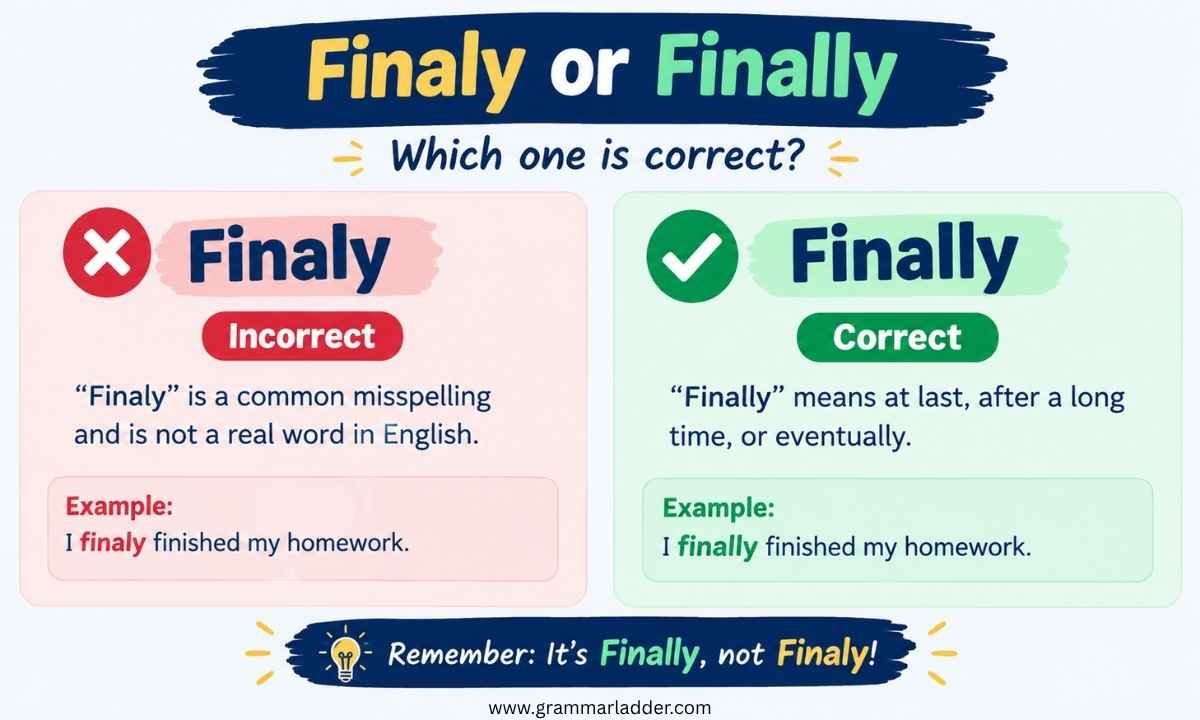
- Correct spelling: Finally (F-I-N-A-L-L-Y — two “l’s”)
- Incorrect spelling: Finaly (not a real word in standard English)
- Rule to remember: Always double the “l”
Example
- ✅ We finally reached the airport after a three-hour delay.
- ❌ We finaly reached the airport after a three-hour delay.
Simple Origin or Background Explanation
The word “finally” comes from the adjective “final,” which traces back to the Latin word finalis, meaning “of or relating to an end,” and ultimately from finis, meaning “end” or “boundary.”
In English, we often turn adjectives into adverbs by adding “-ly.” Since “final” already ends in “l,” adding “-ly” naturally creates a double “l”:
final + ly = finally
This is the same pattern used in other words like:
- real + ly = really
- accidental + ly = accidentally
- usual + ly = usually
“Finaly” simply drops one of those required letters, which breaks the standard spelling rule and makes the word incorrect.
Clear Explanation of the Difference
Before diving into meanings and rules, let’s break down exactly how “finally” is used and why “finaly” never fits into correct English.
What does “finally” mean?
“Finally” is an adverb used in two main ways in everyday English.
1. After a long time
It describes something happening after a wait, delay, or difficulty. It often carries a sense of relief.
- After hours in traffic, we finally reached home.
- She finally got the job she had been applying for.
2. At the end
It is also used to introduce the last point in a list, argument, or sequence of events.
- First, preheat the oven. Second, mix the batter. Finally, bake for 20 minutes.
- Finally, I would like to thank everyone who supported this project.
What does “finaly” mean?
“Finaly” has no meaning in standard English. It does not appear in any major dictionary, including Merriam-Webster, Oxford, or Cambridge. It is simply a misspelling of “finally,” usually caused by typing speed, autocorrect issues, or unfamiliarity with the double-“l” spelling rule.
Key Point
There is no situation, formal or informal, in which “finaly” is the accepted or correct spelling. It should always be corrected to “finally.”
Finaly or Finally Grammar
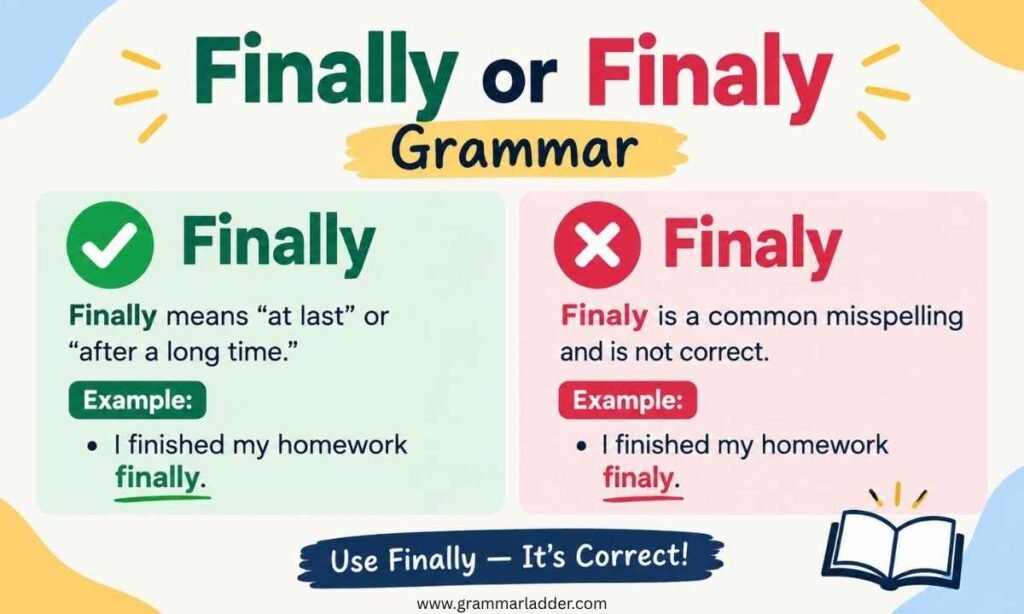
Grammatically, “finally” functions as an adverb of time or an adverb of sequence, depending on context.
- As an adverb of time: He finally answered the phone.
- As a sequencing/transition word: Finally, let’s look at the results.
It can appear:
- At the start of a sentence, followed by a comma (Finally, we arrived.)
- In the middle of a sentence, before the main verb (We finally arrived.)
- At the end of a sentence in some casual speech (We got there, finally.)
“Finaly” has no grammatical function because it is not a recognized word — it cannot be classified as an adverb, adjective, or any other part of speech.
Finaly or Finally Synonym
Since “finaly” isn’t a real word, all synonyms belong to “finally.” Common alternatives include:
| Synonym | Best Used For |
| Eventually | Neutral, less emotional outcome |
| At last | Emphasizing relief after a long wait |
| In the end | Summarizing an outcome |
| Ultimately | Formal writing, conclusions |
| Lastly | Introducing the final point in a list |
Finaly or Finally Adverb
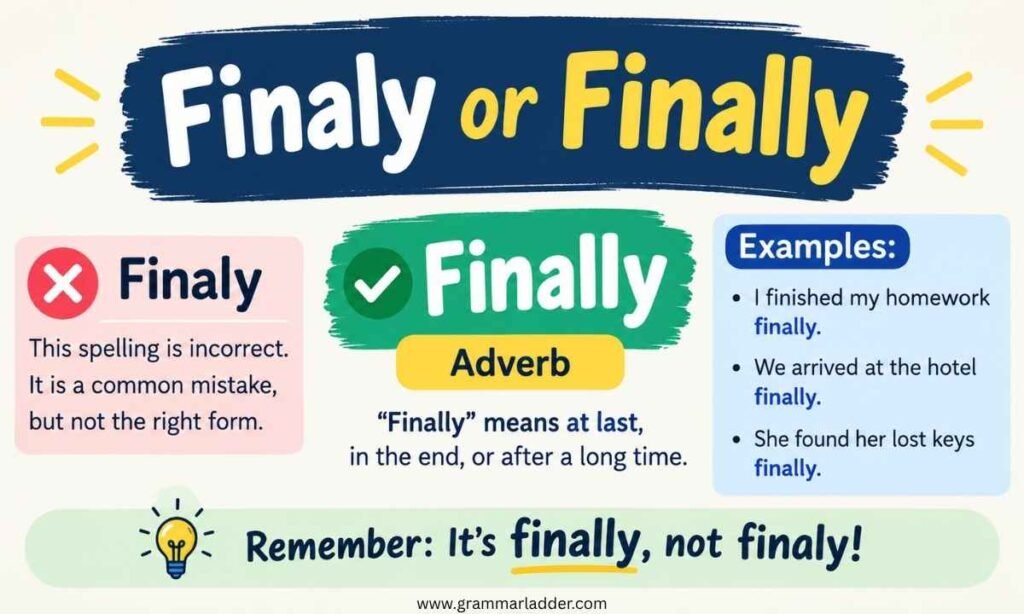
“Finally” is classified as an adverb, specifically:
- An adverb of time (showing when something happened, often after a delay)
- A transition/sequencing adverb (organizing ideas in writing or speech)
Since “finaly” is not a standard word, it cannot be assigned any part of speech, including adverb status.
Finaly or Finally Meaning
To summarize the meaning clearly:
- Finally (correct): after a long time, delay, or effort; or, to introduce the last item in a sequence.
- Finaly (incorrect): has no meaning; it is a spelling mistake with no dictionary entry.
Comparison Table
| Feature | Finally | Finaly |
| Correct spelling | Yes | No |
| Found in dictionaries | Yes | No |
| Part of speech | Adverb | None |
| Used in formal writing | Yes | Never |
| Used in casual texting | Yes | Sometimes (by mistake) |
| Meaning | After a long time / at the end | No meaning |
Which One to Use and When
Knowing the meaning is one thing, but knowing exactly when to reach for “finally” makes your writing sound natural and confident.
Use “finally” when:
- You want to show something happened after waiting or effort
- You are introducing the last point in an essay, email, or speech
- You are writing formally (emails, reports, articles, resumes)
- You are texting or chatting casually but still want correct spelling
Never use “finaly”
There is no context — professional, academic, casual, or creative — where “finaly” is acceptable. It should always be treated as a typo and corrected immediately.
Simple Rule
If the word means “at last” or “in the end,” it always needs two l’s: f-i-n-a-l-l-y.
Common Mistakes People Make
Even though the rule is simple, this spelling slip shows up often in real writing — here’s why it happens and how to spot it.
1. Missing one “l”
The most frequent error is simply dropping a letter, writing “finaly” instead of “finally,” especially when typing fast.
2. Typing too fast
On mobile keyboards, people often skip the second “l” because their fingers move quickly across small keys.
3. Not checking spelling
Many people trust autocorrect blindly, but not all keyboards catch this specific error, especially in casual apps like WhatsApp or Instagram comments.
4. Thinking both are correct
Some learners assume “finaly” might be an informal or shortened version of “finally,” similar to text abbreviations. It is not — it’s simply wrong.
Everyday Real Life Examples
To see how these rules play out beyond the dictionary, here are some situations where “finally” naturally shows up in daily communication.
In Emails
- “Finally, I wanted to confirm our meeting for Thursday at 3 PM.”
- “After several follow-ups, we finally received the shipment.”
In News
- “Officials finally announced the results after a week-long delay.”
- “The bridge project is finally complete after three years of construction.”
On Social Media
- “Finally got my exam results! “
- “Finally Friday!”
In Daily Conversation
- “I finally finished cleaning the whole house.”
- “She finally called me back after two days.”
Incorrect Examples (for learning)
- ❌ “I finaly finished my homework.” → ✅ “I finally finished my homework.”
- ❌ “Finaly, thank you all for coming.” → ✅ “Finally, thank you all for coming.”
Short Learning Section for Students and Beginners
If you’re still worried about mixing up the spelling, these simple memory tricks can help it stick for good.
Trick 1: Double “L” Rule
Since the base word is “final” (which already ends in “l”), adding “-ly” naturally creates two l’s together. Think of it as “final” + “ly,” not “fina” + “ly.”
Trick 2: Think of “full”
Just like “full” has two l’s, remember that “finally” also needs two — both words feel “complete” only with the double letter.
Trick 3: Say it slowly
Pronounce it as “fi-nal-ly,” emphasizing the middle “nal” sound. This helps your brain register the double “l” in the middle of the word.
Practice Sentences
Try completing these with the correct spelling:
- We _______ arrived after a ten-hour flight.
- _______, I would like to thank my team.
- He _______ passed his driving test on the third try.
- _______, let’s move on to the next topic.
(Answer for all: finally)
Frequently Asked Questions
Is “finaly” ever correct in British or American English?
No. Both British and American English use “finally” with two l’s; “finaly” is incorrect in every English variant.
Why do people misspell “finally” as “finaly”?
It usually happens due to fast typing, autocorrect gaps, or not knowing that “final” plus “-ly” keeps both l’s.
Is “finally” the same as “eventually”?
They’re similar, but “finally” often carries more emotion or relief, while “eventually” is more neutral.
Can “finally” start a sentence?
Yes, it’s commonly used at the start of a sentence, followed by a comma, to introduce a final point.
Is “finaly” a slang or texting shortcut?
No, it is not an accepted abbreviation or slang term — it is simply a spelling mistake.
What part of speech is “finally”?
It is an adverb, used to indicate time or to sequence ideas.
Conclusion
The confusion between “finaly” and “finally” almost always comes down to one missing letter — but that single “l” makes all the difference. “Finally” is the only correct spelling, rooted in the word “final” plus the “-ly” adverb ending, while “finaly” has no place in proper English writing.
Whether you’re writing a formal email, a school essay, or a quick text to a friend, remembering the double “l” rule will keep your writing accurate and professional. The next time you’re unsure, just picture the word “final” first — then add “ly,” and you’ll always land on the correct spelling: finally.

I am an English writer with over four years of experience in grammar and language education.
Through Grammar Ladder, I share clear explanations, practical examples, and helpful English tips.
My goal is to share my knowledge so others can benefit and improve their language skills.
I believe anyone can master English with proper guidance and consistent practice.