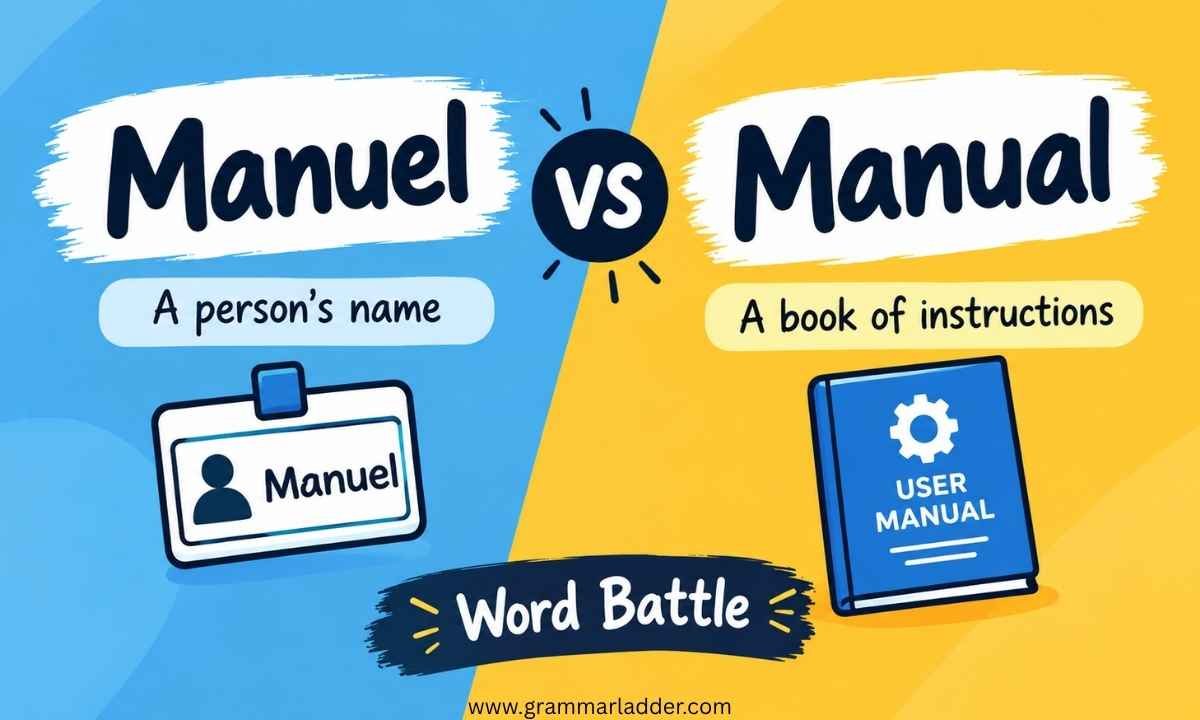
Have you ever typed “manuel” and wondered if it looked right? You’re not alone. This tiny spelling mix-up trips up even careful writers every day.
The truth is simple. “Manual” and “Manuel” are two completely different words. This guide will help you use each one correctly, every time.
Quick Answer
- “Manual” is the correct word for anything related to hands-on operation or an instruction book.
- “Manuel” is a personal name — not a common word.
- The two words sound almost identical, but they are not interchangeable.
- Writing about a process, device, or guidebook? Use “manual.”
- Addressing or referring to a person? Use “Manuel.”
- This mix-up is one of the most common spelling slips in English, especially with fast typing, voice-to-text, or autocorrect.
- Once you understand the root of each word, you’ll never confuse them again.
Simple Background
English borrows many words from Latin. “Manual” and “Manuel” both come from old roots. But those roots are very different.
- Manual comes from the Latin word manus. It means “hand.” It came into English through Old French.
- Manuel comes from the Hebrew name “Immanuel.” It means “God is with us.” It’s a common name in Spanish, Portuguese, and French cultures.
The two words differ by just one letter. That’s why people mix them up so easily.
Clear Explanation of the Difference
What is “Manual”?
“Manual” is a normal English word. It can be an adjective or a noun.
- As an adjective, it means something done by hand. Example: She uses a manual can opener.
- As a noun, it means an instruction book. Example: Read the manual first.
It’s always lowercase. Only capitalize it if it starts a sentence.
What is “Manuel”?
“Manuel” is a name. It’s used for people, not things.
Example: Manuel is picking up the kids today.
It’s always capitalized, no matter where it appears in a sentence.
Manuel or Manual Book
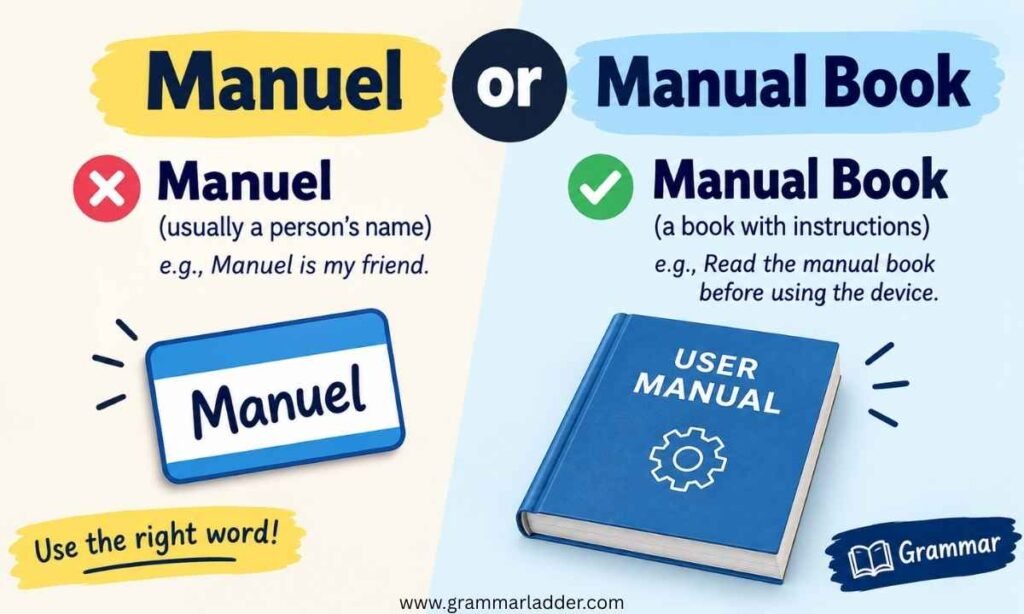
The correct phrase is always “manual book.” It means a guide or instruction booklet. “Manuel book” is wrong. It’s just a common typo.
Example: The manual book explains how to set up the washing machine.
Manuel or Manual Car
A car with hand-operated gears is called a “manual car.” It is never called a “Manuel car.” Names can’t describe objects.
Example: He learned to drive a manual car first.
Manuel vs Manual Meme
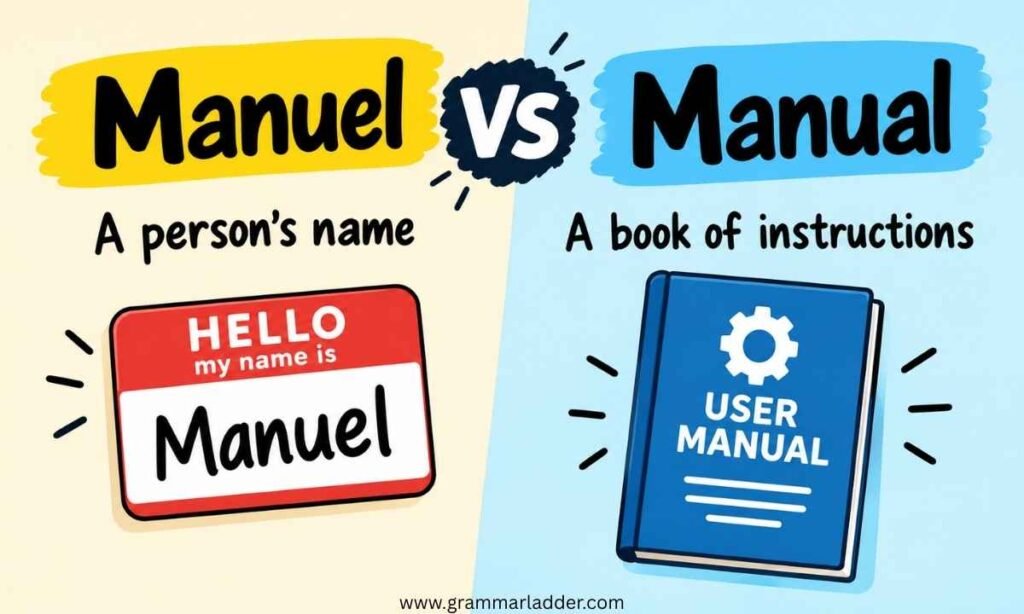
This mix-up shows up in memes too. People joke about autocorrect fails. Some even joke about friends who think “manuel” is a real word. It’s a small reminder that one letter can change everything.
Comparison Table
| Feature | Manual | Manuel |
| Part of speech | Adjective / Noun | Proper noun (name) |
| Meaning | Hand-operated, or a guidebook | A person’s name |
| Capitalization | Lowercase | Always capitalized |
| Origin | Latin manus (hand) | Hebrew Immanuel |
| Example | “This is a manual car.” | “Manuel called earlier.” |
| Common use | Cars, tools, guides, labor | Names, greetings |
Which One to Use and When
Use “manual” for:
- Instruction guides (user manual, training manual)
- Hand-done tasks (manual labor, manual entry)
- Vehicles with hand-shifted gears (manual transmission)
Use “Manuel” only for:
- A person’s actual name
- Writing about someone named Manuel
Simple Tip to Remember
Try this trick: “Manual” has an “A” for Action. Actions are done by hand. “Manuel” has an “E” for Everyone’s name. Names belong to people. If you’re describing a task or a tool, pick “manual.”
Common Mistakes People Make
1. Using “manuel” instead of “manual”
This happens most in texts and emails. People type fast. They don’t check their spelling.
2. Thinking both words mean the same
Some people think “Manuel” is just another spelling of “manual.” It’s not. One is a name. One is a regular word. They never swap places.
3. Spelling confusion
Spell-check tools don’t always catch this error. “Manuel” is a real word (a name). So the checker lets it pass, even when it’s wrong for the sentence.
4. Autocorrect problems
Phones learn your typing habits. If you type “Manuel” often, your keyboard may suggest it again. This can happen even when you meant “manual.”
Everyday Real Life Examples
In Emails
“Please check the attached manual for setup steps.”
Correct, because it’s about a document.
In News
News stories use “Manuel” for people’s names. They use “manual” for things like manual recounts or manual labor.
On Social Media
People often write “manuel labor” by mistake. It should be “manual labor.” This typo is common enough to be a running joke online.
In Daily Life
You might hear both in one day: “Where’s the manual for the blender?” and “Manuel is coming for dinner.” Both are correct, because each word fits its own context.
Short Learning Section for Students
Want to master this rule fast? Follow these four easy steps.
Step 1: Focus on meaning
Ask yourself one question: Am I talking about a person, or a task? This alone solves most confusion.
Step 2: Practice sentences
Write a few example sentences:
- The manual explains how to reset the router.
- Manuel reset the router for me.
Practice builds memory.
Step 3: Check spelling
Always reread your work. This catches autocorrect mistakes before you hit send.
Step 4: Use a memory trick
Remember: “A” for Action, “E” for Everyone’s name. Use it anytime you feel unsure.
Frequently Asked Questions
Is “Manuel” a real English word?
No. It’s only a name, not a dictionary word.
Can “manual” be used as a name?
No. It’s always a regular word, never a name.
Why do people mix up manual and Manuel?
They look and sound almost the same. Autocorrect makes it worse.
Is “manual car” or “Manuel car” correct?
“Manual car” is correct. It means a car with hand-shifted gears.
Does “manual” always relate to hands?
Yes. Its root word means “hand” in Latin.
Is capitalization a quick way to tell them apart?
Yes. “Manuel” is always capitalized. “Manual” stays lowercase mid-sentence.
Conclusion
The difference is simple. “Manuel” is a name. “Manual” is a word for hands-on tasks or guidebooks. They look alike, but they mean very different things.
Use the “Action vs. Everyone’s name” trick to stay sure. Check your autocorrect. Practice with real sentences. Soon, you’ll never mix up “Manuel” and “manual” again.

I am an English writer with over four years of experience in grammar and language education.
Through Grammar Ladder, I share clear explanations, practical examples, and helpful English tips.
My goal is to share my knowledge so others can benefit and improve their language skills.
I believe anyone can master English with proper guidance and consistent practice.