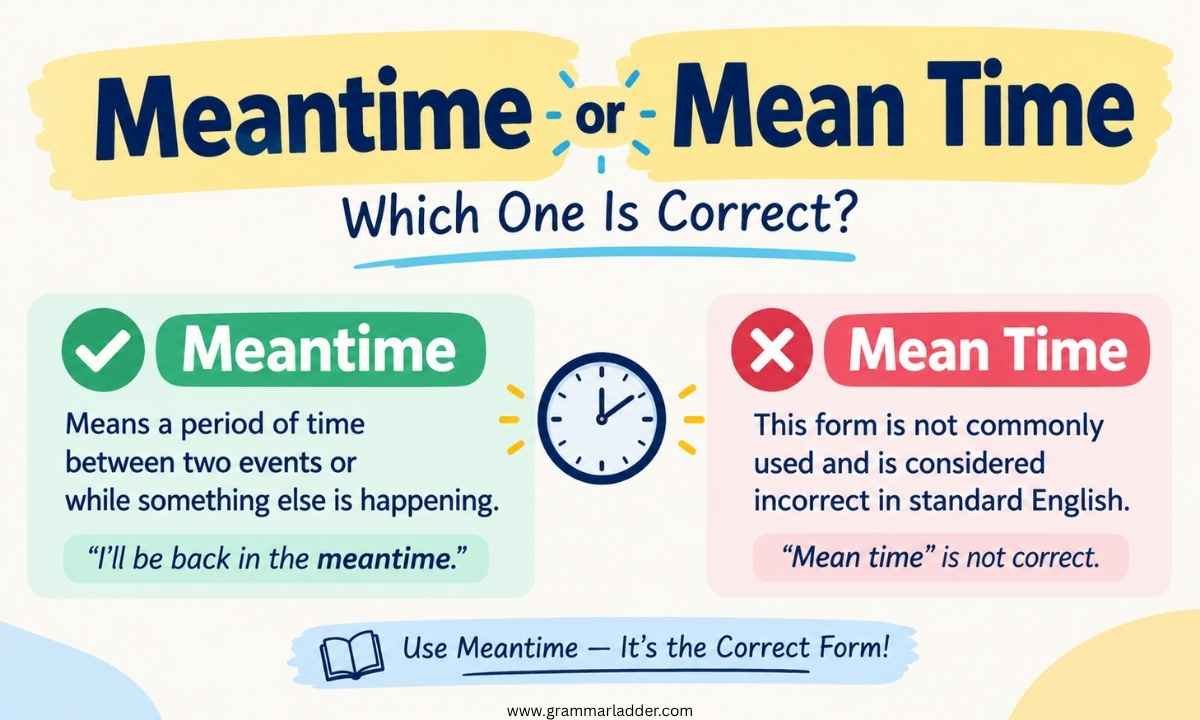
If you’ve ever paused mid-sentence wondering whether to write “in the meantime” or “in the mean time,” you’re not alone. These two forms look almost identical, sound the same when spoken, and yet they serve completely different purposes in English. Getting them mixed up is one of the most common small grammar slips in everyday writing — from emails to text messages to professional reports.
This guide breaks down the difference in plain, simple language so you never have to second-guess yourself again.
Quick Answer
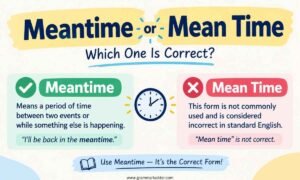
- “Meantime” is one word and works as a noun, usually appearing in the phrase “in the meantime,” meaning “during the period between two events.”
- “Mean time” is two words and refers to an average or calculated time value, often used in technical, scientific, or statistical contexts (like “mean time to failure”).
- In everyday writing, “meantime” is almost always what you want.
- “Mean time” only shows up in specific technical or mathematical situations.
Background
- English has many word pairs that look similar but change meaning based on spacing — like “everyday” vs. “every day,” or “sometime” vs. “some time.” “Meantime” and “mean time” fall into this same group.
- The confusion happens because both phrases share the same two building blocks: “mean” and “time.”
- Writers often assume the two versions are interchangeable — they’re not.
- One version fused into a single word through common usage; the other stayed split because it carries a specific, literal meaning.
- Origin of “meantime”: evolved as a single compound noun centuries ago to describe an in-between period.
- Origin of “mean time”: kept its two-word structure because “mean” acts as an adjective describing “time” — specifically, an averaged or calculated value.
Clear Explanation of the Difference
What is “Meantime”?
“Meantime” is a single word functioning as a noun. It refers to the period between one point in time and another. You’ll almost always see it inside the phrase “in the meantime,” which means “while something else is happening” or “until then.”
Examples:
- The results won’t be ready until Friday. In the meantime, please continue with the current plan.
- She’s still recovering from surgery. In the meantime, her sister is handling the household duties.
- We’re waiting on approval from the client. In the meantime, let’s prepare the next draft.
This form is common in everyday conversation, business writing, emails, and casual messages.
What is “Mean Time”?
“Mean time” is two separate words. Here, “mean” doesn’t refer to unkindness — it refers to a mathematical average. “Mean time” describes a calculated or average time value, and it’s frequently used in technical, engineering, statistical, or scientific fields.
Examples:
- The mean time between failures for this device is 500 hours.
- Analysts calculated the mean time to resolution for support tickets.
- Greenwich Mean Time is based on the average solar time at the Greenwich meridian.
This form shows up in reports, technical documentation, data analysis, and scientific writing — not in casual conversation.
Comparison Table
| Feature | Meantime | Mean Time |
| Word form | One word | Two words |
| Part of speech | Noun | Adjective + Noun |
| Meaning | The period between two events | An averaged or calculated time value |
| Common phrase | “In the meantime” | “Mean time to failure,” “Mean time between failures” |
| Where it’s used | Everyday writing, emails, conversation | Technical, scientific, statistical writing |
| Example | “In the meantime, wait here.” | “The mean time was 3.2 seconds.” |
| Formality | Casual to semi-formal | Formal, technical |
Which One to Use and When
The choice comes down to context:
- Use “meantime” when you’re talking about a gap between two events, a waiting period, or something happening while you wait for something else.
- Use “mean time” when you’re referring to an average, calculated, or statistical time measurement — often paired with terms like “mean time to repair” (MTTR) or “mean time between failures” (MTBF).
If you’re writing a personal email, a message to a friend, a blog post, or general business communication, “meantime” is almost certainly correct. If you’re writing an engineering report, a data analysis, or discussing reliability metrics, “mean time” is the right choice.
Simple Tip to Remember
Here’s an easy trick: if you can replace the phrase with “meanwhile,” you need the one-word version, “meantime.”
- “In the meantime, let’s wait.” → “Meanwhile, let’s wait.” ✅ Works, so use “meantime.”
- “The mean time was 4 hours.” → “The meanwhile was 4 hours.” ❌ Doesn’t work, so use “mean time.”
This one substitution test solves almost every case of confusion instantly.
Common Mistakes People Make
1. Writing “mean time” instead of “meantime”
Many writers accidentally split “meantime” into two words, especially when typing quickly. Writing “in the mean time” instead of “in the meantime” is grammatically incorrect in standard usage, even though it’s a frequent typo.
2. Thinking both forms are the same
Some people assume spacing doesn’t matter and that both forms mean the same thing. In reality, using the wrong form in a technical report (or a casual message) can confuse readers or make the writing look unpolished.
3. Splitting the word by mistake
Autocorrect and spell-check tools don’t always catch this error since both “meantime” and “mean time” are technically valid words — just with different meanings. This makes it easy for the mistake to slip through unnoticed.
Meantime or Mean Time Synonym
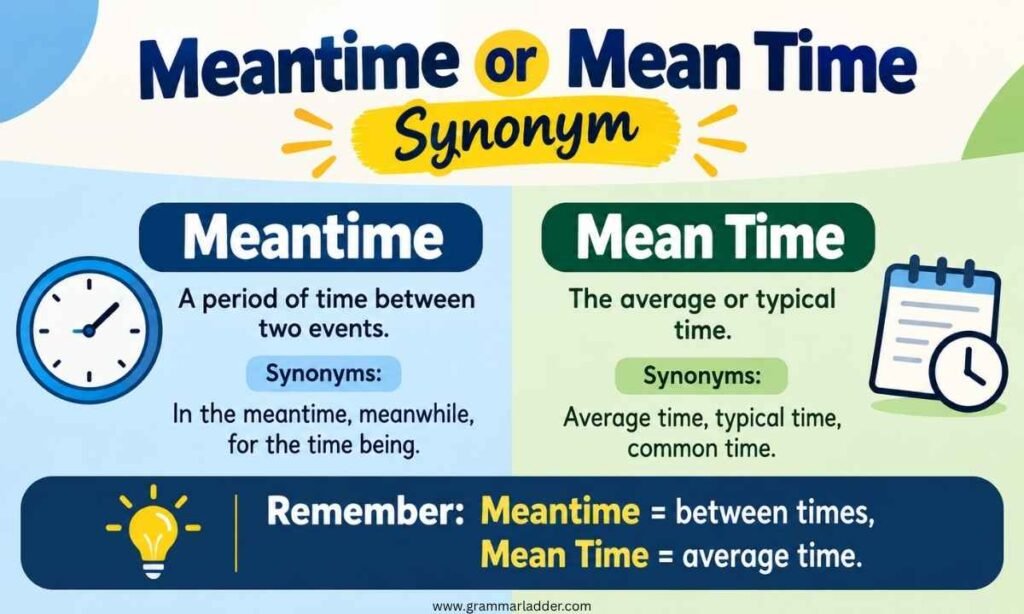
If you want alternatives to “meantime” (the everyday, one-word version), consider:
- Meanwhile
- In the interim
- For now
- Until then
- At the same time
For “mean time” (the technical, averaged version), related terms include:
- Average time
- Median time (in some contexts)
- Expected duration
- Calculated interval
Choosing the right synonym depends on whether you’re writing casually or working with data.
Meantime or Mean Time UK
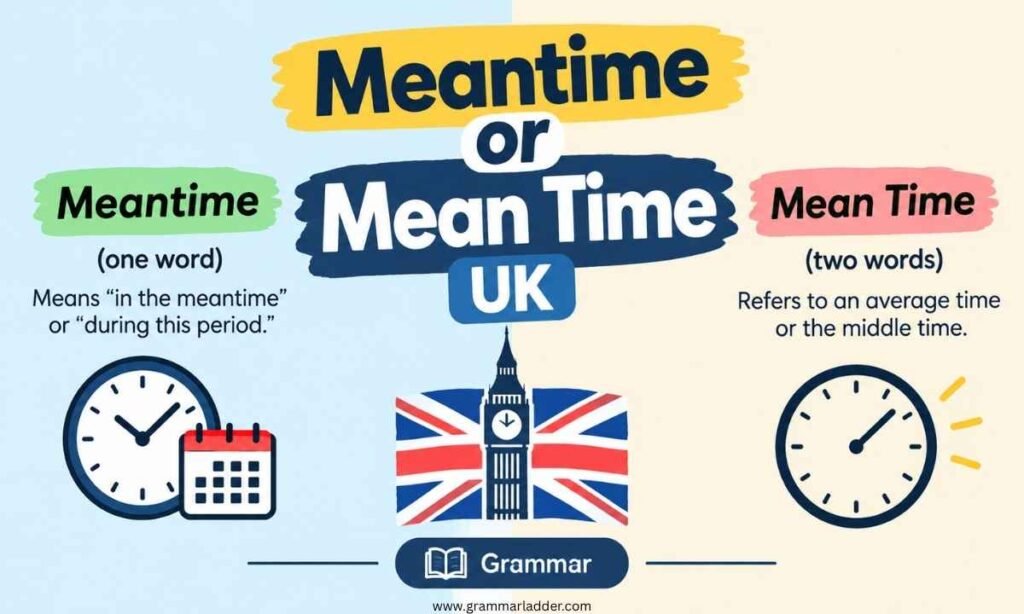
British and American English don’t differ meaningfully here — both use “meantime” as the standard one-word form for describing an in-between period, and “mean time” for averaged calculations. However, UK English does have one well-known example of “mean time” in everyday use: Greenwich Mean Time (GMT), the time standard based on the average solar time at the Greenwich meridian. This is one of the few cases where “mean time” appears in general, non-technical British usage rather than strictly scientific writing.
Everyday Real Life Examples
In Emails
“Thanks for your patience. In the meantime, I’ll follow up with the vendor and update you by Thursday.”
In Messages
“Running 10 minutes late. In the meantime, feel free to grab a table.”
On Social Media
“New episode drops next week. In the meantime, catch up on Season 1!”
In Daily Life
“Dinner will be ready soon. In the meantime, wash your hands and set the table.”
In Technical Use
“Our servers reported a mean time between failures of 720 hours last quarter, an improvement over the previous benchmark.”
Short Learning Section for Students
If you’re a student trying to lock in this rule, here’s a simple four-step approach.
Step 1: Learn the common word
Start by memorizing that “meantime” (one word) is the version you’ll use 95% of the time in normal writing and speech.
Step 2: Practice
Write five sentences using “in the meantime” until it feels natural. Then write two or three technical sentences using “mean time” to see the contrast.
Step 3: Use a memory trick
Remember the “meanwhile” substitution test mentioned earlier. If “meanwhile” fits, use “meantime.”
Step 4: Check your writing
Before submitting an assignment or sending an email, search for “mean time” in your document and double-check that it’s only used in technical or averaged contexts.
Frequently Asked Questions
Is “meantime” one word or two?
“Meantime” is one word when referring to the period between two events, as in “in the meantime.”
What does “mean time” mean in statistics?
It refers to an average or calculated time value, such as the mean time between failures.
Can “meantime” and “mean time” ever mean the same thing?
No, they have distinct meanings — one describes a waiting period, the other describes an average.
Which form is correct for business emails?
“Meantime,” as in “in the meantime,” is the correct and natural choice for professional and casual writing.
Why does spell-check not catch this mistake?
Both forms are valid words individually, so spell-check tools can’t detect context-based errors automatically.
Is “meantime” used in British English too?
Yes, “meantime” is used the same way in both British and American English.
Conclusion
The difference between “meantime” and “mean time” comes down to a simple rule: one word for describing a waiting period, two words for describing an average or calculated time value. Once you apply the “meanwhile” substitution trick, choosing the correct form becomes almost automatic.
Whether you’re writing a quick text message, a professional email, or a technical report, knowing this distinction helps your writing look polished, accurate, and confident. Keep this guide handy the next time you’re unsure — and in the meantime, happy writing!

I am an English writer with over four years of experience in grammar and language education.
Through Grammar Ladder, I share clear explanations, practical examples, and helpful English tips.
My goal is to share my knowledge so others can benefit and improve their language skills.
I believe anyone can master English with proper guidance and consistent practice.