Do you ever pause while typing the word “studying”? You are not alone. Many people wonder if it should be “studying” or “studing.” This small mix-up happens more often than you think.
The good news is the answer is simple. English has one clear rule for this word. Once you learn it, you will never second-guess yourself again.
Quick Answer: Studying vs Studing
- “Studying” is the correct spelling.
- “Studing” is a common misspelling that does not exist as a proper English word.
- The confusion usually comes from how English handles verbs that end in “y” when you add “-ing.”
- Remember this simple rule: study → studying (never “studing”).
What Does “Studying” Mean?
Before diving into the spelling rule, it helps to understand what the word actually means and how it functions in a sentence.
Simple Definitions
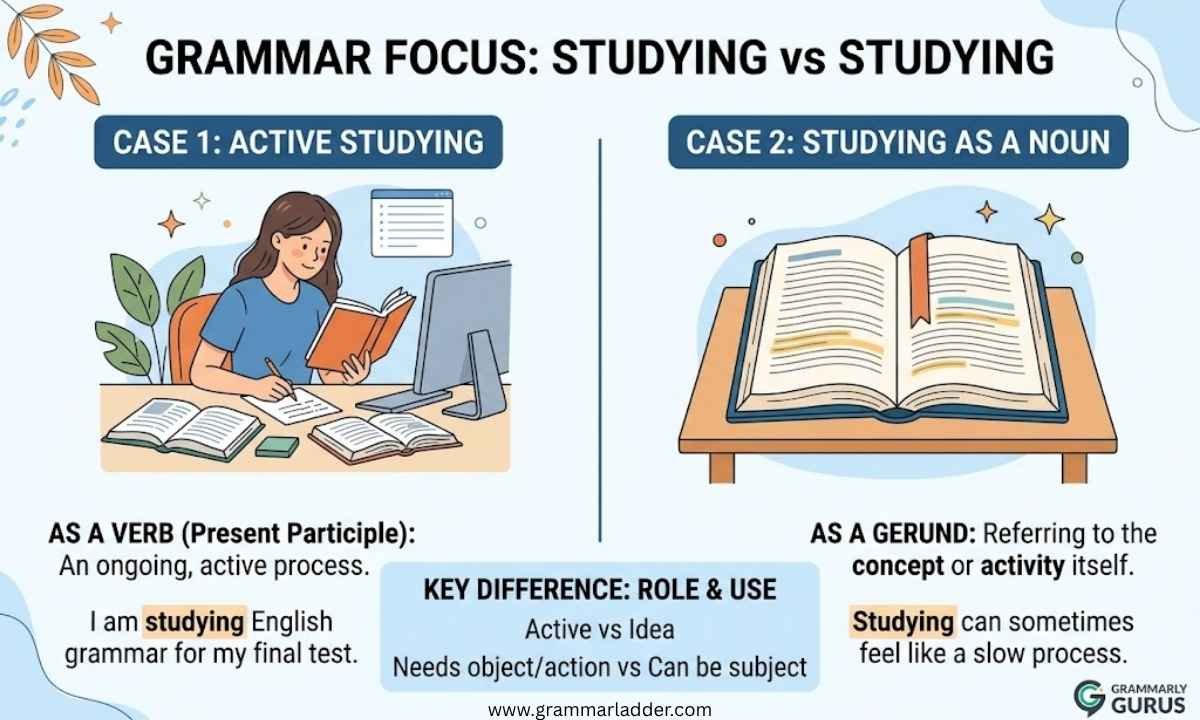
“Studying” is the present participle (or gerund) form of the verb “to study.” It refers to the act of devoting time and effort to learning about a subject through reading, practice, memorization, or research.
- As a verb: “She is studying for her exam.”
- As a noun (gerund): “Studying is her top priority this week.”
Examples in Sentences
- I am studying biology this semester.
- He spends every evening studying for the bar exam.
- Studying a little each day is better than cramming.
- They were studying the map when the tour guide arrived.
Why Do People Write “Studing”?
This misspelling is surprisingly common, and it usually comes down to a handful of everyday habits and misunderstandings.
Common Reasons
- Rushed typing — dropping a letter is easy when typing quickly on a phone or keyboard.
- Sound-based spelling — some writers spell words the way they sound rather than following spelling conventions, and “studing” seems to mirror the pronunciation.
- Confusion with other “-ing” rules — English has multiple patterns for adding “-ing” (drop the “e,” double the consonant, keep the “y”), and it’s easy to mix them up.
- Autocorrect gaps — not all spell-checkers catch this error immediately, especially in informal writing like texts or social media.
Understanding the Correct Spelling Rule
Once you know the underlying pattern, spelling “studying” correctly becomes second nature.
The Rule
When a verb ends in a consonant + y, you keep the “y” and simply add “-ing.” You do not change the “y” to an “i” the way you would when forming the past tense (like “studied”).
- study → studying (not “studing”)
- try → trying
- carry → carrying
- worry → worrying
This is different from the past tense rule, where “y” changes to “i” before adding “-ed”:
- study → studied
- try → tried
- carry → carried
Examples
- study → studying (present participle) → studied (past tense)
- try → trying (present participle) → tried (past tense)
- carry → carrying (present participle) → carried (past tense)
- worry → worrying (present participle) → worried (past tense)
Key Insight
The “-ing” rule for words ending in a consonant + “y” is simple: just add “-ing” to the full word — no letters are dropped or changed. This is different from words ending in “e,” where the “e” is usually dropped (like “write” → “writing”).
Studying vs Studing: Comparison Table
| Spelling | Correct? | Notes |
| Studying | ✅ Yes | Standard, dictionary-recognized spelling |
| Studing | ❌ No | Common misspelling; not a real word |
Why Studying, Not Studing?
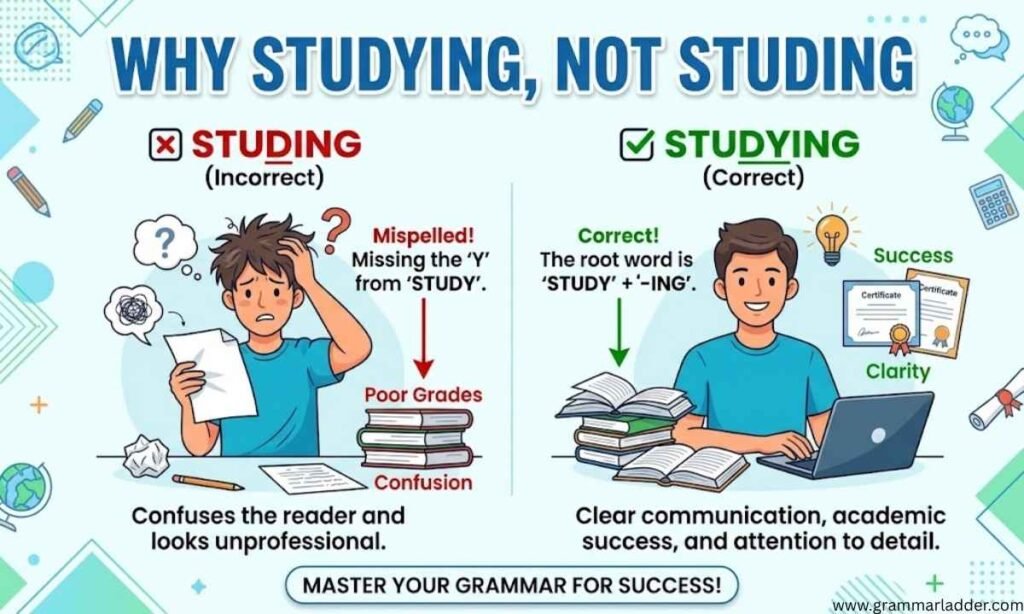
The word “study” ends in a consonant (“d”) followed by “y.” According to standard English spelling conventions, when adding “-ing” to a verb ending in consonant + “y,” the “y” is retained in full. Removing it (as in “studing”) breaks this rule and creates a nonstandard, incorrect spelling.
Common Mistakes to Avoid
Here are the most frequent ways people get this word wrong, along with why each mistake happens.
1. Dropping the “Y”
The most frequent error is simply omitting the “y” before adding “-ing,” turning “studying” into “studing.”
2. Confusing with Other “Y” Rules
Writers sometimes apply the past-tense rule (change “y” to “i”) to the “-ing” form by mistake, or confuse “study” with words ending in a vowel + y (like “play” → “playing”), where the “y” behaves differently in past tense but is still always kept before “-ing.”
3. Typing Too Fast
Fast typing, especially on mobile devices, often causes single letters to be skipped — “studying” is a common casualty.
4. Mixing Verb Forms
Some writers blend tenses, accidentally combining the past tense stem with the present participle ending, producing nonstandard forms.
More Examples of “Studying” in Context
Seeing the word used across different settings makes it easier to remember its correct spelling and usage.
In Academic Life
- She’s studying computer science at university.
- The students spent the whole weekend studying for finals.
- He’s studying abroad this semester in Spain.
In Everyday Use
- I’ve been studying this recipe to get it just right.
- They’re studying the instructions before assembling the furniture.
- We’re studying our options before making a decision.
In Professional Context
- The analyst is studying market trends before the presentation.
- Our team is studying the client’s feedback in detail.
- Researchers are studying the effects of the new policy.
Present Continuous: Studying or Studing
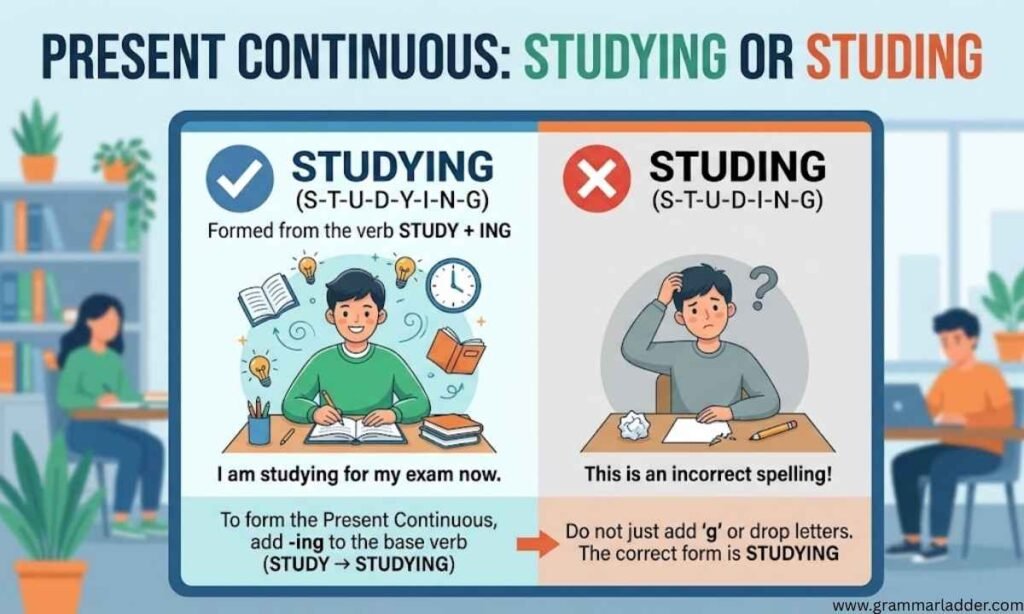
In the present continuous tense (also called present progressive), you always use “studying,” never “studing.”
- Correct: I am studying right now.
- Incorrect: I am studing right now.
- Correct: She is studying medicine.
- Incorrect: She is studing medicine.
American vs British English Differences
There is no difference between American and British English when it comes to spelling “studying.” Both dialects use the identical spelling. This is one of the rare cases where regional spelling variations (like “color” vs “colour”) do not apply — “studying” is spelled the same way everywhere English is written.
Why Correct Spelling Matters?
Getting this word right isn’t just about grammar rules — it has real, practical effects on how your writing is received.
Key Benefits
- Credibility — correct spelling makes your writing look polished and professional, especially in academic papers, resumes, and emails.
- Clarity — proper spelling avoids confusion and ensures readers understand your meaning instantly.
- First impressions — in job applications or school assignments, small spelling errors can create a negative impression, even if the content is strong.
- Searchability — using correct spelling helps your content appear properly in search engines and spell-checkers.
Synonyms and Related Words
Knowing a few alternative words can help you vary your writing while keeping the same meaning.
Synonyms of “Studying”
- Learning
- Reviewing
- Researching
- Reading up
- Cramming (informal)
- Revising
- Preparing
- Analyzing
Easy Memory Trick
Think of the phrase: “Study” keeps its ‘y’ when it’s busy ‘ying.’
Or picture it this way: whenever you add “-ing” to a word ending in a consonant + “y,” the “y” stays put — it never packs up and leaves. Only the past tense (“-ed”) swaps the “y” for an “i.”
Frequently Asked Questions
Is “studing” ever correct?
No. “Studing” is not a recognized word in any standard English dictionary. It is always a misspelling of “studying.”
Why isn’t it “studieing”?
Because the “-ing” rule for consonant + “y” verbs doesn’t change the “y” at all — you just add “-ing” directly, without inserting an extra “i” or “e.”
Does autocorrect always catch “studing”?
Not always. Some autocorrect systems miss this error, especially in casual texting or on certain keyboards, so it’s worth double-checking your spelling manually.
What’s the correct past tense of “study”?
The correct past tense is “studied,” where the “y” changes to “i” before adding “-ed.”
Conclusion
When comparing “studying vs studing,” there is only one correct answer: studying. The word “study” keeps its “y” when forming the “-ing” version, following the standard English spelling rule for consonant + “y” verbs. “Studing” is a common but incorrect spelling that should be avoided in any formal or informal writing. By remembering this simple rule — keep the “y,” just add “-ing” — you can confidently use “studying” correctly every time.

I am an English writer with over four years of experience in grammar and language education.
Through Grammar Ladder, I share clear explanations, practical examples, and helpful English tips.
My goal is to share my knowledge so others can benefit and improve their language skills.
I believe anyone can master English with proper guidance and consistent practice.