If you’ve ever typed “lieing” and then paused, wondering if it looks right, you’re not alone. This is one of the most common spelling slips in English, and it trips up native speakers and learners alike. The confusion usually starts with a simple guess: if “lie” ends in “ie,” shouldn’t the “-ing” form just be “lieing”? It’s a reasonable guess — but it’s wrong.
In this guide, you’ll get a clear, no-nonsense answer, learn exactly why the rule works the way it does, and pick up a few memory tricks so you never second-guess this word again.
Quick Answer
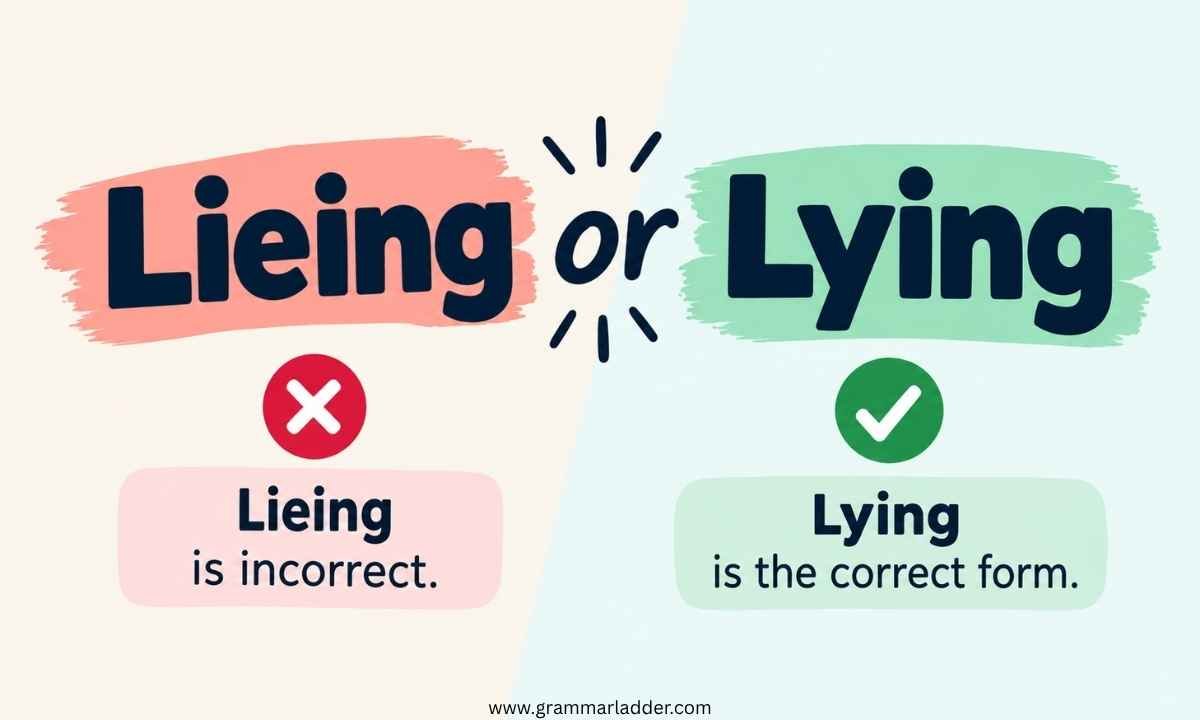
- “Lying” is the correct spelling. “Lieing” is not a real word.
- The present participle (the “-ing” form) of the verb “lie” is always spelled lying — never “lieing.”
- This applies whether you’re talking about telling an untruth or reclining on a couch.
- It holds in every context: casual texting, formal essays, resumes, and everyday conversation.
Simple Background
English has a small but well-known spelling rule that governs verbs ending in “ie.” When you add “-ing” to these verbs, the “ie” changes to “y” before the “-ing” is attached. This isn’t unique to “lie” — it happens with other common verbs too, such as “tie” becoming “tying” and “die” becoming “dying.”
The reason behind this rule is mostly about avoiding awkward letter combinations. English spelling conventions try to prevent three vowels from bunching together in a way that looks strange and is hard to read. “Lieing” would create exactly that kind of clunky visual, which is one reason the language shifted the “ie” to “y” over time.
Clear Explanation of the Difference
What is “Lying”?
“Lying” is the correct, dictionary-recognized present participle of the verb “lie.” It has two distinct meanings depending on context:
- To say something untrue: “She is lying about where she was last night.”
- To rest in a flat or horizontal position: “The cat is lying on the windowsill.”
Both meanings use the exact same spelling — “lying” — even though they come from two different root verbs (“to lie” meaning to deceive, and “to lie” meaning to recline). English speakers rely entirely on context to tell them apart, since the spelling doesn’t change.
What is “Lieing”?
“Lieing” is simply a misspelling. It does not appear in any standard dictionary, and it doesn’t follow accepted English spelling patterns. People usually write it because they’re applying a very literal, letter-by-letter approach: they see “lie” and assume adding “-ing” just means tacking the letters on directly, without adjusting the spelling. It’s an understandable mistake, but it isn’t grammatically or lexically valid.
Comparison Table
| Feature | Lying (Correct) | Lieing (Incorrect) |
| Dictionary status | Recognized standard spelling | Not a real word |
| Root verb | “To lie” (deceive or recline) | Same root, misapplied spelling |
| Spelling rule | “ie” changes to “y” before “-ing” | Ignores the ie-to-y rule |
| Used in formal writing | Yes | Never |
| Common in casual typing | Rarely, since it’s correct usage | Frequently, due to typing errors |
| Grammatical function | Present participle/gerund | No accepted grammatical role |
Which One to Use and When
There’s really only one rule to remember here: always use lying, regardless of the sentence’s meaning or tone. There is no situation — formal, informal, academic, or conversational — where “lieing” is the acceptable choice.
- Use “lying” when describing dishonesty: He kept lying about his age.
- Use “lying” when describing a resting position: The dog was lying near the fireplace.
- Never use “lieing” in any context, including text messages or social media captions, if you want your writing to look polished and credible.
Simple Tip to Remember
Here’s an easy mental shortcut: “ie” becomes “y” before “-ing.” Picture it as a small swap — the “i” and “e” step aside, and a single “y” takes their place. If you can remember that “tie” becomes “tying” and “die” becomes “dying,” you’ll automatically remember that “lie” becomes “lying,” because all three verbs follow the identical pattern.
Lieing or Lying Meaning
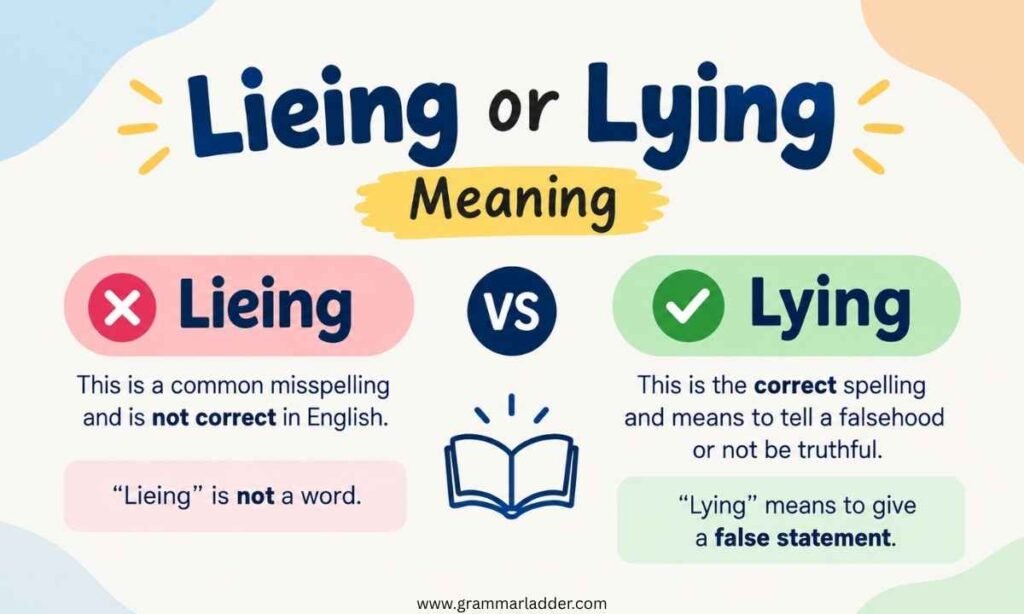
The meaning of “lying” depends entirely on its sentence context:
- Dishonesty sense: Making a false statement on purpose, intending to mislead someone.
- Physical position sense: Being in a horizontal, resting posture, such as lying on a bed, floor, or grass.
“Lieing” has no meaning of its own since it isn’t a recognized word — it’s simply an incorrect attempt to write “lying.”
Lieing or Lying in a Sentence
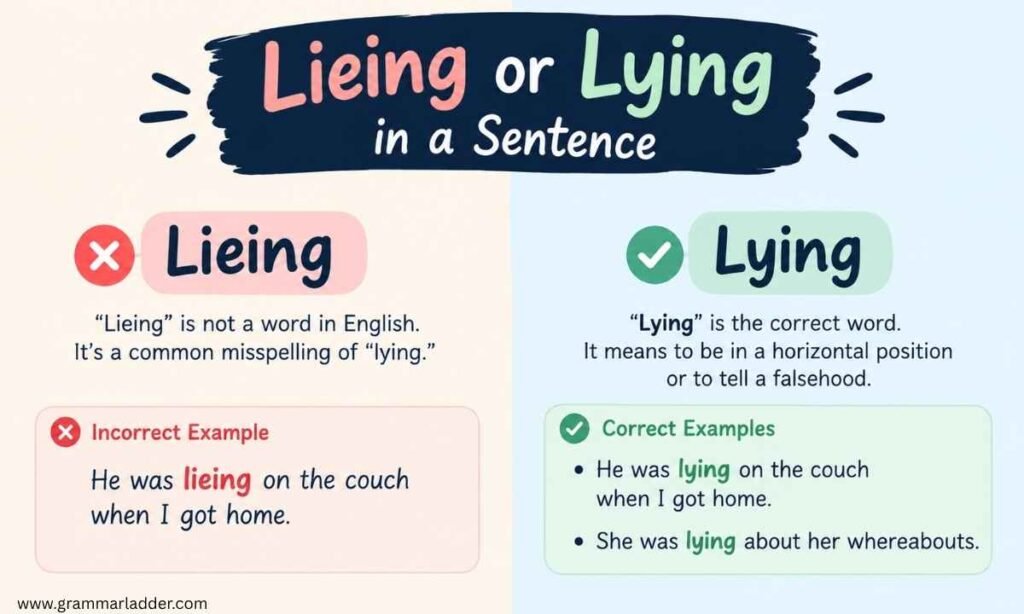
Seeing the word used correctly in different situations makes the rule stick faster than memorizing it in isolation.
- I don’t believe you’re lying to me.
- She has been lying awake for hours, unable to sleep.
- Stop lying about your whereabouts.
- The keys were lying on the kitchen counter the whole time.
Lieing or Lying: Not Telling the Truth
When someone is being dishonest, the correct word is always “lying,” not “lieing.” For example: The witness was accused of lying under oath. This sense of the word covers everything from small white lies to serious deception, but the spelling never changes based on how serious the lie is.
Lieing or Lying on the Floor
When referring to a physical position, “lying” is still correct: The remote control was lying on the floor next to the couch. Some people confuse this with “laying,” which is a related but different verb — “lay” requires a direct object (you lay something down), while “lie” does not (you simply lie down yourself). Either way, the “-ing” form of “lie” remains “lying,” never “lieing.”
Lieing or Lying in Bed
This is one of the most searched versions of this phrase, and the answer stays consistent: She was lying in bed, scrolling through her phone. You’ll also see “laying in bed” used casually in speech, but strictly speaking, “lying in bed” is the grammatically correct choice since no object is being placed down.
Lieing or Lying Quiz
Test yourself with these quick questions:
- Fill in the blank: “He was ______ about his test score.” (lying / lieing)
- True or False: “Lieing” is an accepted alternate spelling in British English.
- Fill in the blank: “The blanket was ______ on the bed.” (lying / lieing)
Answers: 1. lying, 2. False, 3. lying
Common Mistakes People Make
1. Keeping the “ie”
The most frequent error is simply adding “-ing” straight onto “lie” without changing the spelling, resulting in “lieing.” This happens because the rule isn’t always taught explicitly, even though it’s applied consistently across similar verbs.
2. Forgetting Spelling-Change Rules
Many English learners aren’t aware that certain verb endings require a spelling adjustment before “-ing” is added. Beyond “ie” to “y,” there are other patterns too, like doubling a final consonant (“run” to “running”) or dropping a silent “e” (“make” to “making”). Forgetting these small but consistent rules leads to errors like “lieing.”
3. Confusing Pronunciation and Spelling
Since “lying” and “lieing” would sound identical if “lieing” were ever spoken, some people simply never notice the mistake until they see it written down. Spoken English gives no clue about which spelling is correct, which is part of why this error persists.
Everyday Real-Life Examples
Seeing how “lying” shows up in everyday situations makes the correct spelling easier to remember and apply naturally.
In Daily Life
People often use this word without thinking twice, whether they’re describing someone’s dishonesty or simply noting where an object is resting: Your glasses are lying on the table.
In Messages
Quick texts are where “lieing” shows up most often, since people type fast and rarely proofread: “stop lieing lol” is a common (incorrect) text, when it should read “stop lying lol.”
On Social Media
Captions and comments frequently misspell this word too, especially in casual or emotional posts where users aren’t focused on grammar accuracy.
In School
Students learning English grammar often encounter this word early on, since it’s a classic example used to teach spelling-change rules for “-ing” verb forms.
Short Learning Section for Students
For students still getting comfortable with English spelling rules, breaking the process down into small steps makes it much easier to remember why “lying” is correct and how to avoid the same mistake in similar words.
Step 1: Learn the Rule
Understand that verbs ending in “ie” swap those two letters for a “y” before adding “-ing.” This applies to “lie,” “tie,” and “die.”
Step 2: Practice
Write out a few example sentences using “lying” in both its meanings — dishonesty and physical position — until the spelling feels automatic.
Step 3: Use a Memory Trick
Repeat the mnemonic: “ie becomes y before -ing.” Saying it aloud a few times helps it stick in long-term memory.
Step 4: Check Spelling Carefully
Before submitting an assignment, email, or post, do a quick scan for “-ing” verbs and double-check any that come from “ie” root words.
Frequently Asked Questions
Is “lieing” ever correct in any dialect of English?
No, it is not accepted in American, British, or any other standard English dialect.
Why does “lie” become “lying” instead of “lieing”?
English spelling rules require “ie” to change to “y” before adding “-ing” to avoid awkward vowel combinations.
Is “lying” used the same way for both meanings of “lie”?
Yes, the same spelling applies whether you mean telling an untruth or reclining in a flat position.
Do other verbs follow this same “ie” to “y” pattern?
Yes, common examples include “tie” becoming “tying” and “die” becoming “dying.”
Is “laying” the same as “lying”?
No, “laying” comes from the verb “lay,” which needs a direct object, while “lying” comes from “lie,” which does not.
Will spell-checkers catch “lieing” automatically?
Most modern spell-checkers will flag it, but it’s still best to know the rule rather than rely solely on software.
Conclusion
The takeaway here is simple: “lying” is always correct, and “lieing” is always wrong. This holds true whether you’re writing about dishonesty or describing someone resting on a couch. The confusion comes from a natural but mistaken assumption about how “-ing” attaches to verbs ending in “ie.” Once you remember the small rule — “ie” becomes “y” before “-ing” — you’ll never hesitate over this word again. Keep the mnemonic in mind, practice with a few sentences, and your spelling will stay accurate in every kind of writing, from casual texts to professional documents.

I am an English writer with over four years of experience in grammar and language education.
Through Grammar Ladder, I share clear explanations, practical examples, and helpful English tips.
My goal is to share my knowledge so others can benefit and improve their language skills.
I believe anyone can master English with proper guidance and consistent practice.