You are typing a quick email, a report, or a product description. You write “solar pannel,” and your spell-checker draws a red line under it. Was that a typo, or is there a second spelling you never knew about?
This guide settles the panel vs. pannel question in plain language. You will get the correct spelling, the meaning, grammar rules, real examples, pronunciation tips, and regional differences. Read on, and you will never second-guess this word again.
Quick Definition
Panel is a noun and a verb. As a noun, it means:
- A flat, rectangular section of a wall, door, ceiling, or vehicle.
- A control surface with switches, dials, or screens, such as a solar panel or an instrument panel.
- A small group of people chosen to discuss, judge, or advise on a topic.
As a verb, to panel means to cover or decorate a surface with panels.
Pannel is not a standard modern English word. It is an old, obsolete form of “panel”.
Quick Answer
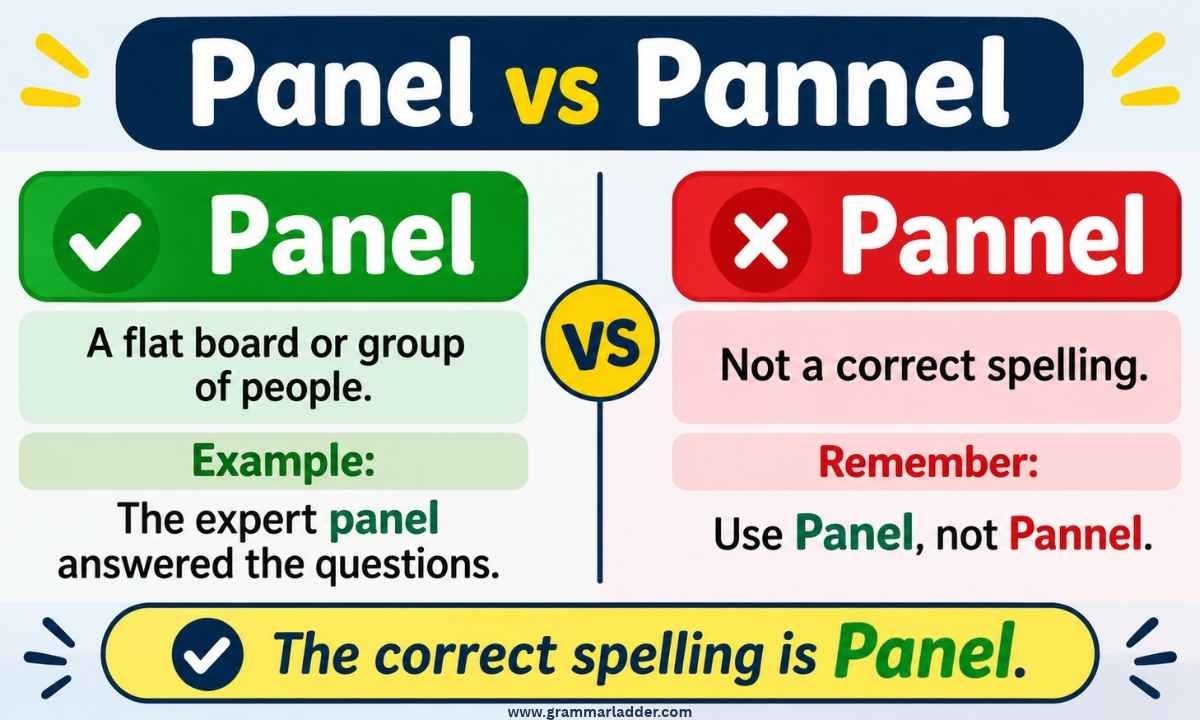
Panel is correct. Pannel is a misspelling in everyday writing.
Use “panel” with one n in schoolwork, business writing, websites, emails, and code. The only places you may still see “pannel” are historical texts and a few specialist fields, covered below.
Panel or Pannel: Which is Correct?
In current English, “panel” is the only accepted spelling. Major dictionaries list “pannel” only as a historical variant, if they list it at all.
Why does the wrong spelling look so natural? Many English words double a consonant before a short ending. Think of “channel”, “tunnel”, and “flannel”. Writers apply that pattern to “panel” by habit. Add the spoken sound of the word, and the extra n feels logical, even though it is wrong.
Here is a simple memory trick: “A panel has a single plan.” One n, one plan.
Key Differences Explained
| Feature | Panel | Pannel |
| Status | Standard, modern spelling | Obsolete or historical spelling |
| Used in | All modern writing | Old texts, rare legal and falconry terms |
| Part of speech | Noun and verb | Noun and verb (archaic) |
| Safe for exams and work? | Yes | No |
The main takeaway is simple. Both forms trace back to the same word, but only one survived into modern usage.
Panel vs Pannel Grammar
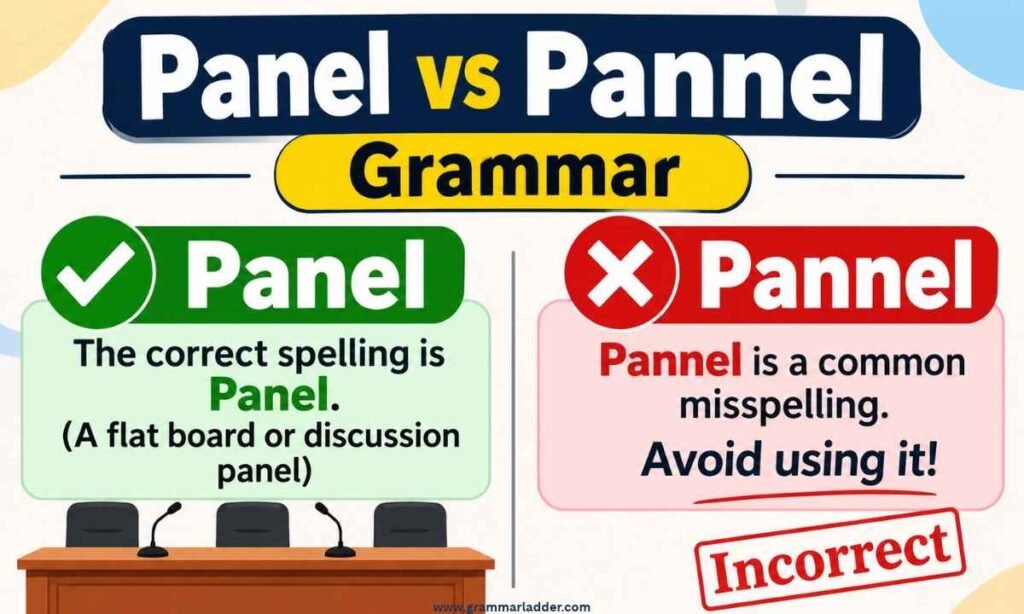
Here is how “panel” behaves in a sentence.
As a noun
- Singular: panel
- Plural: panels
- It can be countable (“three panels”) or part of a compound noun (“panel discussion”, “panel member”).
As a verb
- Base form: panel
- Present participle: paneling (US) or panelling (UK)
- Past tense: paneled (US) or panelled (UK)
As a modifier
The word often works like an adjective in front of another noun: panel beater, panel data, panel truck, panel review.
The same rules apply to the old spelling “pannel” in historical writing, but you should not use that form today. If you see “pannelled” or “panneling” in a modern document, it is an error.
Panel vs Pannel Examples
These sentences show correct use of “panel”:
- The carpenter fitted a new oak panel to the cabinet door.
- A panel of three judges will pick the winner.
- The engineer checked every solar panel on the roof.
- We paneled the study in dark walnut.
- Please press the red button on the control panel.
And here is what not to write:
- ❌ The carpenter fitted a new oak pannel.
- ❌ She joined a pannel of experts.
- ❌ Check the electrical pannel.
Panel vs Pannel Examples in English
The word “panel” appears in many settings. This table shows the most common ones.
| Context | Meaning | Example sentence |
| Construction | Flat section of a wall or ceiling | The builder installed acoustic panels in the studio. |
| Technology | Display or control surface | The touch panel froze during the update. |
| Energy | Solar or electrical unit | The electrical panel needs an upgrade. |
| Events and media | Group of speakers | The panel answered questions from the audience. |
| Law | Group of jurors or judges | The court summoned a jury panel. |
| Art | A single board or picture section | The comic’s final panel delivered the joke. |
| Fashion and sewing | Piece of fabric in a garment | The dress has a lace panel at the back. |
| Research | Group of repeated survey participants | The study used a panel of 500 households. |
Panel or Pannel Discussion
A common search is “pannel discussion”. The correct phrase is panel discussion.
A panel discussion is a structured conversation among a small group of experts in front of an audience. A moderator guides the talk, asks questions, and keeps time. Conferences, webinars, podcasts, and TV shows use this format all the time.
Related correct phrases include:
- Panel discussion
- Panel members
- Panel moderator
- Panel interview
- Expert panel
- Panel of judges
If you are promoting an event, always check the flyer and the web page. A single misspelled word in a title can hurt your credibility.
Common Mistakes and Misspellings
Here are the errors that show up most often, plus the fix for each.
- Pannel – the most common slip. Correct form: panel.
- Pannelist – wrong. A person on a panel is a panelist (US) or panellist (UK).
- Pannelling – wrong. Use paneling (US) or panelling (UK).
- Panal – a vowel swap. Correct form: panel.
- Panle – letters in the wrong order. Correct form: panel.
- Pane vs panel – these are different words. A pane is a single sheet of glass in a window. A panel is a larger flat section or a group of people.
Proofreading tip: Search your document for “pann” before you publish. It catches every variant in seconds.
Pronunciation Guide
“Panel” has two syllables and the stress falls on the first.
- IPA: /ˈpæn.əl/
- Simple respelling: PAN-uhl
- Rhymes with: channel (in its ending sound)
The second syllable is soft and quick. Do not say “pan-EL” with a hard, stressed ending.
Here is the key point for spelling. The word is pronounced with one clear n sound. Because “panel” and “pannel” sound identical, you cannot rely on your ear to choose the right spelling. You have to remember it.
Comparison Table
| Aspect | Panel | Pannel |
| Correct today? | ✅ Yes | ❌ No |
| Pronunciation | /ˈpæn.əl/ | Same sound |
| Common in dictionaries? | Yes | Only as obsolete or historical |
| Plural | Panels | Pannels (archaic) |
| Verb forms | Paneled/panelled | Rarely seen |
| Best used in | Everyday and professional English | Historical quotes only |
Etymology and Word Origin
The word has a long history. “Panel” entered Middle English in the 1300s, borrowed from Old French. Its earliest sense was a piece of cloth, then a pad or cushion under a saddle.
The path looks like this:
- Latin pannus – a piece of cloth.
- Late Latin pannellus – a small piece of cloth.
- Old French panel (modern French panneau) – a section or piece.
- Middle English panel or pannel – a section, a saddle cloth, or a list of jurors written on a strip of parchment.
The jury meaning explains why we say “panel” for a group of people today. Court clerks once wrote juror names on a small piece of parchment, and that list was called the panel.
Spelling was not fixed in those centuries. Writers used “pannel” and “panel” side by side. Over time, the single-n form won out in standard English.
Where “pannel” survives
A few niches still use the old form:
- Scots law: Older legal texts use “pannel” for the accused person in a criminal trial. Modern drafting prefers “panel” or simply “the accused”.
- Falconry: Historical writing uses “pannel” for a hawk’s stomach.
- Old literature: Older books use it in the sense of a saddle cloth.
These are specialist or historical cases. They do not make “pannel” correct for general writing.
Regional Usage
The base word “panel” is spelled the same in every major English-speaking country. The difference shows up in the verb and related forms, where one l or two may appear.
American English
Americans use panel, paneling, paneled, and panelist. Single l is the norm, which matches the general US habit of avoiding doubled consonants before endings.
Example: The panelist praised the paneled library.
British English
British writers use panel, panelling, panelled, and panellist. The final l is doubled before an ending.
Example: The panellist admired the panelled hall.
Australian English
Australian English follows the British pattern: panelling, panelled, panellist. You will also hear “panel beater” for a person who repairs car bodies, and “panel van” for a delivery vehicle.
Example: The panel beater fixed the dented door.
Canadian English
Canadian English mixes both styles. Many Canadian writers and publishers prefer the doubled l (panelled, panellist), while American-style forms also appear, especially in business and online content. Pick one style and stay consistent.
Example: The panellist joined the conference panel from Toronto.
In every region, “pannel” remains incorrect.
Frequently Asked Questions
Is it panel or pannel?
The correct spelling is panel. “Pannel” is an obsolete form and counts as an error in modern writing.
What does panel mean?
A panel is a flat section of a surface, a control board, or a small group of people chosen to discuss or judge something.
Is “pannel discussion” correct?
No. The right phrase is panel discussion.
Why do people spell it “pannel”?
Words like “channel” and “tunnel” use double n, so writers copy the pattern by habit. The old spelling also appears in historical texts.
Is “pannel” ever correct?
Only in historical or specialist contexts, such as old Scots law or falconry writing. Never use it in modern work.
What is the difference between pane and panel?
A pane is one sheet of glass in a window. A panel is a larger flat section or a group of people.
Is it paneled or panelled?
Both are right. Use paneled in American English and panelled in British, Australian, and often Canadian English.
How do you pronounce panel?
Say PAN-uhl, with stress on the first syllable and a soft, quick second syllable.
Conclusion
The panel vs pannel question has a clear answer. Panel is the correct spelling for every modern purpose, from wall panels and solar panels to expert panels and panel discussions. Pannel is an old variant that belongs in history books, old legal documents, and falconry manuals.
Remember three things:
- Spell it with one n: p-a-n-e-l.
- Match your verb forms to your region: paneled in the US, panelled elsewhere.
- Check titles and headings twice before you hit publish.
Keep this guide handy the next time your spell-checker flags a word. A small spelling choice can make your writing look sharper and more trustworthy.

I am an English writer with over four years of experience in grammar and language education.
Through Grammar Ladder, I share clear explanations, practical examples, and helpful English tips.
My goal is to share my knowledge so others can benefit and improve their language skills.
I believe anyone can master English with proper guidance and consistent practice.