Two spellings, one meaning, and a lot of confusion. If you have ever stopped mid-sentence to wonder whether signalling needs that extra “l”, you are not alone.
The short version: both spellings are correct. The right one depends on where your readers live. This guide explains the rule, shows real examples, and helps you pick the right form every time.
Quick Answer
Both are correct.
- Signaling (one L) is standard in American English.
- Signalling (two Ls) is standard in British English and in most other English-speaking countries.
| Spelling | Used in | Past tense |
| Signaling | United States | Signaled |
| Signalling | UK, Australia, New Zealand, most of Canada | Signalled |
If you remember one thing, remember this: pick the spelling that matches your audience, then stay consistent.
Signalling or Signaling Meaning
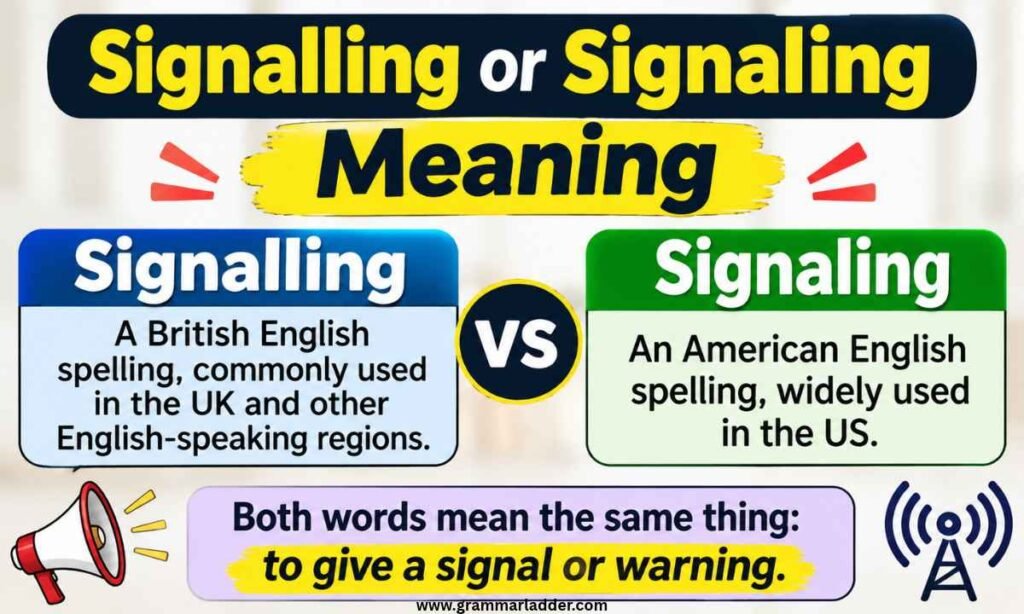
Both words are the -ing form of the verb signal. They mean the same thing:
- Sending a message, warning, or instruction through a sign, gesture, light, sound, or electronic pulse.
- Showing or indicating that something is happening or about to happen.
The base word is signal. It is spelled the same in every English variety. Only the verb forms (signaling/signalling, signaled/signalled) change.
Think of the word in three roles:
- Noun: The driver gave a signal before turning.
- Verb: She is signaling (or signalling) for help.
- Adjective use: The signalling equipment failed. (Here it describes the equipment.)
Which One Is Correct?
Neither is wrong. Each is correct in its own region. Here is how it breaks down.
American English: Signaling
In the US, dictionaries and major style guides prefer the single-L form. Words like signaling, signaled, and signaler are the norm in American newspapers, textbooks, and business writing.
British English: Signalling
In the UK, the double-L form is standard. You will see signalling, signalled, and signaller in British newspapers, railway documents, and academic journals.
Canadian, Australian, and Other Varieties
Australia, New Zealand, India, and South Africa generally follow the British pattern. Canada is a mix, but signalling is common in Canadian publishing. Always check the style guide you are writing for.
Why Do the Spellings Differ?
It comes down to a doubling rule.
- British English usually doubles a final “l” when adding -ing or -ed, even in unstressed syllables. So signal becomes signalling.
- American English doubles the final consonant only when the stress falls on the last syllable. In SIG-nal, the stress is on the first syllable, so the “l” stays single: signaling.
Noah Webster pushed for simpler, more regular spellings in his early 19th-century American dictionary. That is a big reason American English dropped many doubled letters.
Signalling or Signaling Examples

Seeing the words in context makes the choice easier.
American English Examples
- The driver was signaling a left turn.
- Cell signaling pathways are central to this study.
- He signaled the waiter for the check.
- The company is signaling a shift in strategy.
British English Examples
- The driver was signalling a left turn.
- Cell signalling pathways are central to this study.
- He signalled the waiter for the bill.
- The company is signalling a shift in strategy.
Signalling or Signaling Synonym
Sometimes the best fix is a different word. Here are common alternatives:
- Indicating
- Showing
- Suggesting
- Gesturing
- Flagging
- Communicating
- Hinting
- Alerting
- Beckoning
- Motioning
Example: Instead of “The report is signaling a slowdown,” you could write “The report is suggesting a slowdown.”
Synonyms help when you write for a mixed audience and want to avoid the spelling question altogether. They also make your writing less repetitive.
How to Use Signalling and Signaling
Follow these steps to choose confidently.
- Identify your audience. Is the reader American, British, or international?
- Choose one variety. Use American spelling for US readers and British spelling for UK and most Commonwealth readers.
- Check your style guide. Publishers, universities, and employers often set the rule for you.
- Set your spellchecker. Switch your word processor to English (US) or English (UK).
- Stay consistent. Do not mix signaling and signalling in one document.
Quick Memory Trick
American = one L (signaling). British = two Ls (signalling).
Common Mistakes
Even confident writers slip up. Watch for these.
- Mixing spellings in one document. Writing signaling in paragraph one and signalling in paragraph five looks careless.
- Doubling the L in the noun. The noun is signal, never signall.
- Marking the “wrong” spelling as an error. Both are valid. Do not “correct” a British writer’s signalling in a UK document.
- Ignoring the audience. A US company website using signalling may look like a typo to American readers.
- Mixing up the endings. Pair signaled with signaling, and signalled with signalling.
- Confusing the word with similar ones. Signage (signs collectively) is a different word entirely.
Usage Tips
Use these habits to get it right every time.
- Match the spelling to the platform. Writing for a US blog? Use signaling. Writing for a UK publication? Use signalling.
- Use Find and Replace before publishing. Search your document for both forms to catch stray inconsistencies.
- Trust a good dictionary. Merriam-Webster lists signaling as the main American form, while Oxford and Cambridge show signalling as the British form.
- Follow field conventions. In technical documents, check how the standard or manual you are citing spells the term.
- Keep one variety throughout. This applies to related words too: color/colour, organize/organise, center/centre.
- Proofread aloud. Reading slowly helps you spot spelling slips your eyes skip over.
Frequently Asked Questions
Is it signalling or signaling?
Both are correct. Use signaling in American English and signalling in British English.
Which spelling is more common?
Worldwide, signalling is used in most English-speaking countries, while signaling dominates in the US. The US has the largest single audience online, so you will see both often.
Is “signalled” correct?
Yes. Signalled is the British past tense, and signaled is the American one.
Is “signaling” a misspelling in British English?
It is not a typo, but it reads as the American variant. In a UK document, use signalling.
Why does British English use a double L?
British spelling usually doubles the final “l” before -ing or -ed, even when the syllable is unstressed.
What is the noun form?
The noun is signal. It is spelled the same in every English variety.
Does Canadian English use signalling or signaling?
Canadian usage is mixed, but signalling is common. Check the style guide of your publication.
Can I use both spellings in one article?
Only if you are explaining the difference, as in this article. Otherwise, stay consistent.
Conclusion
The signalling or signaling debate is not about right and wrong. It is about audience. Signaling suits American readers, and signalling suits British and most international readers.
Choose one, apply it throughout, and let your spellchecker’s language setting back you up. When in doubt, check a trusted dictionary or your style guide.

I am an English writer with over four years of experience in grammar and language education.
Through Grammar Ladder, I share clear explanations, practical examples, and helpful English tips.
My goal is to share my knowledge so others can benefit and improve their language skills.
I believe anyone can master English with proper guidance and consistent practice.