You’re typing an email, and you pause. Is it “beginning” or “begining”? Your spell-checker is quiet, but something looks off.
You’re right to double-check. This is one of the most commonly misspelled words in English. The good news: the answer is simple, and the rule behind it will help you spell dozens of other words correctly.
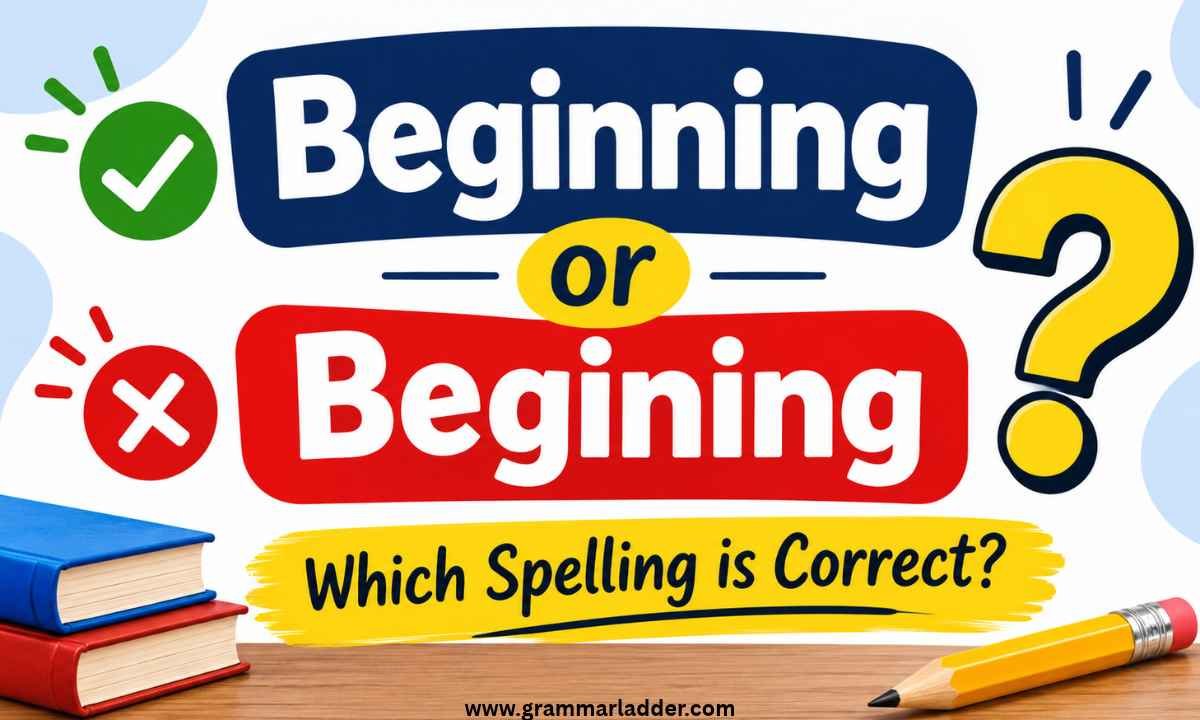
Quick Answer: Beginning or Begining?
- ✅ “Beginning” is the correct spelling. It has two n’s in the middle: b-e-g-i-n-n-i-n-g. It is standard in both American and British English.
- ❌ “Begining” is always wrong. It is missing the second n and does not appear in standard dictionaries.
- ❌ “Beggining” is wrong. It has an extra g and the wrong double letter.
- ❌ “Begginning” is wrong. It doubles the wrong letters.
Beginning or Begining Meaning

“Beginning” refers to the start of something. It can work as a noun, a verb form, or an adjective.
- Noun: the point where something starts. The beginning of the movie was slow.
- Verb form (present participle of “begin”): She is beginning to understand.
- Adjective: describing something at an early stage. A beginning course in Spanish.
Synonyms include start, outset, onset, opening, origin, and launch. The opposite is end, finish, or conclusion.
“Begining” has no meaning at all, because it isn’t a real word. It’s only a typo or a spelling slip.
What Is the Correct Spelling: Beginning or Begining?
The correct spelling is beginning. Every major dictionary, including Merriam-Webster, Oxford, and Cambridge, lists it this way.
There is no regional difference here. Whether you write in the US, the UK, Canada, or Australia, the spelling stays the same. Some words, like color and colour, change by region. This one doesn’t.
Why Do People Write “Begining” by Mistake?
There are a few clear reasons.
- We spell by sound. When you say the word aloud, the double n is barely audible. It sounds like “be-GIN-ing.”
- The root word has one n. Since “begin” ends in a single n, it feels natural to just add -ing.
- Typing speed. Fast typists often skip repeated letters.
- Similar words confuse us. Some words double their final letter (running), while others don’t (opening). It’s easy to mix them up.
- Autocorrect habits. People rely on spell-check and never learn the rule.
Why Is There a Double N in Beginning?
The double n comes from the consonant doubling rule: when a word ends in a stressed vowel plus consonant, the last letter doubles before a suffix that starts with a vowel (-ing, -ed, -er).
“Begin” passes all three checks:
- It ends in one vowel plus one consonant (i + n).
- The stress falls on the last syllable: be-GIN.
- The suffix “-ing” starts with a vowel.
So begin + n + ing = beginning. The doubled n also keeps the “i” sound short.
The same rule gives running, swimming, admitting, occurring, and forgetting. Exception: if the stress is not on the last syllable, the letter stays single, as in opening and visiting.
Beginning or Begining in English: Usage in Everyday Writing
In formal writing, such as essays, emails, resumes, and reports, a spelling mistake can hurt your credibility. A reader may judge the whole message by one small error.
The word shows up in many common settings:
- Academic writing: At the beginning of the study, participants completed a survey.
- Business: We expect growth from the beginning of Q1.
- Storytelling: Every good story needs a strong beginning.
- Everyday talk: It’s just the beginning.
It also appears in many fixed phrases:
- in the beginning
- from the beginning
- beginning of the end
- a beginning, a middle, and an end
- beginner’s luck (note: beginner has a double n too)
Easy Rules to Remember “Beginning”
Try one or two of these. Pick whichever sticks in your memory.
- The doubling rule. Begin ends in a stressed vowel + consonant, so double the n before -ing.
- Split it into chunks. Say it as begin + ning. You already know “begin,” so just add “ning.”
- Count the pairs. The word has 9 letters and two pairs worth remembering: nn in the middle, plus a final ing.
- Mental picture. Imagine the two n’s as two starting posts on a racetrack, because a beginning is where the race starts.
- Write it three times. Muscle memory works. Write the word three times by hand, then once from memory.
- Link it to “beginner.” If you can spell beginner (double n), you can spell beginning.
Beginning or Begining Examples
- ✅ The beginning of the semester is always the busiest time.
- ✅ I’m beginning to see how this works.
- ✅ In the beginning, nobody believed in the idea.
- ❌ “The begining of the book is slow” → ✅ “The beginning of the book is slow.”
- ❌ “He’s begining his new job” → ✅ “He’s beginning his new job.”
Beginning or Beginning Quiz

Test yourself. Pick the correct spelling in each sentence. Answers are below.
- The (beginning / begining) of the speech was powerful.
- She is (beginning / begining) her studies next week.
- Which is correct: beggining, begining, or beginning?
- Fill in the blank: Every ending is also a new b_ginning. (Which letter is missing? Trick question: the word is already spelled right!)
- Choose the correct word: (beginer / beginner).
Answers: 1) beginning, 2) beginning, 3) beginning, 4) nothing is missing; it’s spelled correctly, 5) beginner.
Score 5 out of 5? You’ve mastered it. If you missed any, review the doubling rule above.
Frequently Asked Questions
Is it “beginning” or “begining”?
It is “beginning.” “Begining” is a common misspelling and is never correct.
Why does “beginning” have two n’s?
Because “begin” ends in a stressed vowel plus consonant, the n doubles before adding “-ing.”
Is “begining” a word in British English?
No. British and American English both use “beginning.”
How do you spell “beginning” correctly?
Spell it b-e-g-i-n-n-i-n-g, with a double n in the middle.
Is “beginner” spelled with one n or two?
Two. It follows the same rule: “beginner.”
What is the easiest trick to remember the spelling?
Think “begin + n + ing.” Adding one extra n keeps the word correct.
Can “beginning” be a verb?
It’s the present participle of “begin,” as in “She is beginning to learn.”
Conclusion
The answer is clear: “beginning” is correct, and “begining” is not. The double n comes from the consonant doubling rule, which also explains words like running, swimming, and occurring. Most people slip because they spell by sound or copy the single n from the root word “begin.”
Once you know the rule, you no longer have to guess. Use the memory tricks above, try the quiz again in a few days, and watch for similar words. This is only the beginning of better spelling, so save this guide for the next time you hesitate and share it with someone who needs it.

I am an English writer with over four years of experience in grammar and language education.
Through Grammar Ladder, I share clear explanations, practical examples, and helpful English tips.
My goal is to share my knowledge so others can benefit and improve their language skills.
I believe anyone can master English with proper guidance and consistent practice.