You are typing a sentence and stop. Is it “benefited” or “benefitted”? Both look right, and spellcheck may not help.
Here is the short answer. Benefited (one T in the middle) is the standard spelling in American English and the safer choice almost everywhere. Benefitted is an accepted variant, found more often in British writing. This guide explains why, with examples, a comparison table, and a simple rule.
Benefited vs Benefitted Meaning
Both words are the past tense and past participle of the verb benefit. They mean the same thing: to gain an advantage, profit, or improvement from something.
There is no difference in meaning, tone, or formality. The only difference is spelling.
- She benefited from the extra training.
- She benefitted from the extra training.
Both sentences say the same thing.
Benefited vs Benefitted: Meaning & Key Differences
The key differences come down to three things:
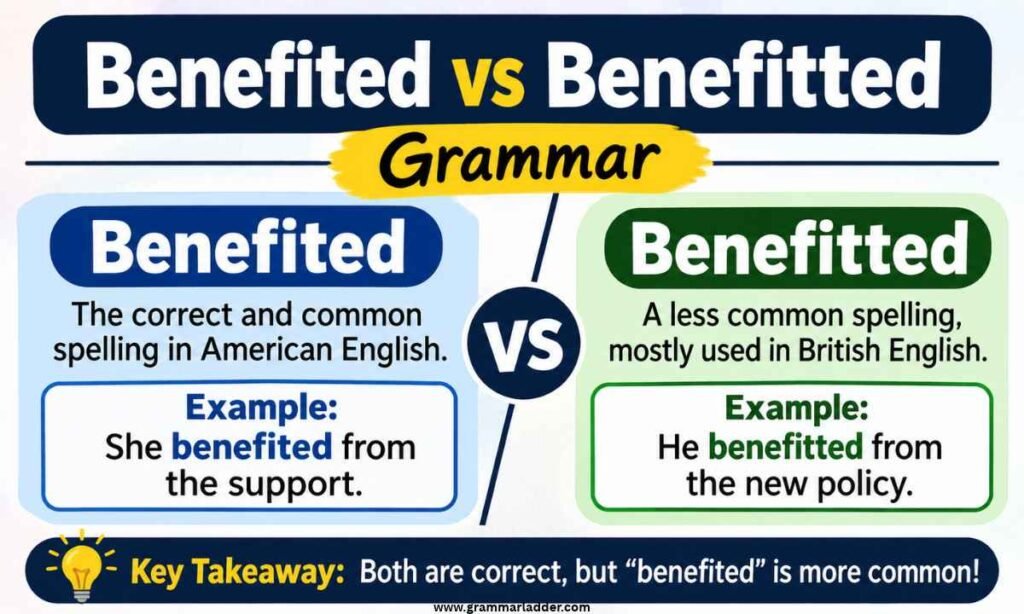
- Region: Benefited is the American standard. Benefitted is a variant that appears more in British English.
- Frequency: Benefited is far more common overall, including in much British writing.
- Style rules: Many style guides and editors prefer the single-T form.
So the choice is about audience and consistency, not correctness.
Benefited vs Benefitted in the Oxford Dictionary
Major dictionaries treat these as the same word. Merriam-Webster lists benefited as the main form and benefitted as a variant. Dictionary.com groups both forms under one entry. Oxford-style dictionaries also give benefited as the primary spelling and recognise the double-T form as an alternative.
If you want the form that dictionaries list first, choose benefited.
Benefited vs Benefitted Grammar
The grammar rule explains the confusion.
Many short verbs double their final consonant before -ed. Think of stop → stopped or plan → planned. That happens when the stress falls on the last syllable.
But benefit is stressed on the first syllable: BEN-e-fit. When the stress is not on the final syllable, the consonant normally stays single. Compare:
- limit → limited
- visit → visited
- credit → credited
- benefit → benefited
That is why benefited follows the regular pattern. Benefitted comes from the doubling habit applied by analogy, and it is tolerated rather than required.
Benefited or Benefitted in the UK
British English is where the confusion mostly lives. Some British writers double consonants more freely, for example travelled and labelled, so benefitted looks natural to them.
But it is not a firm UK rule. British dictionaries still list benefited first, and many UK publishers use it. If you write for a UK audience, either form is acceptable. Just pick one and stay consistent.
Benefited vs Benefitted Examples
Benefited in a sentence:
- Small businesses benefited from the new tax relief.
- Students who read daily have benefited the most.
- The town benefited when the factory reopened.
Benefitted in a sentence:
- Many residents have benefitted from the new bus route.
- The charity benefitted from a generous donation.
- Who benefitted most from the policy change?
Notice that the context never changes the meaning.
Benefited or Benefitted Pronunciation
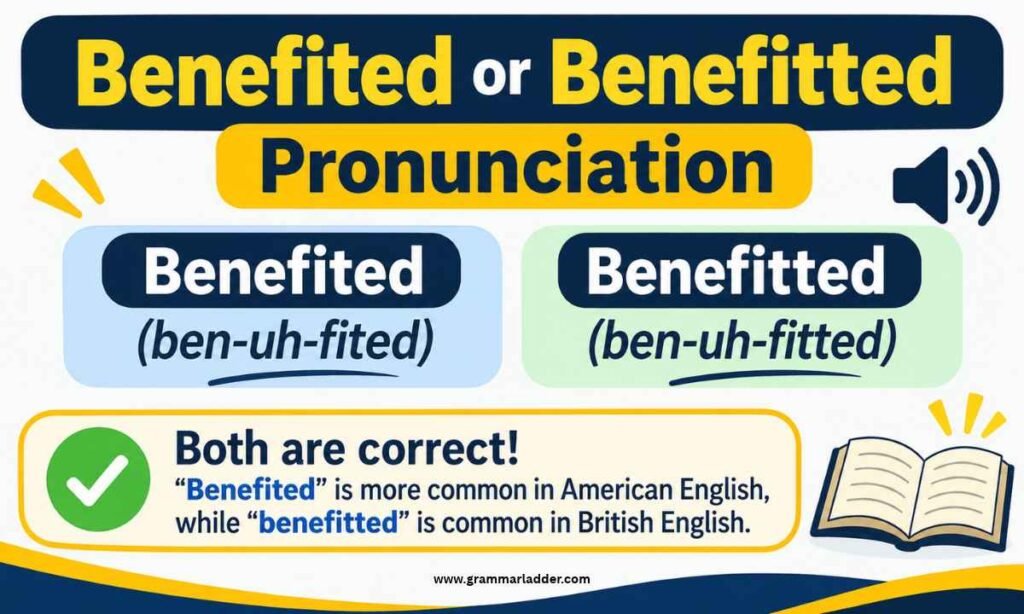
The two spellings sound identical. Both are pronounced BEN-uh-fit-id (/ˈbɛnɪfɪtɪd/), with the stress on the first syllable and the middle T pronounced once.
That’s why the double T isn’t needed. It does not change how the word sounds.
Benefited vs Benefitted: Side-by-Side Comparison
| Feature | Benefited | Benefitted |
| Meaning | Gained an advantage | Gained an advantage |
| Status | Standard spelling | Accepted variant |
| Main region | US, widely used in the UK | More often UK |
| Dictionary position | Listed first | Listed as alternative |
| Pronunciation | BEN-uh-fit-id | BEN-uh-fit-id |
| Safest for global readers | Yes | Acceptable |
Benefiting vs Benefitting (Present Form)
The same logic applies to the -ing form. Benefiting is the standard spelling, and benefitting is the variant.
- Remote workers are benefiting from flexible hours.
- Remote workers are benefitting from flexible hours.
The rule is the same. If you use benefited, use benefiting. If you use benefitted, use benefitting. Do not mix them in one document.
Usage in Professional Writing
In business, academic and journalistic writing, consistency matters more than the form you choose. Here is what works well:
- Follow the style guide. Check your company, publisher, or university guide first.
- Know your audience. For a mixed or international audience, benefited is the safe default.
- Match your spelling set. If your document uses UK spellings like colour and organisation, benefitted will not look out of place.
- Set your editor’s language. Choose English (US) or English (UK) so your tools flag inconsistencies.
In resumes, reports, and SEO content, benefited is also the more searched and more recognised form.
Common Mistakes Writers Make
Even experienced writers slip here. Watch for these:
- Mixing both spellings in one article or email.
- Calling one “wrong.” Benefitted is not an error, only less standard.
- Writing “benifited” or “benefitted” with a missing letter. Check the e after the n.
- Mismatching forms, such as benefited with benefitting.
- Confusing the word with “beneficial.” Benefited is a verb. Beneficial is an adjective, as in “a beneficial change.”
Quick Rule to Remember
One T for the standard spelling: benefited, benefiting.
Use this three-step check:
- Writing for a US or international audience? Use benefited.
- Writing for a UK audience with a house style that prefers it? Benefitted is fine.
- Not sure? Choose benefited and keep it consistent.
A handy memory trick: the stress is on BEN, not on fit, so the T does not double. Like limited and visited.
Frequently Asked Questions
Is it benefited or benefitted?
Both are accepted, but benefited is the standard and most common spelling.
Is benefitted wrong?
No. It is a recognised variant, just less preferred in most style guides.
Which spelling is used in the UK?
Both appear in British English. Benefitted is more common there than in the US, but benefited is still widely used.
Is benefited the American spelling?
Yes. American dictionaries and style guides list benefited as the standard form.
Do benefited and benefitted sound different?
No. Both are pronounced BEN-uh-fit-id.
What is the present participle of benefit?
It is benefiting, with benefitting as the variant.
Can I use both in one document?
No. Pick one spelling and use it throughout for consistency.
Why does benefited have one T?
Because the stress falls on the first syllable, the final consonant isn’t doubled.
Conclusion
The benefited vs benefitted debate is smaller than it looks. Both words mean the same thing, sound the same, and are accepted by major dictionaries.
For most writers, benefited is the best choice. It follows the standard grammar rule, matches dictionary preference, and suits global readers. Use benefitted only when your style guide or UK audience calls for it, and stay consistent either way.

I am an English writer with over four years of experience in grammar and language education.
Through Grammar Ladder, I share clear explanations, practical examples, and helpful English tips.
My goal is to share my knowledge so others can benefit and improve their language skills.
I believe anyone can master English with proper guidance and consistent practice.