You are typing an email, and you pause. Is it persue or pursue? You are not alone. This is one of the most common spelling slip-ups in English, and the confusion comes from how the word sounds.
The good news? The answer is simple. In this guide, you will get the correct spelling, the meaning, easy memory tricks, and real examples you can use right away.
Quick Answer
“Pursue” is the correct spelling. “Persue” is a misspelling. It is an old, obsolete form that modern dictionaries no longer accept.
| Spelling | Status | Example |
| Pursue | ✅ Correct | She wants to pursue a career in law. |
| Persue | ❌ Incorrect | She wants to |
Quick tip: pursue has a u in both syllables: p-u-r-s-u-e.
Persue or Pursue: Meaning
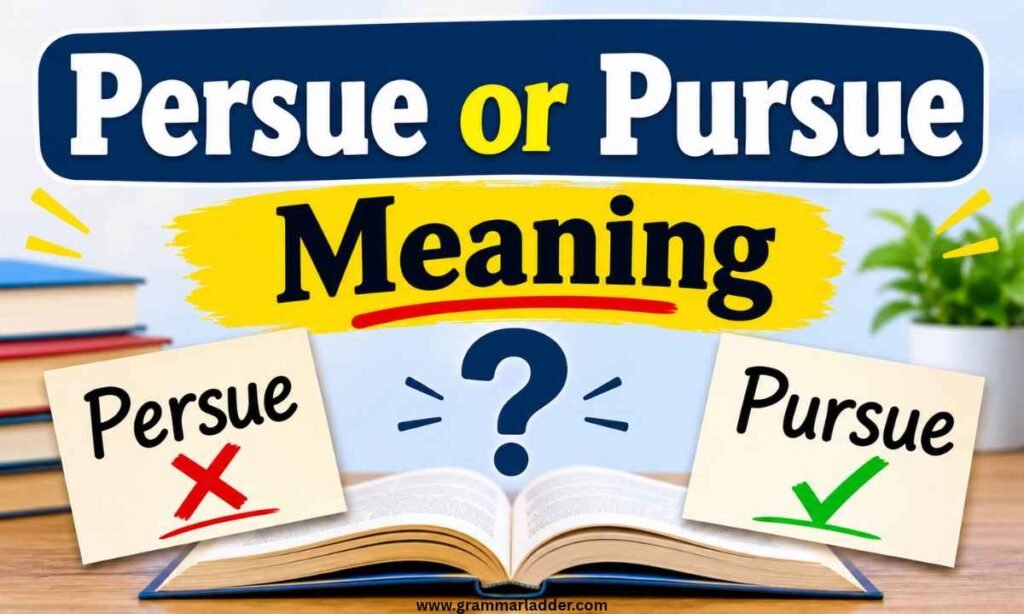
“Pursue” is a verb. It has a few related meanings:
- To chase or follow someone or something. The police pursued the car.
- To work toward a goal over time. He plans to pursue a master’s degree.
- To take part in an activity or profession. She pursues painting in her free time.
- To continue with a course of action. The company will pursue legal action.
“Persue” has no meaning of its own in modern English. It is simply a wrong spelling of the word above.
Where the Word Comes From
“Pursue” entered English from Anglo-French and Old French, and it traces back to the Latin word prosequi, meaning “to follow forward.” Over the centuries, older spellings such as “persue” faded out. Today, only “pursue” is standard.
Persue or Pursue in English
To use “pursue” well, it helps to see how it behaves in a sentence. It is a regular verb, so its forms are easy.
- Base form: pursue – I want to pursue my dreams.
- Third person: pursues – He pursues excellence.
- Past tense: pursued – They pursued the lead.
- Present participle: pursuing – She is pursuing a degree.
- Noun: pursuit – The pursuit of happiness.
- Person: pursuer – The pursuer was out of breath.
Example Sentences
- Many students pursue higher education abroad.
- You should pursue what you love.
- The detective pursued every clue.
- I am pursuing a certification in digital marketing.
- She pursues her goals with patience.
Wrong vs. Right
- ❌ I will persue this opportunity.
- ✅ I will pursue this opportunity.
- ❌ He is persuing a new job.
- ✅ He is pursuing a new job.
Persue or Pursue Difference
There is no real difference in meaning, because only one of them is a word. The “difference” is simply correct versus incorrect.
| Feature | Pursue | Persue |
| Correct in dictionaries | Yes | No |
| Part of speech | Verb | None (misspelling) |
| Acceptable in formal writing | Yes | No |
| Spelling pattern | p-u-r-s-u-e | p-e-r-s-u-e |
Why Do People Write “Persue”?
There are two main reasons:
- Sound. The first syllable sounds like “per,” so many people spell it that way.
- Look-alike words. “Persuade,” “persist,” and “person” all start with per. The brain follows the pattern.
In short, “pursue” breaks the pattern. That is why it trips people up.
Don’t Confuse It With “Persuade”
These two words look similar but mean different things.
| Word | Meaning | Example |
| Pursue | To chase or work toward | He will pursue a degree. |
| Persuade | To convince someone | She will persuade him to stay. |
Persue or Pursue Pronunciation
The word is pronounced /pərˈsuː/ (pur-SOO). In British English, some speakers say /pəˈsjuː/ (puh-SYOO). Both are correct.
- Stress: on the second syllable (pur-SUE).
- Rhymes with: sue, new, view, do.
- Syllables: two (pur-sue).
The first syllable sounds like “per.” That is exactly why the spelling confuses so many writers. You hear an e sound, but the letter is a u.
Persue or Pursue Synonym
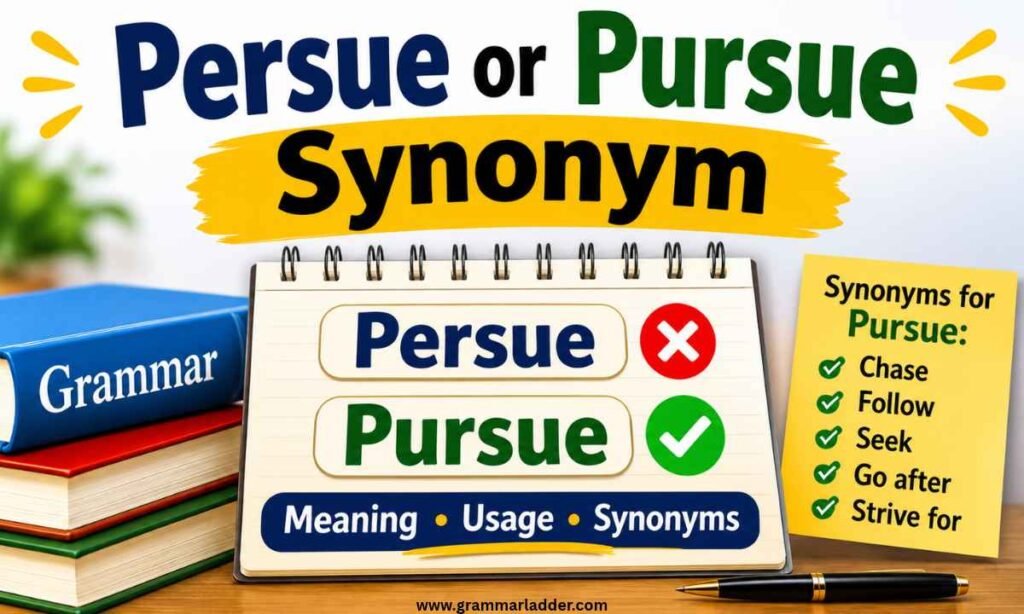
Want to avoid repeating the same word? These synonyms work well. Pick the one that fits your meaning.
| Meaning | Synonyms |
| To chase | follow, chase, hunt, track, trail, stalk |
| To work toward a goal | seek, strive for, go after, aim for, chase |
| To take up an activity | practise, engage in, follow, undertake |
| To continue | carry on, keep up, proceed with, persist in |
Examples:
- She will go after her dream job. (pursue)
- He strives for perfection. (pursues)
- They tracked the suspect across town. (pursued)
Easy Ways to Remember the Spelling
- Think “pursuit.” Nobody writes “persuit.” If the noun has a u, the verb does too.
- Spot the double U. Pursue has one u in each syllable.
- Say it slowly. Pronounce it as “pur-sue,” and picture the sue ending.
- Use a phrase. “I will pursue what is true.” The rhyme helps it stick.
- Write it ten times. Repetition builds muscle memory.
Why Spelling “Pursue” Correctly Matters Professionally
Spelling errors may look small, but readers notice them. In professional writing, they can change how people see you.
- Resumes and cover letters. A line like “I want to persue a role in finance” can hurt your chances. Recruiters often scan for errors first.
- Business emails. Typos can make a message look rushed or careless.
- Academic work. Teachers and journal editors expect accurate spelling.
- Websites and blogs. Mistakes lower trust. They can also affect how search engines judge content quality.
- Social media. Errors on public profiles reflect on your personal brand.
Accurate spelling signals care, credibility, and attention to detail. Those are qualities every reader values.
Common Mistakes Beyond “Persue”
“Pursue” is not the only word that causes trouble. Here are other frequent errors, especially in the same word family.
- Pursuing (not “persuing”)
- Pursued (not “persued”)
- Pursuit (not “persuit”)
- Pursuer (not “persuer”)
- Pursuance (not “persuance”)
- Pursue (not “persue”)
Here are a few other commonly misspelled words worth checking:
- Definitely (not “definately”)
- Separate (not “seperate”)
- Receive (not “recieve”)
- Occurrence (not “occurence”)
- Necessary (not “neccessary”)
Pro tip: Always proofread once more before you hit send. Reading your text aloud, or checking it against a trusted dictionary, catches many errors that spell-check tools can miss.
Frequently Asked Questions
Is it persue or pursue?
The correct spelling is pursue. “Persue” is a misspelling.
Is “persue” ever correct?
No. It is an obsolete spelling that modern dictionaries do not accept.
What does pursue mean?
It means to chase something, or to work toward a goal over time.
How do you spell pursuing?
The correct spelling is p-u-r-s-u-i-n-g. “Persuing” is wrong.
What is the noun form of pursue?
The noun is pursuit, as in “the pursuit of success.”
How do I remember the spelling of pursue?
Link it to “pursuit.” Both words have a u after the p.
Is “pursue” the same as “persuade”?
No. “Pursue” means to chase or seek, while “persuade” means to convince.
Can I use “pursue” in formal writing?
Yes. It works in formal and casual writing alike.
Conclusion
So, persue or pursue? The answer is clear: pursue is the only correct spelling. “Persue” is a leftover misspelling from older English, and it does not belong in modern writing.
Remember the key points:
- Spell it p-u-r-s-u-e, with a u in both syllables.
- Link it to pursuit to avoid mistakes.
- Don’t mix it up with persuade.
- Proofread important documents before sharing them.
Next time you write about chasing a goal, you can pursue it with confidence, and spell it right too.

I am an English writer with over four years of experience in grammar and language education.
Through Grammar Ladder, I share clear explanations, practical examples, and helpful English tips.
My goal is to share my knowledge so others can benefit and improve their language skills.
I believe anyone can master English with proper guidance and consistent practice.