You are writing a report, an email, or a science caption. You type “gas” in the plural and stop. Is it gases or gasses?
Both look right, which is why so many writers get stuck. This guide gives you the answer, the reason behind it, and the one case where “gasses” is correct.
Quick Answer
“Gases” is the correct plural of “gas” in both American and British English.
“Gasses” is correct only as a verb, as in “The machine gasses the room.” Some dictionaries also list it as a rare variant plural. For everyday writing, choose “gases.”
Gases or Gasses Meaning
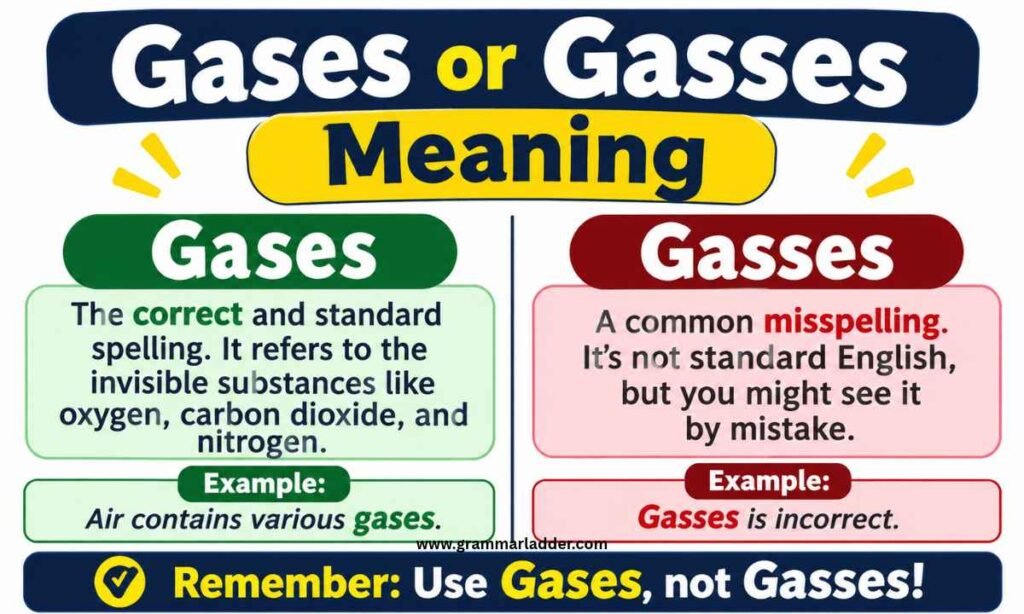
The two words share the same root but do different jobs.
- Gases (noun, plural): substances that are neither solid nor liquid. Carbon dioxide and methane are greenhouse gases.
- Gasses (verb, third-person singular): fills or poisons with gas. The pest control team gasses the warehouse monthly.
- Gasses (rare variant plural): same meaning as “gases,” but less standard. You will mostly find it in older or informal texts.
A gas is a state of matter with no fixed shape or volume. It expands to fill whatever container holds it. Air, oxygen, helium, and steam are all examples.
Which One Is Correct?
For the plural noun, gases is the standard spelling. Major dictionaries list it first, and style guides and science publishers use it.
“Gasses” is not completely wrong. Some dictionaries record it as a variant. But writers who choose it risk looking careless, and spellcheckers often flag it.
Quick rule:
- Talking about more than one gas? Use gases.
- Describing someone filling a space with gas? Use gasses.
Gases or Gasses in American English
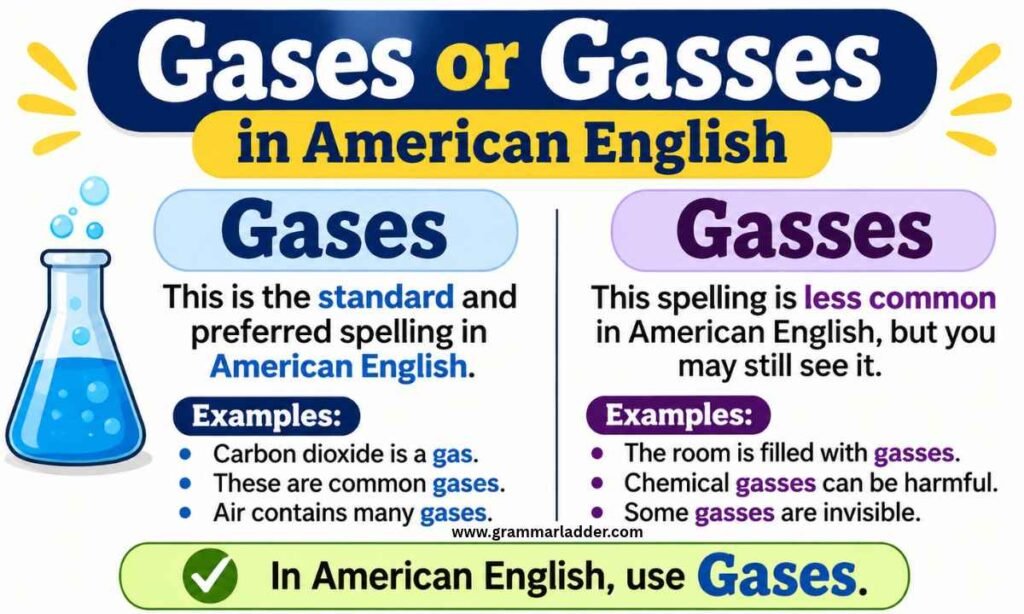
In American English, “gases” is the clear winner. Language-usage data shows that roughly nine in ten American writers use it. American dictionaries such as Merriam-Webster list “gases” as the main plural.
You will still see “gasses” in some American writing, usually in:
- Casual blog posts
- Older printed material
- Trade or welding contexts
Even there, “gases” is the safer choice.
Gasses or Gases in the Oxford Dictionary
Oxford dictionaries give gases as the plural noun. They treat gasses as the third-person singular verb form (he gasses, she gasses) and note it as an occasional variant plural.
British English follows the same pattern as American English. Some websites claim “gasses” is the British spelling, but dictionary and usage evidence does not support that. Writers in the UK, Australia and New Zealand overwhelmingly prefer “gases” too.
Grammar and Usage
Why “gases” has one S
English has a simple pluralization rule. For words ending in -s, -x, -z, -ch, or -sh, add -es.
- bus → buses
- box → boxes
- quiz → quizzes
- church → churches
- gas → gases
You add “-es” to the end of “gas.” You do not double the final “s” first.
Why “gasses” works as a verb
English often doubles a final consonant when adding an ending to a short word, as in run → running or stop → stopped. The verb “gas” follows that habit, so it becomes gasses, gassed and gassing.
Here is how the whole word family looks:
| Form | Spelling |
| Noun (singular) | gas |
| Noun (plural) | gases |
| Verb (base) | gas |
| Verb (third person) | gasses |
| Past tense | gassed |
| Present participle | gassing |
Gases or Gases Examples
Correct uses of “gases” (noun)
- Noble gases such as neon and argon rarely react with other elements.
- Factories release harmful gases into the air.
- Students learned how gases behave under pressure.
- The lab stores several flammable gases in sealed cylinders.
Correct uses of “gasses” (verb)
- The exterminator gasses the building to remove rodents.
- The fumigation crew gasses each container before shipping.
- He gasses up the truck before every long trip.
Notice the difference. In the first group, “gases” names things. In the second, “gasses” describes an action.
Common Mistakes
Even careful writers slip here. Watch for these errors.
- Using “gasses” as a plural noun. Greenhouse gasses trap heat should be greenhouse gases.
- Writing “gass” or “gasess.” Neither is a word.
- Mixing both spellings in one document. Pick one and stay consistent.
- Using “gases” as a verb. The device gases the room should be gasses.
- Trusting a source because it looks official. Always check against a dictionary.
Pro tip: Run a quick search-and-replace for “gasses” before you publish. Then check each hit to see whether it is a verb.
Linguistic Insight
The word “gas” is younger than most people think. The Flemish chemist Jan Baptist van Helmont coined it in the 1600s. He based it on the Greek word chaos, partly to describe the invisible vapors he observed in experiments.
When a word is new, its plural has no tradition to follow, so writers choose based on the patterns they know. That is why both “gases” and “gasses” appeared early on. Over time, dictionaries and publishers settled on “gases,” which matches the pattern of buses and boxes.
Some words still show the same split. Buses and busses are an example. Standardization in publishing favored the single-S form, and “gases” came out ahead as well.
Usage Tips
Use these quick checks to get it right every time.
- Test the sentence. If you can swap in “gas” with “is” or “are,” you need the noun. Use “gases.”
- Look for an action. If someone or something is filling a space with gas, use “gasses.”
- Match your audience. For academic, scientific, and professional writing, always use “gases.”
- Use the bus rule. If you spell the plural of “bus” as “buses,” spell the plural of “gas” as “gases.”
- Be consistent. Never switch between spellings inside one article, paper, or report.
- Check your style guide. APA, MLA, Chicago, and most journals use “gases.”
Memory trick: One S, one gas type. Double S, double action. The noun has a single S before the ending, and the verb doubles it.
Frequently Asked Questions
Is it “gases” or “gasses”?
“Gases” is the correct plural noun. “Gasses” is a verb or a rare variant.
Is “gasses” ever correct?
Yes, as a verb: “The crew gasses the hold.” It is not the standard plural noun.
What is the plural of gas?
The plural of gas is gases.
Is “greenhouse gases” or “greenhouse gasses” correct?
“Greenhouse gases” is the standard form in science, policy and news writing.
Is “gasses” British or American spelling?
Neither. “Gases” is preferred in both American and British English.
How do you spell the past tense of “gas”?
It is gassed, with a double S.
Why is “gases” spelled with one S?
English adds “-es” to words ending in “s,” as in buses and boxes. It does not double the S for noun plurals.
Can I use “gasses” in creative writing?
You can, but most readers will see it as a typo. Use it only for a deliberate stylistic effect.
Conclusion
The answer is simple. Use gases as the plural of “gas” in nearly every situation. Keep gasses for the verb, as in “he gasses the room.”
Both American and British English prefer “gases,” and dictionaries and style guides agree. If you remember the pattern from buses and boxes, you will not need to look it up again.

I am an English writer with over four years of experience in grammar and language education.
Through Grammar Ladder, I share clear explanations, practical examples, and helpful English tips.
My goal is to share my knowledge so others can benefit and improve their language skills.
I believe anyone can master English with proper guidance and consistent practice.