If you’ve ever paused mid-sentence wondering whether to type “realy” or “really,” you’re not alone. This is one of the most common spelling mix-ups in English, and it trips up native speakers and learners alike. The good news? The answer is simple, and by the end of this guide, you’ll never second-guess it again.
Realy or Really – Quick Answer
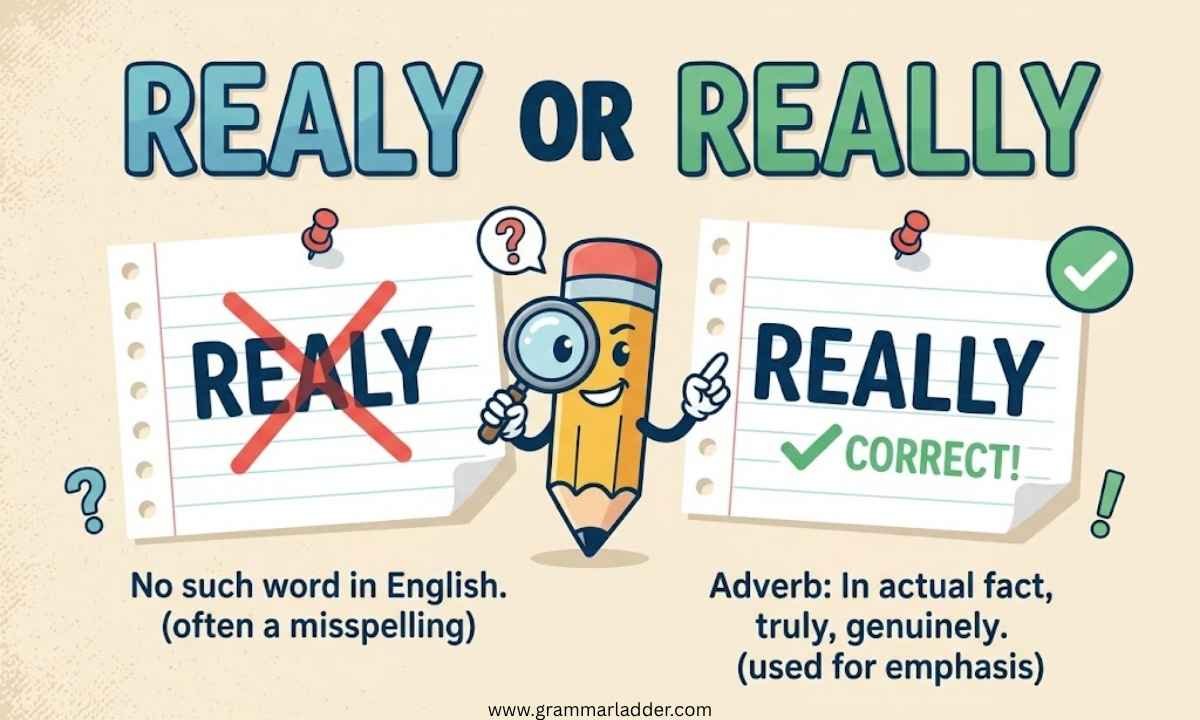
“Really” is correct. “Realy” is just a common misspelling — it drops one of the two L’s, often because of how the word sounds when spoken quickly.
| Quick Look | Realy | Really |
| Correct spelling? | ❌ No | ✅ Yes |
| Dictionary word? | No | Yes |
| Number of L’s | One | Two |
| Part of speech | Not applicable | Adverb |
| Safe to use in writing? | Never | Always |
What Is “Realy”?
“Realy” is not a word. It does not appear in Merriam-Webster, Oxford, Cambridge, or any other reputable English dictionary. It’s a misspelling of “really” that occurs because:
- The double “L” gets slurred together in casual speech
- Autocorrect sometimes fails to catch it
- Fast typing on mobile keyboards leads to dropped letters
If you see “realy” in a text, email, or social media post, it almost always means the writer intended to type “really” but missed a letter.
What Is “Really”?
“Really” is a standard English adverb that means “in reality,” “truly,” or “to a great extent.” It’s used to:
- Emphasize a statement (“I really need this done today”)
- Ask for confirmation (“Really? Are you sure?”)
- Intensify an adjective or verb (“She’s really talented”)
- Express surprise or disbelief (“Really, that’s unbelievable”)
It’s one of the most frequently used adverbs in everyday English, appearing in casual conversation, professional writing, journalism, and literature alike.
How to Pronounce “Realy” vs. How to Pronounce “Really”
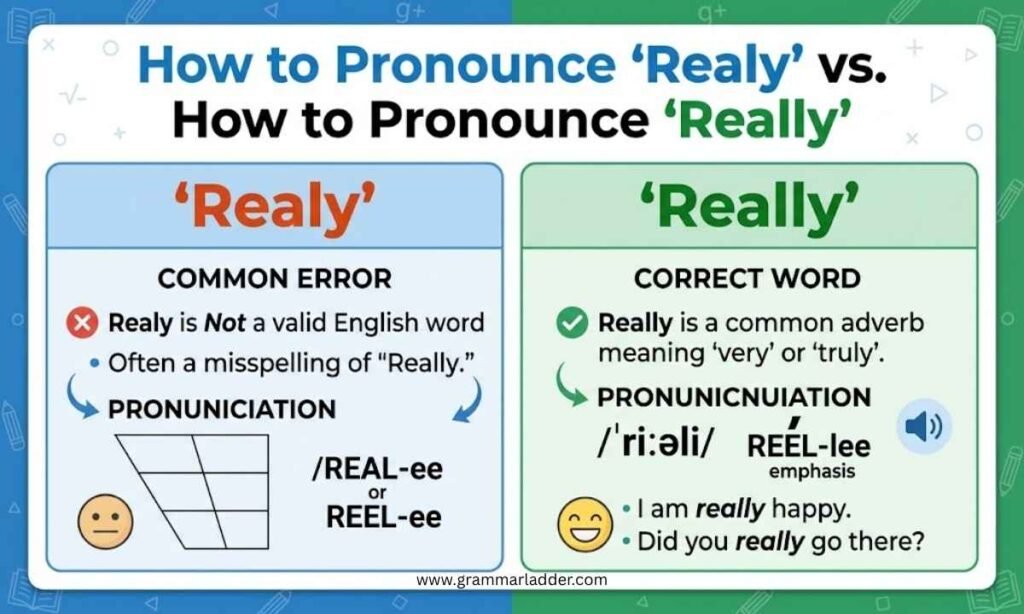
Since “realy” isn’t an actual word, it has no official pronunciation — people simply read it as if it were “really.” The correct word, “really,” does have two recognized pronunciation patterns depending on the dialect.
British English Pronunciation of Really
In British English, “really” is typically pronounced as /ˈrɪəli/ (REER-lee), with a softer, slightly rounded vowel sound at the start.
American English Pronunciation of Really
In American English, “really” is usually pronounced /ˈriːəli/ or informally /ˈrɪli/ (REE-lee), with a flatter, more clipped vowel sound.
Despite the pronunciation differences, the spelling remains identical — “really” — in both British and American English.
The Origin of “Really”
The word “really” comes from the adjective “real,” which traces back to the Late Latin word realis, meaning “actual” or “relating to things.” Over time, English speakers added the suffix “-ly” to convert the adjective “real” into the adverb “really.”
This is a standard pattern in English: many adverbs are formed by adding “-ly” to an adjective (quick → quickly, sad → sadly). Since “real” already ends in “l,” adding “-ly” naturally creates the double-L spelling: real + ly = really.
Understanding this word formation is the easiest way to see why “realy” is incorrect — dropping a letter breaks the standard adjective-to-adverb pattern.
British English vs. American English Spelling
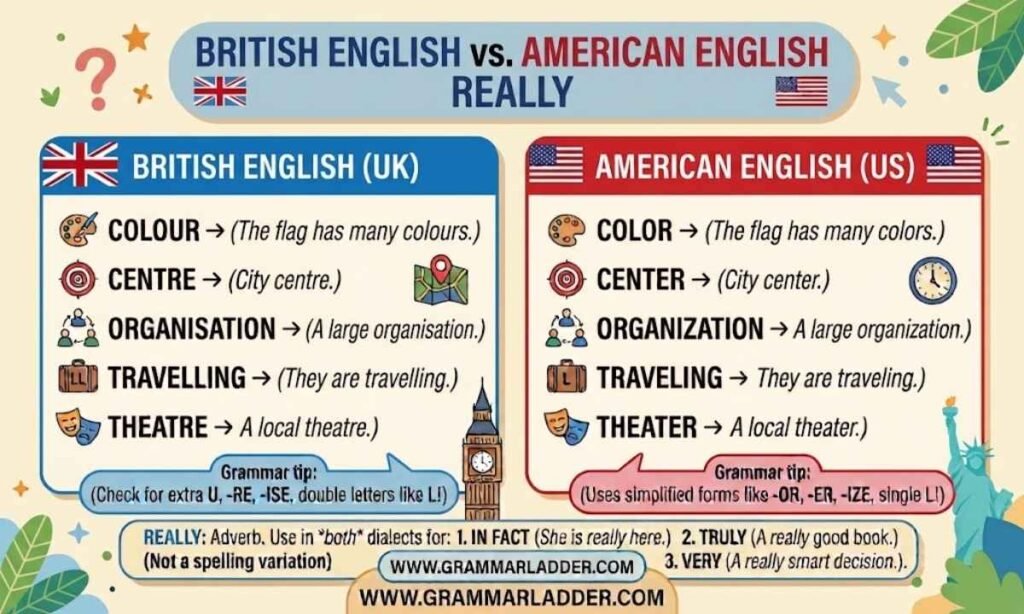
Unlike words such as “colour/color” or “organise/organize,” “really” doesn’t change between British and American English. Both spelling systems use the same form.
| Feature | British English | American English |
| Spelling | Really | Really |
| Pronunciation | /ˈrɪəli/ | /ˈriːəli/ or /ˈrɪli/ |
| Usage | Same | Same |
| Common in | Formal & casual writing | Formal & casual writing |
This consistency makes “really” one of the easier words to spell correctly once you know the rule — there’s no regional variation to worry about.
Which Spelling Should You Use?
Always use “really.” There is no context — formal, informal, academic, or conversational — where “realy” is acceptable. Whether you’re writing:
- A business email
- A social media caption
- A school essay
- A text message to a friend
“Really” is the only correct choice. If you’re ever unsure while typing quickly, slow down and check for the double L before hitting send.
Common Mistakes with “Really”
Even though “really” is a simple word, a few errors show up often:
- Realy – missing the second “L”
- Realley – extra unnecessary letters
- Realllly – informal stretching used for emphasis in texting (fine casually, not in formal writing)
- Really vs. Real – using “real” as an adverb (“I real like this”) instead of “really,” which is grammatically incorrect in standard English
Unscramble Realy or Really
If you’re solving a word puzzle or anagram game, the letters R-E-A-L-Y unscramble to a few short words like “early” (with rearrangement) or simply confirm the intended word “really” once the missing letter is added back in. In word games, always double-check the intended target word before submitting, since “realy” itself isn’t a valid dictionary entry.
Realy or Really Grammar

Grammatically, “really” functions as an adverb that modifies verbs, adjectives, or entire sentences. It can also act as an intensifier. “Realy” has no grammatical function since it isn’t a recognized word — it’s purely a spelling error.
Realy or Really Adverb
Yes, “really” is classified as an adverb of degree or an adverb of emphasis. It answers the question “to what extent?” — for example, “She is really happy” tells us the degree of her happiness.
Realy or Really Meaning
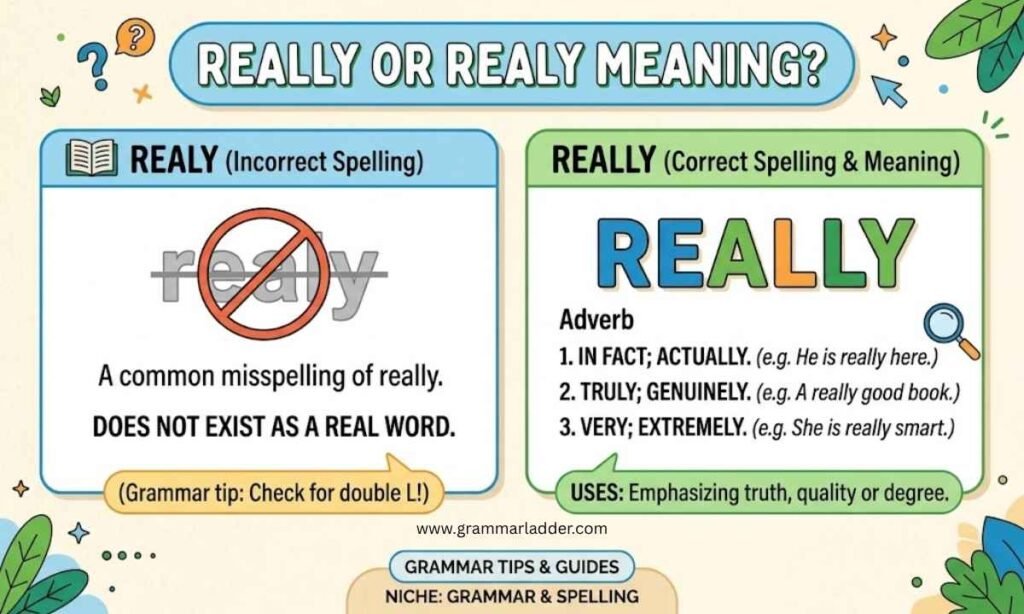
“Really” means “in truth,” “genuinely,” or “very.” For example, “I really appreciate your help” means “I genuinely appreciate your help.” There is no separate meaning for “realy” since it’s simply an incorrect spelling of the same word.
Why Do People Misspell “Really” as “Realy”?
There are a few clear reasons this mistake happens so often:
- Speech influence – In fast, casual speech, the double L often blends into a single sound, making it easy to forget when writing.
- Typing speed – On phones and keyboards, people frequently skip repeated letters when typing quickly.
- Visual similarity – “Realy” looks close enough to “really” at a glance that it slips past casual proofreading.
- Autocorrect gaps – Some keyboards and apps don’t always flag the error, especially in informal messaging apps.
How to Remember the Correct Spelling of “Really”
Here’s a simple trick: think of the word as two parts — “real” + “ly.”
- Start with the adjective real
- Add the suffix -ly
- Combine them: real + ly = really
Since “real” ends in one “L” and “-ly” begins with another, you naturally get two L’s together. If you remember the word’s building blocks, you’ll never misspell it again.
“Realy or Really”: Synonyms
Depending on context, you can substitute “really” with one of these words:
| Synonym | Example Sentence |
| Truly | “I truly enjoyed the movie.” |
| Genuinely | “She’s genuinely happy for you.” |
| Actually | “He actually finished the project early.” |
| Certainly | “This is certainly the best option.” |
| Indeed | “That was, indeed, a great performance.” |
| Very | “It’s a very good idea.” |
| Extremely | “The exam was extremely difficult.” |
For example: “I really enjoyed the movie” could become “I genuinely enjoyed the movie” or “I truly enjoyed the movie.”
“Really” in Everyday Examples
To see just how versatile “really” is, here’s how it naturally fits into different everyday writing styles — from casual chats to professional communication.
Emails
“I really appreciate you taking the time to review this proposal.”
News
“Officials say the new policy will really change how businesses operate.”
Social Media
“This sunset is really unreal #blessed”
Formal Writing
“The research really demonstrates a measurable improvement in patient outcomes.”
Across every context — professional, casual, or journalistic — the spelling stays the same: really.
Realy or Really – Google Trends & Usage Data
Search behavior shows that many people type “realy or really” or simply “realy” into search engines when they’re unsure of the spelling or when autocorrect doesn’t catch the mistake. This is a natural, common query pattern, similar to other frequently confused word pairs like “definately vs. definitely” or “seperate vs. separate.” The consistent search interest around this topic confirms it’s a widespread, everyday spelling question rather than a rare error.
Comparison Table: Realy vs. Really
| Aspect | Realy | Really |
| Correct spelling? | ❌ No | ✅ Yes |
| Found in dictionaries? | No | Yes |
| Part of speech | None (not a word) | Adverb |
| Common usage | Typo/error | Standard, widely used |
| Formal writing acceptable? | Never | Always |
| Origin | Misspelling | From “real” + “-ly” |
Frequently Asked Questions
Is “realy” ever correct?
No, “realy” is always a misspelling of “really” and has no valid use in standard English.
Why does “really” have two L’s?
Because it’s formed by adding the suffix “-ly” to the adjective “real,” which already ends in one L.
Is “really” formal or informal?
“Really” works in both formal and informal writing, though excessive use in academic writing is best avoided.
Can I use “real” instead of “really” as an adverb?
No, “real” is an adjective. Using it as an adverb (e.g., “real good”) is considered nonstandard or overly casual.
Does British English spell “really” differently?
No, the spelling “really” is identical in both British and American English.
What part of speech is “really”?
“Really” is an adverb, often used to add emphasis or confirm truth.
Conclusion
The confusion between “realy” and “really” comes down to a simple, common typing slip — not an actual spelling debate. “Really” is the only correct form, built from the adjective “real” plus the suffix “-ly.” Whether you’re writing a text message, a formal report, or a social media post, remembering this simple word-formation trick will help you spell it correctly every time. Next time your fingers move fast and you’re tempted to drop a letter, pause for a second and remember: real + ly = really.

I am an English writer with over four years of experience in grammar and language education.
Through Grammar Ladder, I share clear explanations, practical examples, and helpful English tips.
My goal is to share my knowledge so others can benefit and improve their language skills.
I believe anyone can master English with proper guidance and consistent practice.