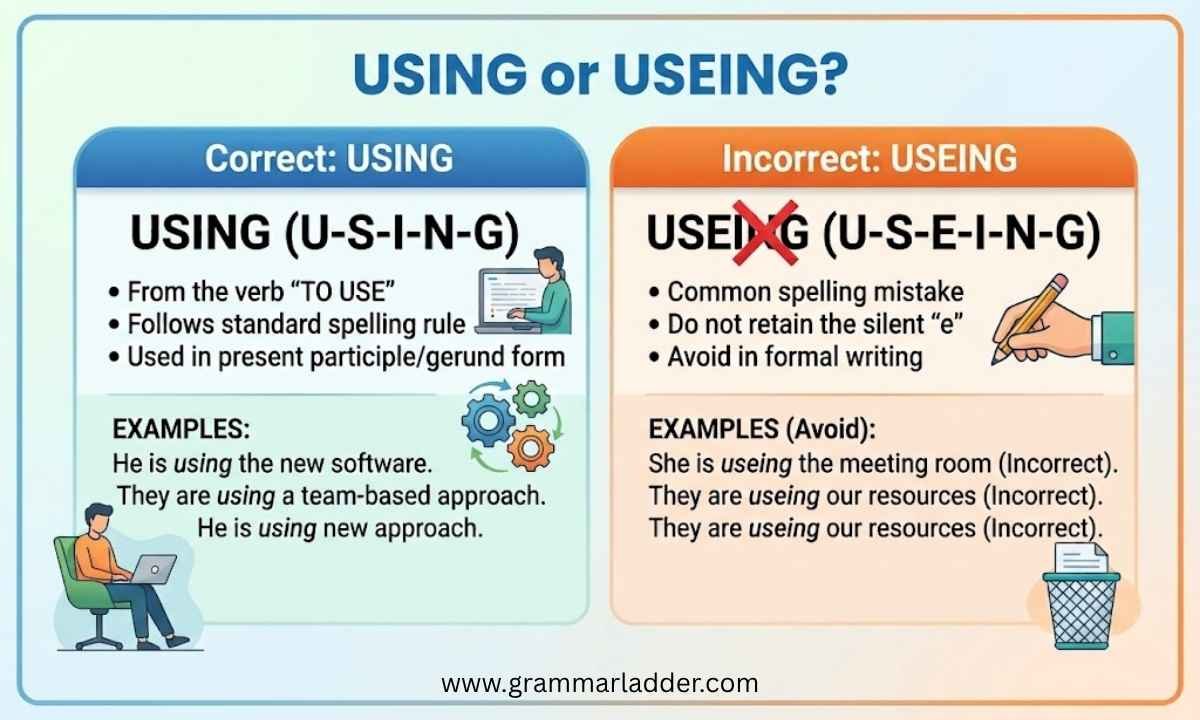
Have you ever typed “useing” and paused? You’re not alone. Many people make this small mistake without noticing. It happens because English spelling rules aren’t always easy to guess.
The good news is the answer is simple. “Using” is the only correct spelling. “Useing” is just a common typo. Once you learn the rule, you’ll never mix them up again
Useing
“Useing” is not a correct English word. It looks like a natural way to add “-ing” to “use,” but it breaks a basic spelling rule: when a word ends in a silent “e,” you drop that “e” before adding a vowel suffix like “-ing.” So “useing” is simply a misspelling, no matter which dialect of English you’re writing in — British, American, Canadian, or Australian.
Using
“Using” is the correct spelling. It’s the present participle/gerund form of the verb “use,” formed by dropping the silent “e” and adding “-ing.” You’ll see it everywhere: “using a computer,” “using your imagination,” “she is using the new app.”
Useing / Using – Quick Answer
- Correct spelling: using
- Incorrect spelling: useing
- Root word: use
- Rule applied: Drop the silent “e” before adding “-ing”
- Regional variation: None — “using” is standard everywhere
If you remember nothing else from this article, remember this: it’s always “using,” never “useing.”
Using or Useing: Why the Confusion?
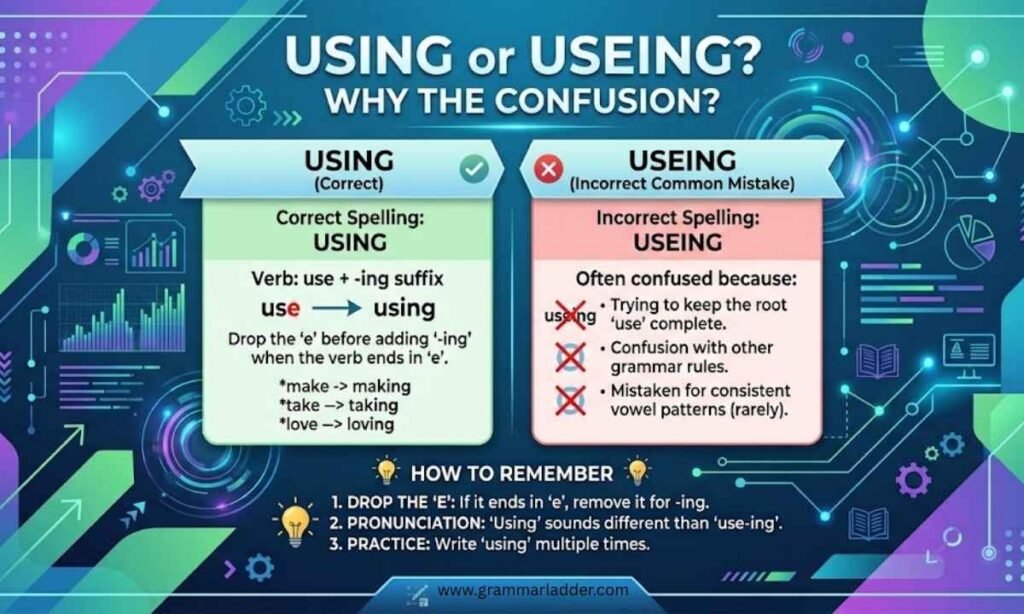
The confusion usually comes from three places:
- Doubling instinct — English learners often expect consonants or letters to carry over when a suffix is added (like “run” → “running”), and mistakenly assume the same logic applies to the silent “e” in “use.”
- Phonetic spelling — “Useing” looks like it should be pronounced the same way as “using,” so some writers spell it the way it “feels” it should look.
- Autocorrect gaps — Some fast typers or non-native speakers type quickly and don’t notice the extra “e” before hitting send, and not every keyboard or app catches it.
None of these reasons make “useing” acceptable — it’s flagged as an error by every major dictionary, spell-checker, and style guide.
Examples
- ✅ She is using her laptop to write the report.
- ❌ She is useing her laptop to write the report.
- ✅ We were using the old method before switching.
- ❌ We were useing the old method before switching.
Using or Useing Spelling
The spelling rule behind this is one of the most consistent in English:
Silent-e drop rule: If a verb ends in a silent “e,” drop the “e” before adding a suffix that begins with a vowel (like “-ing,” “-ed,” or “-able”).
Applying it to “use”:
- use → us + ing → using
- use → us + ed → used
- use → us + able → usable
Compare this to other common verbs that follow the same pattern:
- make → making (not “makeing”)
- write → writing (not “writeing”)
- love → loving (not “loveing”)
“Using” fits this exact pattern, which is why “useing” is always wrong.
The Origin of Using
The verb “use” comes from the Old French “user,” which traces back to the Latin “ūsus,” the past participle of “ūtī,” meaning “to use” or “to make use of.” As the word entered Middle English, it kept its silent final “e,” a common feature of English spelling carried over from French and Latin-influenced vocabulary. When English grammar rules for verb conjugation solidified, the silent-e-drop convention became standard for forming the “-ing” (present participle) and “-ed” (past tense) forms — which is how we ended up with “using” and “used” rather than “useing” and “useed.”
Useing or Using Exercises Crossword
Want to lock in the spelling? Try this quick mini-exercise. Fill in the blanks with the correct form of “use,” then check your answers below.
- I am _______ a new phone this year.
- They were _______ the wrong tool for the job.
- Stop _______ that broken charger.
- He enjoys _______ his free time to read.
- We are _______ renewable energy at home.
Answers: 1. using 2. using 3. using 4. using 5. using
Every blank takes the same spelling — “using” — which is a good way to drill the pattern into memory. You can turn this into a simple crossword by placing “USING” as the answer word across multiple clues built from sentences like the ones above.
Useing or Using Meaning

Since “useing” isn’t a real word, it has no independent meaning of its own — it’s simply an incorrect way of writing “using.” The correct word, “using,” means:
- Employing something for a purpose (e.g., “using a hammer to build a shelf”)
- Consuming or utilizing a resource (e.g., “using electricity”)
- Taking advantage of an opportunity or skill (e.g., “using her experience to solve the problem”)
British English vs American English Spelling
Good news here: there’s no split between British and American English on this one. Unlike words such as “colour/color” or “organise/organize,” the spelling of “using” doesn’t change across dialects. Both British and American style guides — including Oxford and Merriam-Webster — agree that “using” is correct and “useing” is a spelling error.
Which Spelling Should You Use?
Always use “using.” There is no context — formal writing, casual texting, academic papers, business emails — where “useing” is acceptable. If you’re ever unsure, just remember the rule: drop the silent “e,” then add “-ing.”
Common Mistakes with Useing / Using
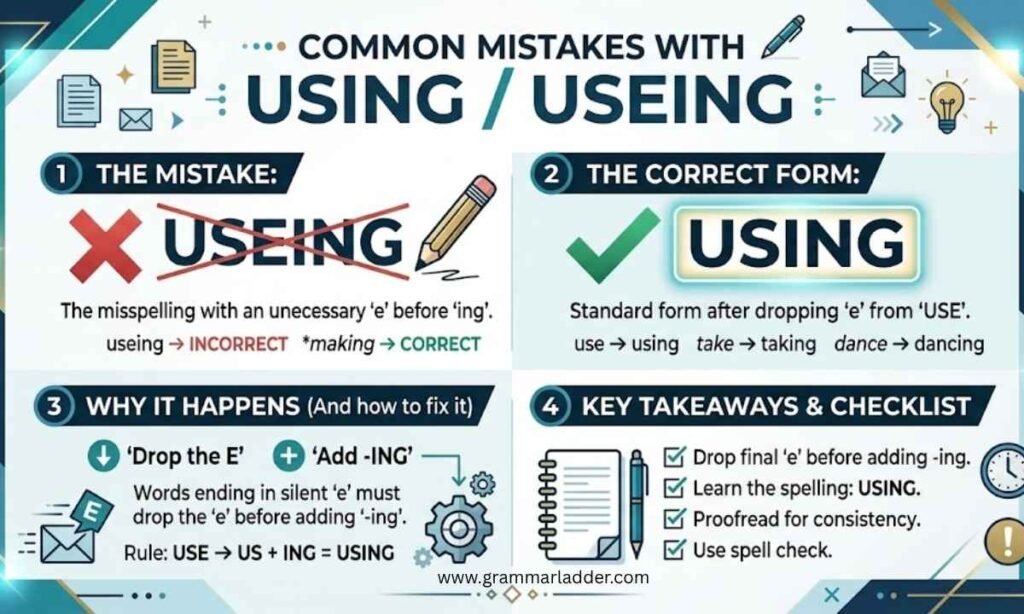
- Writing “useing” out of habit or typing speed
- Confusing the silent-e rule with words that double their final consonant (like “running” or “stopping”)
- Assuming regional spelling differences apply here (they don’t)
- Auto-correct not catching the error in fast, informal typing (texts, chats, social media)
Using in a Sentence
- I’ve been using this app for three months now.
- Are you using the printer right now?
- She’s using her savings to start a small business.
- We recommend using a strong password for your accounts.
- By using renewable resources, the company cut its carbon footprint.
Techniques to Remember the Correct Spelling
- The “drop the e” trick: Say the root word out loud — “use” — and physically cross out the final “e” before writing “-ing.”
- Pattern matching: Think of other silent-e verbs you already spell correctly, like “make → making” or “write → writing,” and apply the same logic to “use → using.”
- Visual repetition: Write out “using” a few times in a row until the correct pattern feels automatic.
- Spell-check habit: Let your spell-checker catch it once, then consciously note the correction so you internalize it.
Using in Everyday Examples
- Technology: “I’m using a new note-taking app.”
- Cooking: “She’s using olive oil instead of butter.”
- Work: “We are using a new project management tool this quarter.”
- Travel: “They’re using public transport to get around the city.”
- Fitness: “He’s using resistance bands for his workout.”
Useing / Using – Google Trends & Usage Data
Search and usage data consistently show “using” as the overwhelmingly dominant search term, while “useing” appears mainly as a misspelling search — people typing it by mistake and then searching to confirm the correct form, or looking up “useing or using” precisely because they’re unsure. This pattern is common with silent-e verbs; misspelled variants generate a steady trickle of search volume, but they never come close to overtaking the correct spelling in everyday or published use.
Comparison Table: Useing vs Using
| Feature | Using | Useing |
| Correct spelling | ✅ Yes | ❌ No |
| Found in dictionaries | ✅ Yes | ❌ No |
| Follows silent-e rule | ✅ Yes | ❌ No |
| Accepted in formal writing | ✅ Yes | ❌ No |
| Common typo | — | ✅ Yes |
| Regional variation (US/UK) | None | None |
Frequently Asked Questions
Is “useing” ever correct?
No. It’s a misspelling in all contexts and all English dialects.
Why do we drop the “e” in “using” but not in some other words?
The silent-e-drop rule applies specifically when adding a suffix that starts with a vowel (like “-ing” or “-ed”) to a word ending in a silent “e.” Suffixes starting with a consonant (like “-ly” or “-ment”) usually keep the “e.”
Is this a British vs. American spelling difference?
No. Both dialects use “using” exclusively.
What’s the noun form related to “using”?
“Use” itself can function as a noun (“the use of this tool”), and “usage” is a related noun describing how something is used or the frequency of use.
How can I stop making this mistake?
Practice the silent-e rule with a few example verbs, use spell-check consistently, and read your sentences back before sending or submitting them.
Conclusion
The debate between “useing” and “using” isn’t really a debate at all — “using” is the only correct spelling, in every English-speaking region and every writing context. The confusion comes from a natural but incorrect instinct to keep the silent “e” before adding “-ing.” Once you internalize the simple rule — drop the “e,” add “-ing” — you’ll never second-guess this spelling again.

I am an English writer with over four years of experience in grammar and language education.
Through Grammar Ladder, I share clear explanations, practical examples, and helpful English tips.
My goal is to share my knowledge so others can benefit and improve their language skills.
I believe anyone can master English with proper guidance and consistent practice.