You are typing a job offer, a payroll policy, or a company report. Then you stop. Is it renumeration or remuneration? The two look almost identical, and one small slip can make a professional document look careless.
The good news is that the answer is simple. In this guide, you will learn which spelling is correct, what the word means, why the mistake is so common, and how to use it with confidence in business and everyday writing.
Quick Answer
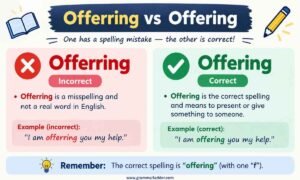
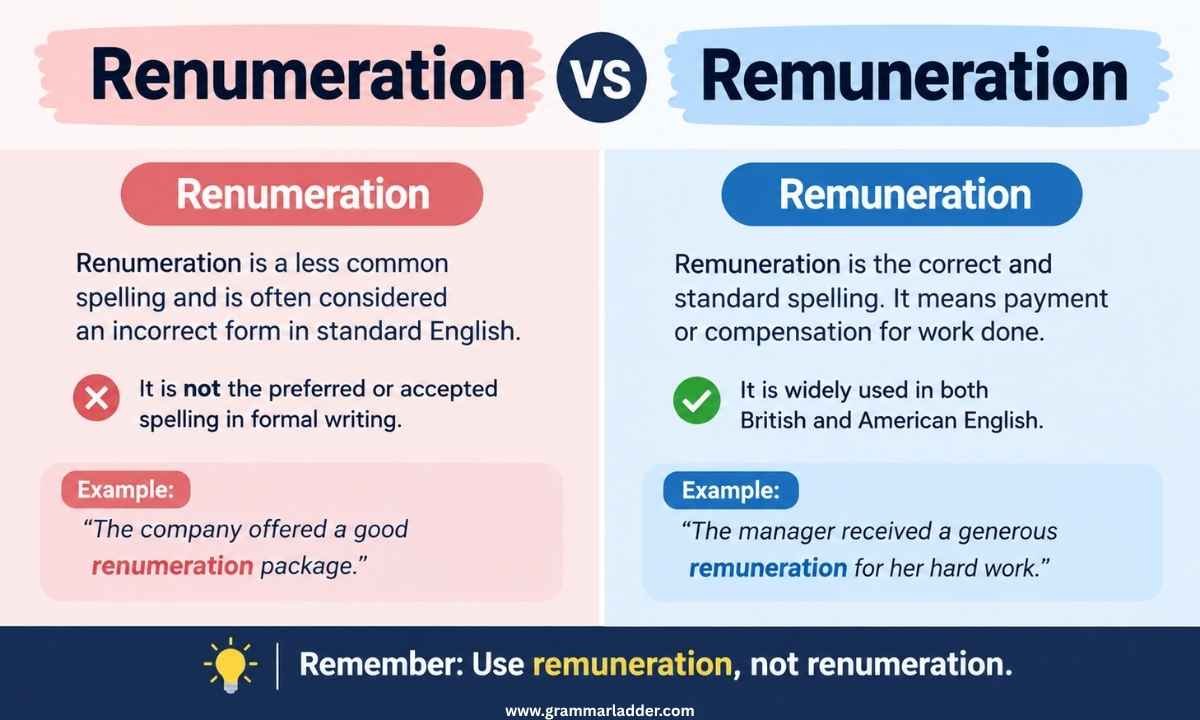
“Remuneration” is the correct spelling. “Renumeration” is a common misspelling and is not a standard English word. Remuneration means payment for work or services, including salary, bonuses, and benefits.
- Correct: remuneration
- Incorrect: renumeration
- Part of speech: noun
- Related verb: remunerate
- Pronunciation: rih-MYOO-nuh-RAY-shun
What Does “Remuneration” Mean?
Remuneration is the total payment a person receives in return for their work, services, or time. It is a formal word, so you’ll most often see it in contracts, HR documents, annual reports, and legal text.
Many people think it only means a paycheck. In reality, it covers much more. Remuneration can include:
- Base salary or hourly wages
- Bonuses and incentive pay
- Commissions
- Overtime pay
- Allowances (housing, travel, meals)
- Pension or retirement contributions
- Health insurance and other benefits
- Stock options or share awards
The word comes from the Latin remunerari, meaning “to reward” or “to repay.” That root is built from re- (back) and munus (a gift or service). At its core, remuneration is something given in return for work done.
Example: “The remuneration package includes a base salary, an annual bonus and private medical cover.”
What About “Renumeration”?
Renumeration is not listed as a correct word in major dictionaries such as Merriam-Webster, Oxford, or Cambridge. When it appears, it is almost always a typing or spelling error.
It has no separate meaning. If someone writes “renumeration,” they nearly always mean “remuneration.” Spell checkers will usually flag it, and editors will correct it.
There is one small catch. A related word, “renumber,” does exist and means to assign new numbers to something. You might renumber pages in a report or renumber invoices. But “renumeration” is not the noun form of that verb.
Renumeration vs Remuneration: Key Differences
Since only one of these is a real word, the “difference” is really about correct versus incorrect usage. This table makes it clear at a glance.
| Feature | Remuneration | Renumeration |
| Is it correct? | Yes | No |
| Found in dictionaries? | Yes | No |
| Meaning | Payment for work or services | None (a misspelling) |
| Word root | Latin remunerari (to reward) | No valid root |
| Verb form | Remunerate | None |
| Adjective form | Remunerative | None |
| Safe for formal writing? | Yes | No |
Key takeaway: Always choose “remuneration.” If you see “renumeration,” treat it as an error and fix it.
Why Do People Misspell Remuneration as Renumeration?
This error is not a sign of poor English. It happens for understandable reasons.
1. The word looks like “number”
The middle of remuneration, “-numer-,” looks like the root of “number,” “numeral,” and “enumeration.” Your brain may assume the word is about counting or numbers, so it swaps in an “n” where an “m” belongs.
2. The “re-” prefix feels familiar
English has many words that begin with “re-,” such as renew, repay, and renumber. Because “renumeration” starts like these, it looks natural even though it is wrong.
3. The sounds are close
The “m” and “n” sounds are both nasal. In fast speech, the opening syllables of remuneration can blur, so people write what they think they heard.
4. It is a low-frequency word
Most people do not write “remuneration” every day. Words we use rarely are easier to misspell because we have fewer chances to see the correct form.
Common Mistakes to Avoid
Here are the errors writers make most often with this word:
- Writing “renumeration” instead of “remuneration.”
- Writing “remuniration” or “remuneretion,” with the wrong vowels in the middle or end.
- Using it as a verb. “Remuneration” is a noun. The verb is “remunerate.”
- Treating it as the same as salary. Salary is only one part of remuneration.
- Using it in casual chat. The word is formal, so “pay” or “wages” often sounds more natural in everyday conversation.
- Confusing it with “renumber.” One is about pay, the other is about changing numbers.
How to Use “Remuneration” Correctly?
Use “remuneration” when you are talking about payment in a formal or professional setting. Here are a few simple patterns.
As a noun (most common):
- “Her remuneration is reviewed every year.”
- “The board approved the executive remuneration policy.”
With common word partners (collocations):
- remuneration package
- remuneration committee
- fair remuneration
- total remuneration
- remuneration report
- performance-related remuneration
As a verb (remunerate):
- “Volunteers were not remunerated for their time.”
As an adjective (remunerative):
- “Consulting turned out to be a remunerative career.”
A useful rule: if the sentence is about being paid or rewarded for work, and the tone is formal, “remuneration” fits.
Renumeration or Remuneration Synonym
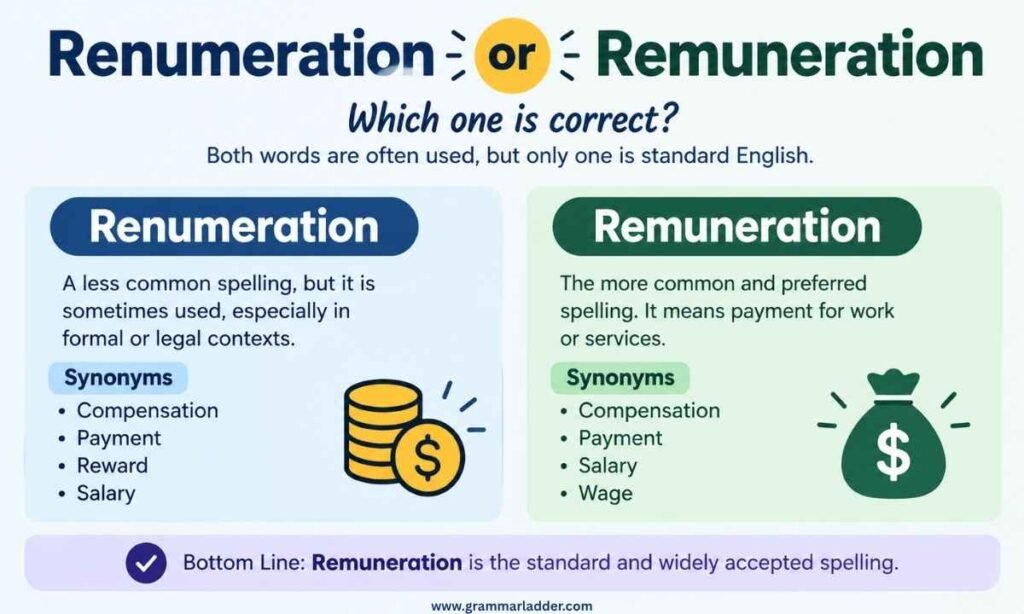
Looking for a simpler or alternative word? Since “renumeration” is not a real word, the synonyms below all belong to remuneration.
| Synonym | Best used when | Formality |
| Pay | Everyday, general talk | Casual |
| Wages | Hourly or weekly workers | Neutral |
| Salary | Fixed monthly or yearly income | Neutral |
| Compensation | Total rewards, common in the US | Formal |
| Earnings | Money received overall | Neutral |
| Payment | A single transaction | Neutral |
| Emolument | Legal or very formal documents | Very formal |
| Reward | Recognition for effort | Neutral |
| Fee | Payment for a professional service | Neutral |
Tip: In job ads and HR emails, “compensation” or “pay” often reads better. In legal, financial, and board-level writing, “remuneration” is the standard choice.
Remuneration vs Salary
These two words are often mixed up, but they are not the same thing. Salary is a part of remuneration, while remuneration is the whole package.
| Point | Remuneration | Salary |
| Scope | Total payment and benefits | Fixed base pay only |
| Includes bonuses? | Yes | No |
| Includes benefits? | Yes | No |
| Payment pattern | Varies | Regular (monthly or yearly) |
| Typical use | Contracts, reports, policies | Job offers, payslips |
A simple example: Imagine an employee earns a salary of 60,000 per year. She also gets a 5,000 bonus, a car allowance and employer pension contributions. Her salary is 60,000, but her remuneration is the full value of everything she receives.
This is why employers usually talk about a “total remuneration package” when they want candidates to see the full picture and not just the base number.
Renumeration vs Remuneration Example
Seeing the word in context is the fastest way to learn it. Compare the incorrect and correct versions below.
- Incorrect: The renumeration for this role is competitive.
- Correct: The remuneration for this role is competitive.
- Incorrect: Staff renumeration will be reviewed in April.
- Correct: Staff remuneration will be reviewed in April.
- Incorrect: He asked about the renumeration package.
- Correct: He asked about the remuneration package.
- Incorrect: Fair renumeration is a basic worker right.
- Correct: Fair remuneration is a basic worker right.
More correct examples in different settings:
- Job offer: “Your annual remuneration will include a base salary and a performance bonus.”
- Company report: “Directors’ remuneration rose by 4% compared with last year.”
- Freelance contract: “The contractor’s remuneration will be paid within 30 days of invoice.”
- News: “Unions called for higher remuneration for nurses.”
Renumeration or Remuneration UK
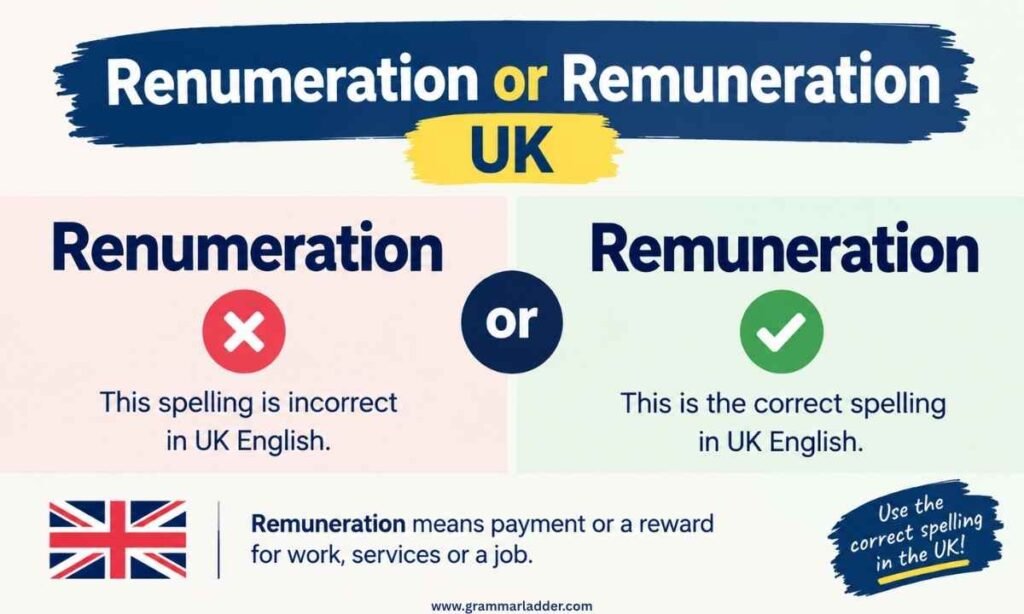
There is no spelling difference between British and American English for this word. “Remuneration” is correct in both. “Renumeration” is wrong in the UK, the US, Canada, Australia, and everywhere else.
The difference is in how often the word is used. In the UK, “remuneration” appears frequently in business and governance writing. For example:
- Remuneration committee: a board group that sets executive pay. This is a standard feature of UK corporate governance.
- Directors’ remuneration report: UK-quoted companies publish this report as part of their annual reporting.
- Remuneration policy: a formal document explaining how a company decides pay.
In the US, many writers prefer “compensation” in the same contexts, such as “executive compensation.” Both terms are understood, but the spelling of remuneration never changes.
Memory Trick to Remember the Difference
Use any of these quick tricks to lock in the right spelling.
- Think “M for Money.” Remuneration starts with re- followed by m. Money, Make, Measure: the “m” is your payment cue.
- Spot the “mune.” Say it as re-MUNE-ration. The syllable “mune” is the heart of the word, and it comes from munus, the Latin word for a gift or service.
- Link it to “reward.” Remuneration means a reward for work. Both start with “re.”
- Break it into chunks. re – mu – ne – ra – tion. Writing it in five parts helps your memory.
- Remember “number” is not the clue. The word has nothing to do with numbers, so do not let the “n” tempt you to move forward in the spelling.
Frequently Asked Questions
Is it renumeration or remuneration?
The correct spelling is “remuneration.” “Renumeration” is a common misspelling that does not appear in standard dictionaries.
What does remuneration mean in simple words?
Remuneration means the payment and benefits you receive for doing work. It covers salary, bonuses, allowances, and other rewards.
Is renumeration a real word?
No, it is not recognised as a real English word. It is almost always a typo for “remuneration.”
What is the difference between remuneration and salary?
Salary is your fixed base pay. Remuneration is the full package, including salary, bonuses, and benefits.
How do you pronounce remuneration?
Say it as rih-MYOO-nuh-RAY-shun, with the main stress on the second syllable.
Is remuneration a verb or a noun?
Remuneration is a noun. The verb is “remunerate,” and the adjective is “remunerative.”
Is the spelling different in British and American English?
No. Both use “remuneration.” The word is spelled the same everywhere.
Can I use remuneration in an email or CV?
Yes, in formal emails and job-related documents it works well. For casual messages, “pay” or “salary” may sound friendlier.
Conclusion
So, renumeration vs remuneration: only one of them is correct. “Remuneration” is the right spelling, and “renumeration” is simply a misspelling caused by the word’s resemblance to “number” and other “re-” words.
Remember three things. First, remuneration means the total pay and benefits for work, not just salary. Second, it is spelled the same in UK and US English. Third, a quick memory trick, such as linking the “m” to money or breaking the word into five chunks, will keep you from slipping.
Use “remuneration” in contracts, reports, and professional emails, and switch to a simpler synonym like “pay” when you want a friendlier tone. With a little practice, you will never second-guess this spelling again.

I am an English writer with over four years of experience in grammar and language education.
Through Grammar Ladder, I share clear explanations, practical examples, and helpful English tips.
My goal is to share my knowledge so others can benefit and improve their language skills.
I believe anyone can master English with proper guidance and consistent practice.