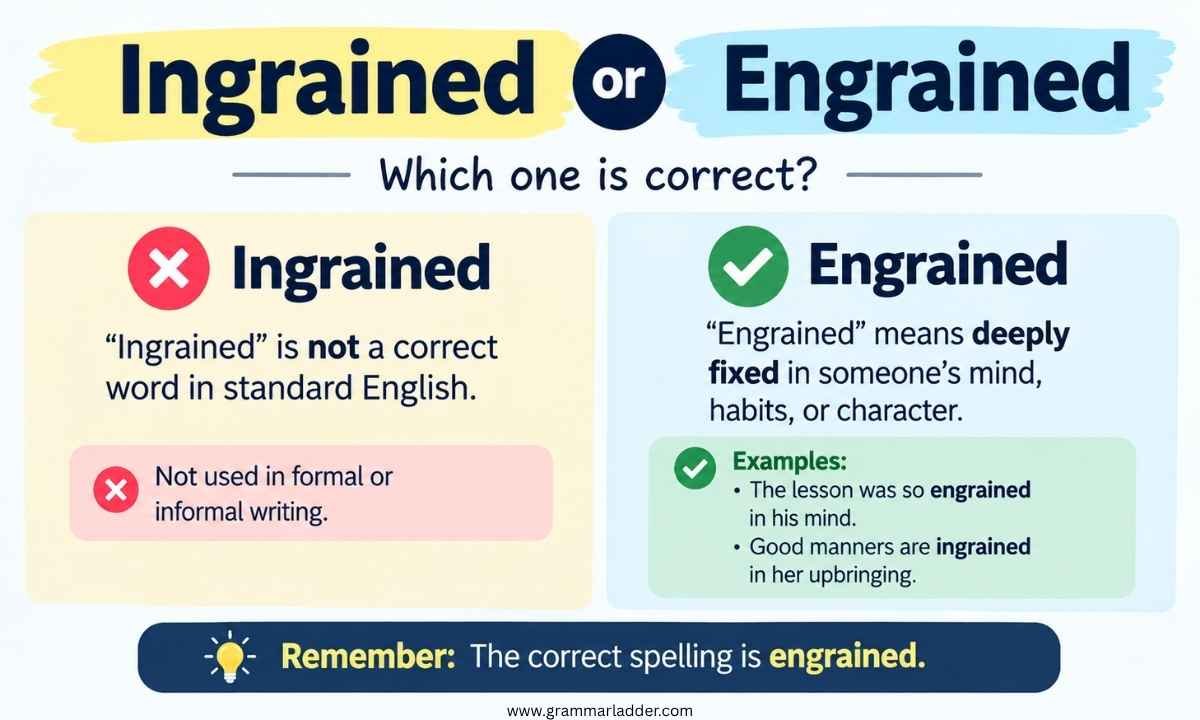
You’re typing a sentence about a habit that’s hard to break, and you stop. Is it engrained or ingrained?
Short answer: ingrained is the standard spelling. Engrained is a recognized variant, but it’s much rarer and often gets flagged as a typo.
This guide covers the meaning, origin, and real usage of both words. You’ll also get examples, common mistakes, and a quick reference table so you never second-guess yourself again.
The Core Difference Between Ingrained and Engrained
Both words mean the same thing. They have the same meaning; only the spelling and popularity differ.
- Ingrained: the preferred spelling in dictionaries, style guides, and everyday writing.
- Engrained: an accepted but uncommon variant.
If you want the safe choice for essays, emails, reports, or web content, use ingrained.
What “Ingrained” Actually Means
Ingrained is an adjective. It describes something firmly fixed, deeply rooted, or hard to remove. It applies to habits, beliefs, attitudes, and even physical stains.
Two senses are common:
- Figurative: a deeply established belief or habit (“an ingrained fear of failure”).
- Literal: something worked deep into a material (“ingrained dirt on his hands”).
The figurative sense is far more common today. You’ll see it in conversations about culture, behavior, and personality.
Real-World Uses of “Ingrained”
The word shows up in many settings. Here is how it behaves in each.
Everyday Speech
People use it casually for habits and traditions.
- “Saying thank you is ingrained in her.”
- “Early rising is ingrained in our family.”
Professional Writing
In business writing, it often describes culture or processes.
- “Safety awareness must be ingrained in every team member.”
- “Ingrained workflows can slow down change.”
Academic and Scientific Work
Researchers use it for deeply rooted patterns in societies, systems, or materials.
- “Ingrained social norms shape how communities respond to reform.”
- “Ingrained bias in historical data affects model outcomes.”
Psychology and Behavioral Science
Here it describes habits, conditioned responses, and thinking patterns.
- “Ingrained thought patterns can take months to reshape.”
- “Repetition makes a behavior ingrained over time.”
Engrained or Ingrained Meaning
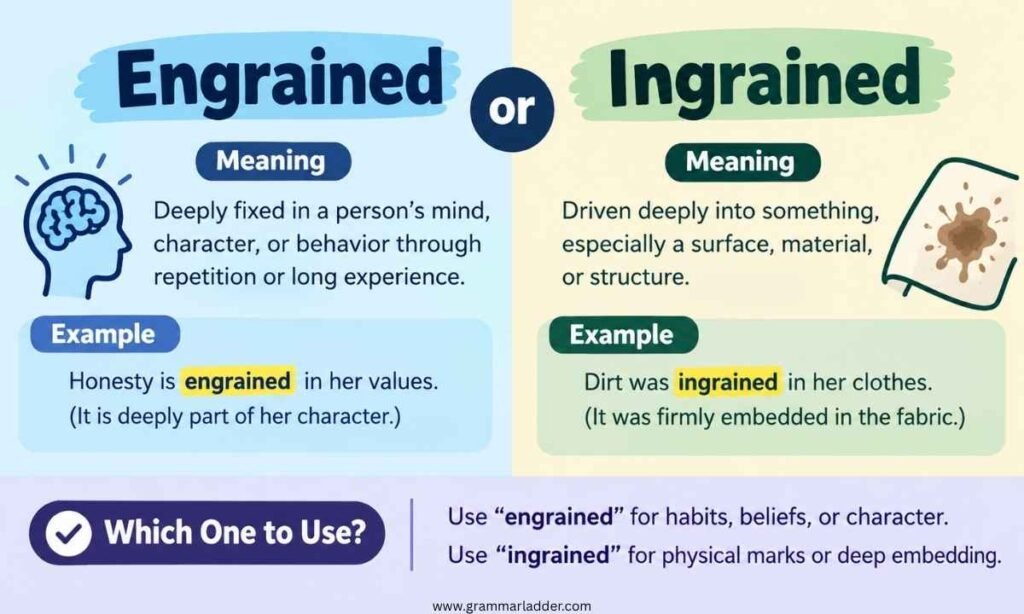
Both spellings mean “firmly established or deeply fixed.” The dictionary definition centers on something that has become part of a person’s nature or a material’s texture.
Think of a wood-grain stain that won’t sand out. Now think of a belief you’ve held since childhood. Both are ingrained.
Engrained or Ingrained Synonym
Looking for alternatives? These words fit different contexts.
| Context | Synonyms |
| Habits | habitual, established, entrenched |
| Beliefs | deep-seated, deep-rooted, firmly held |
| Personality | inherent, innate, inborn |
| Stains or dirt | embedded, set-in, worked-in |
| Culture | institutionalized, systemic, pervasive |
Pick the one that matches your tone. “Deep-seated” sounds formal, while “set-in” sounds practical.
Engrained or Ingrained UK
Is the spelling different in British English? Not really. Both the UK and the US prefer ingrained. British dictionaries list engrained as a variant, but it isn’t a regional spelling like colour and colour.
So there’s no UK-versus-US rule to memorize. Choose ingrained, and you’re correct on both sides of the Atlantic.
Engrained or Ingrained in My Brain
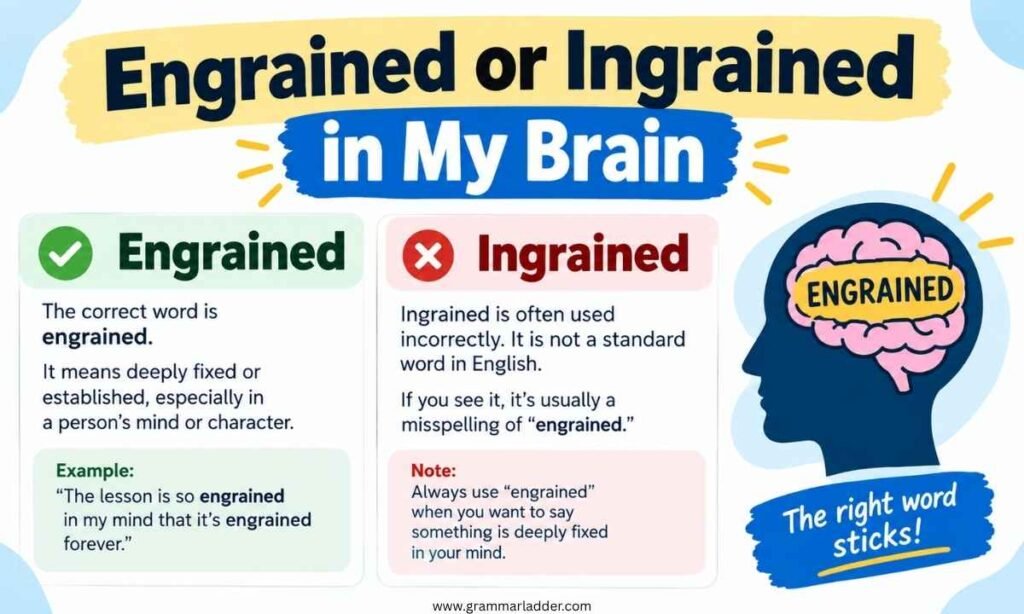
Many people search this exact phrase, usually about songs, lessons, or memories that stick.
The correct form is “ingrained in my brain.”
- “That jingle is ingrained in my brain.”
- “Those times tables are permanently ingrained in my brain.”
The phrase also rhymes, which helps it feel natural and memorable.
Origins and Etymology of “Ingrained”
The word has a colorful past. “Grain” once referred to a costly red dye made from tiny insects. Cloth dyed “in grain” kept its color deeply and permanently.
Over time, ingrain came to mean “to dye deeply.” Later, writers applied it figuratively to habits and qualities that were just as fixed. That’s the sense we use today.
This history explains why the word carries a feeling of depth. Color that has soaked into fabric fibers is very hard to wash out, and the same is true of an ingrained habit.
What “Engrained” Means and Why It Exists
Engrained is the same word with a different prefix. English borrowed many words from Old and Middle French, where the en- prefix was common. Older texts show both forms.
Spelling wasn’t standardized for centuries, so variants survived. Engrained is one of them. It means exactly what ingrained means.
Why “Engrained” Is Rare in Modern English
Several reasons explain its decline:
- Dictionary preference: major dictionaries list ingrained first.
- Editing habits: spellcheck tools and editors often change engrained automatically.
- Simplicity: in- matches related words like inborn and innate.
Because readers see ingrained far more often, engrained can look like a mistake even though it isn’t technically wrong.
Ingrained vs Engrained in Today’s English
In modern usage, ingrained dominates news writing, books, academic papers, and web content. Engrained still appears, mostly in informal writing or in older texts.
For SEO and professional credibility, stick with ingrained. It signals polish and avoids distracting readers.
Usage Frequency Trends (1800-2023)
Google Books Ngram Viewer tracks how often words appear in published books. The table below summarizes the general pattern for this word pair.
| Period | Ingrained | Engrained | Overall Trend |
| 1800s | More common | Minor variant | Both forms in use; ingrained leads |
| Early 1900s | Dominant | Minor variant | Standardized printing favors ingrained |
| Mid-1900s | Dominant | Rare | Dictionaries list ingrained first |
| Late 1900s to 2000s | Very dominant | Rare | Editing norms widen the gap |
| 2010s to 2023 | Standard | Very rare | Digital spellcheck reinforces ingrained |
The table shows general patterns, not exact counts. Ingrained has led across the whole period, and the gap has grown as editors and spellcheck tools favor it. You can run the comparison yourself in Ngram Viewer to see the exact figures.
Regional and Style Considerations
- US English: Ingrained is standard. Engrained is a rare variant.
- UK English: Ingrained is standard. Engrained is a rare variant.
- Academic writing: Ingrained is expected. Avoid engrained.
- Journalism: Ingrained is preferred. Engrained is usually corrected by editors.
- Informal writing: Ingrained is common. Engrained is occasionally seen.
Major style guides and dictionaries favor ingrained. If your publisher or editor has a house style, follow it, but ingrained is almost always the default.
The Verbs Behind the Adjectives: Ingrain vs Engrain
The adjectives come from verbs. Understanding the verbs explains the words.
What “Ingrain” Means
To ingrain is to fix something deeply in a person or material.
- “Parents ingrain values in their children.”
- “Years of repetition ingrained the routine.”
What “Engrain” Means
Engrain has the same meaning. It’s simply the rarer spelling of the verb.
- “The coach tried to engrain discipline in the team.”
Most editors would change this to ingrain.
How the Verbs Shape the Adjectives
The adjective is the past participle of the verb. When you ingrain a habit, the habit becomes ingrained. When you engrain it, it becomes engrained.
Keep the pair consistent. Don’t write “ingrain” in one paragraph and “engrained” in the next.
Practical Guide: How to Use “Ingrained” Correctly
Correct Usage Examples
- “Kindness is ingrained in our company culture.”
- “The smell of smoke was ingrained in the old curtains.”
- “Fear of public speaking can become deeply ingrained.”
- “Her work ethic was ingrained from an early age.”
Notice the pattern. Ingrained usually pairs with in or with a noun like habit, belief, behavior, or culture.
Common Mistakes to Avoid
| Mistake | Why It’s Wrong | Correct Example |
| Confusing ingrained with ingrown | Ingrown describes things that grow inward, like toenails and hairs. Ingrained describes things that are deeply fixed. | “Ingrown toenail,” never “ingrained toenail” |
| Writing “in-grained” with a hyphen | The word is written as one piece, with no hyphen. | “Ingrained habits” |
| Mixing spellings in one document | Switching between ingrained and engrained looks inconsistent. | Pick ingrained and use it throughout |
| Using it for temporary things | The word implies depth and permanence, not something short-lived. | “An ingrained fear of heights,” not “an ingrained mood today” |
Quick Tips to Remember
- Think “in” the grain, as dye sinks into fabric.
- Match it to innate and inborn, which also start with in-.
- When unsure, choose ingrained. It’s always safe.
Why “Ingrained” Won the Language Battle
Linguistic Evolution and Simplicity
English tends to favor forms that match related words. Ingrained fits alongside inherent and instilled, which made it feel more natural to speakers over time.
Style Guides and Dictionaries
Dictionaries list ingrained as the main entry and treat engrained as a variant. Editors follow that lead, so the preferred form keeps getting reinforced in print.
Popular Culture and Media
Headlines, books, podcasts, and self-help content overwhelmingly use ingrained. Repeated exposure trains readers to expect it, which pushes the variant even further out of view.
Quick Reference Table: Ingrained vs Engrained
| Feature | Ingrained | Engrained |
| Meaning | Deeply fixed or rooted | Same |
| Status | Standard spelling | Accepted variant |
| Frequency | Very common | Rare |
| UK vs US | Preferred in both | Rare in both |
| Best for | All writing | Rarely recommended |
| Verb form | Ingrain | Engrain |
Frequently Asked Questions
Is it engrained or ingrained?
Ingrained is the standard spelling. Engrained is a rare variant with the same meaning.
Is “engrained” a real word?
Yes, dictionaries list it as a variant of ingrained. It’s just far less common.
What does ingrained mean?
It means deeply fixed or firmly rooted, as with a habit, belief, or stain.
Is ingrained spelled differently in the UK?
No. British and American English both prefer ingrained.
What’s the difference between ingrained and ingrown?
Ingrained means deeply fixed. Ingrown means growing inward, like a toenail.
Is it “ingrained in my brain” or “engrained in my brain”?
Use “ingrained in my brain.” It’s the standard form.
What’s a good synonym for ingrained?
Good options include deep-seated, entrenched, habitual, and deep-rooted.
Conclusion
The engrained or ingrained question has a simple answer. Both mean “deeply fixed,” but ingrained is the standard, preferred spelling in the UK, the US, and in professional writing.
Engrained isn’t an outright error, but it’s rare enough to look like one. When you want clean, credible writing, go with ingrained every time.
Remember the dye origin, the link to words like innate, and the contrast with ingrown. Those three tricks will keep the spelling ingrained in your brain.

I am an English writer with over four years of experience in grammar and language education.
Through Grammar Ladder, I share clear explanations, practical examples, and helpful English tips.
My goal is to share my knowledge so others can benefit and improve their language skills.
I believe anyone can master English with proper guidance and consistent practice.