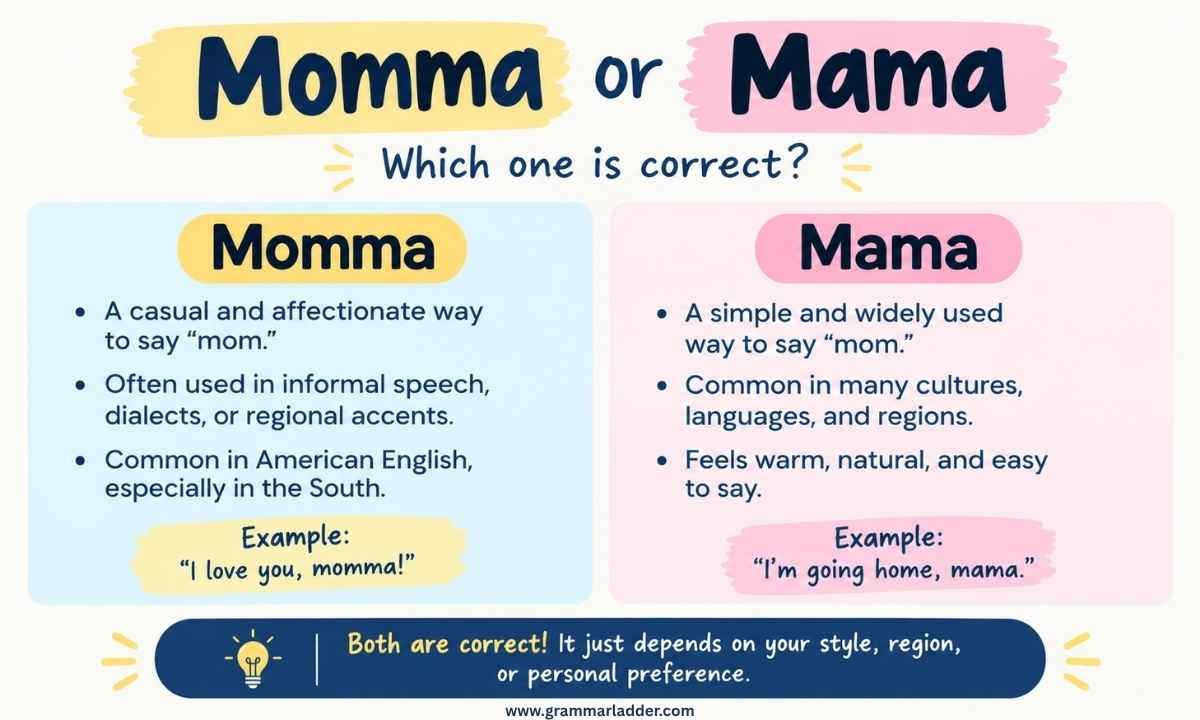
Few words feel as personal as the one we use for our mothers. So when you are writing a birthday card, a social media caption, or a novel, a small question pops up: is it momma or mama? Both look right. Both sound right. Yet one may suit your sentence better than the other.
This guide gives you the short answer first. Then it explains meaning, pronunciation, regional habits, and simple usage rules, so you can choose the right spelling with confidence.
Quick Answer
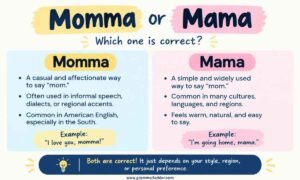
- Both spellings are correct. “Mama” is the standard, more widely used form. “Momma” is an accepted variant, mostly found in casual American English.
- Major dictionaries list both words as informal terms for “mother.” Neither is a spelling mistake.
- The real difference is tone, audience, and personal style.
- Simple rule: Use “mama” for a neutral, international, or polished feel. Use “momma” for a warm, down-to-earth, American voice.
Momma or Mama Meaning
The two words mean the same thing: a mother. Children use them as affectionate names, and adults use them in speech, music, and writing.
The word “mama” is one of the oldest baby sounds in human language. The “m” sound is among the easiest for infants to make, which is why similar words for mother appear in many languages around the world. Linguists often point to this as a reason the word feels so universal.
“Momma” grew out of the same sound. The doubled “m” and the “o” mirror how many Americans say the word in everyday speech.
Other meanings you may see:
- A term of endearment for a woman, as in “Hey, mama.”
- A title for a nurturing or strong female figure.
- A word used in song titles, brand names, and slang.
Momma or Mama Bear
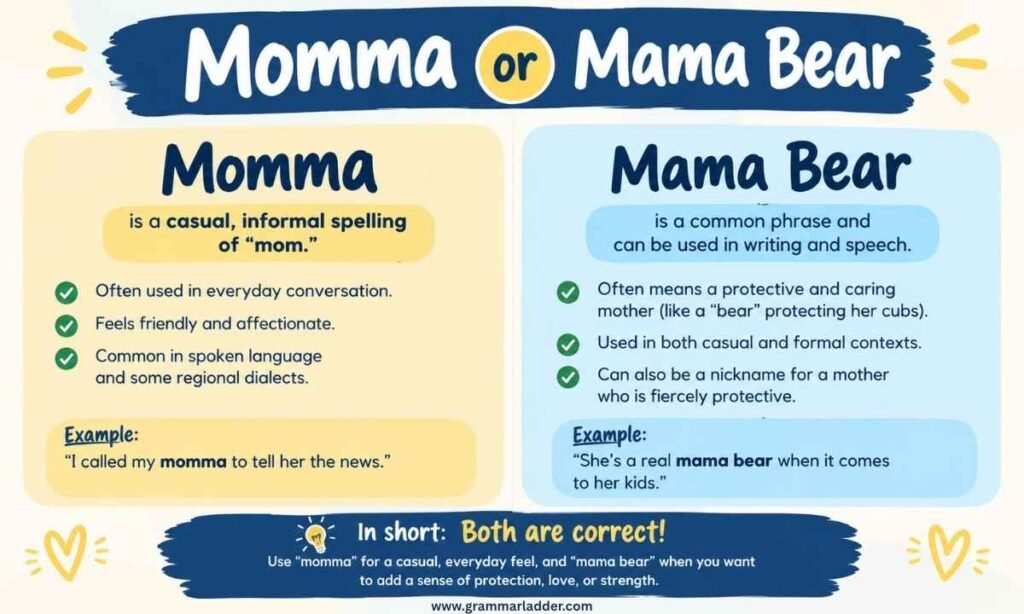
The phrase “mama bear” describes a mother who fiercely protects her children. It comes from real bear behavior, since female bears defend their cubs aggressively.
You will see both “mama bear” and “momma bear” online. Both are accepted. Here is how they usually appear:
- Mama bear is more common in books, news articles, and parenting blogs.
- Momma bear appears often in social posts, gift items, and casual conversation.
Example: “She turned into a mama bear the moment someone criticized her son’s teacher.”
If you are writing for a broad audience, “mama bear” is the safer choice.
Mama vs Momma Pronunciation
Pronunciation is where most of the confusion starts. In the United States, many people say both words in nearly the same way.
| Word | Common US Sound | Other Sound |
| Mama | MAH-muh | MUH-muh (less common) |
| Momma | MAH-muh | MOH-muh (rare) |
Here is the key point: the spelling “momma” often reflects the “ah” sound in American speech. That is why many writers choose it when they want the page to sound like real talk.
In some regions, stress and vowel length shift slightly. A speaker may say “MAH-mah” with a longer final vowel. Context and accent matter more than spelling here.
Mama or Momma in the South
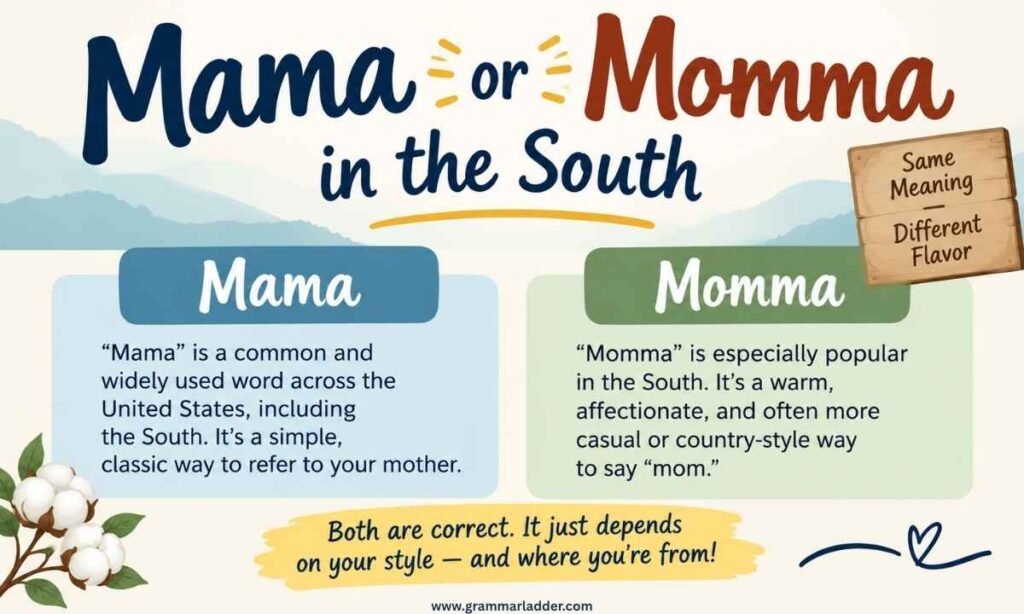
- In the American South, “momma” and “mama” are both everyday words.
- Many Southern families also use related forms such as “mamaw” or “mawmaw” for a grandmother, and “mamma” or “mammy” in older speech.
- Writers often choose “momma” in Southern settings because it captures a warm, drawn-out accent on the page.
- Authors and songwriters rely on this spelling to build voice and place.
- Still, plenty of Southerners write “mama” in cards, obituaries, and formal letters.
- Family habit usually decides the spelling more than geography does.
Momma vs Mama: Side-by-Side Comparison
Use this table for a quick decision.
| Feature | Mama | Momma |
| Status | Standard form | Accepted variant |
| Tone | Neutral, warm | Casual, homey |
| Best for | Global audiences, formal-leaning writing | US dialogue, personal posts |
| Common in | Books, news, songs, many languages | Social media, fiction, Southern voice |
| Risk of looking “wrong” | Very low | Low, but some editors prefer “mama” |
American vs British English
- United States: mom, mama, momma
- United Kingdom: mum, mummy
- Australia and New Zealand: mum, mummy
- Canada: mom in most areas, mum in some
- Best choice for global readers: “mama,” since it is understood everywhere and is not tied to one region
- Best choice for American readers: “momma,” since it feels distinctly American
When Should You Use “Mama”?
Choose “mama” in these situations:
- Writing for a global audience. It reads as natural in many English-speaking countries.
- Formal or semi-formal content. Think blog posts, articles, and published essays.
- Titles and branding. Short, clean words tend to look better in logos and headlines.
- Music and poetry. Songs often favor “mama” because it is simple and easy to read.
- Multilingual contexts. The word closely matches “mama” in Spanish, Russian, Swahili, and many other languages.
Example: “My mama taught me to cook before I could read.”
When Should You Use “Momma”?
Choose “momma” when you want a more personal, spoken feel:
- Dialogue in fiction. It helps characters sound real, especially American ones.
- Social media captions. It matches the relaxed tone of online posts.
- Southern or regional voice. It adds local flavor.
- Family messages. Cards and texts often use the spelling your family already uses.
Example: “Momma always saved the biggest slice of pie for me.”
Common Mistakes to Avoid
Small slips can make writing look careless. Watch for these:
- Mixing both spellings in one piece. Pick one and stay consistent.
- Misspelling it as “mamma” by accident. “Mamma” is a real variant, but it is less common in American writing. It also appears in Italian and in the biological term “mamma” (breast).
- Capitalizing incorrectly. Capitalize the word when it acts as a name: “I called Mama.” Keep it lowercase when it follows a possessive: “I called my mama.”
- Using “momma” in formal documents. Legal or academic writing usually prefers “mother.”
- Confusing it with “mommy.” “Mommy” is another casual form, more common with young children.
Is One More Correct Than the Other?
No. Neither spelling is wrong.
Here is what we can say with confidence:
- Dictionaries recognize both words.
- “Mama” is the more established and more widely printed form.
- “Momma” is a legitimate spelling variant used mainly in American English.
If an editor, school, or publisher gives you a style guide, follow it. Without one, choose the spelling that fits your audience and then stay consistent.
Cultural and Emotional Context
- Words for mother carry more than meaning. They carry memory.
- For many people, “mama” brings back lullabies, kitchen smells, and childhood comfort.
- “Momma” can feel even closer to home, because it mirrors how a child may have actually spoken.
- Some adults keep the childhood spelling for life, even when they write professionally.
- In many African American and Southern families, “momma” is a deeply familiar, affectionate term.
- In Latin American and many global communities, “mama” is the natural and beloved form.
- Neither spelling is more loving than the other.
- In pop culture, songs, films, and book titles use both forms to express love, humor, struggle, and pride.
Real-Life Example Sentences
Using “mama”:
- “Mama called to remind me about Sunday dinner.”
- “She is a first-time mama, and she is doing great.”
- “The mama bird returned to the nest at dawn.”
Using “momma”:
- “Momma, can I stay up ten more minutes?”
- “My momma makes the best sweet tea in town.”
- “You don’t mess with a momma bear’s cubs.”
Using both naturally in dialogue:
- “Mama said there’d be days like this.”
- “Tell your momma I said hello.”
Frequently Asked Questions
Is it momma or mama?
Both are correct. “Mama” is the standard form, and “momma” is a common American variant.
Which spelling is more common?
“Mama” is generally more common in published writing and worldwide use. “Momma” is popular in casual American English.
Is “momma” a real word?
Yes. Major dictionaries list it as an informal word for mother.
Is “mama bear” or “momma bear” correct?
Both work. “Mama bear” is slightly more common in print, while “momma bear” is popular in casual posts.
Do Southerners say, momma or mama?
Both are used. “Momma” is especially common in Southern writing and dialogue.
How do you pronounce momma?
Most Americans say it “MAH-muh,” the same way they say “mama.”
Is “mama” used in British English?
It is understood, but British speakers more often say “mum” or “mummy.”
Should I capitalize mama or momma?
Capitalize it when it is used as a name, such as “I love you, Mama.” Use lowercase after “my,” “your,” or “his.”
Can I use momma in formal writing?
It is better to use “mother” in formal or academic writing. Use “momma” in casual or creative pieces.
Conclusion
So, which spelling is correct? Both are. “Mama” is the standard form that most people know. “Momma” is a common American variant, and neither one is a mistake.
Pick the one that fits your readers and your tone. Use “mama” for a clean, global feel. Use “momma” for a warm, casual voice, and then stay consistent from start to finish.

I am an English writer with over four years of experience in grammar and language education.
Through Grammar Ladder, I share clear explanations, practical examples, and helpful English tips.
My goal is to share my knowledge so others can benefit and improve their language skills.
I believe anyone can master English with proper guidance and consistent practice.