If you’ve ever paused mid-sentence wondering whether to write “trialled” or “trialed,” you’re not alone. This is one of the most common spelling mix-ups in English, and the confusion makes perfect sense — both versions show up constantly online, in emails, and in news articles.
The good news? There’s a clear, simple rule behind this spelling difference, and once you understand it, you’ll never second-guess yourself again.
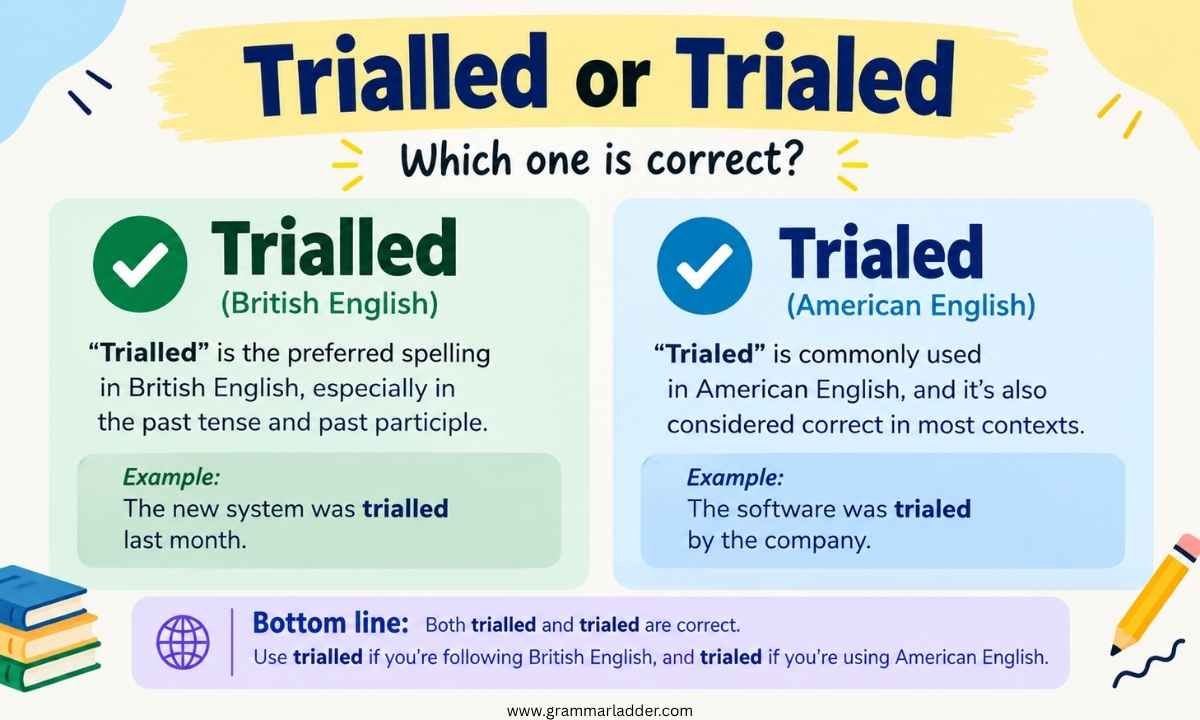
Trialled or Trialed – Quick Answer
Both spellings are correct. It simply depends on which version of English you’re using:
- Trialled — British English, Australian English, Canadian English
- Trialed — American English
Neither word is a typo. Neither is “more correct” than the other. The difference comes down to regional spelling conventions, not grammar rules.
Simple examples:
- British: “The company trialled a new product before launch.”
- American: “The company trialed a new product before launch.”
Both sentences are grammatically identical — only the spelling changes based on audience and region.
The Origin of Trialled and Trialed
The word “trial” started as a noun (a test or legal proceeding) and later became a verb meaning “to test something out.” When a one-syllable or two-syllable word ending in a single consonant gets a suffix like “-ed” or “-ing,” English spelling rules kick in to decide whether that final consonant doubles.
This is where things get interesting — and where British and American English officially parted ways.
Why the spelling split happened
In the early 1800s, American lexicographer Noah Webster set out to simplify and standardize American spelling. He dropped a lot of the “extra” letters found in British spelling, especially double consonants that didn’t affect pronunciation.
That’s why American English gives us:
- traveled (not travelled)
- canceled (not cancelled)
- trialed (not trialled)
Meanwhile, British English kept the traditional doubling pattern, giving us “trialled,” “travelled,” and “cancelled.” This isn’t random — it reflects two different, deliberate spelling traditions that developed over time.
British English vs American English Spelling
The core rule
Here’s the rule in plain terms:
- British English tends to double the final consonant before adding “-ed” or “-ing,” even when the last syllable isn’t stressed.
- American English usually keeps a single consonant unless the final syllable is stressed.
Since “trial” ends in “l” preceded by a vowel, this exact pattern applies — the same way it applies to “travel” and “cancel.”
Comparison table
| Base Word | British English | American English |
| Trial | Trialled | Trialed |
| Travel | Travelled | Traveled |
| Cancel | Cancelled | Canceled |
| Label | Labelled | Labeled |
| Model | Modelled | Modeled |
Notice the pattern? If you already know one of these pairs, you effectively know all of them.
Which Spelling Should You Use?
Choosing between “trialled” and “trialed” isn’t about correctness — it’s about consistency with your audience.
Use trialed if:
- You’re writing for a US-based audience
- Your publication follows American style guides (AP, Chicago)
- You’re targeting American search traffic for SEO
- Your company or brand uses American English as standard
Use trialled if:
- You’re writing for UK, Australian, or Canadian readers
- Your organization follows British or Commonwealth English
- You’re publishing on a UK-based website or platform
- Your content targets Australian or British search intent
For global or mixed audiences
If your content reaches an international audience, the most important thing is consistency, not which spelling you pick. Choose one version and use it throughout the entire piece. Mixing both spellings in the same document looks careless and can hurt readability, even if each usage is technically correct.
Many global brands simply default to American English for wider reach, while UK-based companies stick with British spelling to match their local audience and tone.
Trialled or Trialed Synonyms
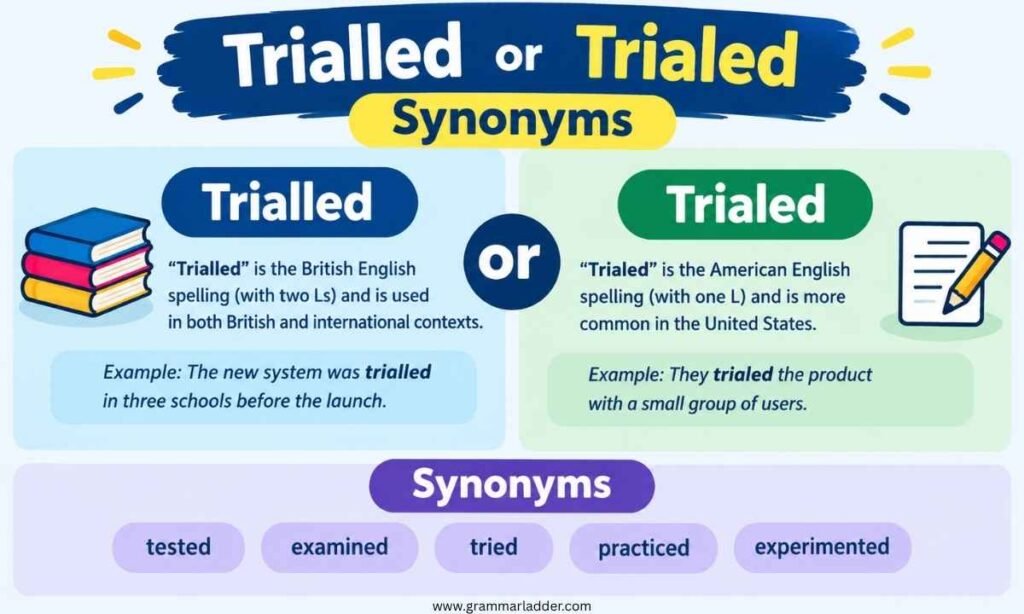
If you want to vary your writing or avoid repeating “trialled/trialed” too often, several natural alternatives work well:
- Tested
- Piloted
- Tried out
- Evaluated
- Assessed
- Experimented with
- Put to the test
These synonyms are especially useful in product reviews, marketing copy, and reports where the word “trial” might otherwise repeat too frequently.
Trialled or Trialed Meaning
Regardless of spelling, the meaning stays the same. As a verb, “trial” means to test something, often on a temporary or experimental basis, before making a final decision.
Example: “The airline trialled a new boarding process for three months before adopting it permanently.”
Whether written as “trialled” or “trialed,” the sentence communicates the same idea: something was tested before being fully implemented.
Trialled or Trialed Australia
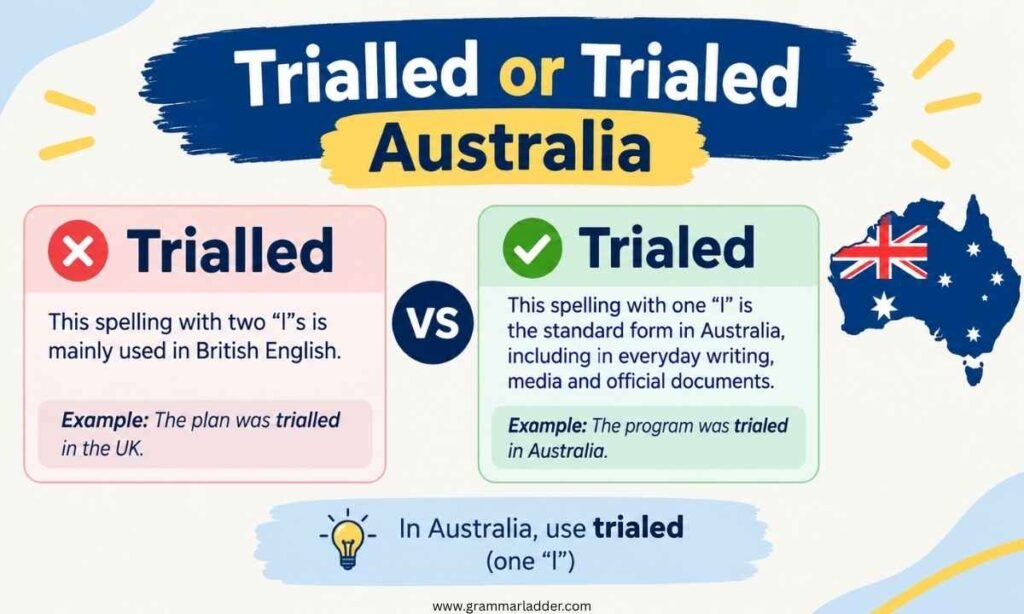
Australian English generally follows British spelling conventions, which means “trialled” is the standard and preferred form across Australian media, government publications, and everyday writing. If you’re creating content specifically for an Australian audience, “trialled” is the safer, more familiar choice.
Common Mistakes with Trialed or Trialled
Mixing spellings
Using “trialled” in one paragraph and “trialed” in another is one of the most frequent errors, especially in longer articles or collaborative documents with multiple writers.
Assuming one is wrong
Some writers assume American spelling is always “correct” simply because it’s more common online. In reality, both spellings are standard within their respective English variants.
Overcorrecting based on spellcheck
Spellcheck tools are often set to one regional dictionary by default. Relying on spellcheck alone can push you toward the wrong spelling for your intended audience if your settings don’t match your target region.
Inconsistent SEO usage
For websites and blogs, using both spellings randomly across pages can dilute keyword focus. Search engines still reward consistency, especially for region-specific search intent.
Trialed vs Trialled in Everyday Examples
Emails
“We trialed the new software for two weeks before rolling it out company-wide.” (American)
News writing
“The council trialled a 20-mph speed limit across residential streets.” (British)
Social media
“Just trialled this skincare product for a month — here’s my honest review!” (British/Australian tone)
Formal and academic writing
“The treatment was trialed across three separate patient groups to measure effectiveness.” (American, common in scientific and medical writing)
Trialed and Trialled – Google Trends & Usage Data
Search interest data consistently shows a regional pattern: “trialled” dominates searches from the UK, Australia, and other Commonwealth countries, while “trialed” is far more common in searches originating from the United States.
Context matters
This regional split matters for SEO. If you’re targeting American search traffic, “trialed” typically aligns better with local search behavior. If your audience is primarily British or Australian, “trialled” will feel more natural and match how people actually search and read.
Comparison Table: Trialled vs Trialed
| Feature | Trialled | Trialed |
| Region | UK, Australia, Canada | United States |
| Style guide | Oxford, Commonwealth English | AP, Chicago Manual of Style |
| Consonant doubling | Yes | No |
| Common in | News, government, academic (UK) | Business, tech, medical (US) |
| SEO targeting | UK/AU search intent | US search intent |
Frequently Asked Questions
Is “trialled” or “trialed” correct?
Both are correct — “trialled” is British English, and “trialed” is American English.
Which spelling should I use for SEO?
Match the spelling to your target audience’s region for the best search relevance.
Is “trialled” a real word?
Yes, it’s the standard British English past tense of the verb “trial.”
Why does American English use one “l”?
American spelling reform simplified many double consonants, including in words like “trialed” and “traveled.”
Can I use both spellings in one article?
It’s best to pick one spelling and use it consistently throughout your content.
Is “trialed in court” correct?
No — the correct phrase is “tried in court,” not “trialed in court.”
Conclusion
“Trialled” and “trialed” are both correct spellings of the same word — the only real difference is regional. British, Australian, and Canadian English use “trialled,” while American English uses “trialed.” Neither version is wrong; the right choice simply depends on your audience and the style guide you’re following.
The key takeaway is consistency. Pick the spelling that matches your readers, stick with it throughout your writing, and you’ll come across as polished, professional, and region-aware — exactly what strong, trustworthy content should do.

I am an English writer with over four years of experience in grammar and language education.
Through Grammar Ladder, I share clear explanations, practical examples, and helpful English tips.
My goal is to share my knowledge so others can benefit and improve their language skills.
I believe anyone can master English with proper guidance and consistent practice.