Few word pairs trip up English learners and native speakers alike as often as emigrate and immigrate. They sound almost identical, share the same Latin root, and both describe people moving from one country to another. Yet using the wrong one in a resume, visa application, or news article can make your writing look careless.
This guide breaks down the meaning, origin, spelling, pronunciation, and real-world usage of immigrate vs emigrate, so you never have to second-guess yourself again.
Emigrate or Immigrate – Quick Answer
Here’s the short version before we go deeper:
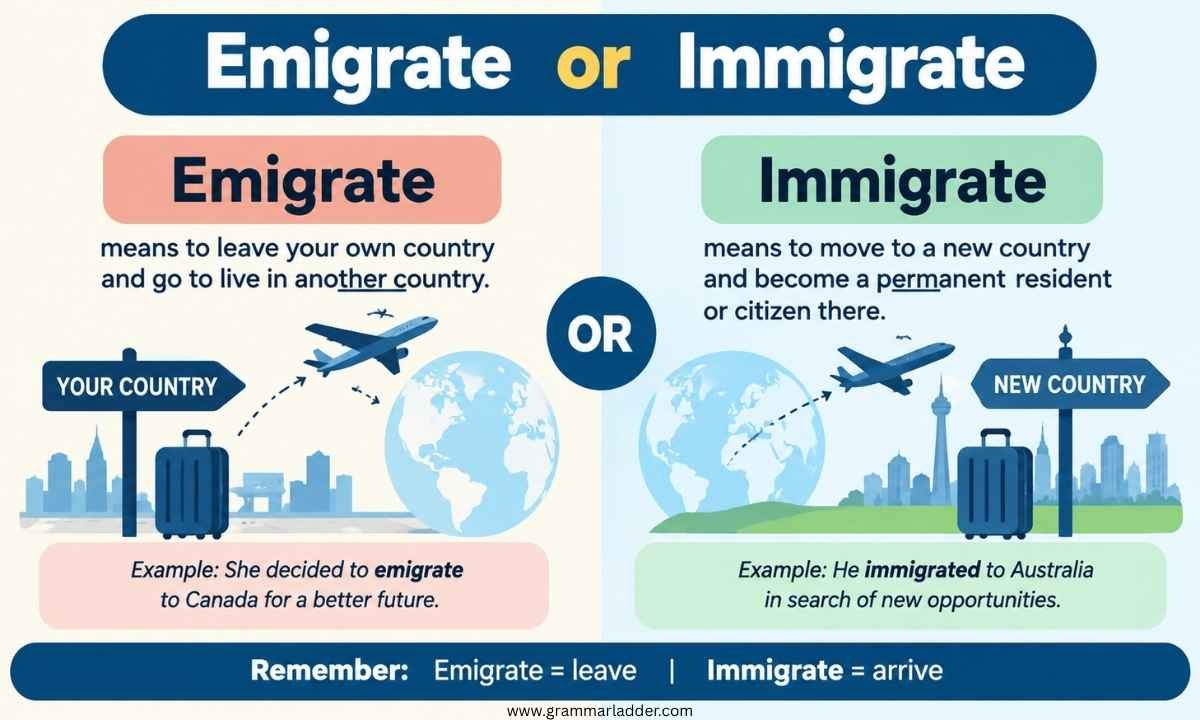
- Emigrate = to leave your home country to live somewhere else. Always paired with “from.”
- Immigrate = to enter and settle in a new country. Always paired with “to.”
Think of it this way: you emigrate from your homeland, and you immigrate to your new home. Same journey, two different perspectives.
The Origin of Emigrate and Immigrate
Both words trace back to the Latin verb migrare, meaning “to move from one place to another” — the same root that gives us “migrate.”
The distinction lies in the prefixes:
- E- (a shortened form of ex-) means “out of” or “away from.” It’s the same prefix found in words like exit and exclude.
- Im- means “into” or “in,” as in implant or inject.
So grammatically, emigrate always looks backward at the place someone is leaving, while immigrate always looks forward to the place someone is entering. Interestingly, records show “immigrate” actually entered the English language before “emigrate,” with early usage traced to 17th-century dictionaries, while “emigrate” appeared roughly a century later.
British English vs American English Spelling
Good news here — there’s no transatlantic spelling battle to worry about. Unlike words such as color/colour or organize/organise, emigrate and immigrate are spelled identically in both British and American English.
What does differ slightly is frequency of use and context:
| Aspect | British English | American English |
| Spelling | Emigrate / Immigrate | Emigrate / Immigrate |
| Common context | Often used in historical and colonial migration discussions | Frequently used in immigration law, visas, and policy discussions |
| Preferred noun form | Emigrant / Immigrant | Emigrant / Immigrant |
Since spelling isn’t the issue, the real challenge is choosing the right word for the right perspective — which is exactly what we’ll cover next.
Emigrate or Immigrate Meaning
Let’s define both terms clearly, with example sentences you can model your own writing on.
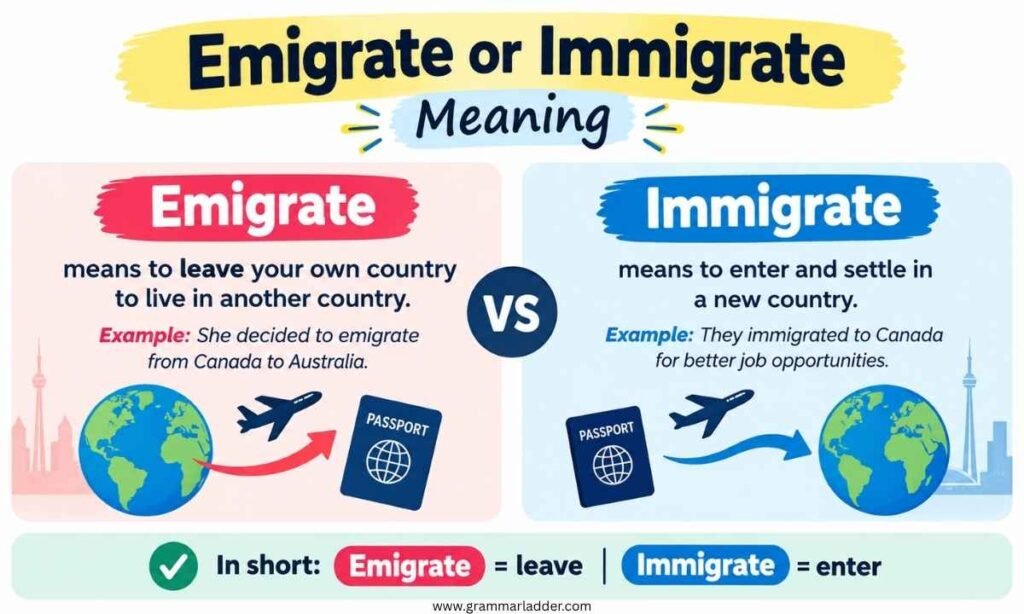
Emigrate (verb)
To leave one’s own country permanently to live in another.
Examples:
- She decided to emigrate from Poland after finishing university.
- Thousands of skilled workers emigrated from the region during the economic downturn.
- My great-grandparents emigrated from Ireland in the 1890s.
Immigrate (verb)
To move into a foreign country to live there permanently.
Examples:
- He immigrated to Canada in search of better job opportunities.
- Her family immigrated to Australia when she was six years old.
- Many people immigrate to the United States each year through employment visas.
Notice the pattern: emigrate is always followed by from, and immigrate is always followed by to. If you remember nothing else from this article, remember that rule.
Immigrate vs Emigrate vs Migrate
There’s a third word in this family that often gets tossed into the confusion: migrate. Here’s how all three compare.
| Word | Meaning | Preposition | Typical Use |
| Emigrate | Leaving one’s home country | from | Permanent departure |
| Immigrate | Entering a new country to settle | to | Permanent arrival |
| Migrate | Moving from one place to another, often temporarily or seasonally | — | General movement, animals, workers, or big-picture population shifts |
Migrate is the broadest of the three. It’s used for seasonal bird movement, temporary labor relocation, or as a neutral umbrella term when you don’t want to specify direction. For example, a news headline might say “Population migrates toward urban centers” without implying permanent settlement the way emigrate or immigrate would.
Which Spelling Should You Use?
Since spelling doesn’t vary by region, the real question isn’t “which spelling” but “which word.” Use this simple test:
- Ask what the sentence is focused on. Is it about someone leaving, or someone arriving?
- Check the preposition that naturally follows. If “from” fits, use emigrate. If “to” fits, use immigrate.
- Consider the noun form. A person who has left is an emigrant; a person who has arrived and settled is an immigrant. The same individual can technically be called both, depending on which country’s perspective you’re writing from.
A handy mnemonic many writers use: Emigrate starts with E, like Exit. Immigrate starts with I, like In.
Immigrate vs Emigrate Pronunciation

Pronunciation is another area where these words are nearly indistinguishable in casual speech, which adds to the confusion.
| Word | Pronunciation (IPA) | Phonetic Spelling |
| Emigrate | /ˈɛm.ɪ.ɡreɪt/ | EM-uh-grayt |
| Immigrate | /ˈɪm.ɪ.ɡreɪt/ | IM-uh-grayt |
The difference comes down to the very first sound — a short “e” versus a short “i.” When spoken quickly, this distinction can vanish, which is why relying on spelling and context (rather than sound alone) is the safer approach in writing.
Common Mistakes with Immigrate or Emigrate
Even experienced writers slip up here. Some of the most frequent errors include:
- Using “emigrate to” — Grammatically, you cannot emigrate to a place. You emigrate from one.
- Using “immigrate from” — Similarly, immigrate should not be followed by “from.” You immigrate to a destination.
- Confusing the noun forms — Saying “she is an immigrant from Canada” when the context is about her leaving Canada (she’d be an emigrant from Canada in that context, though she becomes an immigrant to wherever she settles).
- Overusing “migrate” as a catch-all — While migrate is flexible, using it for permanent relocation stories can feel vague when emigrate or immigrate would be more precise.
- Mixing up direction in storytelling — When narrating someone’s journey, writers sometimes switch perspective mid-paragraph, which confuses readers about which country is “home” and which is “new.”
A simple fix: before publishing, search your document for “emigrate to” and “immigrate from” — these two phrases are almost always incorrect.
Immigrate and Emigrate in Everyday Examples
Here’s how these words show up in real, everyday contexts:
News and journalism:
- “Economic instability has forced thousands to emigrate from the country this year.”
- “The nation’s immigration department reported a rise in people who immigrate to seek asylum.”
Personal storytelling:
- “My grandparents emigrated from Vietnam in the 1970s and later immigrated to the United States.”
Legal and government documents:
- “Applicants must complete Form I-485 to immigrate to the U.S. permanently.”
Historical writing:
- “Millions emigrated from Europe during the 19th century, driven by famine and political unrest.”
Each example anchors the correct word to a clear direction of movement — either departure or arrival.
Immigrate vs Emigrate – Google Trends & Usage Data
Search behavior offers an interesting window into how people actually use these words. “Immigrate” and its related noun “immigration” consistently generate far higher search volume than “emigrate” and “emigration.” This makes sense: most everyday conversations, news coverage, and policy debates focus on the receiving country’s perspective — border policy, visas, and settlement — rather than the departing country’s perspective.
That said, “emigrate” tends to spike during specific world events, such as economic crises, wars, or political upheaval in a particular nation, when media coverage shifts focus to why people are leaving rather than where they’re going.
For content creators and SEO purposes, this means:
- “Immigrate” and “immigration” carry higher general search intent.
- “Emigrate” often performs better in region-specific or historical content.
- Long-tail queries like “difference between emigrate and immigrate” or “emigrate vs immigrate examples” are common informational searches, not transactional ones.
Comparison Table: Emigrate vs Immigrate
| Feature | Emigrate | Immigrate |
| Meaning | Leaving one’s home country | Entering a new country to settle |
| Preposition used | From | To |
| Noun form | Emigrant | Immigrant |
| Perspective | Point of departure | Point of arrival |
| Prefix origin | E- (out of) | Im- (into) |
| Example sentence | She emigrated from Brazil. | She immigrated to Portugal. |
| Common context | Historical, departure-focused stories | Legal, policy, and settlement stories |
Frequently Asked Questions
Is it “emigrate to” or “emigrate from”?
Always “emigrate from.” You leave a country by emigrating from it, never to it.
Can one person be both an emigrant and an immigrant?
Yes. The same person is an emigrant from their home country and an immigrant to their new country.
Which is more common, emigrate or immigrate?
Immigrate and immigration are used far more often, especially in news, law, and policy discussions.
Is migrate the same as emigrate or immigrate?
No. Migrate is a broader, direction-neutral term often used for temporary or seasonal movement.
Do British and American English spell these words differently?
No, both spell “emigrate” and “immigrate” the same way.
What’s an easy way to remember the difference?
Emigrate starts like “exit” (leaving), and immigrate starts like “in” (entering).
Is “immigrated” or “emigrated” used for refugees?
Both can apply, depending on perspective — refugees emigrate from a crisis-hit country and immigrate to a host country.
Conclusion
The difference between emigrate and immigrate comes down to one simple idea: direction. Emigrate looks at the country someone is leaving; immigrate looks at the country someone is entering. Once you anchor each word to its correct preposition — “from” for emigrate and “to” for immigrate — the confusion disappears almost instantly.
Whether you’re writing a personal story, a news article, or a legal document, getting this distinction right adds precision and credibility to your work. And if you ever forget, just remember the simple trick: E is for Exit, I is for In.

I am an English writer with over four years of experience in grammar and language education.
Through Grammar Ladder, I share clear explanations, practical examples, and helpful English tips.
My goal is to share my knowledge so others can benefit and improve their language skills.
I believe anyone can master English with proper guidance and consistent practice.