Mix-ups between “stint” and “stent” are more common than you might think. One letter separates them, yet they belong to two completely different worlds. One describes a period of time. The other describes a tiny medical device.
If you have ever typed “kidney stint” into a search bar or wondered whether a doctor said “heart stent,” you are not alone. This guide explains what each word means, how to use it correctly, and how to remember the difference for good.
Quick Answer
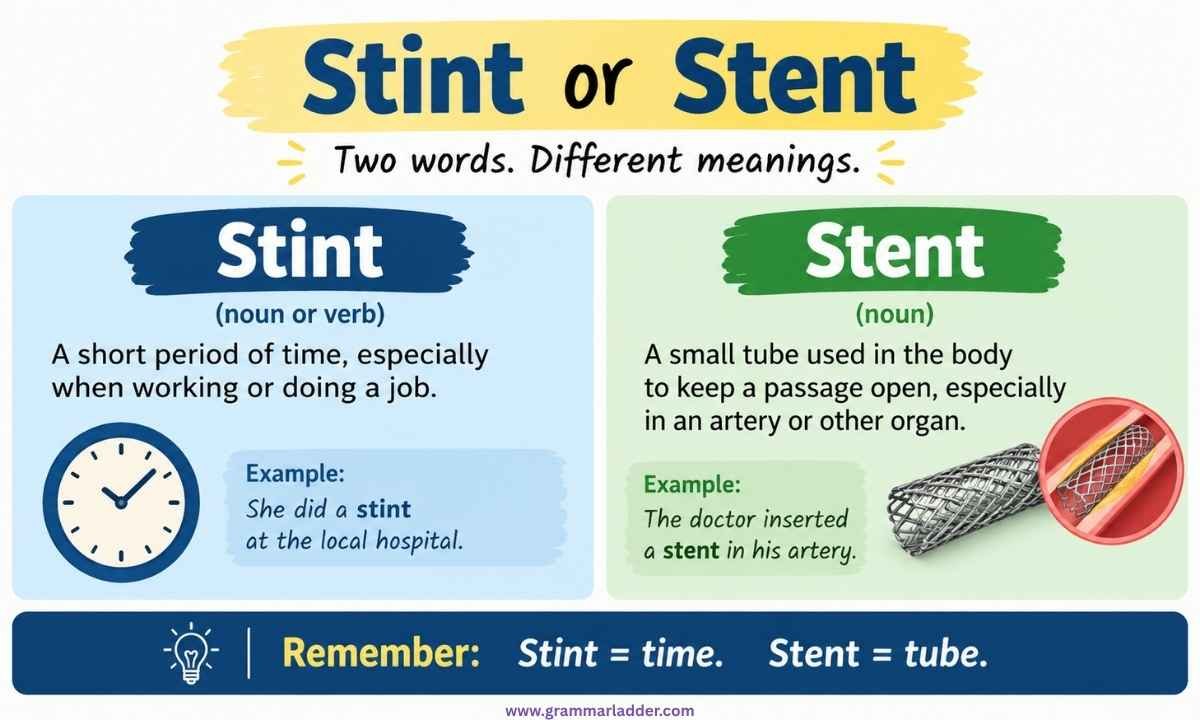
Stint is a period of time spent doing a job or activity. It can also mean being stingy with something.
A stent is a small tube or mesh device placed inside a blood vessel or body passage to keep it open.
So, a person serves a stint in the army. A surgeon places a stent in an artery. They are never interchangeable.
Is Stent a Misspelling of Stint?
No. “Stent” is not a misspelling of “stint.” Each word is correct, but only in its own context.
The confusion comes from sound and spelling. Both words are short, pronounced almost alike, and end in “-nt.” When someone hears “stent” at a hospital, they often write “stint” because it’s more familiar.
The reverse mistake happens too. Some writers use “stent” for a job or work period, which is also wrong.
Here is a simple rule:
- Talking about time, work, or effort? Use stint.
- Talking about a medical tube or support device? Use stent.
What Does Stint Mean?
Stint works as both a noun and a verb.
Stint as a Noun
As a noun, a stint is a fixed or limited period spent on a particular job, role, or activity. It often suggests a temporary stay.
Examples:
- She did a two-year stint in Dubai before moving home.
- His stint as team captain ended after the final match.
- Many students take a short stint as interns.
Stint as a Verb
As a verb, to stint means to be sparing or to give too little of something. You will almost always see it in negative form.
Examples:
- The chef never stints on fresh ingredients.
- Don’t stint on safety equipment.
- They did not stint in their praise.
The related forms are stints, stinted, and stinting.
What Does Stent Mean?
A stent is a small, expandable tube, usually made of metal mesh or plastic. Doctors place it inside a narrowed or blocked vessel, duct, or passage. Its job is simple: hold the passage open so blood, urine, or other fluids can flow normally.
Stents are used in many parts of the body, including the heart, kidneys, brain, bile ducts, and airways. The word is also a verb. A patient can be stented, and the procedure is called stenting.
The term comes from Charles Thomas Stent, a nineteenth-century English dentist known for a dental impression material. Over time, the name came to describe supportive devices used in surgery.
Stint or Stent in Kidney
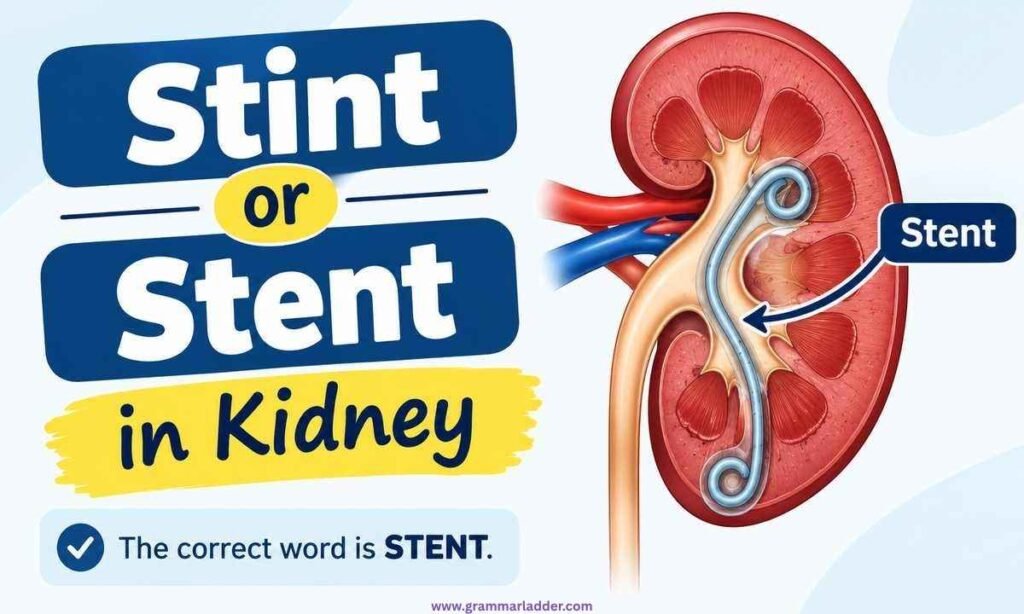
The correct term is kidney stent, or more precisely, a ureteral stent. Some doctors call it a double-J (or JJ) stent because both ends curl.
A ureteral stent is a thin, flexible tube placed in the ureter. That is the channel that carries urine from the kidney to the bladder.
Doctors use it when:
- A kidney stone blocks the ureter.
- Swelling follows surgery or a stone procedure.
- A tumor or scar tissue narrows the ureter.
- The ureter needs time to heal.
Most kidney stents are temporary. They are removed or replaced after a few weeks or months, based on the patient’s condition. Always follow your urologist’s instructions about follow-up care.
So if you searched “kidney stint,” the word you want is stent.
Stint vs Stent Heart
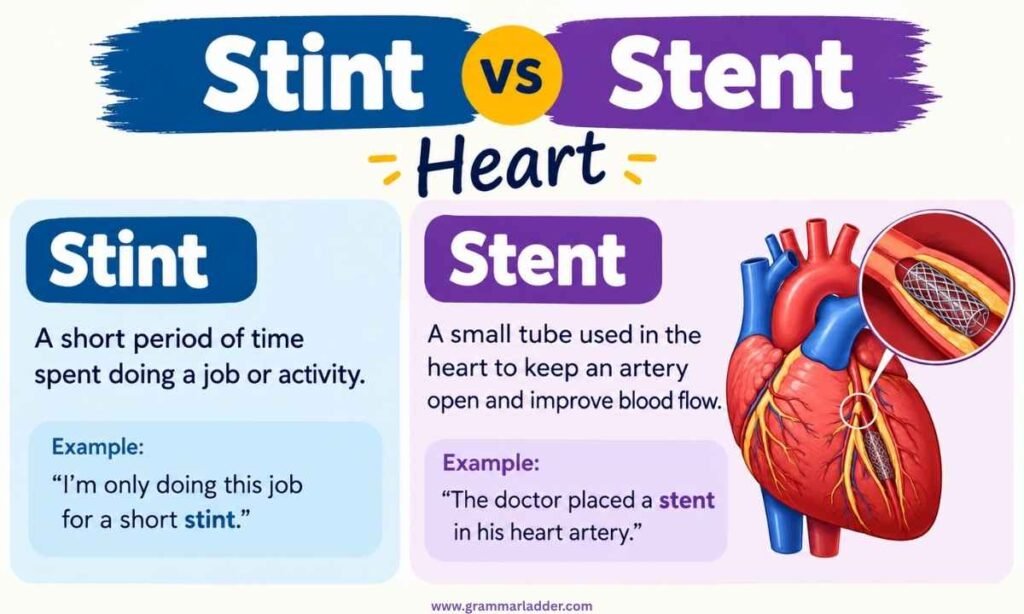
In cardiology, the right word is always stent.
A coronary stent is a tiny mesh tube placed in a narrowed coronary artery during a procedure called angioplasty. The stent props the artery open and helps restore blood flow to the heart muscle.
Two common types are:
- Bare-metal stents: simple metal mesh scaffolds.
- Drug-eluting stents: coated with medication that slowly releases to lower the chance of the artery narrowing again.
People who receive one are often told to take antiplatelet medicines to prevent clots. Your cardiologist decides the type and length of treatment.
You may hear “heart stint” in casual speech, but it is incorrect. A “stint” in cardiology could only refer to time, such as “a stint in the cardiac ward.”
Stint or Stent in the Brain
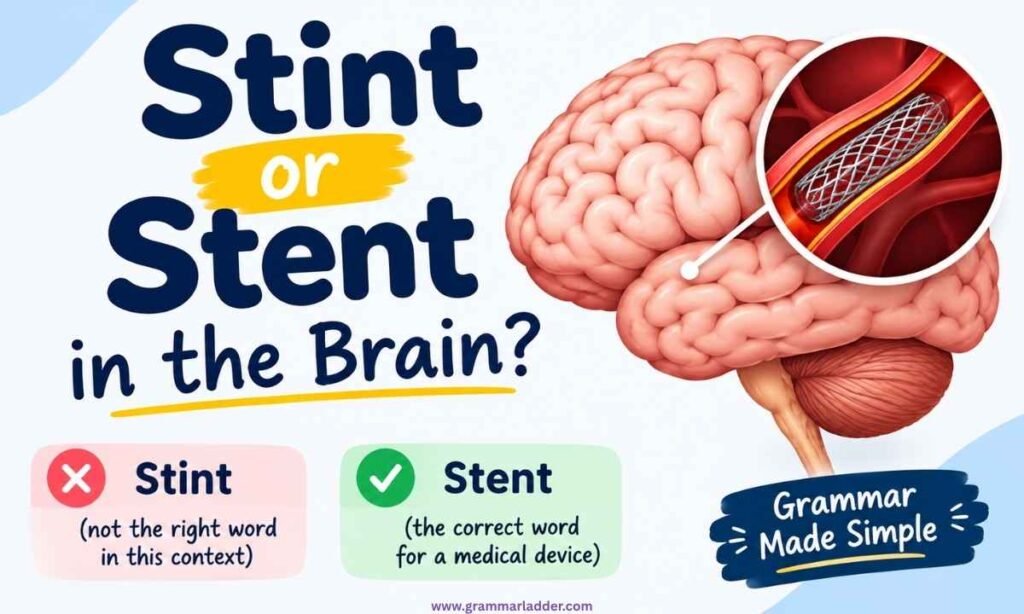
Again, the medical device is a stent. In the brain, doctors use stents in specialized procedures on the blood vessels that supply it.
Common uses include:
- Carotid artery stenting: opens a narrowed artery in the neck to lower stroke risk.
- Intracranial stenting: supports narrowed vessels inside the skull.
- Aneurysm treatment: stent-assisted coiling or flow-diverting devices help manage a weakened vessel wall.
These procedures are performed by neurointerventional specialists. If you see the phrase “brain stint,” treat it as a spelling error for “brain stent.”
Stint vs Stent in One Sentence
Here is the difference in a single line each:
- Stint: He completed a short stint at the hospital as a volunteer.
- Stent: The doctor inserted a stent into his artery.
Both words can appear in one sentence, though it is rare:
After a brief stint in the cardiac unit, she went home with a new stent.
Stint vs Stent: Comparison Table
| Feature | Stint | Stent |
| Part of speech | Noun and verb | Noun and verb |
| Core meaning | A period of work or activity; to be sparing | A tube that keeps a passage open |
| Field | Everyday English, work, sports, travel | Medicine, surgery, cardiology, urology |
| Pronunciation | /stɪnt/ | /stɛnt/ |
| Verb forms | stints, stinted, stinting | stents, stented, stenting |
| Typical example | A three-year stint abroad | A coronary stent |
| Common error | Used for medical devices | Used for time periods |
Common Mistakes People Make
Most errors come from sound-alike spelling and autocorrect. Watch for these:
- “Kidney stint” instead of kidney stent.
- “Heart stint” instead of heart stent.
- “A stent as a manager” instead of a stint as a manager.
- “Stinting surgery“ instead of stenting procedure.
- Mixing the verbs. You cannot “stint” a patient. You stent a vessel.
A quick proofreading step helps: ask whether the sentence is about time or generosity or about a medical tool. That one question catches nearly every slip.
American vs British English
There is no spelling difference between American and British English for either word. Both countries write stint and stent the same way.
There are small differences in how the words are used:
- Stint is common in both varieties. British writers use it often for work spells, such as “a stint in the Civil Service.”
- Stent is a standard international medical term. It appears in NHS leaflets, US hospital guides, and journals alike.
- The verb stent (stenting, stented) is mainly used by clinicians, regardless of region.
So you do not need to switch spelling based on your audience.
Common Collocations
Collocations are words that naturally appear together. Learning them helps you pick the right term by instinct.
Common Collocations with Stint
- a brief stint
- a two-year stint
- a stint abroad
- a stint in prison
- a stint as a coach
- a stint with the military
- without stint (a formal, older phrase)
- stint on quality
- stint on spending
Common Collocations with Stent
- coronary stent
- ureteral stent
- kidney stent
- drug-eluting stent
- stent placement
- stent insertion
- stent removal
- stent procedure
- carotid stent
- stent surgery
Easy Trick to Remember the Difference
Use a memory hook for each word.
- Stint has an “i,” like “in time.” Think of the “i” as a clock hand. A stint is about time spent.
- Stent has an “e,” like “expand.” A stent expands inside a vessel to keep it open.
Another shortcut: if a doctor is involved, pick the e. If a calendar is involved, pick the i.
Why Context Matters
Because both words are real English words, spellcheck will not flag the wrong one. That makes context your best guide.
Context matters most in these cases:
- Health writing. A wrong word in a patient guide can confuse readers and reduce trust.
- Resumes and bios. “Stint” is a polished way to describe a short role. Using “stent” would look careless.
- Search habits. People often search “kidney stint” or “heart stint,” but reliable medical sources use stent. Using the right term helps you find accurate information.
- Professional communication. Clear wording shows attention to detail.
When in doubt, read the sentence aloud and ask what the word is doing. If it describes duration or giving too little, it is stint. If it describes a device in the body, it is stent.
Frequently Asked Questions
Is it stint or stent in the kidney?
It is stent. A kidney (ureteral) stent is a thin tube that helps urine drain from the kidney to the bladder.
Is it a heart stint or a heart stent?
The correct term is heart stent. It is a small mesh tube that keeps a coronary artery open.
What is the difference between stint and stent?
A stint is a period of time or the act of being sparing. A stent is a medical device that holds a passage open.
Can stint be used in medical writing?
Only for time, such as “a stint in the ICU.” It never names a device.
Is stent a verb?
Yes. In medicine, to stent a vessel means to place a stent in it, and the process is called stenting.
What does “stint” mean in a job context?
It means a set period spent in a role, like “a six-month stint as an editor.”
Do American and British English spell these words differently?
No. Both varieties use stint and stent with the same spelling and meaning.
How do I remember which is which?
Stint has an “i” for “in time.” Stent has an “e” for “expand.”
Conclusion
Stint and stent look alike, but their meanings are far apart. A stint is a period of time, like a short job or a term of service. A stent is a tiny tube that doctors place in the body to keep a passage open.
Use stent for the heart, kidney, and brain. Use stint for work, time, or spending too little. Just remember: stint has an “i” for “in time,” and stent has an “e” for “expand.”

I am an English writer with over four years of experience in grammar and language education.
Through Grammar Ladder, I share clear explanations, practical examples, and helpful English tips.
My goal is to share my knowledge so others can benefit and improve their language skills.
I believe anyone can master English with proper guidance and consistent practice.