You are typing a message to a friend: “How are you faring?” Then you stop. Should it be fairing? The two words sound identical, and spell check often won’t catch the mistake.
Here is the short version. Both spellings are correct, but they are different words with different jobs. This guide explains each one, shows real examples, and gives you simple tricks to choose the right spelling every time.
Quick Answer
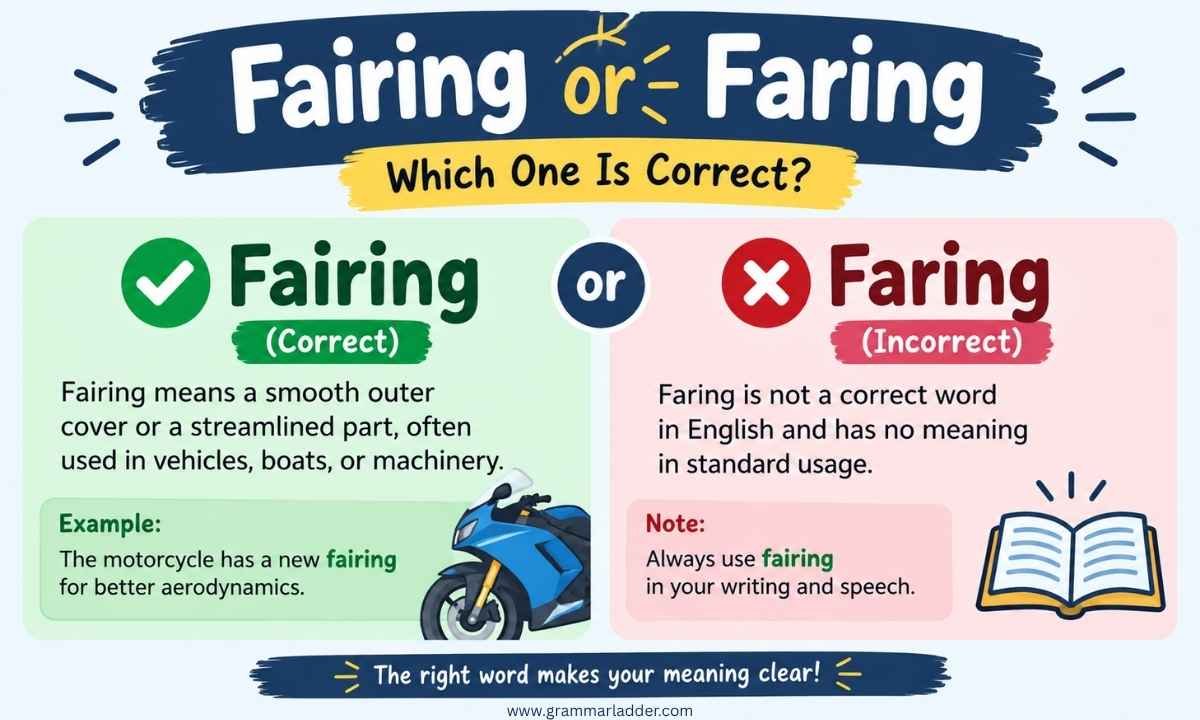
Faring means “doing” or “getting along.” It is the -ing form of the verb fare.
Fairing is a streamlined cover on a vehicle or aircraft. It is a noun.
- Faring: “How is she faring at her new job?”
- Fairing: “The motorcycle has a carbon-fiber fairing.”
If you are asking about a person, a team, or a situation, use faring.
Meaning of “Fairing”
Fairing is mostly a technical noun. It names an outer structure that smooths airflow over a vehicle. Less drag means better speed and better fuel efficiency.
You will see fairings on:
- Motorcycles (the front shell around the headlight and handlebars)
- Aircraft (panels covering joints, landing gear, and wing roots)
- Rockets (the nose cone that protects the payload)
- Bicycles (streamlined shells on racing and recumbent models)
- Ships and trucks (smooth coverings that cut resistance)
The word comes from the older verb to fair, which means to make smooth or even. Shipbuilders used it for shaping a hull so its lines flowed evenly.
Fairing has two lesser-known meanings:
- A small gift bought at a fair. This sense is old-fashioned and rare today.
- A Cornish ginger biscuit. In Britain, “fairings” are crisp spiced cookies traditionally sold at fairs.
In everyday writing, though, the vehicle meaning is the one you will meet.
Meaning of “Faring”
Faring comes from the verb fare. The word traces back to Old English faran, meaning “to travel.” Over time, the meaning shifted from journeys to how things go for someone along the way.
Today, to fare means to get along or to experience a result. We use it for health, progress, success, and outcomes.
- “The team is faring well this season.”
- “How did you fare on the exam?”
- “Small businesses are faring better than expected.”
You can also fare badly, poorly, better, or worse. The word almost always needs an adverb or a comparison to feel complete.
Fare has other meanings too, such as a ticket price (“bus fare”) and food (“hearty fare”). Those are separate senses of the same spelling. Faring, however, only belongs to the “getting along” verb.
Fairing or Faring Synonym
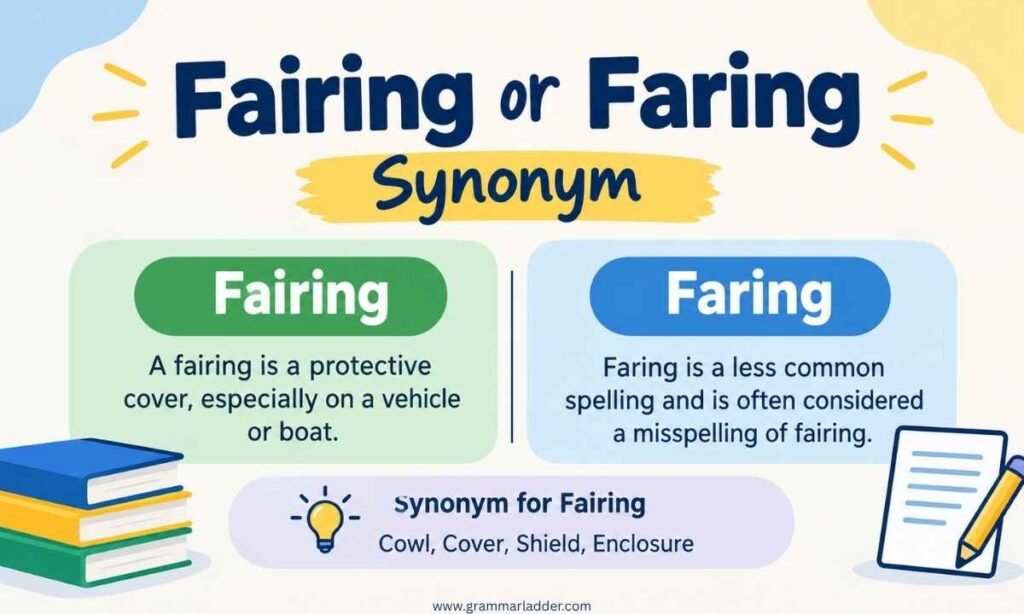
Synonyms are a handy check. If a swap works, you are in the right category.
Synonyms for “faring” (getting along):
- Doing
- Getting along
- Managing
- Performing
- Progressing
- Coping
- Making out
Synonyms for “fairing” (the vehicle part):
- Cowling
- Body panel
- Windscreen or windshield (for certain fairings)
- Streamlined shell
- Aerodynamic cover
Try this test. Replace the word in your sentence with “doing.” If the sentence still makes sense, you want faring.
How Are You Faring or Fairing?
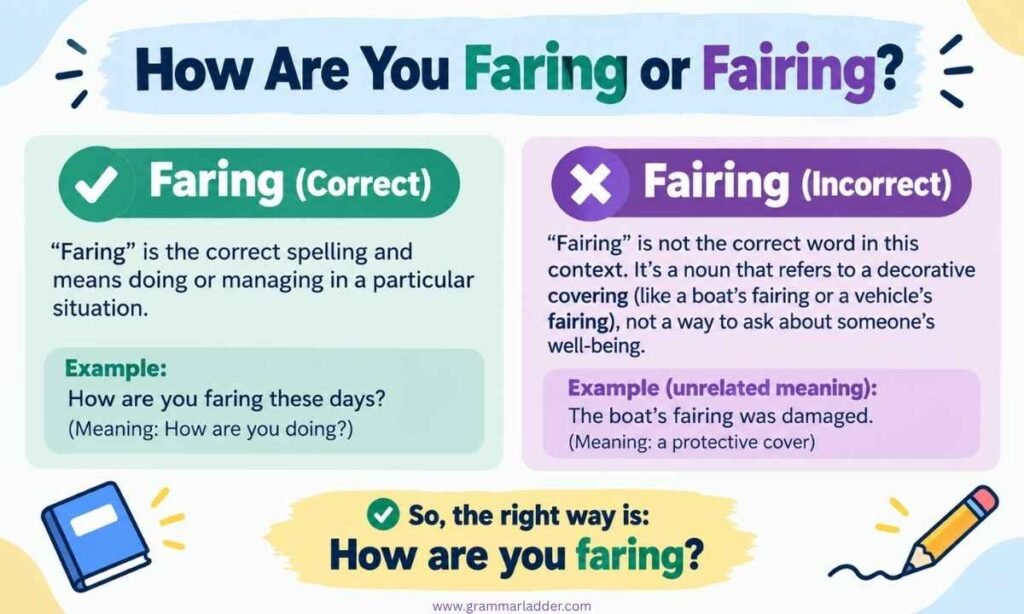
The correct phrase is “How are you faring?”
This is the question people get wrong most often. Here, the word describes how someone is coping or progressing. That is the job of the verb fare, so the spelling is faring.
“How are you fairing?” is a mistake, unless you are literally asking how someone is building a motorcycle cover.
Correct examples:
- How are you faring after the move?
- How is your sister faring in college?
- How are local farmers faring this season?
Incorrect examples:
- ~~How are you fairing today?~~
- ~~She is fairing well in her new role.~~
Both “How are you faring?” and “How are you doing?” are fine. “Faring” simply sounds a bit more polished, which suits emails and formal writing.
Common Mistakes People Make
Even strong writers slip on this pair. Here are the patterns to watch for.
- Writing “fairing” in a how-are-you question. This is the number one error.
- Using “fairing” for outcomes. Example: “The company is fairing well.” It should be faring.
- Writing “faring” for the vehicle part. Example: “The bike’s faring cracked.” It should be fairing.
- Confusing “fare” and “fair.” Spelling “fare well” as “fair well” is a related slip.
- Trusting spell check. Both words are real, so software rarely flags the wrong one.
A quick proofreading habit helps. Search your draft for “fairing” and “faring” and confirm each one fits its meaning.
Memory Tricks to Never Confuse Them Again
Simple tricks work better than rules. Pick the one that sticks.
Trick 1: The “fare” link.
Faring contains far, like a long trip. The verb is fare, so the spelling stays close to fare. Think: “faring, as in traveling through life.”
Trick 2: The “air” link.
Fairing contains air. Fairings manage airflow. Air equals aerodynamics equals fairing.
Trick 3: The “doing” swap.
If you can say “doing” instead, use faring.
Trick 4: The “I” in “fairing.”
Picture a motorcycle’s smooth front. The extra “i” can remind you of the shape of a sleek, upright shell. It is silly, but silly works.
| Word | Memory Hook |
| Faring | Far + journey, how you are getting along |
| Fairing | Air + shell, a part that cuts through air |
American vs British English Differences
Good news: there is no spelling difference between American and British English here. Both varieties use faring for getting along and fairing for the streamlined part.
What differs is mostly usage:
| Feature | American English | British English |
| Spelling of “faring” | faring | faring |
| Spelling of “fairing” | fairing | fairing |
| “Fairing” as a biscuit | Rare | Common in Cornwall and the UK |
| Tone of “How are you faring?” | Slightly formal | Slightly formal, a little more common |
| Related term for windshield | windshield | windscreen |
So you never need to switch spellings when writing for a different audience. The only extra culture note is the Cornish biscuit.
When to Use Fairing in Technical Writing
Use fairing whenever you describe a physical component that shapes airflow. This matters in manuals, product listings, repair guides, and engineering documents.
Typical contexts:
- Motorcycle repair: “Remove the lower fairing before accessing the engine.”
- Aviation: “Wing-to-body fairings reduce drag at the joint.”
- Aerospace: “The payload fairing separated at altitude.”
- Product descriptions: “Full-body ABS fairing kit, gloss black.”
- Cycling: “Aero fairings improve speed on flat roads.”
Tips for clean technical writing:
- Name the exact type (nose fairing, belly fairing, fork fairing).
- Stay consistent. Do not alternate between “fairing” and “cowling” unless they mean different parts.
- Use the plural fairings when describing a set.
- Link or define the term the first time if your readers are beginners.
In technical writing, “fairing” will never be a verb of well-being. If the sentence is about a person or result, the technical word is wrong.
When to Use Faring in Conversation or Writing
Faring is the right choice for any sentence about how someone or something is doing.
Everyday uses:
- Checking in: “How are you faring this week?”
- Business updates: “Retailers are faring well in the holiday quarter.”
- News writing: “Coastal towns are faring worse than inland cities.”
- Sports: “How is the defense faring against fast offenses?”
- Personal notes: “I hope you are faring well.”
Pairing tips:
- Add an adverb: well, badly, poorly, better, worse.
- Pair it with a subject: a person, group, market, or team.
- Keep the tense flexible: fares, fared, faring.
The past tense is fared: “She fared well on the test.” Never write “faired” for this meaning.
Why These Words Get Confused So Often
Several things make this pair tricky.
- They are homophones. Both are pronounced the same way, so your ear cannot help.
- Visual similarity. The only difference is one letter.
- Rarity of “fare” as a verb. People see “fare” as a ticket price, so the verb sense feels unfamiliar.
- Auto-correct and spell check. Both spellings are valid words, so errors slip through.
- Spoken habits. We hear “How are you faring?” aloud and guess the spelling when we write it.
Once you know the verb behind faring, the confusion fades fast.
Key Differences Between Fairing and Faring
| Feature | Faring | Fairing |
| Word type | Verb form (participle) | Noun |
| Root word | fare (Old English faran) | fair (to make smooth) |
| Core meaning | Getting along, performing | Streamlined cover |
| Used for | People, groups, results | Vehicles, aircraft, rockets |
| Typical setting | Conversation, news, emails | Engineering, repair, product listings |
| Example | “She is faring well.” | “The fairing reduces drag.” |
| Past form | fared | not applicable |
Quick Practice Quiz
Choose faring or fairing for each blank.
- How is your brother ______ after surgery?
- The mechanic replaced the cracked ______ on my motorcycle.
- Many startups are ______ better than analysts predicted.
- The rocket’s payload ______ opened in space.
- How are you ______ with the new schedule?
- A carbon-fiber ______ makes the bike more aerodynamic.
Answers:
- faring
- fairing
- faring
- fairing
- faring
- fairing
Score: 6/6 means you have it. 4–5 means you are close, so reread the memory tricks. Under 4 means keep the “doing” swap handy.
Frequently Asked Questions
Is it “fairing” or “faring” in “How are you faring?”
It is “faring.” The phrase asks how someone is getting along, which uses the verb fare.
What does “faring” mean?
It means getting along or performing, as in “The team is faring well.”
What is a fairing on a motorcycle?
It is a shell around the front or sides of the bike that reduces wind resistance and protects the rider.
Is “fairing well” correct?
No. Use “faring well” when you mean doing well.
What is the past tense of “fare”?
The past tense is “fared,” as in “She fared well.”
Is “faring” British or American?
Neither. It is spelled the same in both varieties.
What is a quick way to remember the difference?
Swap in “doing.” If it fits, write “faring.” If you mean a vehicle part, write “fairing.”
Can “fairing” ever mean something other than a vehicle part?
Yes. It can mean an old-fashioned fair gift or a Cornish ginger biscuit, but both uses are rare.
Conclusion
Faring and fairing sound alike but do very different work. Faring describes how someone is getting along. Fairing names a streamlined shell on a vehicle or aircraft.
When in doubt, use the “doing” swap. If you can say “How are you doing?”, write “How are you faring?” If you are talking about a motorcycle, plane, or rocket, write “fairing.”

I am an English writer with over four years of experience in grammar and language education.
Through Grammar Ladder, I share clear explanations, practical examples, and helpful English tips.
My goal is to share my knowledge so others can benefit and improve their language skills.
I believe anyone can master English with proper guidance and consistent practice.