If you’ve ever paused mid-sentence wondering whether to write “finalise” or “finalize,” you’re not alone. This is one of the most common spelling dilemmas in English, and it trips up writers, students, and professionals every day.
The good news? Both spellings are completely correct. The difference comes down to which version of English you’re writing in — British or American. This guide breaks down everything you need to know: the origin of both spellings, when to use each one, common mistakes to avoid, and how to choose the right version for your audience.
Finalise or Finalize
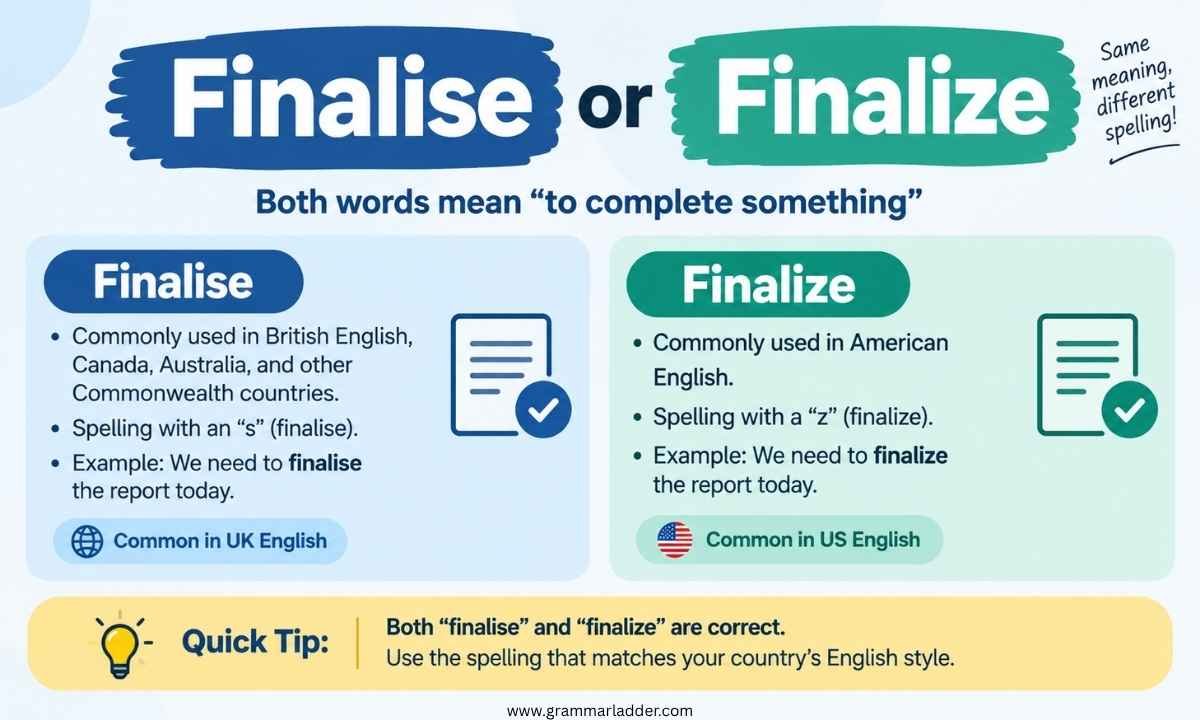
“Finalise” and “finalize” mean exactly the same thing — to complete or settle something, making it official or permanent. There is no difference in meaning, tone, or formality between the two. The only distinction is regional spelling convention:
- Finalise — British English (also used in Australia, Canada, and much of the Commonwealth)
- Finalize — American English
Neither word is more “correct” than the other. They’re simply two accepted spellings of the same verb, similar to “colour” vs. “color” or “organise” vs. “organize.”
Examples
- We need to finalise the contract before Friday. (British)
- We need to finalize the contract before Friday. (American)
- The team is finalising the wedding guest list. (British)
- The team is finalizing the wedding guest list. (American)
The Origin of Finalize and Finalise
“Finalize/finalise” comes from “final,” rooted in the Latin finalis (“relating to an end”). The verb form emerged in the early 20th century.
- “-ize” is actually the older suffix, rooted in Greek “-izein,” and is still recognized as valid in formal British English (Oxford style).
- “-ise” became more popular in everyday British usage over time, likely due to French spelling influence.
- American English standardized on “-ize” largely thanks to Noah Webster, who simplified spelling in the 1800s to give American English its own identity.
British English vs American English Spelling
The finalise/finalize split isn’t an isolated case — it’s part of a much broader pattern of spelling differences between British and American English.
Common Pattern
Many verbs that end in “-ise” in British English end in “-ize” in American English. This applies to a large family of words, not just “finalise/finalize.”
Examples
- Organise (British) → Organize (American)
- Realise (British) → Realize (American)
- Recognise (British) → Recognize (American)
- Apologise (British) → Apologize (American)
- Customise (British) → Customize (American)
- Specialise (British) → Specialize (American)
- Finalise (British) → Finalize (American)
Comparison Table
| Feature | Finalise | Finalize |
| Region | British, Australian, Canadian | American |
| Suffix | -ise | -ize |
| Meaning | To complete or settle | To complete or settle |
| Formality | Same | Same |
| Used in | UK, Australia, NZ, India (often) | USA, sometimes Canada |
| Dictionary status | Valid (Oxford, Cambridge) | Valid (Merriam-Webster) |
Which Spelling Should You Use?
Choosing between “finalise” and “finalize” depends almost entirely on your audience and the style guide you’re following. Here’s a simple breakdown to help you decide.
Use Finalise if:
- You’re writing for a British, Australian, or New Zealand audience
- Your organization follows UK English style guidelines
- You’re a student writing academic papers in the UK, Ireland, or Commonwealth countries
- Your content targets a European or international audience that leans toward British spelling
Use Finalize if:
- You’re writing for an American audience
- Your company or publication follows US English style guides (like AP or Chicago)
- You’re creating content for US-based businesses, apps, or platforms
- Your target readers are primarily based in the United States
For Global or SEO Content
If you’re writing for an international audience or optimizing content for search engines, consistency matters more than which spelling you pick. Choose one version and use it throughout the entire piece. Many global brands default to American English (“finalize”) simply because the US represents the largest English-speaking online audience, but this isn’t a strict rule — it’s a strategic choice based on where most of your readers are located.
Finalise or Finalize Synonym
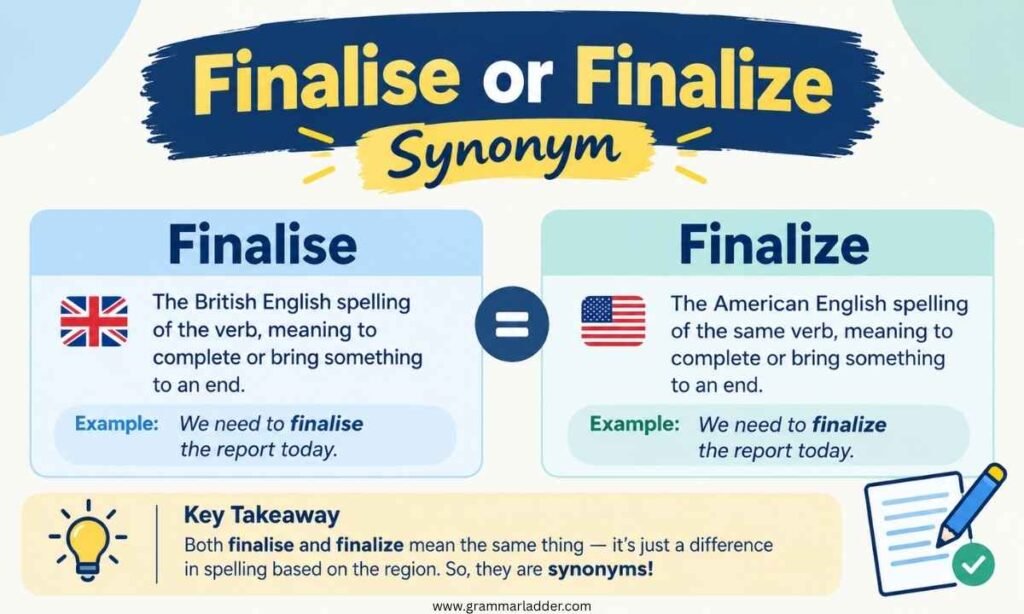
If you want to vary your writing or avoid repetition, several synonyms work well in place of “finalise/finalize,” depending on context:
- Complete
- Conclude
- Settle
- Confirm
- Wrap up
- Close out
- Seal (as in “seal the deal”)
- Approve
- Complete the details of
For example, instead of writing “Let’s finalize the plan,” you could say “Let’s confirm the plan” or “Let’s wrap up the plan,” depending on the tone you’re going for.
Finalise or Finalize in a Sentence
Seeing the word used in different contexts can help clarify how naturally it fits into everyday writing:
- Please finalize the budget before the end of the quarter.
- We’re still waiting to finalise the venue for the conference.
- Can you finalize the report and send it by 5 PM?
- The lawyers are working to finalise the terms of the agreement.
- Once you finalize your travel plans, let me know the dates.
- The couple hasn’t finalised their divorce yet.
Finalise or Finalize Meaning
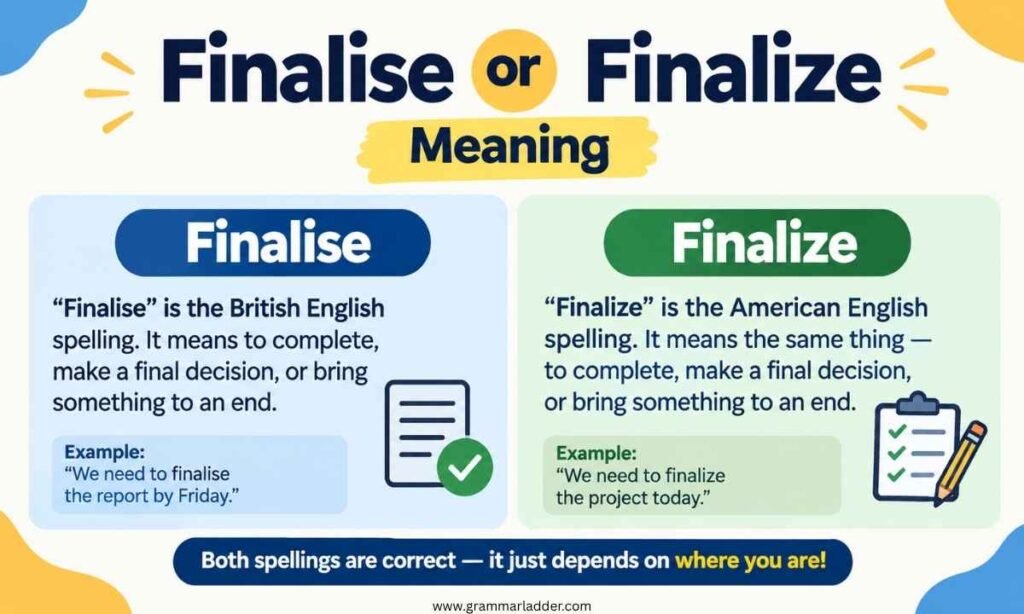
Both words carry the same core meaning: to make something final, complete, or official. It typically refers to the last step in a process — the point where decisions, edits, or negotiations are locked in and no further changes are expected.
Common contexts where you’ll see “finalize/finalise” used include:
- Business (finalizing contracts, deals, budgets)
- Legal matters (finalizing agreements, divorces, settlements)
- Events (finalizing guest lists, venues, schedules)
- Creative work (finalizing designs, drafts, edits)
- Travel (finalizing bookings, itineraries)
Common Mistakes with Finalize or Finalise
Even experienced writers slip up when it comes to this word pair. Here are the most frequent errors and how to avoid them.
Mixing spellings
One of the most common mistakes is using both “finalise” and “finalize” in the same document or piece of content. This looks inconsistent and unprofessional. Pick one spelling convention and stick with it throughout.
Assuming one is incorrect
Some writers mistakenly believe “finalise” is a misspelling of “finalize,” or vice versa. Both are correct — they simply belong to different English variants.
Thinking -ise is informal
There’s a misconception that “-ise” spellings are somehow less formal or less “proper” than “-ize” spellings. This isn’t true. Both suffixes appear in formal, academic, legal, and business writing depending on the regional context.
Changing spelling within one document
Switching between British and American spelling mid-document — not just for this word, but across your entire piece — signals a lack of editorial consistency. Always run a full consistency check before publishing.
Believing -ize is always American
While “-ize” is the standard in American English, it’s also an accepted (and historically preferred) spelling in formal British English, particularly in Oxford-style writing. So seeing “-ize” in a UK publication doesn’t necessarily mean it’s wrong.
Finalize and Finalise in Everyday Examples
Here’s how the word appears in real-world writing contexts:
Emails
“Hi team, please finalize the presentation slides by tomorrow morning so we can review before the client call.”
News Writing
News outlets typically follow their region’s default spelling. American publications like The New York Times use “finalize,” while British outlets like the BBC use “finalise.”
Social Media
Social media captions tend to be less formal, but the spelling still usually reflects the writer’s regional background: “Finally finalising my summer travel plans! ✈️”
Formal and Legal Writing
Legal documents almost always use the spelling standard of their jurisdiction. A US contract will say “finalize,” while a UK legal agreement will say “finalise.”
Finalize vs Finalise: Google Trends & Usage Data
Search interest data consistently shows that “finalize” is searched more frequently worldwide, largely because the United States has the largest population of English speakers online. However, “finalise” maintains strong and steady search volume in the UK, Australia, India, and other Commonwealth nations.
This reflects a broader trend across “-ise/-ize” word pairs: American spelling tends to dominate global search volume due to sheer population size, while British spelling remains the standard in a large number of English-speaking countries outside the US.
Comparison Table: Finalise vs Finalize
| Aspect | Finalise (British) | Finalize (American) |
| Spelling origin | French-influenced English tradition | Webster’s simplified spelling reform |
| Primary regions | UK, Australia, NZ, India | USA |
| Dictionary reference | Oxford English Dictionary | Merriam-Webster |
| Common in | Business, legal, academic (UK) | Business, legal, academic (US) |
| SEO recommendation | Use for UK/AU-targeted content | Use for US-targeted or global content |
Frequently Asked Questions
Is “finalise” or “finalize” correct?
Both are correct. “Finalise” is British English, and “finalize” is American English.
Which spelling should I use for business writing?
Match your audience — use “finalize” for American readers and “finalise” for British or Commonwealth readers.
Does Google penalize mixed spellings for SEO?
Google doesn’t directly penalize spelling variants, but inconsistency can hurt readability and professionalism.
Is “finalize” more commonly used globally?
Yes, largely due to the size of the American English-speaking audience online.
Can I use “finalise” in American writing?
It’s technically understood but considered non-standard; stick to “finalize” for US audiences.
What’s a good synonym for finalize?
“Complete,” “confirm,” or “settle” are common alternatives.
Conclusion
At the end of the day, “finalise” and “finalize” are two correct spellings of the same word, separated only by regional convention. There’s no right or wrong choice — only the right choice for your audience. If you’re writing for British, Australian, or Commonwealth readers, go with “finalise.” If your audience is American or global, “finalize” is the safer bet.
The most important rule isn’t which spelling you pick — it’s staying consistent throughout your writing. Whichever version you choose, make sure it matches your audience’s expectations and remains uniform across your entire document, website, or content strategy.

I am an English writer with over four years of experience in grammar and language education.
Through Grammar Ladder, I share clear explanations, practical examples, and helpful English tips.
My goal is to share my knowledge so others can benefit and improve their language skills.
I believe anyone can master English with proper guidance and consistent practice.