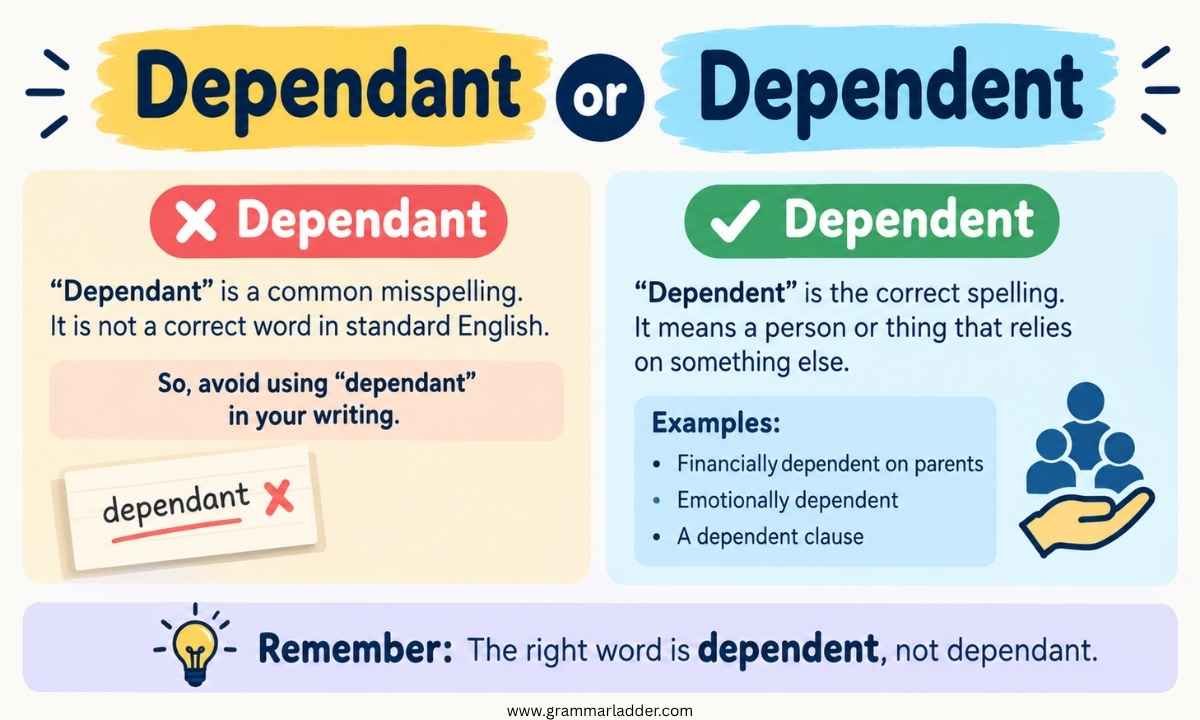
Few spelling pairs cause as much doubt as dependant and dependent. They sound identical and look almost the same. Yet one wrong vowel can make your writing look careless, especially on a visa form or tax document.
The short answer is that “dependent” is always safe as an adjective. The noun is where the two spellings split, and the split depends on where you live. This guide explains the rules, shows real examples, and gives you easy ways to remember them.
What Does Dependent Mean?
Dependent describes something that relies on another person, thing, or condition. It can also mean “determined by” something else.
- The project is dependent on funding.
- She is dependent on her parents for rent.
In the United States, dependent also works as a noun for a person who relies on someone else for financial support.
What Does Dependant Mean?
Dependant is a noun. It names a person who relies on another, usually for money, housing, or care. Think of a child, a non-working spouse, or an elderly parent.
- He listed his wife and two children as dependants.
Dependant is mainly used in British English. It is never an adjective.
Dependent or Dependant: What Is the Difference?
The difference is part of speech and region.
| Feature | Dependent | Dependant |
| Part of speech | Adjective (noun in US English) | Noun only |
| Meaning | Relying on or determined by something | A person who relies on someone |
| Used in UK English | Adjective only | Noun |
| Used in US English | Adjective and noun | Rare variant |
| Example | “Results are dependent on sample size.” | “She has three dependants.” |
When Should You Use Dependent?
Use dependent in these situations:
- Whenever you need an adjective, in any country.
- When you are writing American English and need a noun.
- When you follow a style guide or form that uses US spelling.
If you are unsure, dependent is the lower-risk choice. It is never wrong as an adjective.
When Should You Use Dependant?
Use dependant only when both conditions are true:
- You need a noun that means “a person who relies on someone.”
- You are writing British English, or following a British source such as UK government forms.
Using it as an adjective is always an error.
Dependent as an Adjective
As an adjective, dependent often takes the preposition on. It describes how one thing relies on another.
- Crop yields are dependent on rainfall.
- Teenagers can be heavily dependent on their phones.
- Approval is dependent upon a final check.
Both UK and US dictionaries agree here. The adjective always ends in -ent.
Dependent as a Noun
In American English, dependent is the standard noun. Tax forms in the US use it constantly.
- You may claim your child as a dependent.
- Each dependent must have a Social Security number.
In British English, the same noun is traditionally spelled dependant. Some modern UK writers use dependent for the noun too, so you will see both. Check the style guide you are following.
Dependent vs Dependant: Oxford Dictionary
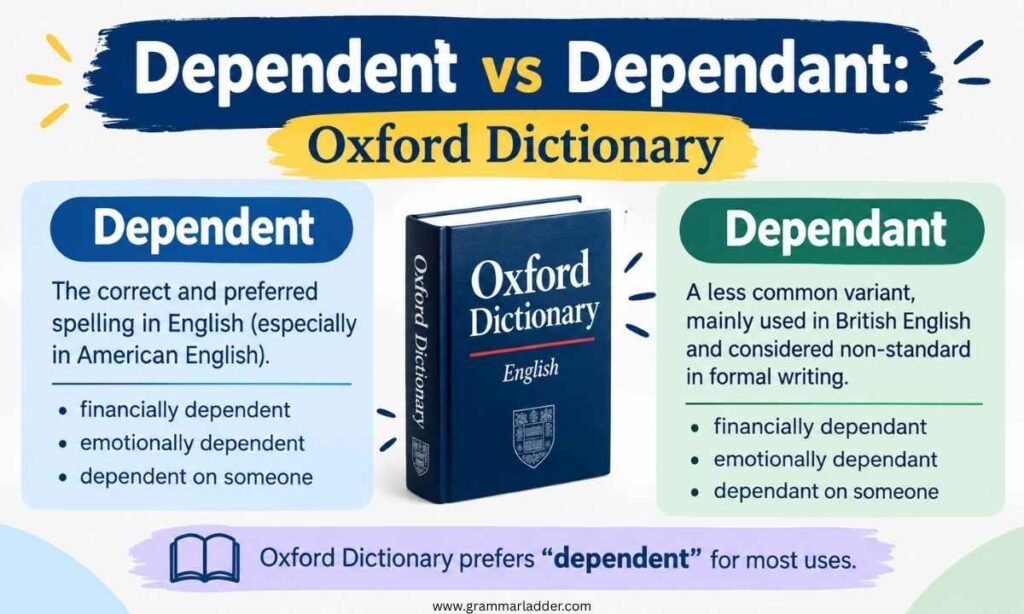
Oxford’s British entries treat dependent as the adjective and dependant as the noun. They also note that US English uses dependent for both. Other major references, including Merriam-Webster, list dependent as the main noun form and show dependant as a variant.
When a dictionary is your source, check which edition you are reading. British and American editions differ.
Common Phrases With Dependent
Dependent on
This is the most common phrase. It means “relying on” or “controlled by.”
- The schedule is dependent on the weather.
You may also see dependent upon in more formal writing. Avoid dependent of, which is incorrect.
Financially dependent
This describes someone who needs money from another person.
- Many students stay financially dependent on family.
Emotionally dependent
This means relying on another person for emotional comfort or stability.
- He became emotionally dependent on his partner.
Completely dependent
Use it when reliance is total.
- The village is completely dependent on one well.
Dependent variable
In research, this is the outcome you measure. It changes in response to another factor.
- Test scores were the dependent variable.
Dependent in Work and Business
In business, dependent describes links between people, tasks, or budgets.
- Task B is dependent on Task A finishing first.
- Sales are dependent on seasonal demand.
Project managers also talk about “task dependencies.” That word is a different noun, spelled with -encies, and it never confuses with dependent.
Dependent in Taxes and Benefits
Taxes are where many US readers meet the noun. A dependent is usually a child or relative you support, and you may claim them to lower your tax bill.
Rules differ by country and change often. Always check your tax authority’s current guidance, such as the IRS in the US or HMRC in the UK. This article explains spelling, not tax eligibility.
Employer health plans also use the term. “Dependent coverage” means insurance for a worker’s family members.
Dependent in Family Relationships
Within families, dependants are people who rely on someone’s income or care. Common examples include:
- Young children
- A spouse who does not earn an income
- Elderly parents
- Adult relatives with a disability
Legal documents such as wills and insurance policies use this wording. In UK documents, expect dependants. In US documents, expect dependents.
Dependent in Science and Research
Science uses dependent strictly as an adjective. A dependent variable is the thing you measure. It “depends” on the independent variable, which you change on purpose.
- Independent variable: The cause you change. Example: hours of sleep.
- Dependent variable: The effect you measure. Example: exam score.
This usage is identical in UK and US science writing.
Dependent and Independent
Independent is the opposite of dependent. Both end in -ent as adjectives.
- A dependent person relies on others.
- An independent person manages alone.
The noun independent (a voter with no party, say) mirrors the US noun dependent, which makes the US pattern easy to follow.
Dependent vs Dependant in British English
British English splits the pair:
- Dependent is the adjective.
- Dependant is the noun.
Example: “Applicants may bring dependants, but their income must be dependent on a sponsor.” UK government pages, immigration forms, and many newspapers follow this rule. Some modern UK publishers now accept dependent for both, so check your publication’s style guide.
Dependent vs Dependant in American English
American English is simpler. Dependent works as both an adjective and a noun.
- She is a dependent. (noun)
- She is dependent on her uncle. (adjective)
You will rarely see dependant in American publications. If you write for a US audience, use dependent every time.
Dependant or Dependent Visa
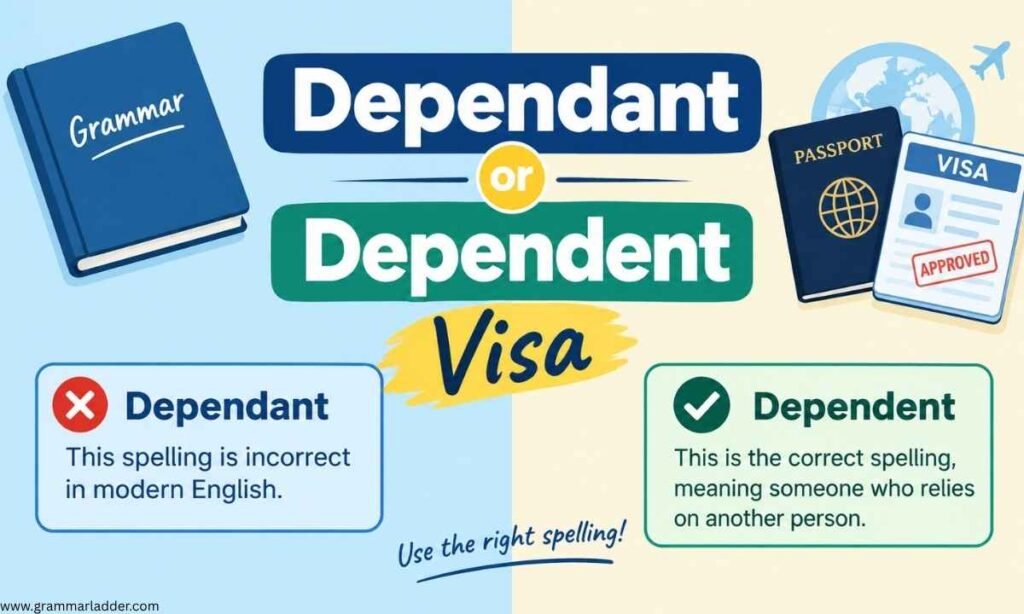
Immigration is where this spelling matters most. UK immigration material uses the noun dependant for family members who join a visa holder, such as “dependant partner” or “dependants of a Skilled Worker.”
Other countries differ. Many use dependent, as in “dependent child” or “dependent visa.” Always copy the exact spelling used by the official application you are completing. If the form says “dependant,” match it.
Why Do Dependent and Dependant Look Different?
The noun and adjective came from the same Latin root, dependere, meaning “to hang from.” English borrowed both through French.
Over time, British writers tried to separate the noun from the adjective, borrowing the pattern of words like assistant and descendant. American English dropped the distinction and settled on -ent for everything.
Common Mistakes With Dependent and Dependant
Watch for these slip-ups:
- Using “dependant” as an adjective. Wrong: “She is dependant on him.”
- Mixing spellings in one document. Pick one system and stay with it.
- Writing “dependent of.” The correct preposition is on.
- Confusing “dependence” and “dependance.” The correct noun is dependence.
- Ignoring your audience. A UK reader may expect dependants.
Dependent or Dependant in Formal Writing
In formal writing, consistency matters more than anything. Choose a regional standard and follow it throughout.
- For UK legal, HR, or immigration documents, use dependant for the noun.
- For US reports, contracts, and tax material, use dependent.
- Always match official forms exactly.
Dependent or Dependant in Everyday Conversation
In speech, nobody hears a difference. Both are pronounced, “dih-PEN-dent.” The question only arises when you type or write.
For emails, texts, and social posts, dependent is the safest pick. Few readers will object, and it avoids any adjective error.
Dependent in Academic Writing
Academic writers mostly use dependent as an adjective: dependent variable, dependent clause, dependent on. A dependent clause is a group of words that cannot stand alone as a sentence.
- Because it rained, we stayed home. (“Because it rained” is dependent.)
If your university uses British spelling, use dependants for people. Follow the department style guide.
How to Remember the Difference?
Try these memory tricks:
- Dependant has “ant.” Ants are small and often live in family groups. Picture a family of dependants.
- Adjectives end in -ent. If it describes something, use dependent.
- When in doubt, go with -ent. It is correct as an adjective everywhere and as a noun in the US.
- Match “descendant” and “assistant.” These UK-style nouns also end in -ant.
Examples of Dependent in Sentences
- Her recovery is dependent on rest.
- The team is dependent on a single supplier.
- You can claim a dependent on your tax return. (US)
- He is financially dependent on his brother.
- The outcome is a dependent variable in this study.
Examples of Dependants in Sentences
- The company offers health cover for employees and their dependants.
- She applied for a visa for herself and two dependants.
- A pension may pass to a surviving dependant.
- He has no dependants, so his costs are low.
- Each dependant must provide a valid passport.
A Quick Grammar Test
Ask two questions:
- Is the word describing something? Use dependent.
- Is it naming a person, and am I writing British English? Use dependant.
If both answers are no, you are probably writing American English, so use dependent.
Practice: Dependent or Dependant?
Fill in the blank, then check the answers below.
- Crop growth is ______ on sunlight.
- She listed her mother as a ______ (UK form).
- He is too ______ on his phone.
- Do you have any ______ under 18? (UK form)
- The ______ variable changed after treatment.
Answers: 1. dependent, 2. dependant, 3. dependent, 4. dependants, 5. Dependent.
Dependent or Dependant: Which One Should You Choose?
Here is a simple decision guide:
- Adjective, any country: Use dependent.
- Noun, US audience: Use dependent.
- Noun, UK audience: Use dependant.
- Official form: Match the spelling on the form.
- Unsure: Use dependent.
Final Tips for Using Dependent and Dependant
- Know your audience before you write.
- Use one spelling system per document.
- Check official forms for the exact spelling.
- Run a spell-check set to the correct English variant.
- Keep a style guide handy for work documents.
Frequently Asked Questions
Is it dependant or dependent?
Use dependent as an adjective everywhere. For the noun, use dependant in British English and dependent in American English.
Is “dependant” a real word?
Yes. It is a standard British noun meaning a person who relies on someone else for support.
Can dependent be used as a noun?
Yes. In American English, it is the standard noun, and many British writers now use it too.
What is the difference between dependent and dependence?
Dependent is an adjective (or US noun), while dependence is the noun for the state of relying on something.
Is it “dependent on” or “dependent of”?
The correct phrase is dependent on. “Dependent of” is incorrect.
Which spelling is used on UK visa forms?
UK immigration material uses dependant for family members who accompany an applicant.
Conclusion
The rule comes down to three points. Dependent is always correct as an adjective. Dependant is a British noun for a person who relies on someone. American English uses dependent for both roles.
Identify your audience, pick one standard, and stay consistent. If you ever feel stuck, choose dependent and double-check any official form that asks for a specific spelling.
Note: I wrote this from established dictionary and style-guide usage rather than a live review of the current top 10 search results. If you’d like, I can run a live SERP check to fine-tune the keywords, or put the article in a file (Word or HTML).

I am an English writer with over four years of experience in grammar and language education.
Through Grammar Ladder, I share clear explanations, practical examples, and helpful English tips.
My goal is to share my knowledge so others can benefit and improve their language skills.
I believe anyone can master English with proper guidance and consistent practice.