Typing “layed” and feeling unsure? You’re not alone. This is one of the most common spelling doubts in English, and the answer is short: “laid” is correct, and “layed” is a misspelling. This guide explains why, how to use lay, laid, lie, and lain correctly, and how to avoid the mistake for good.
Is Layed or Laid Correct?
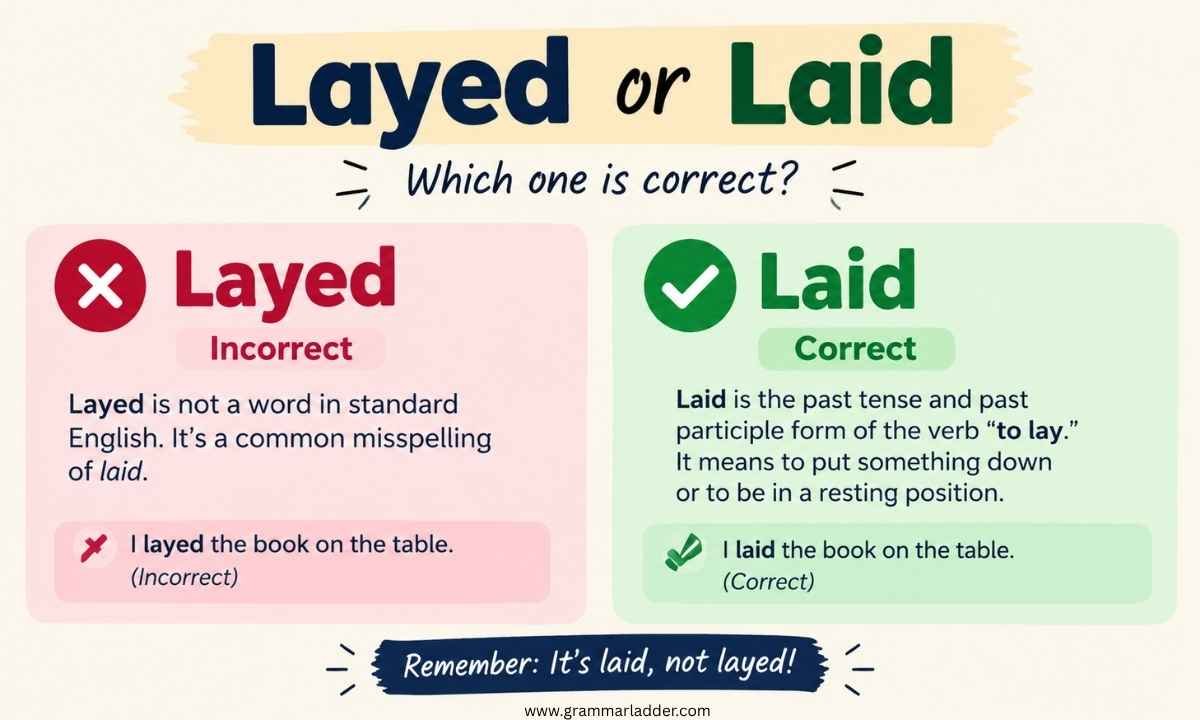
Laid is the correct spelling. It is the past tense and past participle of the verb lay. “Layed” does not appear as a standard form in major dictionaries, and spell-checkers flag it.
- ✅ She laid the keys on the table.
- ❌ She layed the keys on the table.
What Does Laid Mean?
Laid means to have put something down in a careful or deliberate way. It is the past form of lay, which always needs an object (the thing being put down).
Common meanings of laid:
- Placed something down: He laid the book on the desk.
- Produced an egg: The hen laid three eggs.
- Prepared or arranged: They laid the table for dinner.
- Set in place: The workers laid the foundation.
Why Does Layed Look Correct?
Most English verbs form the past tense by adding -ed: walk becomes walked, and play becomes played. Our brains expect lay to follow the same pattern, so “layed” feels natural.
But lay is irregular, and it behaves like two other familiar verbs:
- pay → paid
- say → said
- lay → laid
Nobody writes “payed” or “sayed” in standard English. The same rule applies here. (One small exception: “payed” is used in nautical writing, but that doesn’t affect laid.)
Lay, Laid, and Laying
Here are the three forms you need for the verb lay:
- Lay (present): I lay the cards on the table.
- Laid (past and past participle): I laid the cards down. I have laid them out.
- Laying (present participle): I am laying the cards down.
Notice that “layed” and “layd” appear nowhere in this list.
Layed vs Laid in Simple Sentences
Short examples make the rule easier to see.
- ❌ He layed his coat on the chair.
- ✅ He laid his coat on the chair.
- ❌ She has layed the plans out.
- ✅ She has laid the plans out.
- ❌ We layed the carpet yesterday.
- ✅ We laid the carpet yesterday.
Layed or Laid in Bed
People often write “I layed in bed all day.” That is wrong twice over: the spelling is off, and the verb is too.
You lie in bed, because nothing is being placed. The past tense of lie is lay.
- ✅ I lay in bed all morning.
- ✅ I laid the blanket on the bed. (There is an object: the blanket.)
- ❌ I layed in bed.
Layed or Laid Down
“Laid down” is correct when something is placed down.
- ✅ She laid down her pen.
- ✅ The soldiers laid down their weapons.
- ❌ She layed down her pen.
If a person rests their own body, use lay (the past of lie): “He lay down for a nap.”
Layed or Laid to Rest
The phrase “laid to rest” is always spelled with laid. It means buried, or settled for good.
- ✅ The poet was laid to rest on Sunday.
- ✅ The rumor was finally laid to rest.
The Difference Between Lay and Lie
This pair causes most of the confusion. The key is whether the verb takes an object.
- Lay = to put something down. It needs an object.
- Lie = to rest or recline. It has no object.
| Verb | Meaning | Example |
| Lay | Put something down | Lay the book on the shelf. |
| Lie | Recline yourself | Lie on the couch. |
Quick test: Ask, “Lay what?” If there’s an answer, use lay. If not, use lie.
Lay vs Lie in the Past Tense
The confusion peaks in the past tense, because “lay” is also the past tense of “lie.”
| Verb | Present | Past | Past participle | -ing form |
| Lay (put) | lay | laid | laid | laying |
| Lie (recline) | lie | lay | lain | lying |
Compare these two sentences:
- Yesterday I lay on the sofa. (reclined)
- Yesterday I laid the book on the sofa. (put something down)
A different verb, lie meaning “to tell a falsehood,” is regular: lie, lied, lied, lying.
I Lay, or I Laid?
It depends on what you mean.
- “I lay” works when you reclined: I lay awake all night.
- “I laid” works when you placed something: I laid my phone on the charger.
If you can’t decide, check for an object. No object usually means lay (past of lie).
What About “I Layed Down”?
“I layed down” is incorrect in every case. Choose one of these instead:
- ✅ I lay down (I reclined).
- ✅ I laid down the rules (I set something down).
Laid Down vs Lay Down
These two are different tenses and meanings, so don’t swap them.
- Lay down (present tense): used when you put something down now. Please lay down your bag.
- Laid down (past tense): used when you put something down earlier. He laid down his bag.
- Lay down (past of lie): used when someone reclined in the past. She lay down and slept.
Laid or Lain?
Lain is the past participle of lie. You use it with has, have, or had.
- ✅ The book has lain on the shelf for years.
- ✅ I have lain awake before.
- ❌ I have laid awake before.
Many native speakers say “laid” here, but formal English calls for lain.
Laying or Laying Down?
Laying needs an object. Laying down is the same verb plus a particle, and it works the same way.
- ✅ She is laying tiles in the kitchen.
- ✅ He is laying down the law.
- ❌ I am laying down on the sofa. (Use lying down.)
Lying or Laying?
Pick based on the same object test.
- Lying = resting or reclining: I’m lying on the floor.
- Laying = placing something: I’m laying the book on the floor.
Also remember that lying can mean telling untruths: He is lying about the delay.
Laid in Everyday English
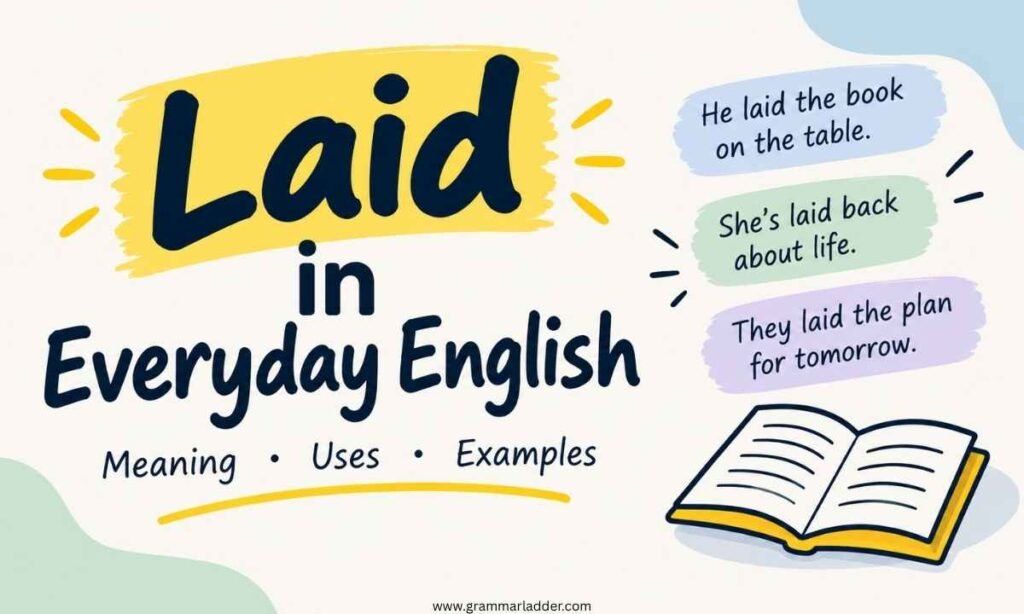
You’ll meet laid constantly in daily speech and writing:
- She laid out her clothes for tomorrow.
- We laid the baby in the crib.
- He laid his hand on my shoulder.
One caution: in casual speech, laid can also carry a slang sexual meaning. Use clear context so your sentence isn’t misread.
Laid in Construction and Building
In trades, laid describes work done in layers or rows.
- Bricks are laid.
- Flooring and carpet are laid.
- Pipes and cables are laid underground.
- A foundation is laid before walls go up.
Because the word is so common in technical writing, getting it right makes your work look more professional.
Laid in Business and Professional Writing
In offices and reports, laid often appears in a figurative sense:
- The CEO laid out a three-year strategy.
- The team laid the groundwork for the launch.
- The company laid off forty employees.
- Management laid down new policies.
Writing “layed off” in a report or email is a quick way to lose credibility.
Common Expressions With Laid
Here are idioms and phrasal verbs that use laid:
- Laid back: relaxed and easygoing
- Laid off: dismissed from a job
- Laid out: arranged or explained in detail
- Laid up: stuck in bed through illness or injury
- Laid bare: revealed completely
- Laid to waste: destroyed
- Laid low: made weak or humbled
- Laid the foundation: started something important
Common Mistakes With Layed
Watch for these frequent errors:
- Adding -ed to lay. Always use laid.
- Mixing up lay and lie. Check for an object.
- Using “laid” for “lain.” Lain is the correct past participle of lie.
- Writing “I laid in bed.” Use I lay in bed.
- Trusting how it sounds. Laid and “layed” sound identical, so rely on the spelling rule.
How to Remember Laid?
A few simple tricks help the spelling stick:
- Pay → paid, say → said, lay → laid. All three drop the y and add id.
- Lay needs an object. Think “lay something.”
- Lie has an ie, like lie down, and it has no object.
- Say it aloud. If “payed” looks wrong, so does “layed.”
Layed or Laid in Texting
Texts are casual, and typos pass without notice. Still, “layed” is a misspelling even in a quick message.
- ✅ I laid out my plan for tomorrow.
- ❌ I layed out my plan for tomorrow.
Autocorrect will often fix it, but don’t rely on that. Learning the right form takes a few seconds.
Layed or Laid in Formal Writing
In essays, emails to clients, reports, and resumes, correct forms matter. Mistakes with lay and lie can make strong writing look careless.
For formal work:
- Use laid for the past tense of lay.
- Use lay for the past tense of lie.
- Use lain after has, have, or had with lie.
If a sentence feels awkward, rewrite it: “She rested” is clearer than a shaky lay/lie choice.
Quick Comparison of Lay, Lie, Laid, and Lain
| Word | Verb form | Meaning | Example |
| Lay | Present of lay/past of lie | Put down / reclined (past) | Lay it here. He lay down. |
| Laid | Past and past participle of lay | Put down | She laid it here. |
| Lie | Present of lie | Recline | I lie on the grass. |
| Lain | Past participle of lie | Reclined | It has lain there for days. |
| Laying | -ing form of lay | Putting down | He is laying bricks. |
| Lying | -ing form of lie | Reclining (or fibbing) | She is lying down. |
Practice Questions
Choose the correct word. Answers are in the next section.
- She ___ the plates on the table.
- I ___ awake all night.
- The hens have ___ five eggs.
- He has ___ in bed since morning.
- They were ___ the carpet in the hall.
Correct the Mistakes
Fix each sentence, then check your work.
- ❌ He layed his bag by the door.
- ❌ I layed on the couch after lunch.
- ❌ She was layed off last month.
- ❌ The cat has laid there for hours.
Answers to practice questions: (1) laid, (2) lay, (3) laid, (4) lain, (5) laying.
Corrections: (1) He laid his bag by the door. (2) I lay on the couch after lunch. (3) She was laid off last month. (4) The cat has lain there for hours.
Final Tips
- Remember: laid is always right, and “layed” is always wrong.
- Look for an object before choosing lay or lie.
- Use the paid/said/laid pattern as a memory aid.
- Reread important writing for lay/lie slips, which are easy to miss.
- When unsure, rephrase the sentence.
Frequently Asked Questions
Is “layed” ever correct?
No. “Layed” is not an accepted standard spelling, so use “laid.”
What is the past tense of lay?
The past tense of lay is laid.
What is the past tense of lie?
For reclining, it is lay. For telling falsehoods, it is lied.
Is it “I laid in bed” or “I lay in bed”?
“I lay in bed” is correct, because you are reclining and no object is involved.
What is the past participle of lie?
It is lain, as in “She has lain there all day.”
Is “laid back” one word or two?
It is written as two words, or hyphenated before a noun: “a laid-back attitude.”
Is “laying down” correct?
Only when you’re placing something, as in “laying down the rules.” For reclining, use “lying down.”
Why is “laid” confusing?
It sounds like “lay” in the past and clashes with the -ed pattern, so many writers add an extra -ed by habit.
Conclusion
The rule is simple: laid is correct and layed is not. Remember that lay is irregular, like pay and say, and check for an object when deciding between lay and lie. With the tables and tips above, you can write laid, lay, and lain with confidence in texts, emails, and formal documents alike.

I am an English writer with over four years of experience in grammar and language education.
Through Grammar Ladder, I share clear explanations, practical examples, and helpful English tips.
My goal is to share my knowledge so others can benefit and improve their language skills.
I believe anyone can master English with proper guidance and consistent practice.