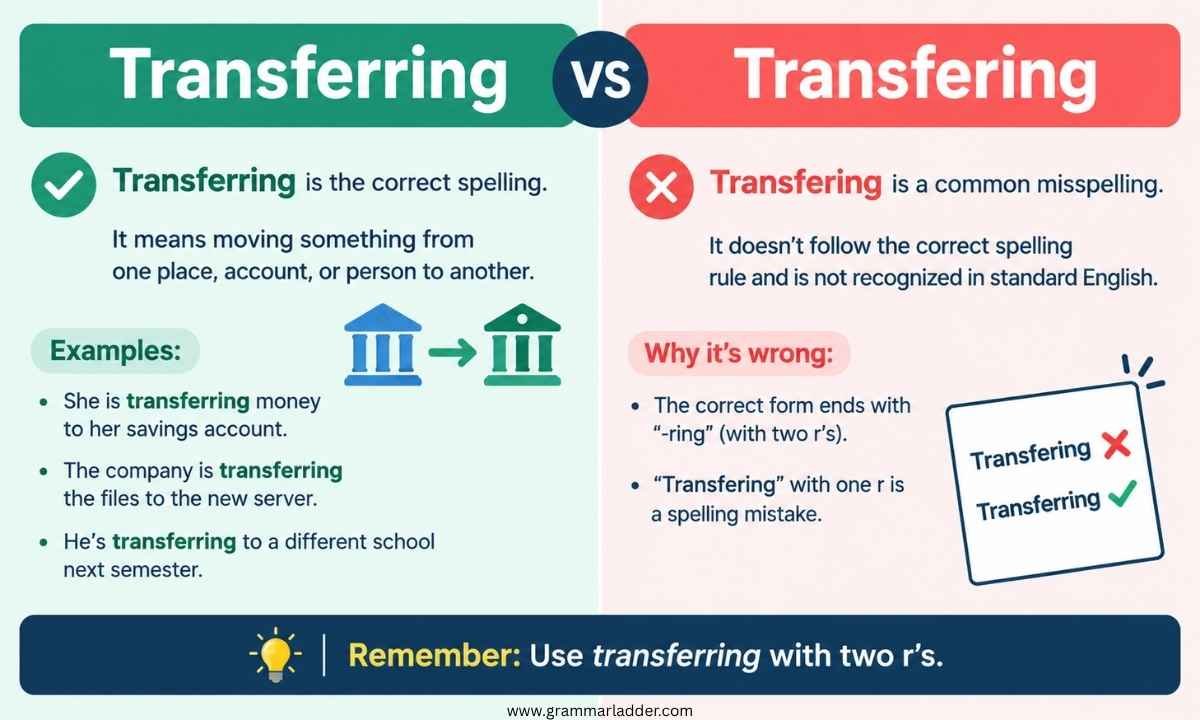
Many writers pause when they type this word. Is it “transferring” or “transfering”? The spelling looks small, but it shows up in emails, essays, and bank messages every day. One missing letter can make your writing look careless.
The correct spelling is “transferring,” with two r’s. The word “transfer” stresses its last syllable, so the r doubles before -ing. Once you know this rule, you will never miss it again.
Quick Answer: Transferring vs Transfering
- “Transferring” is the correct spelling.
- “Transfering” is always wrong.
- This is true in American, British, Canadian, and Australian English.
- The last “r” in transfer doubles before -ing.
- Example: transfer → transferring
What Does Transferring Mean?
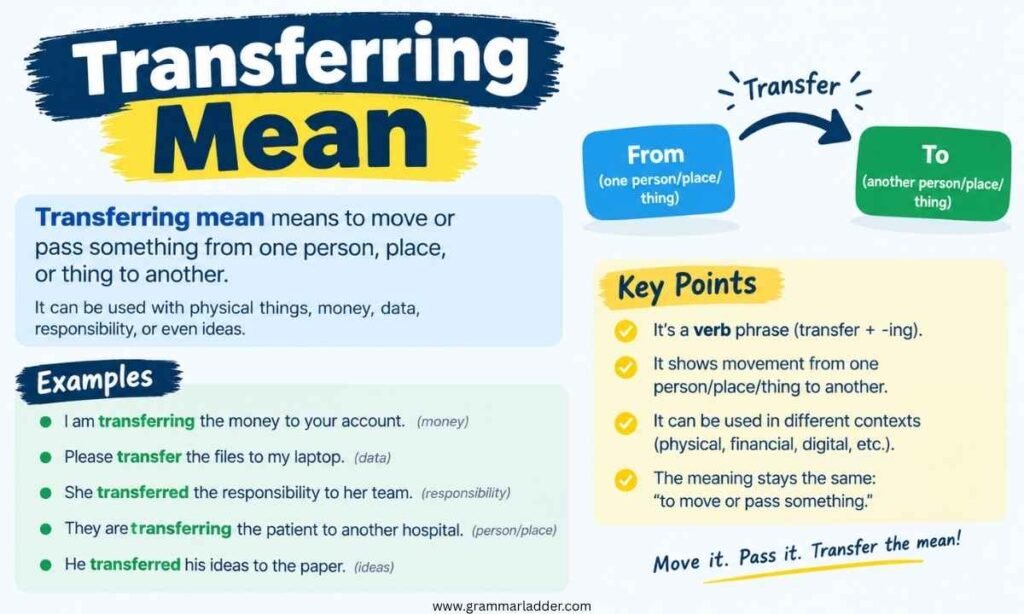
Transferring is the present participle of the verb transfer. It describes the act of moving something or someone from one place, person, or state to another.
Transferring as Moving Something
In its most common sense, transferring means handing over or moving something so it belongs to, or is held by, someone or something else.
- She is transferring money to her savings account.
- The company is transferring ownership of the property next month.
- I’m transferring the files to a new laptop.
Transferring as Changing Location or Position
Transferring also covers people or things changing place, role, school, or vehicle.
- He is transferring to the Lahore office in January.
- She’s transferring to a different university.
- We’re transferring at Heathrow for our connecting flight.
Why “Transfering” Is Incorrect
The Double-Consonant Rule
English doubles the final consonant of a verb before a suffix like -ing or -ed when two conditions are met:
- The verb ends in a single vowel followed by a single consonant.
- The stress falls on the last syllable.
Transfer is pronounced trans-FER, with stress on the final syllable, so the “r” doubles:
- transfer → transferring
- transfer → transferred
If the stress were on the first syllable, the consonant would stay single, as in offer → offering. Because transfer is stressed at the end, “transfering” breaks the rule and looks wrong.
Transferring or Transfering UK
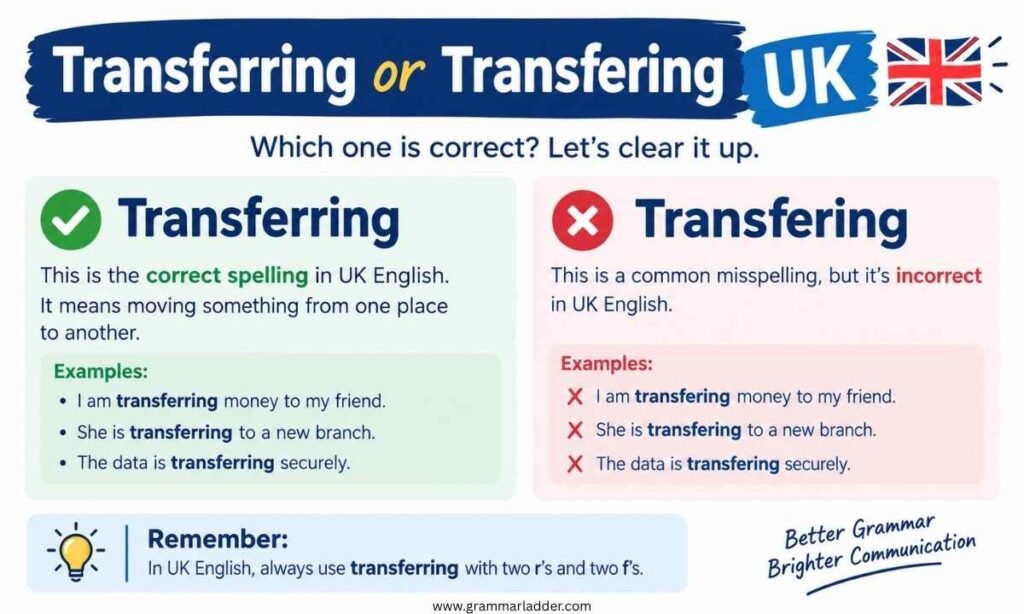
Both are the same in the UK: transferring. People often assume British English differs because of words like travelling and cancelling, which British English doubles but American English usually doesn’t. That difference doesn’t apply here. Both varieties double the “r” in transferring.
Transferring vs Transfering: Comparison Table
| Spelling | Correct? | Notes |
| Transferring | ✅ Yes | Standard in all varieties of English |
| Transfering | ❌ No | Common misspelling; breaks the doubling rule |
| Transferred | ✅ Yes | Past tense, same doubling |
| Transfered | ❌ No | Misspelling of the past tense |
Examples of Transferring in Sentences
- The bank is transferring your balance to the new account.
- Students transferring from other schools must submit their transcripts.
- She spent the afternoon transferring photos from her phone.
- The doctor is transferring the patient to a specialist.
- We are transferring the domain to a new hosting provider.
- He’s transferring his skills from teaching to corporate training.
Common Mistakes with Transferring
- Dropping the double “r”: writing transfering or transfered.
- Over-correcting nouns: the noun is transfer with a single “r” (a bank transfer, not a bank “transferr”).
- Doubling in the wrong places: transferrence is wrong. The correct noun is transference, because the stress shifts to the first syllable (TRANS-fer-ence), so no doubling occurs.
- Confusing “transferable”: both transferable and transferrable appear in dictionaries, but transferable is far more common and is the safer choice.
Quick memory trick: if you can hear the stress on the last syllable (trans-FER), double the “r.”
Similar Words That Follow the Same Rule
Other verbs stressed on the final syllable double their last consonant too:
- refer → referring, referred
- prefer → preferring, preferred
- defer → deferring, deferred
- confer → conferring, conferred
- occur → occurring, occurred
- admit → admitting, admitted
- submit → submitting, submitted
Verbs stressed on the first syllable keep the single consonant:
- offer → offering
- suffer → suffering
- differ → differing
- enter → entering
American vs British English
For this word there is no difference between American and British English. Both use transferring and transferred.
The well-known spelling split involves verbs ending in “l” with unstressed final syllables. British English doubles the “l” (travelling, cancelling, labelling), while American English typically doesn’t (traveling, canceling, labeling). Since transfer ends in “r” with a stressed final syllable, that split doesn’t apply.
Frequently Asked Questions
Is “transfering” ever correct?
No. It is a misspelling in a wide variety of English.
What is the past tense of transfer?
Transferred, with a double “r.”
Why does “transfer” double the “r” but “offer” doesn’t?
Stress. Transfer is stressed on the last syllable (trans-FER), while offer is stressed on the first (OF-fer).
Is it “transferable” or “transferrable”?
Both are listed in dictionaries, but transferable is the more common and widely preferred spelling.
Is the noun spelled “transfer” or “transferr”?
Always transfer. The doubling happens only when a suffix like -ing or -ed is added.
Conclusion
The correct spelling is transferring, never “transfering.” Remember that transfer is stressed on its final syllable, so the “r” doubles before -ing and -ed. Use the same rule for referring, preferring, and occurring, and your spelling will be right in both American and British English.
If you’d like, I can put this in a file (Word or Markdown) or adjust the tone and length for your site.

I am an English writer with over four years of experience in grammar and language education.
Through Grammar Ladder, I share clear explanations, practical examples, and helpful English tips.
My goal is to share my knowledge so others can benefit and improve their language skills.
I believe anyone can master English with proper guidance and consistent practice.