You are typing an email and stop mid-sentence: reinforce or reenforce? Both look right, and spell-check may not settle it for you.
This guide explains the difference, shows how each word works in a sentence, and gives you a simple rule to follow every time. By the end, you will know which spelling to use and why.
Quick Answer
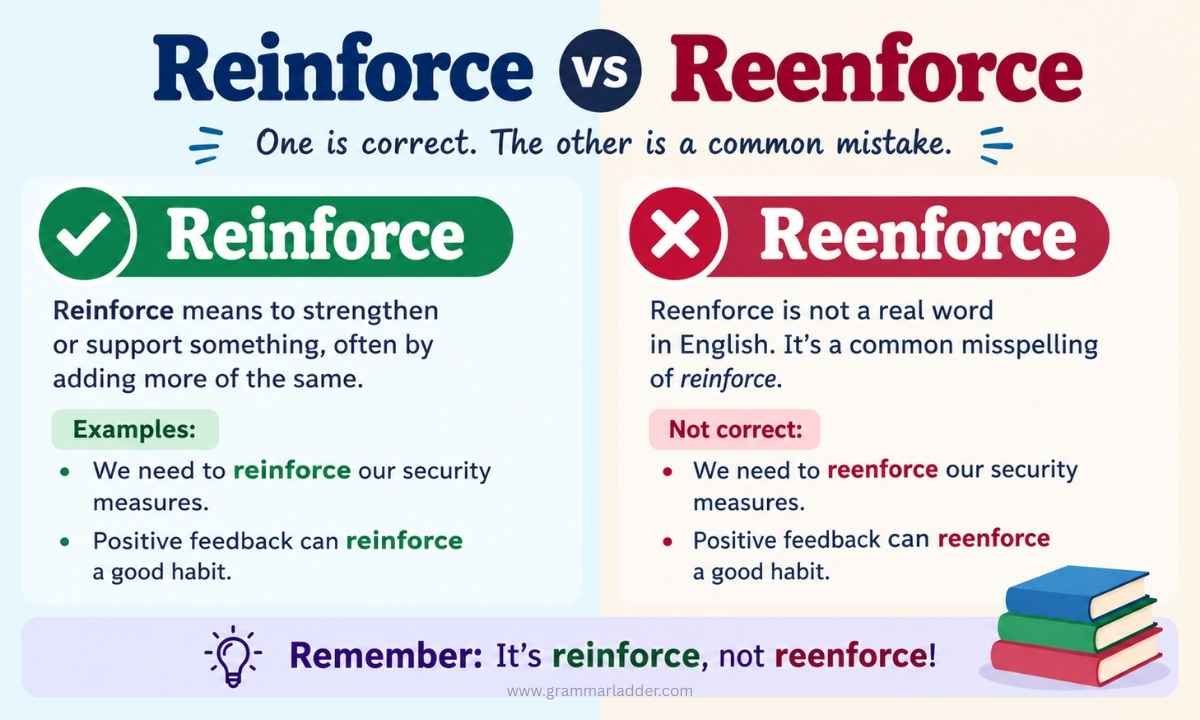
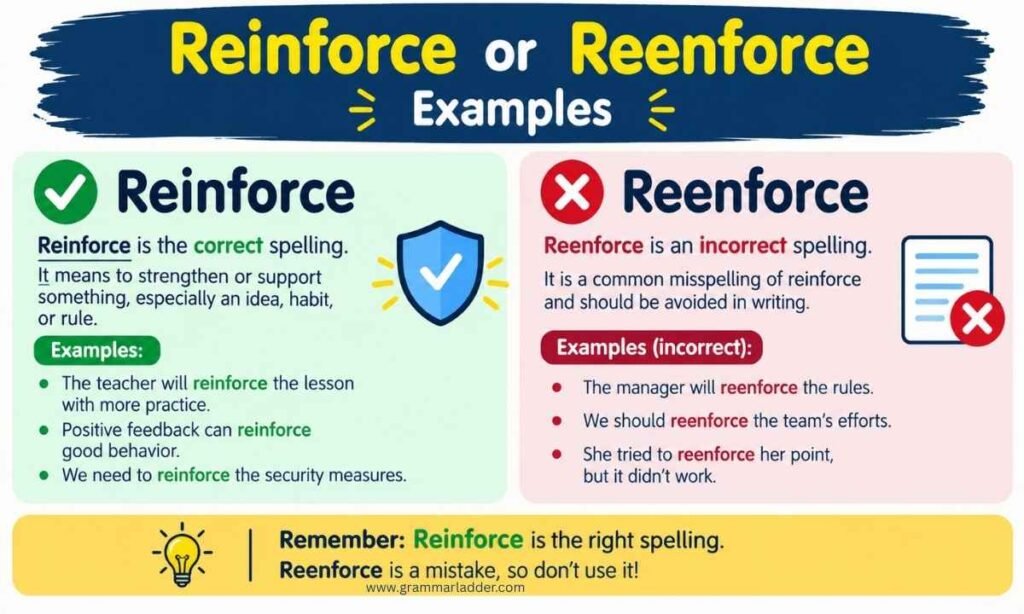
“Reinforce” is the correct spelling. It means to strengthen, support, or make something more effective.
“Reenforce” is a rare, outdated variant of the same word. Modern dictionaries and style guides favor “reinforce,” and so should you.
Correct: The coach used drills to reinforce good habits.
Avoid: The coach used drills to reenforce good habits.
There is one narrow exception, covered later: the hyphenated “re-enforce,” meaning “to enforce again.”
Why Do People Confuse It?
The confusion is easy to understand. Three things cause it:
- The “re-” prefix. Most “re-” words add the prefix directly to a root word, as in rewrite or rebuild. So re + enforce seems like it should give “reenforce.”
- The sound. In speech, “reinforce” and “reenforce” sound almost the same.
- The word “enforce.” Because “enforce” is a real word, the brain assumes “reenforce” is just its repeat form.
In reality, “reinforce” came from older forms built on inforce, a past spelling of “enforce.” The “rein-” opening stuck over time, and the spelling became fixed.
Reinforce
Reinforce is a verb. It means to make something stronger, firmer, or more effective by adding support, force, or evidence.
You can reinforce things in three main ways:
- Physically: adding material to make a structure stronger.
- Figuratively: strengthening an idea, belief, or habit.
- Militarily: sending extra troops or supplies.
Examples:
- Builders reinforced the bridge with steel beams.
- Her results reinforce the earlier findings.
- Teachers often reinforce lessons with short quizzes.
Other Forms of Reinforce
Every form keeps the “rein-” spelling:
- Reinforces: This study reinforces her point.
- Reinforced: The box is reinforced with tape.
- Reinforcing: A reinforcing message works best.
- Reinforcement(s): Reinforcements arrived by morning.
- Reinforcer: A treat can be a reinforcer in training.
You will never see “reenforcement” in professional writing.
Reenforce
Reenforce is a variant spelling of “reinforce.” It appears in older books and documents but is now uncommon.
Some dictionaries still list it, usually as an alternate or dated form. That means it is not strictly wrong, but it is not standard either. Editors will almost always change it to “reinforce.”
Is “Reenforce” Ever Used?
Yes, but rarely, and in two situations:
- Older texts. Writers from the 1800s and early 1900s sometimes used it, and you may spot it in historical material.
- The hyphenated “re-enforce.” Here the prefix has a real job: it means “to enforce again.”
Example: After the loophole was found, the city decided to re-enforce the old parking rule.
In that sentence, the writer means enforce once more, not strengthen. Even so, many writers choose clearer wording such as “enforce again” or “reinstate” to avoid confusion.
Reinforce or Reenforce Synonym
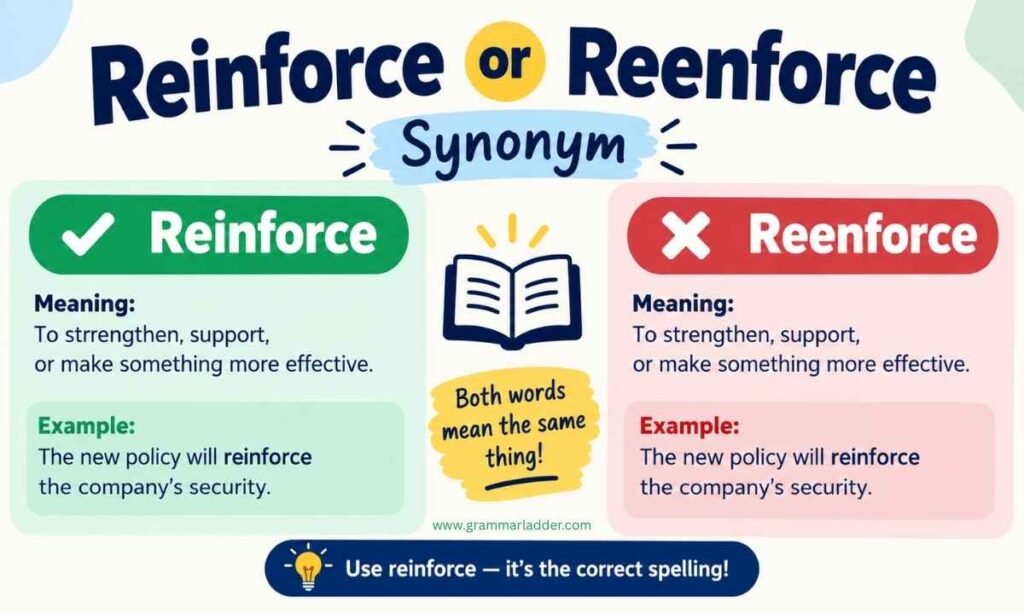
If you want to avoid the spelling question altogether, use a synonym. The best choice depends on context.
Synonyms for “reinforce”:
- Strengthen
- Support
- Bolster
- Fortify
- Buttress
- Back up
- Underscore
- Substantiate
- Shore up
Context matters:
- For buildings and objects, try strengthen, fortify, or shore up.
- For ideas and arguments, try bolster, underscore, or substantiate.
- For teams and armies, try support or back up.
Reinforce or Reenforce Meaning
Here is how the meaning breaks down for each spelling.
Reinforce means:
- To strengthen with extra support or material
- To make an idea, feeling, or behavior stronger
- To add troops or resources to a force
- In psychology, to encourage a behavior through rewards or consequences
The psychological sense is common in education and parenting. A child who gets praise after finishing homework is more likely to repeat the behavior. That praise is called positive reinforcement, a term linked to behavioral psychology and the work of B.F. Skinner.
Reenforce means:
- A rare variant of “reinforce” with the same meaning
- When hyphenated (“re-enforce”), to enforce again
Reinforce vs Reenforce: Comparison Table
| Feature | Reinforce | Reenforce |
| Status | Standard, correct spelling | Rare, dated variant |
| Meaning | Strengthen or support | Same as reinforce (rarely: enforce again) |
| Modern usage | Very common | Very uncommon |
| Used in formal writing | Yes | No |
| Accepted by style guides | Yes | Generally not recommended |
| Noun form | Reinforcement | Reenforcement (rare) |
| Region | US and UK | Occasional older usage |
| Safe to use? | Always | Avoid |
When Should You Use Each?
The short rule: use “reinforce” almost every time. The details are below.
When to Use “Reinforce”
Choose “reinforce” in all of these cases:
- Academic papers, reports, and business writing
- Blog posts, emails, and social media
- Creative writing and journalism
- Any situation where you mean strengthen, support, or encourage
This covers essentially every real-world use.
When to Use “Reenforce”
Use it only in rare cases:
- Quoting a historical source that used the older spelling
- Writing “re-enforce” with a hyphen when you truly mean enforce again
Outside those cases, skip it. Readers may think it is a typo, and that can weaken your credibility.
Reinforce or Reenforce Examples
Seeing the words in context makes the rule stick. These examples show correct usage across different settings.
Everyday life
- Regular practice will reinforce what you learned in class.
- He wore a patch to reinforce the torn knee of his jeans.
Work and business
- The new data reinforces our decision to expand.
- Managers should reinforce company values through daily actions.
Education and psychology
- Teachers reinforce good behavior with praise.
- Consistent routines reinforce a sense of safety in young children.
Construction and engineering
- Reinforced concrete uses steel bars to resist cracking.
- The crew reinforced the old roof before the monsoon season.
Military and history
- Reinforcements arrived just before dawn.
- The general reinforced the northern border.
Hyphenated exception
- The council voted to re-enforce the noise ordinance after months of neglect.
Common Mistakes
Even careful writers slip up. Here are the errors to watch for.
- Writing “reenforce” as the default spelling. This is the biggest one. Use “reinforce.”
- Writing “reenforcement.” The correct noun is “reinforcement.”
- Confusing “reinforce” with “enforce.” They are different words.
- Enforce means to make people follow a rule.
- Reinforce means to strengthen something.
- Using “reinforce” when you mean “reinstate.” If a rule is coming back, “reinstate” or “re-enforce” may fit better.
- Mixing spellings in one document. Stay consistent, and choose “reinforce.”
Memory Trick
Here are two easy ways to remember the right spelling.
Trick 1: Spot the “in” inside “reinforce.”
The word has “in” in the middle, and you are adding strength into something. Reinforce = re+in+force. More force goes in.
Trick 2: Think of the word “force.”
Reinforce contains the word force. When you reinforce something, you add force or strength to it.
Bonus tip: If you see “reenforce” on a page and your gut says something is off, trust it. Switch to “reinforce.”
American vs British English
Unlike many word pairs, this one does not split along regional lines. Americans and Britons both use reinforce as the standard spelling.
- American English: Reinforce. “Reenforce” is dated.
- British English: Reinforce. “Reenforce” is dated.
- Canadian and Australian English: Reinforce. They follow the same pattern.
So you do not need to adjust the spelling for your audience. This is one case where all wide English varieties agree.
Frequently Asked Questions
Is “reenforce” a real word?
It appears in some dictionaries as a rare variant, but “reinforce” is the standard spelling.
Which is correct, reinforce or reenforce?
“Reinforce” is correct. Use it in all formal and informal writing.
What does “reinforce” mean?
It means to strengthen or support something, such as a structure, an idea, or a habit.
Is “re-enforce” with a hyphen correct?
Yes, but only when you mean “enforce again.” It does not mean “strengthen.”
What is the noun form of reinforce?
The noun is “reinforcement,” or “reinforcements” in the plural.
What is the difference between reinforce and enforce?
“Enforce” means making sure rules are followed, while “reinforce” means making something stronger.
Is “reinforce” used differently in the UK and the US?
No. Both use the same spelling and meaning.
What is a good synonym for reinforce?
“Strengthen” works in most cases, and “bolster” suits ideas and arguments.
Conclusion
The choice between reinforce and reenforce is simple. “Reinforce” is the standard, correct spelling in American, British, and every other major form of English. “Reenforce” is an old variant that belongs mostly in historical texts.
Only use the hyphenated “re-enforce” when you truly mean “enforce again,” and even then, clearer wording often works better.

I am an English writer with over four years of experience in grammar and language education.
Through Grammar Ladder, I share clear explanations, practical examples, and helpful English tips.
My goal is to share my knowledge so others can benefit and improve their language skills.
I believe anyone can master English with proper guidance and consistent practice.