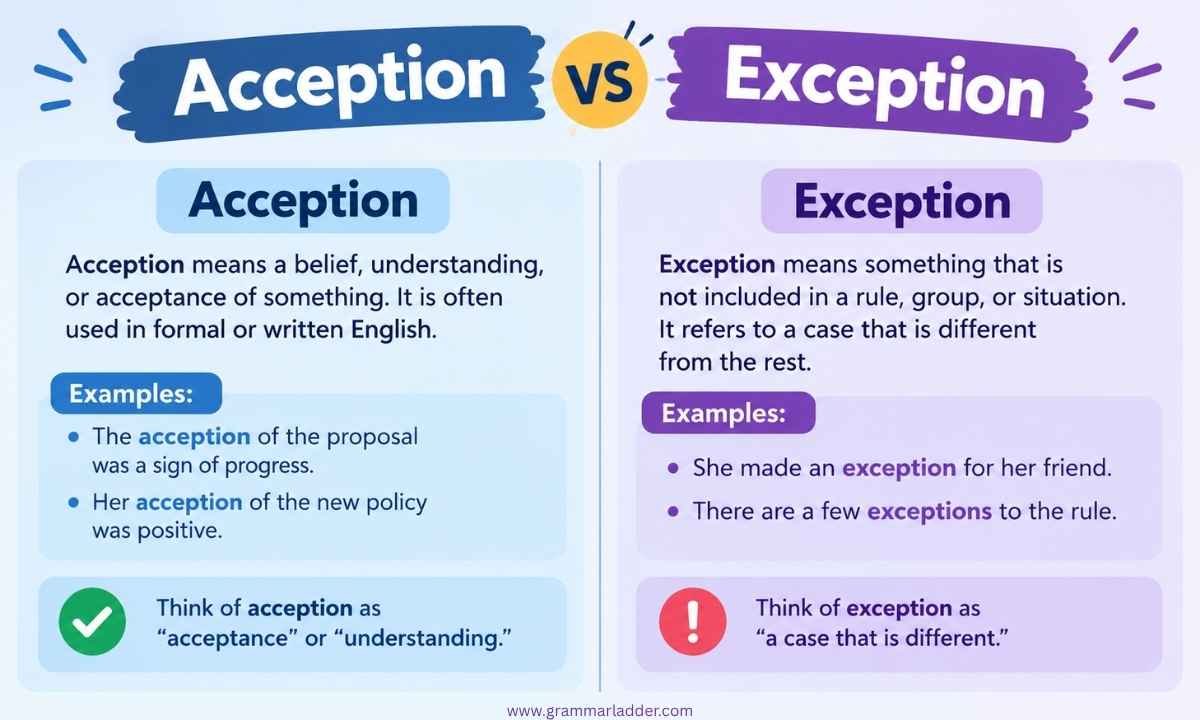
You are typing an email and want to say you will bend a rule just this once. Do you write “I’ll make an acception” or “I’ll make an exception”? The two words look alike and sound alike, so it is easy to second-guess yourself.
The short version is that one of them is a normal everyday word and the other is a rare, almost obsolete one. This guide explains the meaning of each, how they work in a sentence, and why writers mix them up. You will also get examples, a comparison table, and a memory trick you can use right away.
Quick Answer
Use “exception” in almost every situation. It means something that is left out, excluded, or does not follow the usual rule.
“Acception” is a rare, largely archaic word. It refers to the accepted meaning of a word or phrase. Most modern writers never need it, and spell checkers often flag it as an error.
If you are unsure, write “exception.” You will be right more than 99 percent of the time.
What Does “Exception” Mean?
“Exception” is a noun. It describes a person, thing, or case that does not follow a general rule or is left out of a group. It comes from the Latin exceptio, which means “a taking out.”
Major dictionaries list several senses:
- An excluded case: “Everyone passed the test, with one exception.”
- A deviation from the norm: “Winter is usually cold here, but this year was an exception.”
- An objection: “She took exception to the comment” (meaning she was offended).
- A technical error event: In programming, an exception is a problem that interrupts normal code execution.
Related words include except (preposition or verb), exceptional (adjective), exceptionally (adverb), and exceptionable (open to objection).
What Does “Acception” Mean?
“Acception” is a noun too, but it is far less common. It comes from the Latin acceptio, meaning “a receiving.” Historically, it had two uses:
- The accepted meaning of a word. For example, “In its common acception, the word ‘liberal’ has several political shades.”
- The act of accepting or receiving. This sense is now obsolete.
Today, “acception” appears mostly in older literature, legal writing, and academic discussions of word meaning. If you read a text from the 1800s, you may well meet it. In modern writing, “acceptance” or “meaning” is the usual choice.
Acception vs Exception: Side-by-Side Comparison
| Feature | Exception | Acception |
| Part of speech | Noun | Noun |
| Core meaning | Something excluded or not following a rule | The accepted meaning of a word |
| Origin | Latin exceptio | Latin acceptio |
| Frequency today | Very common | Very rare |
| Related words | except, exceptional, exceptionally | accept, acceptance, acceptation |
| Typical use | Everyday writing, law, tech | Archaic, literary, linguistic |
| Safe to use? | Yes | Only in specific contexts |
Notice the related word “acceptation.” It is the more standard spelling of the same idea, and dictionaries often list “acception” as a variant of it.
Acception vs Exception Grammar
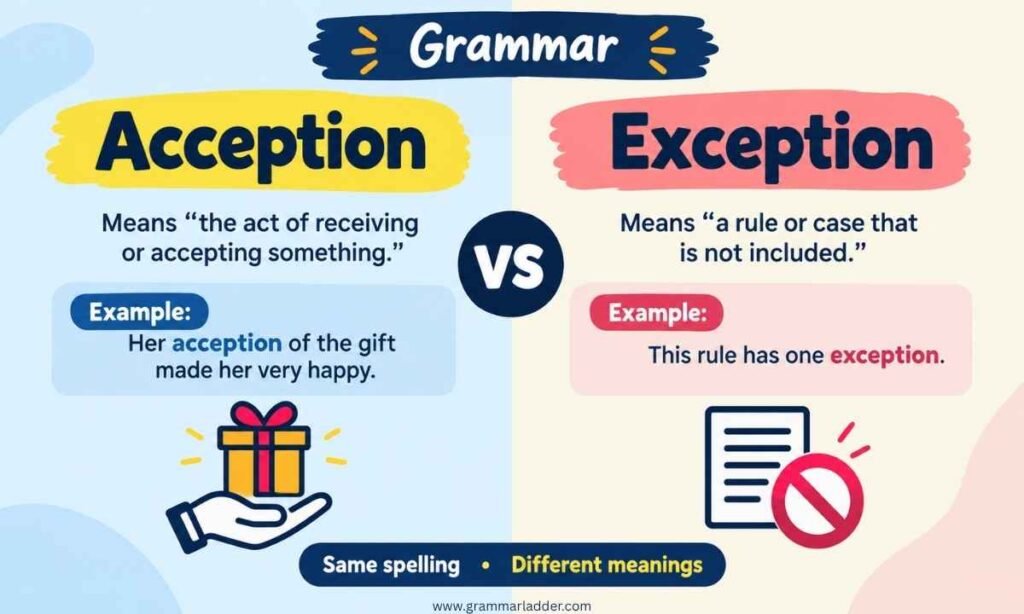
Both words are countable nouns, so they can be singular or plural. You will see “exceptions” often. “Acceptions” is possible but extremely rare.
Here is how “exception” behaves in common phrases:
- Make an exception: “I’ll make an exception this time.”
- Be the exception: “He is the exception, not the rule.”
- With the exception of: “All the rooms are clean, with the exception of room 4.”
- Without exception: “Every employee, without exception, must sign in.”
- Take exception to: “I take exception to that claim.”
“Acception” works with a narrow set of structures, usually “in the … acception of the word” or “in its common acception.”
One grammar point matters a lot. Do not confuse the nouns with the verbs accept and except. “Accept” means to receive or agree to. “Except,” as a verb, means to leave out. Mixing those up is the root of the whole problem, as the next section shows.
Why People Confuse Acception and Exception
Three things cause the mix-up.
1. They look and sound similar. Both words end in “-ception,” and the first syllables (“ac-” and “ex-“) are quick, unstressed sounds in speech.
2. The “accept” vs “except” trap. These two are among the most commonly confused words in English. Writers who mix up the verbs often carry the mistake over to the nouns.
3. Autocorrect and spelling habits. Typing fast, a writer may land on “acception” because it looks plausible. Some spell checkers will not catch it because the word is technically valid.
The result is that people write “acception” when they clearly mean “exception.” Search engines even show many typo-driven queries for this exact reason.
American vs British English Differences
There is no real split here. Both American and British English use “exception” in the same way, with the same spelling. The word “acception” is rare in both varieties.
The only small difference is that older British texts used “acceptation” a bit more often than modern American ones. In today’s writing, neither region treats these words differently. So you do not need to adjust your choice based on your audience.
I’ll Make an Acception or Exception
This is the exact phrase that sends many people searching. The correct version is:
“I’ll make an exception.”
You are talking about a one-time departure from a rule. That is the meaning of “exception.” Notice also the article “an.” Both words start with a vowel sound, so “an” is correct before either one, which is another reason the mistake slips by.
A few natural variations:
- “I’ll make an exception just this once.”
- “We can make an exception for first-time customers.”
- “There’s no need to make an exception here.”
Acception vs Exception Examples
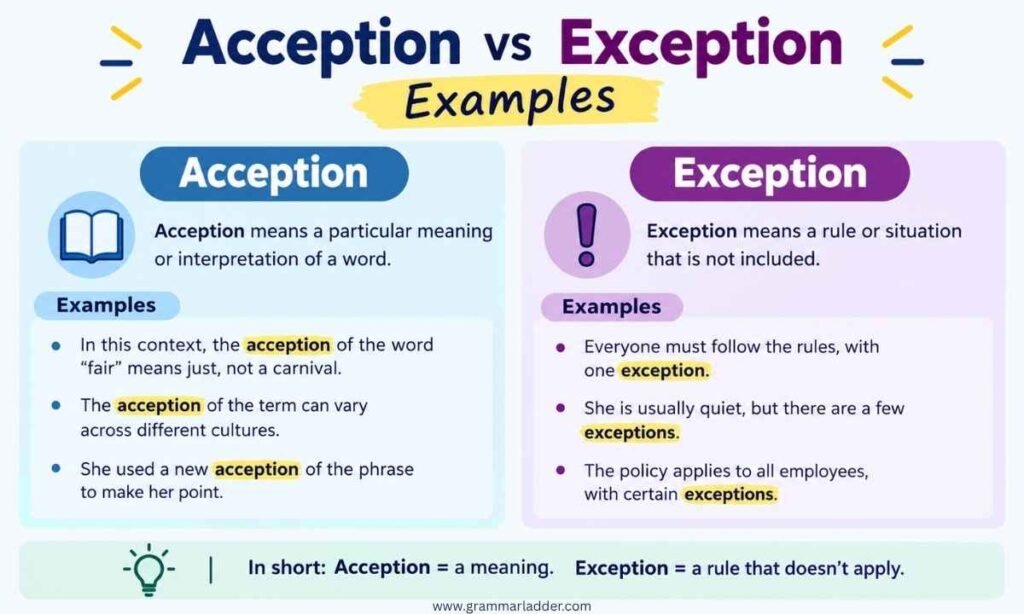
Here are clear examples to show each word in action.
Exception
- “The rule applies to all drivers, with one exception.”
- “Her calm response was the exception in a tense meeting.”
- “The program threw an exception and crashed.”
- “The library waived the late fee as an exception.”
Acception
- “In its strict acception, the term ‘democracy’ means rule by the people.”
- “The word has more than one acception in legal English.”
- “Scholars argue over the true acception of the phrase.”
Look at how different the second group feels. These sentences discuss word meaning, which is the only place “acception” fits.
Common Mistakes
Here are the errors that come up most often, with simple fixes.
- Wrong: I’ll make an acception for you.
Right: I’ll make an exception for you.
Why: You mean a special case, not a word meaning. - Wrong: Everyone came with the acception of Tom.
Right: Everyone came with the exception of Tom.
Why: “Exception of” shows exclusion. - Wrong: She took acception to the remark.
Right: She took exception to the remark.
Why: The idiom is “take exception.” - Wrong: Without acception, all must attend.
Right: Without exception, all must attend.
Why: The phrase means “no one excluded.” - Wrong: I except your offer.
Right: I accept your offer.
Why: The verb for agreeing is “accept.”
A quick fix routine:
- Do you mean “left out” or “special case”? Use exception.
- Do you mean “the meaning of a word”? You could use acception, but meaning is usually clearer.
- Do you mean “agreeing to something”? Use accept or acceptance, not either noun.
When Should You Actually Use “Acception”?
Rarely. Use it only when you are:
- Writing about the meaning of a word in a formal, linguistic, or historical context
- Quoting or imitating older literature
- Writing for readers who will recognize the term
Even then, clearer options exist. “Meaning,” “sense,” “usage,” or “acceptation” will almost always read better. If your goal is clear communication and strong SEO, plain words win. Readers who do not know “acception” may think you made a typo.
Real-World Usage Scenarios
Where do these words show up in daily life?
- Workplace emails: “We can make an exception to the deadline.” This is by far the most common use.
- Legal documents: Contracts often list “exceptions” to a clause. A rare older text may talk about the “acception” of a term.
- Programming and IT: Developers handle “exceptions” such as null pointer errors or failed network calls.
- Education: Teachers discuss grammar “exceptions,” like irregular verbs.
- Linguistics and etymology: Scholars might refer to a word’s historical “acception.”
In every practical scenario outside linguistics, “exception” is the right word.
Synonyms and Related Words
Synonyms for Exception:
- Anomaly
- Oddity
- Irregularity
- Special case
- Deviation
- Exclusion
- Outlier
Synonyms for acception:
- Meaning
- Sense
- Interpretation
- Acceptation
- Signification
Words people mix up with them:
- Accept (to receive or agree)
- Except (to leave out)
- Acceptance (the act of accepting)
- Exceptional (unusually good)
Frequently Asked Questions
Is “acception” a real word?
Yes, but it is rare and mostly archaic. It refers to the accepted meaning of a word.
Which is correct: “make an acception” or “make an exception”?
“Make an exception” is correct. “Make an acception” is a common typo.
What is the difference between acception and acceptation?
They mean the same thing. “Acceptation” is the more standard spelling.
Does “exception” have more than one meaning?
Yes. It can mean a special case, an objection, or a programming error event.
Can I use “acception” in everyday writing?
It is better not to. “Meaning” or “sense” is clearer for modern readers.
What is the difference between “except” and “accept”?
“Except” means to leave out, while “accept” means to receive or agree.
Is there a UK vs US difference?
No. Both varieties use “exception” the same way.
Conclusion
When choosing between acception and exception, the answer is simple. Use exception for anything about a special case, an exclusion, or a rule that has a gap. Reserve acception for rare cases where you are discussing the accepted meaning of a word, and even then consider a clearer alternative.
Remember the memory trick: Exception means something excluded, and acception means an accepted meaning. Keep the “accept vs except” distinction in mind, and you will avoid the most common errors.

I am an English writer with over four years of experience in grammar and language education.
Through Grammar Ladder, I share clear explanations, practical examples, and helpful English tips.
My goal is to share my knowledge so others can benefit and improve their language skills.
I believe anyone can master English with proper guidance and consistent practice.