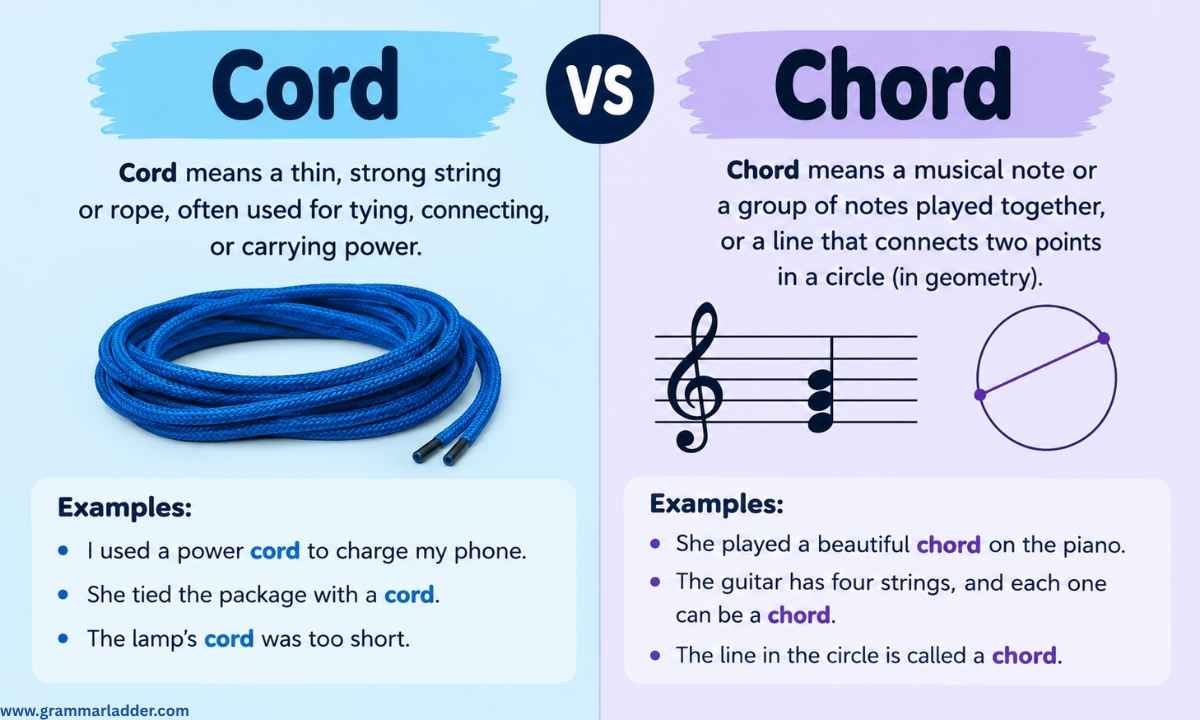
Mixing up cord vs chord is easy because the two words sound identical. One is a rope, a cable, or a body part. The other belongs to music and geometry. This guide explains what each word means, where each comes from, and how to pick the right one every time.
Quick Answer
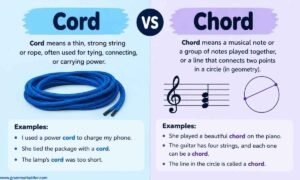
- Cord = a string, rope, or flexible cable (a phone charging cord, a spinal cord).
- Chord = a group of musical notes played together, or a straight line joining two points on a curve.
Quick test: if you can plug it in, tie it, or cut it, use cord. If you can play it or measure it on a circle, use chord.
What Does “Cord” Mean?
“Cord” is a common noun with several everyday meanings:
- A thin rope or string: a cord used to tie a package or hang a picture.
- An insulated electrical cable: a power cord, extension cord, or phone charger cord.
- A body structure: the spinal cord, the umbilical cord, or the vocal cords.
- A unit of firewood: a cord is a stacked pile measuring 128 cubic feet, mostly in US usage.
- A ribbed fabric: corduroy and “cords” (pants) take their name from it.
As a verb, “cord” is rare. You may see it in “to cord a bundle of wood,” but most writers never need it.
What Does “Chord” Mean?
“Chord” has two main meanings.
In music: a chord is three or more notes played at the same time. C, E, and G played together form a C major chord. Guitarists, pianists, and songwriters use the word constantly. You will see terms like chord progression, minor chord, power chord, and chord chart.
In geometry: a chord is a straight line segment connecting two points on a circle or curve. The longest chord in a circle is the diameter.
There is also a figurative use. To “strike a chord” means to resonate emotionally with someone, as in “Her speech struck a chord with the audience.”
Electrical Cord or Chord
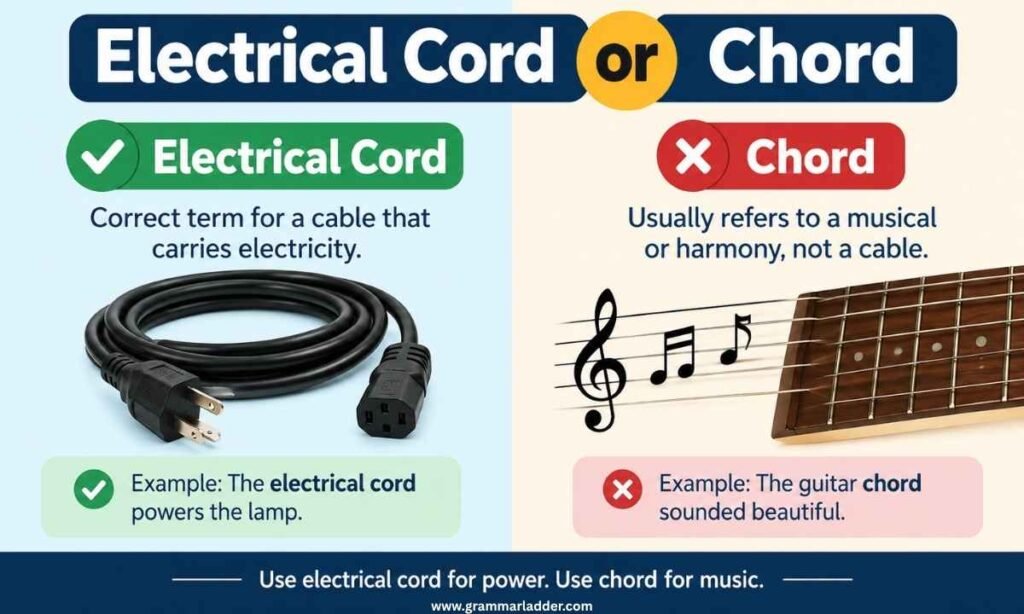
The correct spelling is electrical cord. Anything that carries power or data uses “cord”:
- Power cord
- Extension cord
- Charging cord
- Phone cord
- Cord blind (the pull cord)
“Electrical chord” is always a mistake. The only time “chord” appears near electronics is when a musician plugs a guitar into an amp. Even then, the cable is a cord, while the notes played are chords.
Correct: Plug the guitar cord into the amplifier, then play a G chord.
Cord vs Chord Etymology
Both words trace back to the same ancient source, which explains the confusion.
- The Greek word khordē meant “gut” or “string of a musical instrument.”
- Latin borrowed it as chorda.
- Old French turned it into corde, and English adopted cord in the 1200s to mean a string or rope.
Chord has a slightly twisted history. In the 1400s, English speakers used “cord” for a musical harmony, shortened from accord (agreement). In the 1500s, writers began spelling it “chord” to show a link to the Greek and Latin chorda, meaning a string of an instrument. The geometric sense of “chord” kept the Latin spelling from the start.
So the “h” in chord is a visual reminder of its classical, musical roots.
Chord vs Cord Pronunciation
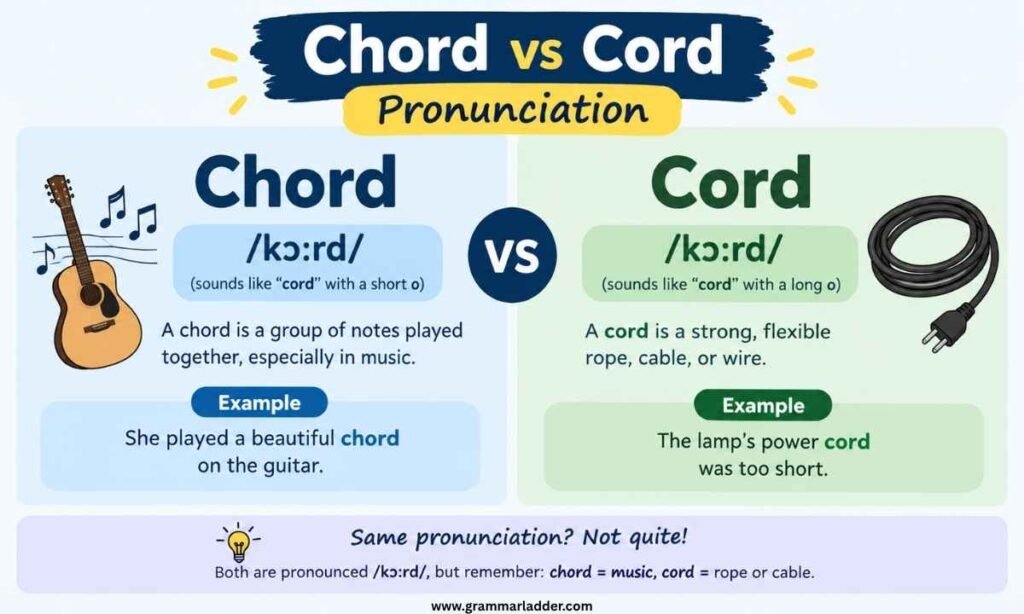
Both words are homophones, meaning they sound the same.
| Word | Pronunciation (IPA) | Sounds like |
| Cord | /kɔːrd/ | “kord” |
| Chord | /kɔːrd/ | “kord” |
Because you cannot hear the difference, the confusion happens almost entirely in writing. Spellcheck will not catch it either, since both words are valid.
Cord vs Chord Comparison Table
| Feature | Cord | Chord |
| Part of speech | Noun (rarely a verb) | Noun |
| Core meaning | Rope, string, cable, body tissue | Musical notes or a geometric line |
| Field | Everyday life, electronics, anatomy, wood measurement | Music, math |
| Example | “The lamp cord is frayed.” | “She played a D minor chord.” |
| Common phrases | spinal cord, power cord, cut the cord | strike a chord, chord progression |
| Plural | cords | chords |
| Pronunciation | /kɔːrd/ | /kɔːrd/ |
How to Use “Cord” Correctly?
Use “cord” whenever you mean something long, thin, and flexible, or a related body part.
Examples:
- She wrapped the extension cord around her arm.
- The surgeon explained the injury to the spinal cord.
- He bought two cords of oak for the winter.
- The baby’s umbilical cord was clamped after birth.
- Singers must protect their vocal cords.
Common phrases with “cord”:
- Cut the cord (become independent)
- Cord blood
- Cord cutting (cancelling cable TV)
- Bungee cord
- Drawstring cord
A note on vocal cords: Some writers type “vocal chords.” Major dictionaries list it as a variant, but vocal cords is the standard spelling, and anatomy sources always use it. Stick with “cords” in formal writing.
How to Use “Chord” Correctly?
Use “chord” for music, math, or emotional resonance.
Music examples:
- Beginners often learn the G, C, and D chords first.
- The song uses a simple four-chord progression.
- He strummed a power chord and let it ring.
Geometry example:
- Draw a chord from point A to point B on the circle.
Figurative example:
- The documentary struck a chord with young viewers.
Common phrases with “chord”:
- Strike a chord
- Strike the right chord
- Major or minor chord
- Chord chart
- Barre chord
Common Mistakes With Cord vs Chord
Here are the errors writers make most often:
- Electrical chord → Electrical cord: Cables are cords, not musical notes.
- Vocal cords → Vocal cords: This is the standard anatomical spelling.
- Spinal cord → Spinal cord: It is a body structure, not music.
- Strike a cord → Strike a chord: The idiom comes from music.
- Power chord (for a cable) → Power cord: Only guitarists play power chords.
- Umbilical cord → Umbilical cord: This is the medical term.
The biggest trap is the idiom “strike a chord.” People often write “strike a cord” because both look natural. Remember that the phrase comes from music, so it takes the musical spelling.
Practical Example Paragraphs
Example 1: Home setting
Maya tripped over the phone charging cord and pulled the plug out of the wall. She picked it up, checked for damage, and moved it behind the sofa. Then she sat down to practice her ukulele, starting with a simple C chord.
Example 2: Health writing
The vocal cords vibrate when air passes through them. Singers warm up before a show to protect those delicate tissues. A doctor may also check the spinal cord if a patient reports numbness.
Example 3: Music lesson
Learning guitar starts with open chords. Once you know G, C, and D, you can play hundreds of songs. A good teacher will also remind you to keep the instrument’s cord tidy so nobody trips on it.
Placement and Grammar Rules Table
| Rule | Cord | Chord |
| Word type | Noun | Noun |
| Usually follows | an adjective or noun (power, spinal, vocal) | an adjective or note name (major, minor, G) |
| Takes “a/an” | Yes (a cord) | Yes (a chord) |
| Plural form | cords | chords |
| Works with verbs like | plug, cut, tie, wrap | play, strum, strike, hit |
| Possessive | cord’s | chord’s |
| Common prepositions | around the cord, on a cord | in a chord, of a chord |
A useful clue is the verb. If someone plays, strums, or strikes it, you want “chord.” If someone plugs, ties, wraps, or cuts it, you want “cord.”
American vs British English Differences
Good news: spelling does not change between American and British English. Both use “cord” and “chord” in the same way.
The differences are small and are about word choice:
- Electrical cord: Americans say “cord” or “extension cord.” Britons often say “flex” or “lead” for appliance cables, though “cord” is understood.
- Cord of wood: this unit is mostly American and Canadian.
- Corduroy pants: Americans often say “cords,” a casual term that is also widely used in the UK.
- Vocal cords: identical in both regions.
So no matter where you write, the key is meaning, not region.
Easy Memory Tricks for Cord vs Chord
Try one of these quick tricks:
- “Ch” for Choir. Chord and choir both start with “ch,” and both involve music.
- “Cord” is a cable. Both start with “C” and are physical things you can touch.
- Harmony has an “h.” Chord has an “h” like harmony.
- Plug or play. If you plug it in, write cord. If you play it, write chord.
- Chop the “h.” If the word has no music, no circle, and no emotional resonance, drop the “h.”
Why Correct Usage Matters
Spelling errors can quietly damage trust. A music blog that writes “guitar cords” for notes, or a medical article that says “spinal chord,” looks careless to readers. Search engines also treat the words as different topics, so a wrong spelling can send readers to the wrong content.
Using the right word shows attention to detail. It also helps your reader understand you faster, which matters in product descriptions, school essays, resumes, and professional emails.
Similar Word Confusions
If cord and chord trip you up, these pairs probably will too:
- Core vs Corps: Core is the center; corps is a group (Peace Corps).
- Choral vs Coral: Choral relates to a choir; coral is a sea organism.
- Board vs Bored: Board is a plank or group; bored means uninterested.
- Coarse vs Course: Coarse means rough; course is a class or path.
- Heard vs Herd: Heard is hearing; herd is a group of animals.
- Principal vs Principle: Principal is a head or main; principle is a rule.
Everyday Examples of Cord and Chord
Cord in daily life:
- The laptop cord is too short.
- She tied the curtains back with a silk cord.
- Cord cutters save money by dropping cable TV.
- Doctors monitor the umbilical cord during delivery.
Chord in daily life:
- He learned his first chord at age ten.
- The pianist ended with a soft C major chord.
- Her story struck a chord with readers.
- The teacher drew a chord across the circle.
Frequently Asked Questions
Is it “electrical cord” or “electrical chord”?
It is electrical cord. A cord is a cable, while a chord is a group of musical notes.
Is it “vocal cords” or “vocal chords”?
Vocal cords is the standard spelling. “Vocal chords” appears as a variant, but it is not preferred.
Do cord and chord sound the same?
Yes. Both are pronounced /kɔːrd/, which is why they are so easy to confuse in writing.
What is a chord in geometry?
It is a straight line segment that joins two points on a circle or curve.
Do the words differ between American and British English?
No. The spelling is the same in both. Only terms like “flex” or “lead” for cables vary in the UK.
Conclusion
The difference between cord and chord comes down to context. A cord is a rope, cable, or body structure. A chord is a set of musical notes or a line in geometry. Because the words sound the same, only your spelling carries the meaning.
Keep the quick tests handy: plug, tie, or cut means cord, while play, strum, or strike means chord. Use the memory tricks above, double-check idioms like “strike a chord,” and your writing will stay clear and professional.

I am an English writer with over four years of experience in grammar and language education.
Through Grammar Ladder, I share clear explanations, practical examples, and helpful English tips.
My goal is to share my knowledge so others can benefit and improve their language skills.
I believe anyone can master English with proper guidance and consistent practice.