You are typing an email, a report, or a social media caption. You write “targeted” and then stop. Something looks off. Should there be two T’s? It is a very common doubt, and you are not alone.
The targetted vs targeted question comes up often because English has a spelling rule that sometimes asks us to double a final consonant. It feels like it should apply here. It does not.
In this guide, you will get the correct spelling, the reason behind it, and a few easy tricks to remember it for good.
Quick Answer: Targetted or Targeted?
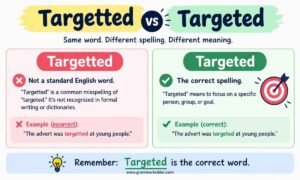
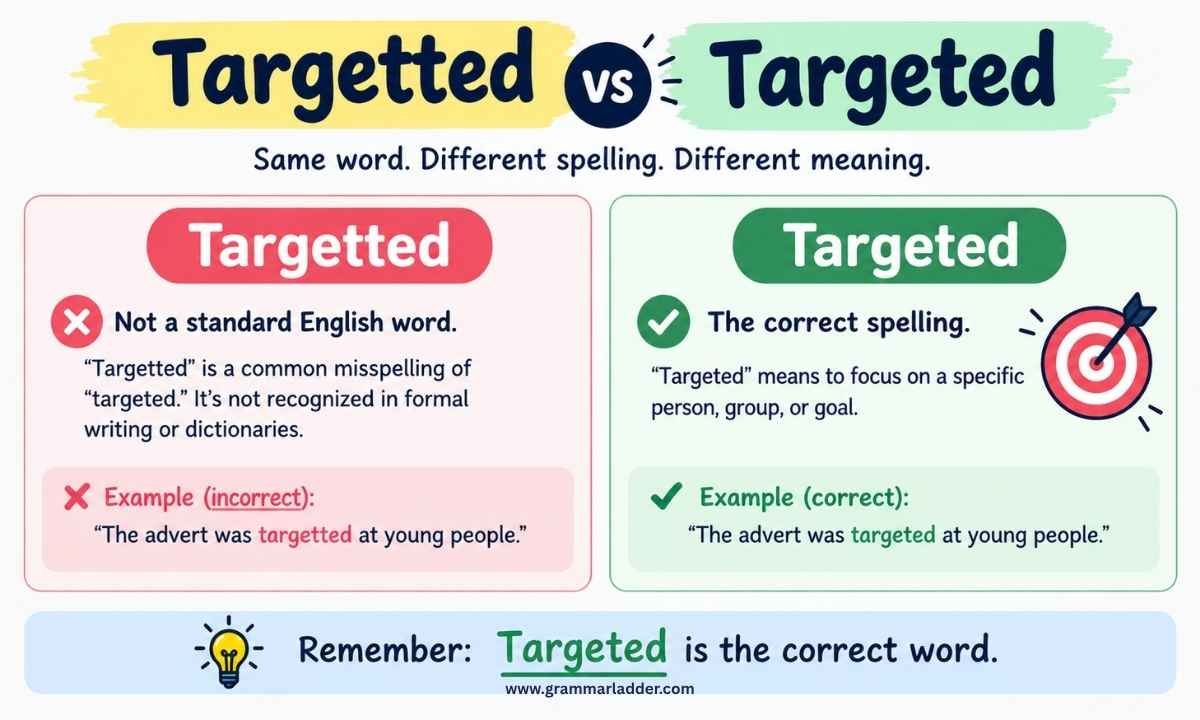
“Targeted” is the correct spelling. It has one T before the “-ed” ending. “Targetted” is a misspelling in both American and British English.
The same applies to the other verb forms:
- target → targeted (past tense)
- target → targeting (present participle)
- target → targets (third person)
So you write “a targeted ad,” “we are targeting new readers,” and “she targeted the right audience.” Never “targetted” or “targetting.”
Meaning of “Targeted”
“Targeted” is the past tense and past participle of the verb target. It is also used as an adjective. In simple words, it means aimed at a specific person, group, goal or object.
The word has two main uses:
- As a verb (past tense): The company targeted young professionals with its new app.
- As an adjective: The brand ran a targeted campaign for first-time buyers.
You will see it in many fields:
- Marketing: targeted advertising, targeted audience, targeted messaging
- Medicine: targeted therapy, targeted treatment
- Business: targeted growth, targeted outreach
- Security: targeted attack, targeted threat
- Education: targeted support, targeted learning goals
The core idea is always the same: focus on something specific instead of spreading effort widely.
Why “Targetted” Is Incorrect?
The confusion starts with a well-known spelling rule. When you add “-ed” or “-ing” to some verbs, you double the last consonant. Think of stop → stopped or plan → planned.
But this rule has a condition. It only applies in two situations:
- The word has one syllable, such as stop or plan.
- The word has more than one syllable, and the stress falls on the last syllable, such as be-GIN → beginning or re-FER → referred.
Now look at “target.” It is pronounced TAR-get. The stress is on the first syllable, not the last. Because the stress is not on the final syllable, the consonant stays single.
That is the whole reason. “Target” does not meet the doubling condition, so you simply add “-ed.”
Simple Rule to Remember
Here is a short version you can keep in your head:
If the stress is not on the last syllable, do not double the final consonant.
Say “target” out loud. You hear TAR-get, not tar-GET. The stress sits at the start, so add “-ed” and move on: targeted.
Targetted or Targeted: Oxford Dictionary
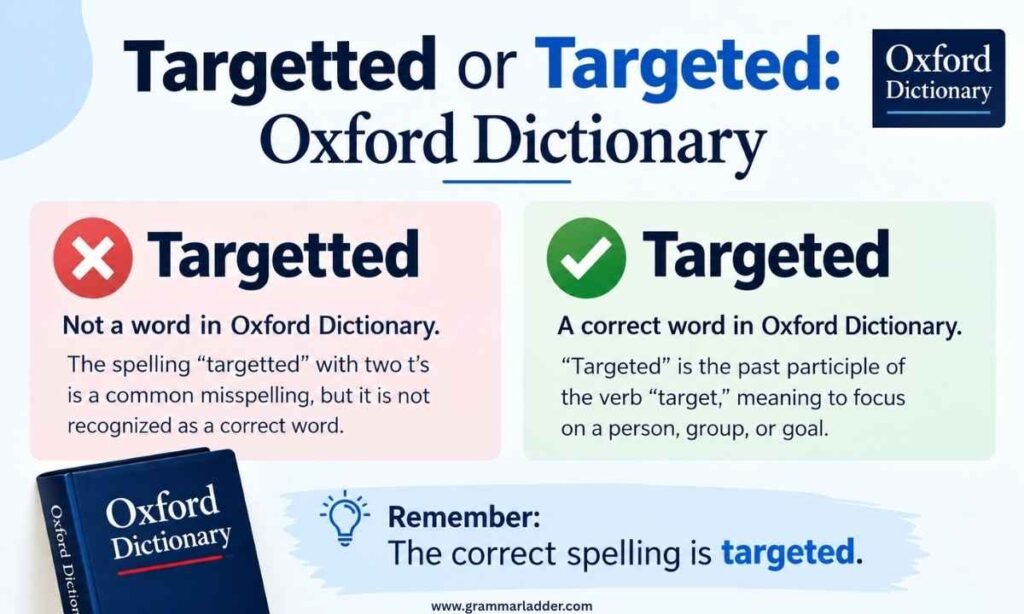
Major dictionaries, including the Oxford dictionaries, list targeted and targeting as the standard forms of the verb target. You will find the same entries in Merriam-Webster, Cambridge and Collins.
In professional writing, standard dictionary spelling is the safest choice. Editors, publishers and search engines all expect it. If you are ever unsure about a word, check a trusted dictionary before you publish. It takes ten seconds and protects your credibility.
Targetted or Targeted: British Spelling
- Many writers assume British English doubles consonants more often than American English. That is partly true: British spelling doubles the “L” in words like travelled, cancelled and modelled, while American spelling often uses a single L.
- But that difference is about the letter L. It has nothing to do with “target.”
- target (past tense): American English “targeted” and British English “targeted”
- travel (past tense): American English “traveled” and British English “travelled”
- cancel (past tense): American English “canceled” and British English “cancelled”
- model (past tense): American English “modeled” and British English “modelled”
- “Targeted” is the same in both varieties. You may occasionally spot “targetted” in older texts or informal writing, but modern style guides do not recommend it.
- Whether your reader is in London, Lahore or Los Angeles, “targeted” is the right choice.
Targetted vs Targeted: Grammar
Let us look at how the word behaves in a sentence.
Targeted as a Verb
As a verb, target is transitive. It needs an object.
- The campaign targeted small business owners.
- Researchers targeted the specific protein.
- We are targeting a 20% increase in traffic this quarter.
Targeted as an Adjective
Here it describes a noun and usually comes before it.
- A targeted email performs better than a generic blast.
- The clinic offers targeted treatment for back pain.
Quick Verb Forms
- Base form: target. They target new customers.
- Third person: targets. She targets high-intent keywords.
- Past tense: targeted. He targeted the right audience.
- Past participle: targeted. The goal was targeted last year.
- Present participle: targeting. We are targeting local readers.
Notice that every form keeps a single T before the ending. That consistency makes the word easy once you learn it.
Targeted vs Targetted: Comparison Table
Use this table as a fast reference.
| Feature | Targeted | Targetted |
| Correct spelling | Yes | No |
| Accepted in US English | Yes | No |
| Accepted in UK English | Yes | No |
| Found in major dictionaries | Yes | Not as standard |
| Safe for professional writing | Yes | No |
| Matching “-ing” form | targeting | targetting (incorrect) |
The verdict is clear. Choose targeted every time.
Common Mistakes People Make
Even confident writers slip up with this word. Here are the most frequent errors and how to fix them.
- Doubling the T after learning the doubling rule. Writers remember stopped and planned, then apply the same logic to “target.” Remember that the stress rule decides it.
- Mixing up British and American habits. The double-L difference is real, but it does not extend to “target.”
- Trusting spellcheck blindly. Some tools may not flag every variant, especially in older settings or mixed-language documents.
- Misspelling the “-ing” form. Many people fix “targeted” but still write “targetting.” The correct form is targeting.
- Copying errors from other pages. Some blogs and product pages contain the wrong spelling. Seeing it often does not make it right.
- Typing too fast. A rushed typo can look like a spelling error. A quick proofread solves it.
Examples: Wrong vs Right
- Wrong: We targetted the wrong audience. Right: We targeted the wrong audience.
- Wrong: They are targetting new markets. Right: They are targeting new markets.
- Wrong: A targetted ad campaign. Right: A targeted ad campaign.
- Wrong: Her targetted approach worked. Right: Her targeted approach worked.
Targetted or Targeted: Synonyms
If you use “targeted” many times in one piece, your writing can sound repetitive. Swap in a synonym that fits the context.
Synonyms for the verb “targeted”:
- aimed at
- directed at
- focused on
- singled out
- pinpointed
- zeroed in on
Synonyms for the adjective “targeted”:
- focused
- specific
- tailored
- precise
- customized
- audience-specific
Examples:
- The company focused on budget-conscious shoppers.
- The nonprofit offered tailored support to small farmers.
- The study zeroed in on one age group.
Pick the synonym that matches your tone. Formal reports suit “directed at” or “precise,” while blog posts often sound better with “tailored” or “focused.”
When Should You Use “Targeted”?
Use “targeted” whenever you describe something aimed at a specific person, group, result, or object. Here are common situations.
- Marketing and advertising: “Targeted ads reach people most likely to buy.”
- SEO and content writing: “We built content around targeted keywords.”
- Healthcare: “Targeted therapy attacks specific cells and spares healthy ones.”
- Cybersecurity: “The firm reported a targeted phishing attempt.”
- Goal setting: “Set targeted goals for each month.”
- Education: “Teachers offered targeted help to struggling students.”
In each case, the word signals focus and intention. If your sentence has nothing specific being aimed at, a different word may fit better.
Memory Trick to Never Misspell It Again
Try one of these simple tricks.
1. The stress trick. Say “TAR-get” out loud. The first part is loud, the second is soft. Soft endings do not double.
2. The one-bullseye trick. A target has one bullseye. So “targeted” gets one T in the middle, not two.
3. The comparison trick. Compare it with “market” and “budget.” You would never write “marketted” or “budgetted,” so do not write “targetted.”
4. The short-sentence trick. Repeat: “I targeted the target.” Both words share the same single-T pattern.
Pick the one that sticks, and the spelling will become automatic.
Frequently Asked Questions
Is it “targetted” or “targeted”?
The correct spelling is “targeted.” “Targetted” is a common misspelling.
Is “targetted” correct in British English?
No. British English also uses “targeted” and “targeting.”
What is the correct spelling of “targeting”?
The correct spelling is “targeting,” with one T before “-ing.” “Targetting” is incorrect.
Why isn’t the T doubled in “targeted”?
Because the stress falls on the first syllable (TAR-get), the final consonant does not double.
What does “targeted” mean?
It means aimed at or focused on a specific person, group, goal or object.
Is “targeted” a verb or an adjective?
It can be both: the past tense of the verb “target” and an adjective describing something specific.
Do other words follow the same rule?
Yes. Words like “marketed,” “budgeted,” and “visited” keep a single consonant for the same reason.
Which word is better for SEO content?
Always use “targeted,” since search engines and readers expect the standard spelling.
Conclusion
The answer is simple. Targeted is the correct spelling in both American and British English. The same goes for targeting. “Targetted” and “targetting” are common mistakes, so skip them in your writing.
Just remember the stress rule. We say TAR-get, so the last T stays single. Words like “market” and “budget” work the same way. Give your text a quick proofread before you publish. Small fixes like this make your writing look more polished.

I am an English writer with over four years of experience in grammar and language education.
Through Grammar Ladder, I share clear explanations, practical examples, and helpful English tips.
My goal is to share my knowledge so others can benefit and improve their language skills.
I believe anyone can master English with proper guidance and consistent practice.