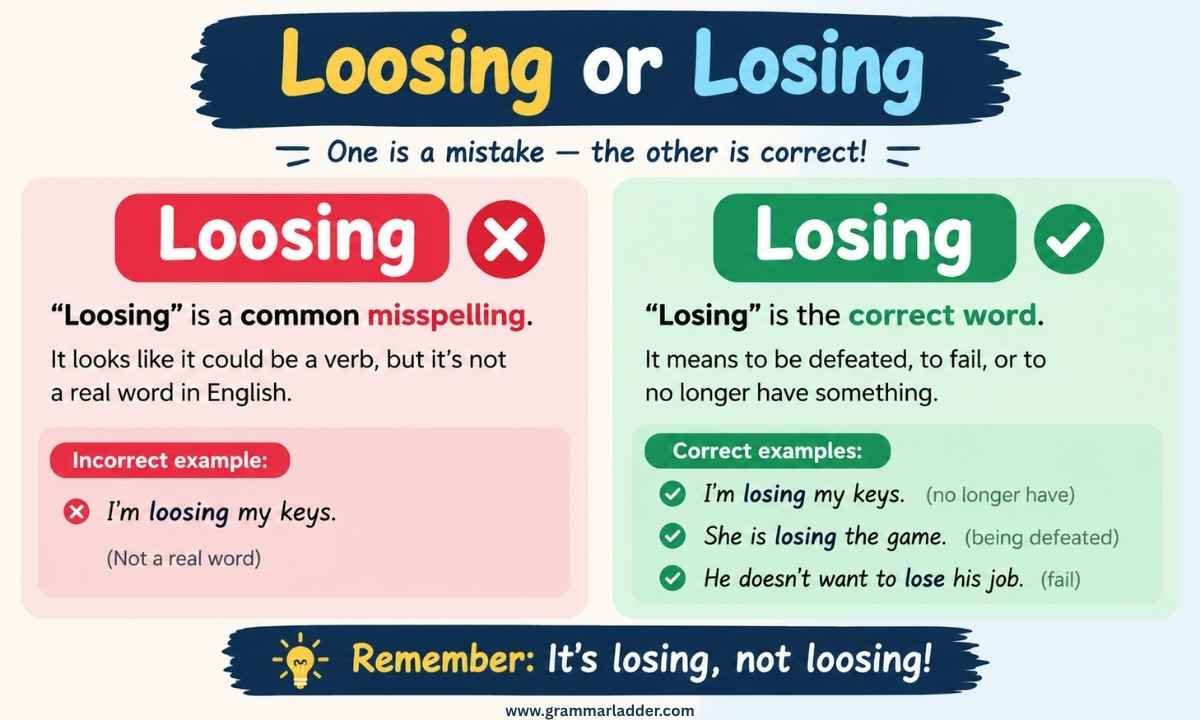
You are typing a quick message and stop. Is it “I’m losing my mind” or “I’m loosing my mind”? You are not alone. This pair trips up students, bloggers, and professional writers every day.
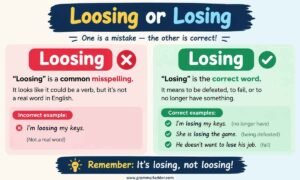
The short answer: losing is correct in nearly every case. It is the “-ing” form of the verb lose, which means to misplace something, fail to win, or have something taken away. Loosing is a real word, but it is rare. It means to release or set free.
This guide explains the difference with clear examples, tables, and memory tricks so you can choose the right word every time.
Loosing or Losing Meaning
Each word comes from a different base word, and that is the root of the confusion.
- Losing comes from the verb lose (rhymes with “shoes”).
- Loosing comes from the verb loose (rhymes with “goose”).
Here is what each one means in plain terms:
- Losing means failing to keep, win, or find something. Example: She is losing her patience.
- Loosing means releasing, freeing, or unfastening. Example: He is loosing the rope from the post.
Most people want losing. If you mean defeat, loss, misplacing, or decreasing, use losing.
Loosing or Losing: What Is the Difference?
The difference comes down to meaning, spelling, and sound.
- Meaning: Losing is about loss. Loosing is about release.
- Spelling: Losing has one “o.” Loosing has two.
- Pronunciation: Losing ends with a “z” sound. Loosing ends with an “s” sound.
- Frequency: Losing appears everywhere. Loosing is uncommon in modern writing.
Think of it this way: losing is what happens when something goes away from you. Loosing is what you do when you let something go.
When Should You Use Losing?
Use losing whenever you mean any kind of loss. This covers the vast majority of everyday situations.
Use “losing” for:
- Competition: The team is losing by two goals.
- Misplacing items: I keep losing my keys.
- Emotions and control: He is losing his temper.
- Money and business: The company is losing customers every month.
- Time: We are losing daylight.
- Health and body: She is losing hair after the illness.
- Relationships: They are losing touch with old friends.
A quick test: if you can swap in “failing to keep” or “no longer having,” then losing is correct.
When Should You Use Loosing?
Loosing is the “-ing” form of loose used as a verb. As a verb, loose means to let go, release, untie, or fire.
You will mostly see it in formal, literary, or historical writing.
Use “loosing” for:
- Releasing animals: The farmer is loosing the hounds.
- Untying something: She spent an hour loosing the knots.
- Firing an arrow: The archer is loosing arrows at the target.
- Unleashing something figuratively: The speech is loosing a wave of public anger.
- Freeing a prisoner: The king is loosing the captives.
Most modern writers choose loosening for everyday use instead. “She is loosening her tie” sounds far more natural than “She is loosing her tie.”
Losing or Loosing a Game
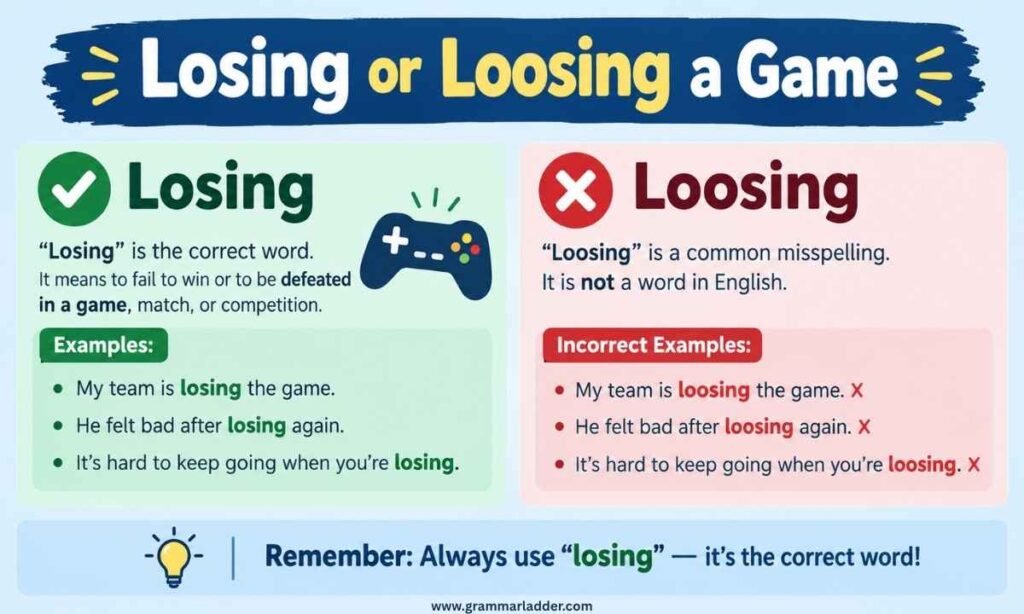
This one is simple: it is losing a game.
Failing to win a match, round, or contest is a loss, so you need losing.
- ✅ Our team is losing the game.
- ✅ He hates losing at chess.
- ❌ Our team is loosing the game.
The only time loosing could appear near a game is in something like “loosing an arrow in an archery contest.” That has nothing to do with winning or losing.
Is It Losing or Loosing a Person?
It is almost always losing a person.
Losing applies whether the person has died, moved away, or drifted out of your life.
- ✅ She is losing her grandfather to illness.
- ✅ I don’t want to risk losing you as a friend.
- ✅ Many families struggle after losing a loved one.
Loosing a person would mean setting them free, like releasing a captive. That meaning is unusual and mostly appears in older or biblical-style writing.
Loosing or Losing Weight Meaning
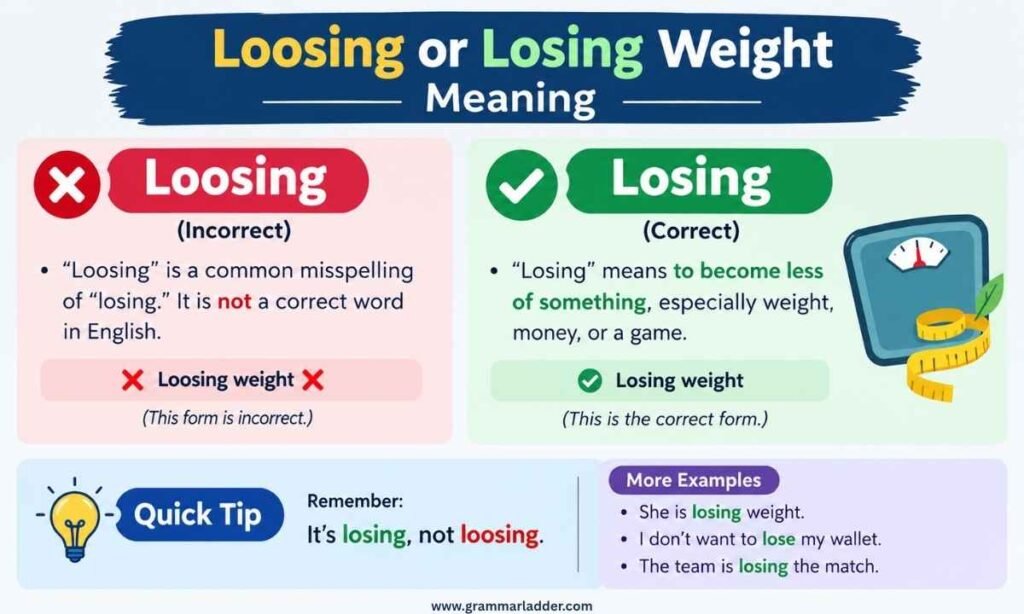
The correct phrase is losing weight.
Here you are talking about reducing body weight, which is a form of loss.
- ✅ He has been losing weight since January.
- ✅ Many people struggle with losing weight after the holidays.
- ❌ She is loosing weight with a new diet.
The error likely feels natural because people picture clothes becoming looser. That is where loose comes in. But the action of dropping pounds is still losing.
Correct pairing: You are losing weight, so your clothes feel loose.
Losing or Loosing Pronunciation
Pronunciation is one of the easiest ways to tell these words apart.
| Word | Phonetic Spelling | Sounds Like | Ending Sound |
| Losing | /ˈluːzɪŋ/ | LOO-zing | “z” (like choosing) |
| Loosing | /ˈluːsɪŋ/ | LOO-sing | “s” (like goose) |
A handy trick: Losing rhymes with choosing and using. Loosing does not rhyme with them.
Say the sentence aloud. If the middle sound is a buzzing “z,” you need losing. If it is a hissing “s,” you need loosing.
Why Do People Confuse Loosing and Losing?
There are a few clear reasons this mix-up happens so often.
- Lose and loose look alike. They differ by just one letter, so the eye skips right over the error.
- Spelling rules feel inconsistent. English drops the silent “e” when adding “-ing” (lose → losing), but learners often expect the double “o” to stay.
- Autocorrect can mislead. Spellcheck accepts loosing because it is a real word, so it does not flag the mistake.
- People write the way they speak. Fast typing and casual messaging lead to sloppy swaps.
- Related words add noise. Loose, loosen, and loosely all contain the double “o,” which makes it feel natural to type it everywhere.
Understanding why the mistake happens makes it easier to avoid.
Common Mistakes
Here are the errors we see most often, along with the fixes.
- ❌ I’m loosing my phone again.
✅ I’m losing my phone again.
Why: Misplacing something means you need the verb lose. - ❌ They are loosing the match.
✅ They are losing the match.
Why: Failing to win is a loss, so use losing. - ❌ She keeps loosing weight.
✅ She keeps losing weight.
Why: Reducing body weight is a form of loss. - ❌ My jeans are losing.
✅ My jeans are loose.
Why: “Not tight” calls for the adjective loose. - ❌ Don’t be afraid of loosing everything.
✅ Don’t be afraid of losing everything.
Why: Any kind of loss uses lose.
Three mistakes to watch for:
- Mixing up the verb and the adjective. Lose is a verb. Loose is usually an adjective (“a loose shirt”).
- Writing “loose” when you mean “lose.” “I don’t want to loose you” should be “I don’t want to lose you.”
- Overusing “loosing.” If you are unsure, losing is usually the safer choice.
Losing in Everyday Conversation
Losing shows up constantly, both in casual talk and in formal writing. A few common phrases:
- Losing my mind: “This traffic is making me lose my mind.”
- Losing track of time: “I was so busy I lost track of time.”
- Losing touch: “We have been losing touch since college.”
- Losing ground: “The brand is losing ground to competitors.”
- Losing sleep: “Don’t lose sleep over it.”
- Losing interest: “The audience was losing interest fast.”
- Losing hope: “She never stopped fighting, even when she was losing hope.”
Notice that every one of these is about something slipping away. That is the clearest sign you need losing.
Quick Comparison Examples
Use this section as a fast reference.
Sentences with “losing”:
- The runner is losing energy near the finish line.
- I am losing patience with this slow internet.
- The store is losing money this quarter.
- He is afraid of losing his job.
- We are losing light, so let’s head home.
Sentences with “loosing”:
- The captain ordered the crew to start loosing the sails.
- The hunter was loosing his dogs at dawn.
- The knight is loosing an arrow toward the tower.
- The report is loosing a storm of criticism.
- She was loosing the chains from the old gate.
Memory tricks to keep handy:
- Lose has lost an “o.” One letter went missing, just like the thing you lose.
- Loose has extra room. The extra “o” gives it more space, like a loose fit.
- Think “choose.” Lose and choose sound alike and both end in “-se” with a “z” sound.
- Think “goose.” Loose rhymes with goose, and both have the double “o.”
Frequently Asked Questions
Is it “loosing” or “losing”?
Losing is correct in almost all cases. Loosing is a rare word meaning to release or set free.
Is “loosing” a real word?
Yes. It is the “-ing” form of the verb loose, meaning to untie, free, or fire.
Is it “losing weight” or “loosing weight”?
It is losing weight. Dropping pounds is a form of loss.
Is it “losing a game” or “loosing a game”?
It is losing a game. Failing to win always uses losing.
How do you spell the “-ing” form of “lose”?
Drop the “e” and add “-ing” to get losing. There is only one “o.”
What is the difference between “lose” and “loose”?
Lose is a verb meaning to misplace or fail to win. Loose usually means not tight.
How do you pronounce “losing”?
Say it as LOO-zing, with a “z” sound in the middle.
Can “loosing” ever be correct?
Yes, but only when you mean releasing or unfastening something, such as loosing an arrow.
What is a simple way to remember the difference?
Think of lose as having lost an “o.” Think of loose as having extra room.
Conclusion
The choice between loosing and losing is easier than it looks. Remember the main points:
- Losing means failing to keep, win, or find something. It is the correct choice for games, weight, people, money, time, and more.
- Loosing means releasing or setting free. It is rare and usually found in formal, literary, or historical writing.
- Pronunciation helps. Losing sounds like “LOO-zing.” Loosing sounds like “LOO-sing.”
- When in doubt, choose losing. It is the right answer in nearly every real-world sentence.
Before you hit publish or send, read the sentence aloud and ask: Am I talking about a loss or a release? That one question will save you from this common slip.
Mastering small details like this makes your writing sharper, more credible, and easier to trust. Bookmark this guide, and share it with anyone who keeps typing “loosing” by mistake.

I am an English writer with over four years of experience in grammar and language education.
Through Grammar Ladder, I share clear explanations, practical examples, and helpful English tips.
My goal is to share my knowledge so others can benefit and improve their language skills.
I believe anyone can master English with proper guidance and consistent practice.