If you’ve ever typed out a happy message for a friend’s promotion, wedding, or graduation and paused halfway through, wondering whether it’s “congratulations” or “congradulations,” you’re far from alone. This is one of the most commonly misspelled words in the English language, and the confusion almost always comes down to how the word sounds when we say it out loud.
In this guide, we’ll settle the spelling question once and for all, explain why so many people get it wrong, and show you exactly how to use the word correctly in emails, texts, social media posts, and formal writing.
Congratulations or Congradulations – Quick Answer
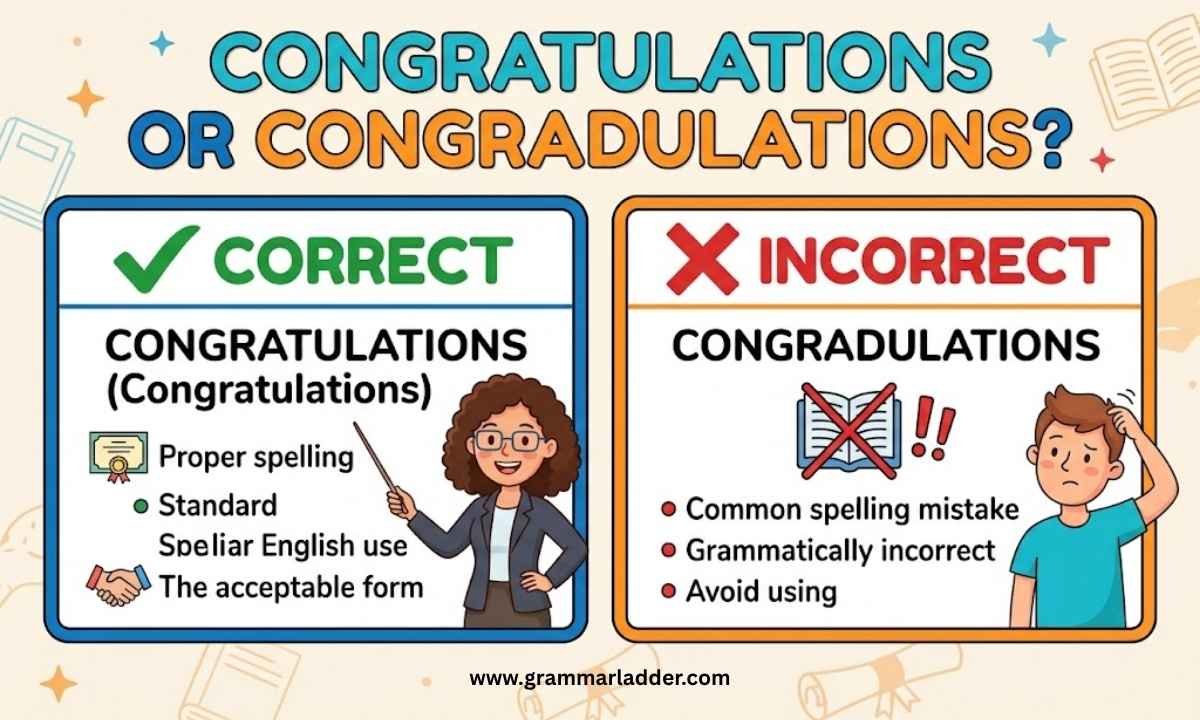
The correct spelling is congratulations, spelled with a “t” — C-O-N-G-R-A-T-U-L-A-T-I-O-N-S.
“Congradulations,” spelled with a “d,” is not a word in any dictionary, in either American or British English. It’s simply a spelling mistake, though an extremely common one, caused by the way the word is pronounced in fast, casual speech.
Examples:
- ✅ Congratulations on your new job!
- ❌ Congradulations on your new job!
- ✅ Congratulations to the entire graduating class.
- ❌ Congradulations to the entire graduating class.
If you remember nothing else from this article, remember this: there is no “d” anywhere in the correct spelling of this word.
The Origin of Congratulations or Congradulations
The word “congratulations” has a long history rooted in Latin. It comes from the Latin word congratulari, formed from com- (meaning “together” or “with”) and gratulari (meaning “to show joy” or “to wish joy to”). The root gratus relates to “gratitude” and “grace,” which is also where words like “grateful” and “gratitude” come from.
By the 15th and 16th centuries, the word had entered English as a way to express shared joy over someone else’s good fortune or achievement. Over time, it evolved into the modern plural noun form we use today: “congratulations,” almost always used in its plural form rather than the singular “congratulation.”
Why does “congradulations” exist?
“Congradulations” isn’t a legitimate alternate spelling — it’s a phonetic misspelling. Here’s why it happens so often:
- Rapid speech blending: When people say “congratulations” quickly, the “t” sound in the middle often softens and starts to sound like a “d.” This is a natural feature of casual English pronunciation, similar to how “water” can sound like “wader.”
- Visual association with similar words: Words like “graduation” and “gradual” contain a “d,” and because “congratulations” is often used around graduation season, the brain sometimes borrows that spelling pattern.
- Muscle memory typos: Many people simply learned or typed the word incorrectly once, and the mistake stuck.
Understanding this helps explain why the error is so widespread, even among fluent English speakers and native speakers who otherwise have strong spelling skills.
British English vs American English Spelling
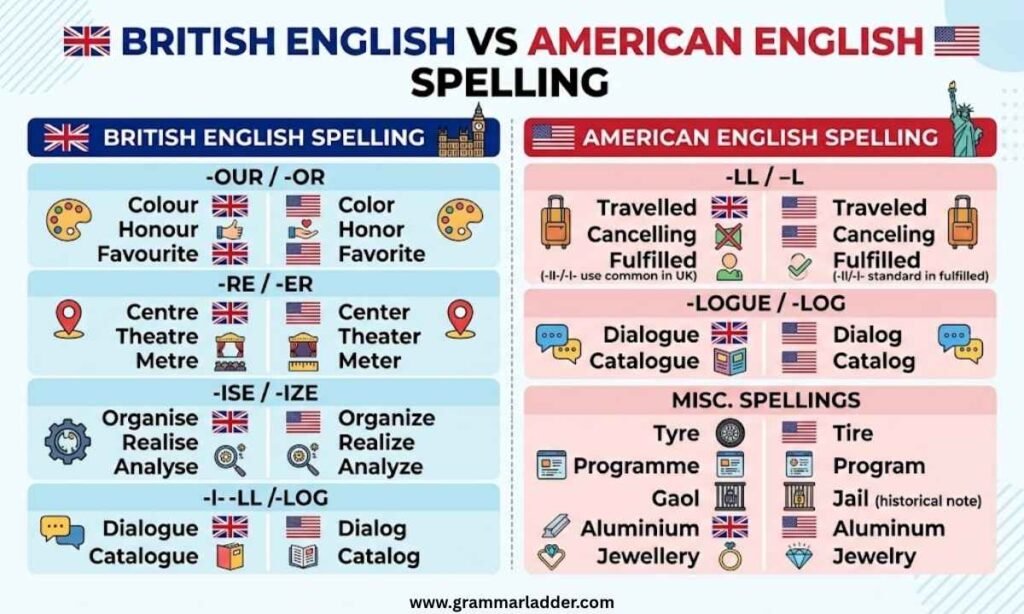
Good news: this is one of the few English words where spelling differences between British and American English don’t apply. Unlike words such as “colour/color” or “organise/organize,” congratulations is spelled the same way on both sides of the Atlantic.
Comparison Table
| Variant | British English | American English | Correct? |
| Congratulations | Congratulations | Congratulations | ✅ Yes |
| Congradulations | Congradulations | Congradulations | ❌ No |
| Congrats (informal) | Congrats | Congrats | ✅ Yes |
| Congratulation (singular) | Congratulation | Congratulation | ✅ Rare but valid |
No matter which dialect of English you’re writing in, the spelling with a “t” is the only accepted standard.
Congratulations or Congradulations Meaning
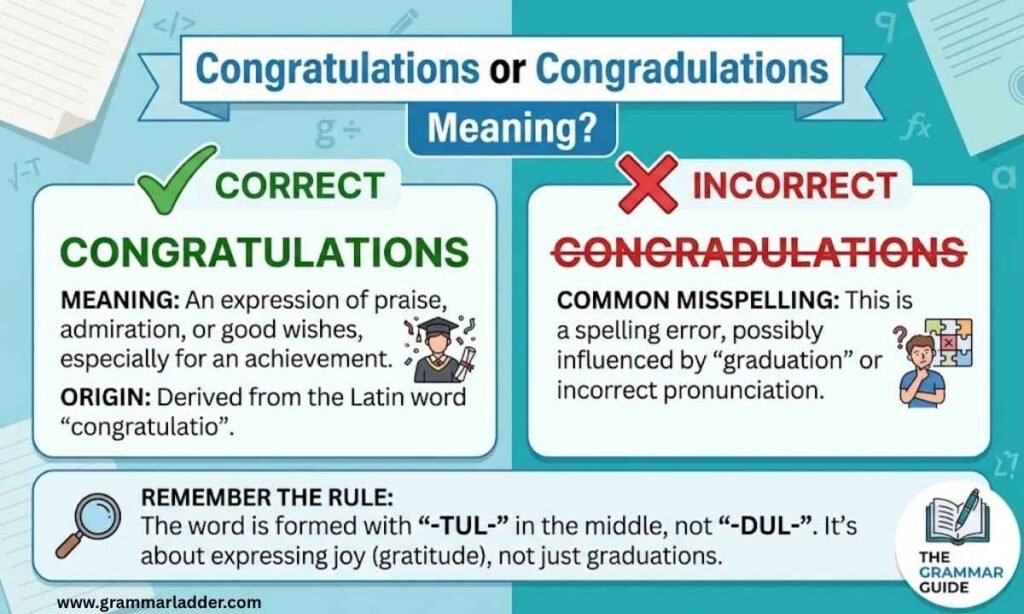
“Congratulations” is a plural noun used to express praise, happiness, or approval for someone’s success, achievement, or good fortune. It’s typically used as an exclamation on its own, or followed by “on” or “to”:
- “Congratulations on passing your exam!”
- “Congratulations to the newlyweds!”
The related verb form is congratulate, meaning to express these good wishes directly to someone: “I want to congratulate you on your achievement.”
“Congradulations” has no meaning at all in standard English — it doesn’t appear in Merriam-Webster, the Cambridge Dictionary, Oxford Dictionary, or Collins Dictionary. It’s purely a misspelling of the real word.
Congratulations or Congradulations in English for Graduation
Graduation season is prime time for this spelling mix-up, largely because “graduation” and “congratulations” sound similar and are used in the same context. But don’t let that similarity trick you.
- ✅ “Congratulations on your graduation, we’re so proud of you!”
- ❌ “Congradulations on your graduation, we’re so proud of you!”
A helpful trick: think of “congratulations” and “graduation” as two completely separate words with two completely separate spellings, even though they often appear together in the same sentence.
Which Spelling Should You Use?
This one is simple: always use congratulations. There is no context — casual, professional, academic, or creative — where “congradulations” is the appropriate choice.
Based on your audience:
- Formal or professional writing (emails, reports, official letters): Use the full word, “Congratulations,” spelled correctly and often followed by a specific reason (“Congratulations on your promotion to Senior Manager”).
- Casual conversations with friends: You can use “Congratulations” or the informal shortcut “Congrats” — but never “Congrads” or “Congradulations.”
- Social media captions: Keep it short and correct — “Congrats!!” works fine, but double-check autocorrect hasn’t swapped in the wrong spelling.
- Academic or graduation-related writing: Stick to the full, correctly spelled “Congratulations” for a polished, professional tone.
Congratulations or Congradulations in English Oxford
If you check the Oxford English Dictionary or Oxford Learner’s Dictionaries, you’ll find only one listed spelling: congratulations. “Congradulations” does not appear as an entry, a variant, or a historical form. This applies across all major English dictionaries, including Oxford, Cambridge, Merriam-Webster, and Collins — a strong signal that the “d” spelling has never been recognized as valid English.
Congratulations or Congradulations in English Grammar
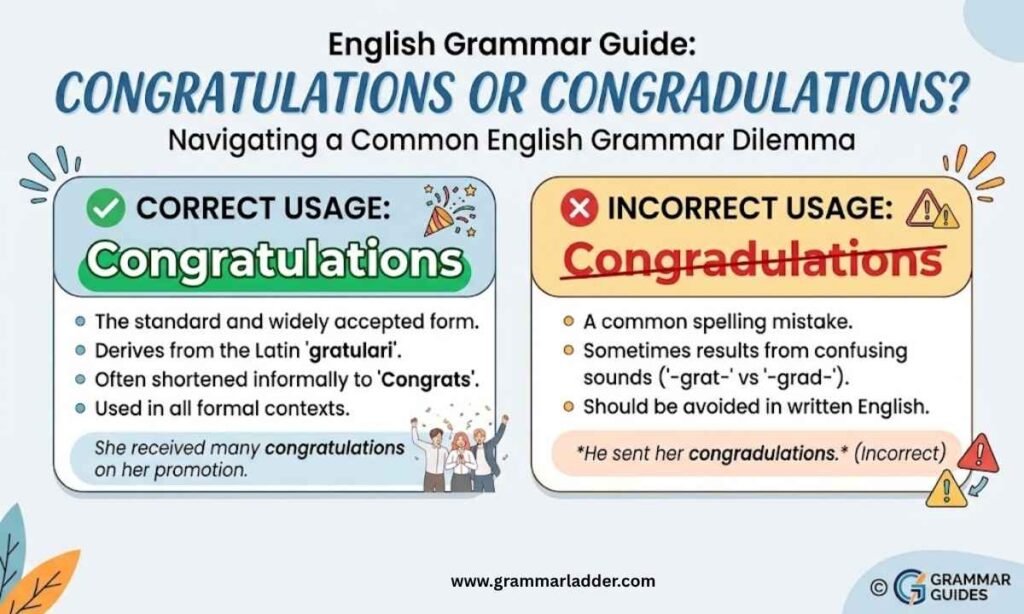
Grammatically, “congratulations” behaves in a specific way:
- It is almost always used in the plural form, even when congratulating just one person, because it refers to multiple expressions of good will.
- It functions as an interjection or exclamatory noun when used alone (“Congratulations!”).
- It can be followed by prepositions like “on” (for an achievement) or “to” (for the person being congratulated).
- The singular form, “congratulation,” exists but is rarely used outside of technical or older texts.
There is no grammatical scenario in standard English where “congradulations” would be considered correct — it’s not a regional variant, an accepted informal form, or an old spelling that fell out of use. It is, and always has been, an error.
Common Mistakes with Congratulations or Congradulations
Even confident writers slip up here. Here’s a quick breakdown of the most frequent errors and how to fix them.
Common Mistakes
- Congradulations (extra “d”)
- Congratulashuns (phonetic spelling)
- Congratulation’s (unnecessary apostrophe)
- Congrats’s (incorrect informal plural)
- Congratualtions (letter swap typo)
Correct Forms
| Form | Word | Notes |
| Standard spelling | Congratulations | The only correct spelling, plural noun |
| Informal short form | Congrats | Accepted in casual writing and speech |
| Singular noun | Congratulation | Rare, mostly formal or older usage |
| Verb | Congratulate | “I congratulate you on your success” |
| Adjective | Congratulatory | As in “a congratulatory message” |
A simple memory trick: think of the informal word “congrats.” Nobody spells it “congrads,” and that “t” is your clue that the full word also uses a “t,” not a “d.”
Congratulations or Congradulations in Everyday Examples
Seeing the correct word used in real, everyday contexts can help cement the spelling in memory.
Emails
“Congratulations on closing the deal — the whole team is thrilled with the result.”
News Headlines
“Congratulations Pour In as Local Teen Wins National Science Award”
Social Media
“Congrats to my best friend on her engagement! 💍 So happy for you both!”
Formal Writing
“On behalf of the board, please accept our sincere congratulations on your well-deserved retirement.”
Notice that in every single example, the spelling remains consistent: a “t,” never a “d.”
Congratulations or Congradulations – Google Trends & Usage Data
Search data consistently shows that “congradulations” is one of the most frequently searched misspellings related to celebratory language online. People often type the incorrect version into search engines either by habit or to double-check their spelling before sending a message.
Key Insights:
- “Congratulations” is searched far more often overall, but “congradulations” spikes during graduation season (May–June) and around holidays involving major life events like weddings.
- Mobile typing and voice-to-text features are common culprits, since autocorrect doesn’t always catch the phonetic error.
- Search interest in “how do you spell congratulations” tends to rise sharply right before major personal milestones, suggesting people want to get it right for a specific occasion.
Comparison Table: Keyword Variations
| Search Term | Correct Spelling? | Common Use Case |
| Congratulations | ✅ Yes | Standard usage in all contexts |
| Congradulations | ❌ No | Common misspelling, especially in casual typing |
| Congrats | ✅ Yes | Informal short form |
| Congradgulations | ❌ No | Rare double-letter typo |
| Congratulation | ✅ Rare, but valid | Singular, formal/older usage |
Frequently Asked Questions
Is “congradulations” ever correct?
No, it is never correct in any form of standard English, formal or informal.
Why do so many people spell it with a “d”?
Because the “t” sound softens during fast speech and can sound like a “d,” leading to the common typo.
Is “congrats” acceptable in professional emails?
It’s fine for friendly workplace messages, but full “Congratulations” is better for formal correspondence.
Does British English spell it differently?
No, the spelling is identical in both British and American English.
What’s the singular form of “congratulations”?
“Congratulation” is technically correct but rarely used; the plural form is standard.
Is “congratulations” a noun or a verb?
It’s a noun; the related verb form is “congratulate.”
How can I remember the correct spelling?
Think of “congrats” — since it’s spelled with a “t,” the full word uses a “t” too, never a “d.”
Conclusion
The debate between “congratulations” and “congradulations” isn’t really a debate at all — only one spelling is correct, and it’s the one with a “t”: congratulations. The “d” version is a phonetic slip that has become common simply because of how the word sounds when spoken quickly, not because it’s an accepted variation.
Whether you’re writing a heartfelt graduation message, a quick text to a friend, or a formal congratulatory email, sticking to the correct spelling shows attention to detail and helps your message land as intended —as a genuine, well-crafted expression of joy for someone else’s success.

I am an English writer with over four years of experience in grammar and language education.
Through Grammar Ladder, I share clear explanations, practical examples, and helpful English tips.
My goal is to share my knowledge so others can benefit and improve their language skills.
I believe anyone can master English with proper guidance and consistent practice.