If you’ve ever paused mid-sentence wondering whether to write “inquire” or “enquire,” you’re not alone. These two words look almost identical, sound the same, and mean nearly the same thing — yet many writers still second-guess themselves every time they type one.
The good news? The answer is simpler than it seems. This guide breaks down the real difference, when to use each word, and how to avoid the small mistakes that trip up even experienced writers.
Quick Answer
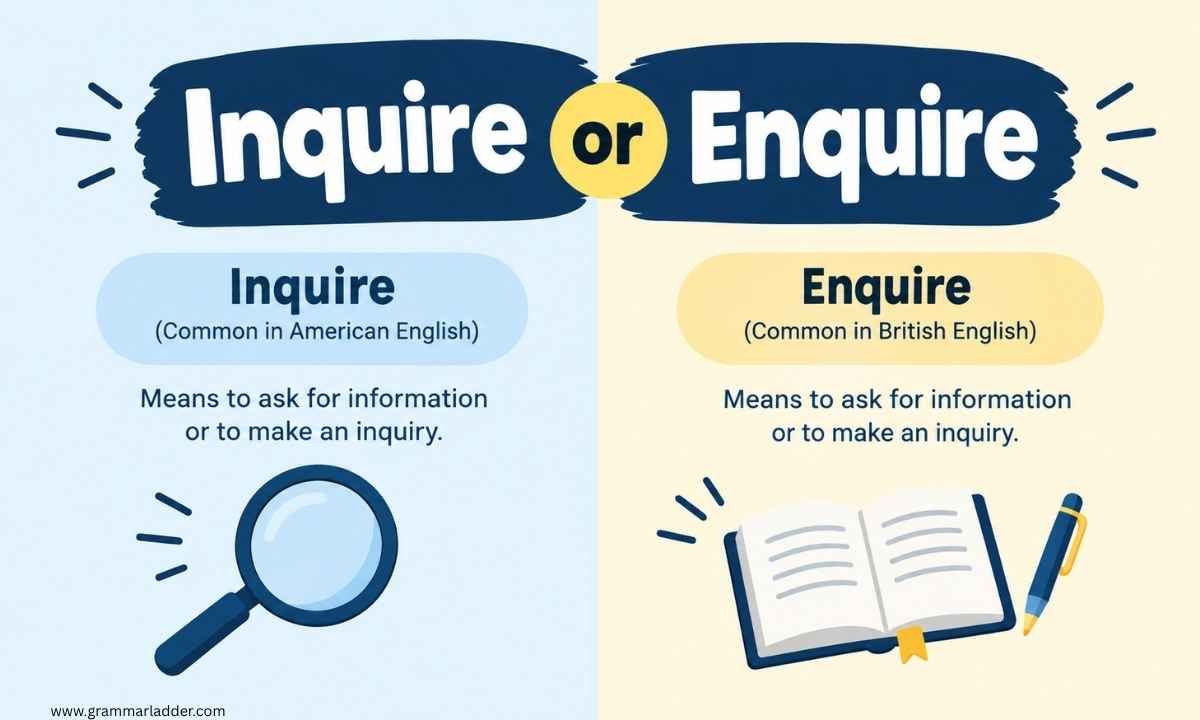
Both “inquire” and “enquire” mean to ask for information. The difference mostly comes down to region and formality:
- Inquire is preferred in American English and is also used for formal or official investigations.
- Enquire is common in British English and usually refers to casual, everyday questions.
In short: they’re not wrong versions of each other — they’re regional cousins.
Simple Background
English has plenty of word pairs that split along British and American lines — think “colour” vs. “color” or “organise” vs. “organize.” Inquire and enquire follow a similar pattern, though the split isn’t as strict.
Both words trace back to the Latin inquirere, meaning “to seek” or “to search into.” Over centuries, British English kept a version starting with “en-,” while American English leaned toward “in-.” Today, both spellings are considered correct, but where and how you use them can subtly change the tone of your writing.
Clear Explanation of the Difference
“Inquire”
“Inquire” is the standard spelling in American English. It’s also the go-to word when referring to a formal investigation or official inquiry, regardless of which side of the Atlantic you’re on.
Example:
- The police will inquire into the cause of the accident.
- She submitted a form to inquire about the scholarship deadline.
“Enquire”
“Enquire” is more common in British, Australian, and other Commonwealth English. It typically refers to a general or casual question, something you’d ask in daily conversation or correspondence.
Example:
- I’d like to enquire about your opening hours.
- He called to enquire whether the package had arrived.
Important Note
Even in British English, “inquiry” (not “enquiry”) is almost always used for formal, official investigations — such as a government inquiry or police inquiry. So the distinction isn’t purely about spelling preference; it’s also about context and formality, especially in the UK.
Comparison Table
| Feature | Inquire | Enquire |
| Primary region | American English | British English |
| Common use | Formal, official, investigative | Everyday, casual questions |
| Noun form | Inquiry (formal investigations, both regions) | Enquiry (general questions, mainly UK) |
| Business usage | Common in US business writing | Common in UK customer service |
| Example phrase | “Inquire about a refund policy” | “Enquire about opening hours” |
| Global preference | Increasingly used worldwide | Used more in the UK, Australia, and India |
Which One to Use and When
Use “inquire” when:
- You’re writing for an American audience or publication.
- You’re referring to a formal investigation (e.g., “an inquiry into misconduct”).
- You’re unsure which to use — “inquire” is the safer, more universally accepted choice.
Use “enquire” when:
- You’re writing for a British, Australian, or Commonwealth audience.
- You’re asking a general, informal question (e.g., booking details, product information).
- Your brand or publication follows British English style guides.
Best Advice
If you’re writing for a global or mixed audience, pick one spelling and stay consistent throughout your document. Mixing “inquire” and “enquire” in the same piece looks inconsistent and can distract readers, even though both are technically correct.
Inquire or Enquire UK
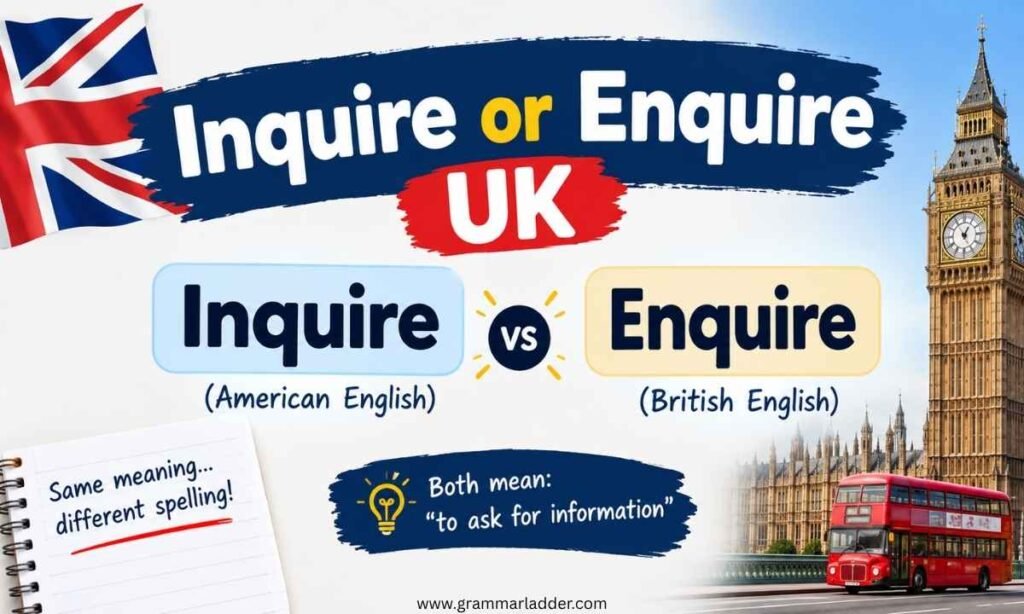
In the UK, both spellings exist side by side. Many British style guides recommend “enquire” for general questions and “inquiry” for formal investigations, making British usage slightly more nuanced than American usage.
Enquire vs Inquire Pronunciation
Here’s a fact that surprises many learners: both words are pronounced the same way — in-KWY-er. The spelling changes, but the sound doesn’t, so pronunciation is never a reliable clue for which one to write.
I would like to Inquire or Enquire
This exact phrase is a great example of how context matters more than “correctness.” An American writing a formal email would likely say, “I would like to inquire about your services.” A British writer in a casual customer service message might say, “I would like to enquire about your services.” Both are perfectly acceptable.
Inquire or Enquire: Synonyms
If you want to avoid the debate entirely, several synonyms work well in both American and British English:
- Ask
- Request information
- Query
- Seek details
- Investigate (for formal contexts)
Inquire or Enquire: Meaning
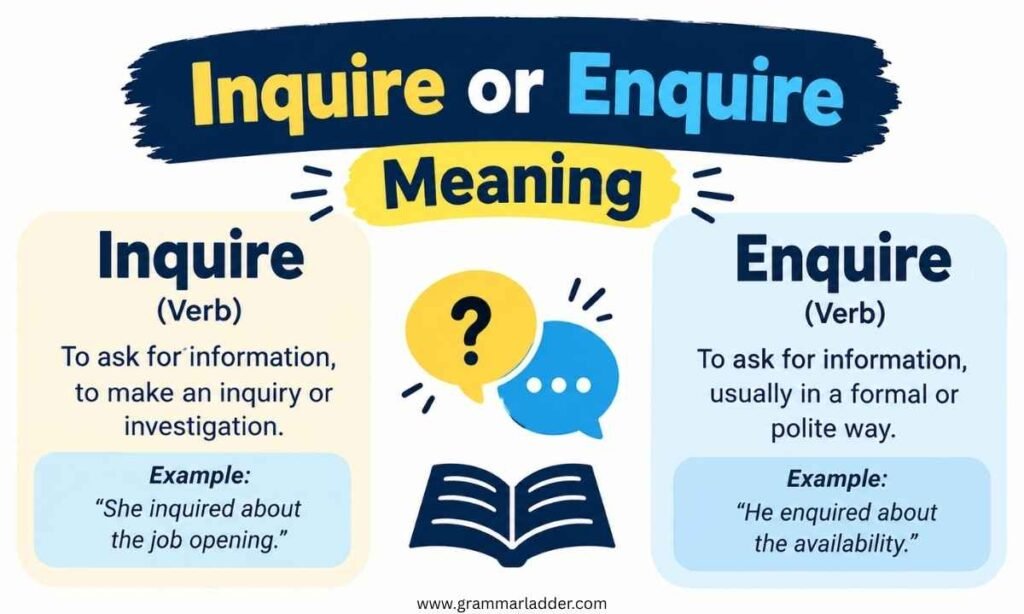
Both words carry the same core meaning: to ask a question or seek information. The meaning doesn’t change based on spelling — only the regional preference and formal-versus-casual tone shift.
Common Mistakes People Make
Even confident writers slip up with these two words, usually because of a few misunderstandings that are easy to fix once you know what to look for.
Mistake 1: Thinking one is wrong
Neither word is incorrect. This is one of the most common misconceptions. The confusion usually comes from writers assuming there’s a single “correct” spelling, when really it’s a regional style choice.
Mistake 2: Mixing styles
Using “inquire” in one paragraph and “enquire” in the next — within the same document — creates an inconsistent tone. Pick a regional style guide (American or British) and stick with it.
Mistake 3: Overthinking the difference
Because the words are so close in meaning, many writers spend more time worrying about which to use than the decision actually warrants. Unless you’re following a strict style guide, either word will be understood clearly by your reader.
Everyday Real-Life Examples
Seeing these words in action makes the distinction much easier to remember than any rule ever could. Here’s how “inquire” and “enquire” show up in the situations you’re likely to encounter every day.
In Emails
- American style: “I am writing to inquire about the status of my application.”
- British style: “I am writing to enquire about the status of my application.”
In Job Context
- “Please inquire directly with HR regarding the vacancy.” (US)
- “Please enquire directly with HR regarding the vacancy.” (UK)
In Customer Service
- US-based companies often use phrases like “Inquire Now” or “Send an Inquiry” on contact pages.
- UK-based companies more often use “Enquire Now” or “Make an Enquiry.”
In Daily Use
If a friend asks you to check something for them, you might say, “I’ll inquire about it” (US) or “I’ll enquire about it” (UK) — both mean you’ll go find out the answer.
Short Learning Section for Students and Beginners
Learning this distinction is easy once you break it into small steps.
Step 1
Identify your audience. Are you writing for American readers, British readers, or a global audience? This decision guides your spelling choice.
Step 2
Check the context. Is this a casual question or a formal investigation? Remember that “inquiry” is standard for formal matters even in British English.
Step 3
Stay consistent. Once you choose a spelling for your document, website, or brand voice, use it throughout.
Practice
Try rewriting these sentences using both spellings to see how naturally each fits your writing style:
- I want to ___ about the refund policy.
- The committee launched an ___ into the incident.
- She called the office to ___ about her order.
Frequently Asked Questions
Is “enquire” a real word?
Yes, it’s a standard English word, especially common in British and Commonwealth English.
Is “inquire” more formal than “enquire”?
Not exactly — “inquire” is more common in formal American writing, while British English uses “inquiry” for formal matters and “enquire” for casual ones.
Can I use “inquire” in British English?
Yes, it’s understood and accepted, though “enquire” is more traditional for everyday questions in the UK.
Which spelling should I use for business writing?
Match your audience: use “inquire” for American clients and “enquire” for British or Commonwealth clients.
Do inquire and enquire have different pronunciations?
No, both words are pronounced identically.
Is one spelling becoming more popular globally?
Yes, “inquire” is increasingly used worldwide due to the influence of American English in business and digital content.
Conclusion
At the end of the day, choosing between “inquire” and “enquire” isn’t about right or wrong — it’s about audience, region, and consistency. American English favors “inquire” in nearly every context, while British English often reserves “enquire” for casual questions and “inquiry” for formal ones.
The simplest rule to remember: when in doubt, choose “inquire” for a safe, globally understood option, or match your regional style guide if you’re writing for a specific audience. Whichever you choose, staying consistent throughout your writing is what truly matters.

I am an English writer with over four years of experience in grammar and language education.
Through Grammar Ladder, I share clear explanations, practical examples, and helpful English tips.
My goal is to share my knowledge so others can benefit and improve their language skills.
I believe anyone can master English with proper guidance and consistent practice.