You are writing a menu, a recipe, or a text to a friend. You type “spicey,” then stop. Something looks off. Is that extra “e” needed?
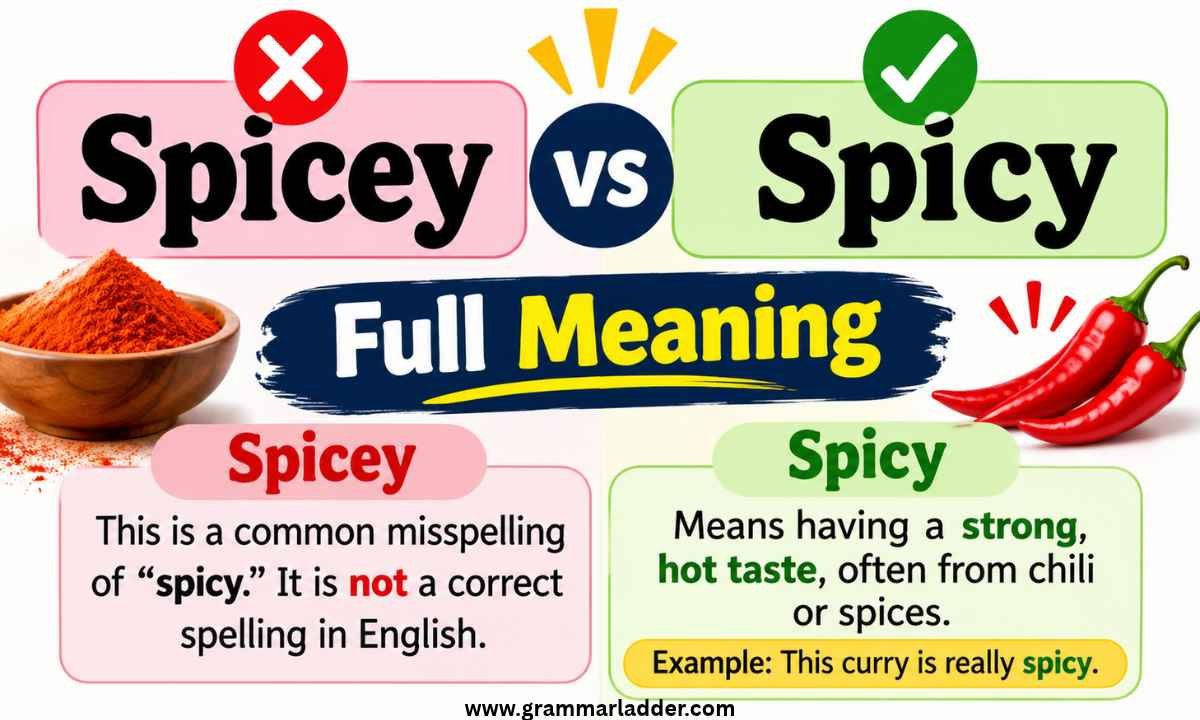
Quick answer: “spicy” is the correct spelling. “Spicey” is a common misspelling. Some dictionaries, such as Dictionary.com, list it as a rare variant, but standard English uses “spicy.” The same is true in American, British, Canadian, and Australian English.
Spicey vs Spicy: Meaning
“Spicy” is an adjective. It describes something that contains spice or tastes hot, sharp, or zesty.
It has two main uses:
- Literal: food seasoned with spices or chili, like curry, salsa, or hot wings.
- Figurative: something lively, daring, or slightly scandalous, like a spicy rumor or a spicy debate.
“Spicey” has no separate meaning. It is simply the same word with a spelling slip. If you see it, it is meant to be “spicy.”
Why I Found It’s Spelled “Spicy”
I compared dictionary entries, spelling guides, and word-formation rules to settle this. The answer comes down to one basic pattern.
The noun is spice. To turn a noun ending in a silent “e” into an adjective, English usually drops the “e” and adds -y.
Spice → drop the “e” → spic + y = spicy
The “e” is already doing its job in “spice” by making the “i” say its long sound. Once the “y” arrives, the “e” is no longer needed.
Here are three more reasons “spicy” wins:
- Major dictionaries list “spicy” as the main entry.
- Style guides and editors treat “spicey” as an error.
- The spelling follows a regular, well-known pattern.
Spicey vs Spicy: Pronunciation
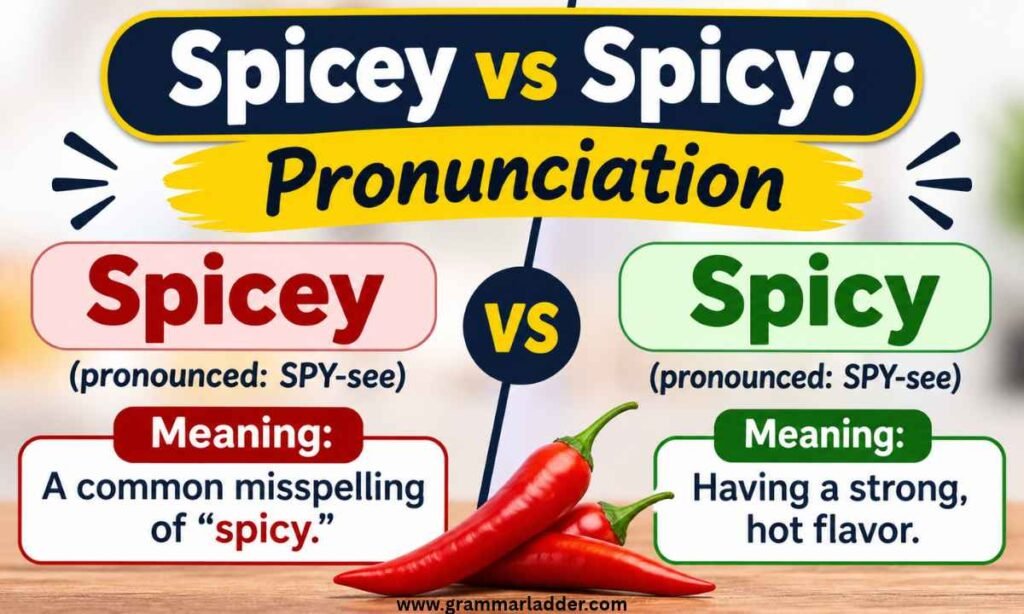
Both spellings are said the same way, which is exactly why the mix-up happens.
- Phonetic: /ˈspaɪ.si/
- Simple respelling: SPY-see
- Stress: on the first syllable
- Syllables: two (spi-cy)
The comparative and superlative forms are spicier and spiciest. Notice that the “y” turns into “i” there. You will never see “spiceyer.”
Because the sound is identical, your ear cannot tell you which spelling is right. Only the rule can.
My Definition and Meaning Analysis
When I looked at how “spicy” is defined, three senses kept coming up.
| Sense | Meaning | Example |
| Flavor | Seasoned with spice or having a hot, pungent taste | A spicy chicken curry |
| Aroma | Smelling of spices | A spicy perfume |
| Figurative | Exciting, bold or mildly improper | A spicy storyline |
On social media, “spicy” has also picked up a casual meaning. A “spicy take” is a bold or controversial opinion. The spelling stays the same in every one of these uses.
The Pattern: Similar Word Transformations
Once you see the pattern, “spicy” feels obvious. Many nouns ending in a silent “e” lose it before -y.
| Base word | Rule | Adjective |
| Spice | Drop “e” + y | Spicy |
| Ice | Drop “e” + y | Icy |
| Juice | Drop “e” + y | Juicy |
| Sauce | Drop “e” + y | Saucy |
| Grease | Drop “e” + y | Greasy |
| Haze | Drop “e” + y | Hazy |
A note on exceptions. A few words keep the “e,” such as pricey and dicey. They are rare, and most writers learn them as individual cases. Some words, like “nosy/nosey,” even accept both forms. “Spicy” is not on that list, so do not treat it as an exception.
Spicey vs Spicy Examples
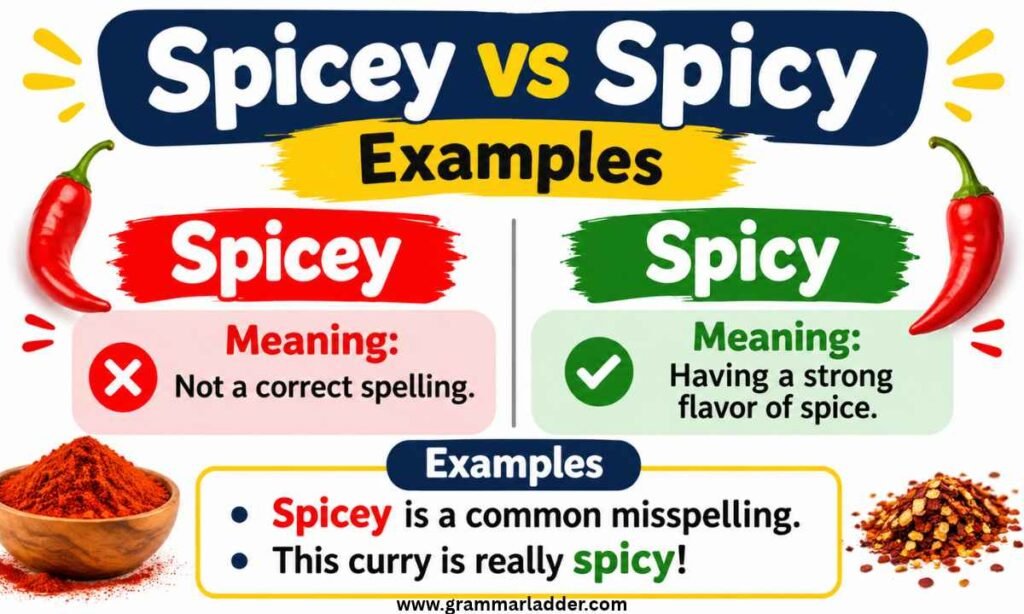
Seeing “spicy” in real sentences is the fastest way to lock in the correct spelling. These examples cover the base form, the comparative, the superlative, and the figurative meaning.
✓ Correct usage of “spicy”
| Form | Correct example |
| Base form (food) | ✓ This salsa is too spicy for me. |
| Figurative | ✓ She added a spicy twist to the story. |
| Comparative | ✓ I prefer spicier food in winter. |
| Superlative | ✓ That was the spiciest ramen I have ever tried. |
| Descriptive | ✓ The chef’s spicy marinade made the dish unforgettable. |
✗ Incorrect usage of “spicey”
| Incorrect sentence | Corrected sentence |
| ✗ | ✓ This curry is too spicy. |
| ✗ | ✓ He ordered the spiciest wings. |
| ✗ | ✓ The conversation got a little spicy. |
Quick fix: every incorrect sentence becomes correct the moment you delete the “e.” In the comparative and superlative, the “y” also changes to “i” (spicier, spiciest).
Spicey or Spicy UK
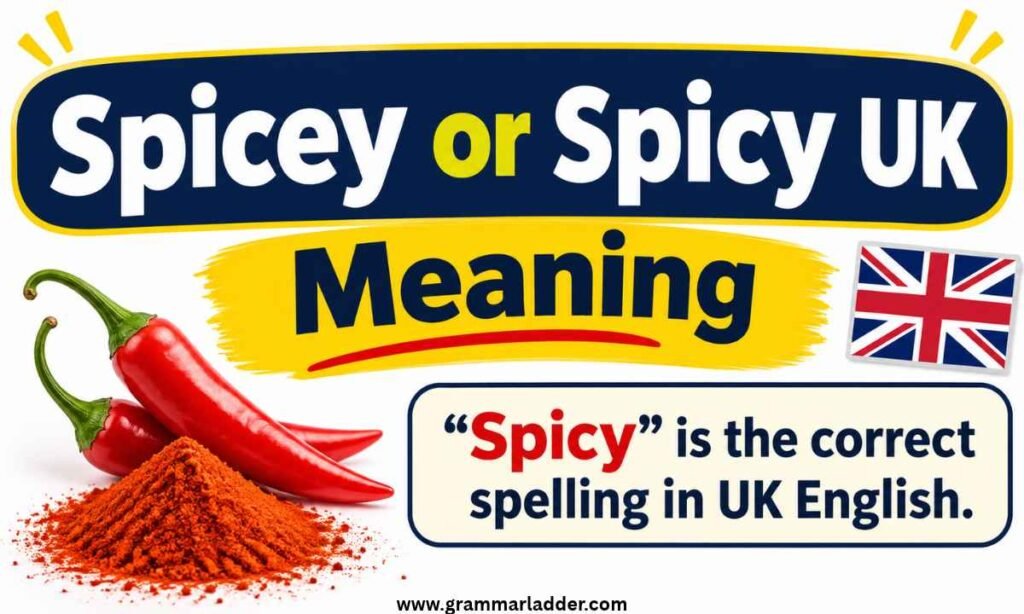
The UK follows the same rule. British English uses “spicy,” and “spicey” is not preferred in any major English-speaking region.
The real UK versus US difference sits in a nearby word:
- Hot pepper: chili in American English, chilli in British English.
- Plural: chilies in American English, chillies in British English.
- Adjective: spicy in both.
So in a British café, you might order a “spicy chilli.” In an American diner, you might order a “spicy chili.” Only the spelling changes. “Spicy” stays the same.
Spicey vs. Spicy Synonyms
Using varied words also makes your writing stronger. Here are useful alternatives, grouped by meaning.
For food and flavor:
- Hot
- Fiery
- Peppery
- Zesty
- Pungent
- Piquant
- Tangy
- Flavorful
For stories, jokes and gossip:
- Racy
- Risqué
- Juicy
- Provocative
- Scandalous
Opposites (antonyms): mild, bland, tasteless, tame.
Pick the synonym that fits the mood. “Fiery” suits a hot curry, while “racy” suits a daring novel.
Spicy vs Spicey: My Visual Comparison
Here is a quick side-by-side check you can screenshot or bookmark.
| Feature | Spicy | Spicey |
| Status | Standard spelling ✓ | Misspelling or rare variant ✗ |
| Dictionary entry | Main entry | Rarely listed |
| Comparative | Spicier | Not used |
| Superlative | Spiciest | Not used |
| Use in formal writing | Yes | No |
| UK and US | Correct in both | Not recommended in either |
Memory trick: Spice loses its “e” when it gets a “y.” The “y” replaces it, like icy and juicy.
Common Mistakes I’ve Learned to Avoid
These are the slips I see most often, and how to fix each one.
- Adding an extra “e” by habit. Words like “pricey” and “nosey” make the “ey” ending feel normal. Check the rule instead of trusting the look.
- Writing “spiceyer” or “spiceyest.” The correct forms are spicier and spiciest.
- Mixing “spice” and “spicy.” “Spice” is the noun, “spicy” is the adjective. Say “too much spice” but “too spicy.”
- Trusting the sound. “Spicy” and “spicey” are pronounced alike, so a spoken check will not help.
- Ignoring spell check. Most tools underline “spicey.” Treat that red line as a useful hint.
- Confusing chili, chilli and chilly. The first two are peppers. “Chilly” means cold.
Frequently Asked Questions
Is it spicy or spicey?
It is “spicy.” “Spicey” is a misspelling or rare variant that standard English avoids.
Is “spicey” ever correct?
Some dictionaries list it as an uncommon variant, but you should not use it in formal or professional writing.
How do you spell the comparative of spicy?
“Spicier,” and the superlative is “spiciest.”
How do you pronounce spicy?
Say “SPY-see,” with the stress on the first syllable.
Is spicy spelled differently in British English?
No. British, American, Canadian, and Australian English all use “spicy.”
Why is it “spicy” but “pricey”?
Most words drop the silent “e” before “-y,” while “pricey” is one of the few exceptions. English spelling is not fully consistent.
What does “spicy” mean besides hot food?
It can mean bold, exciting, or slightly scandalous, as in a “spicy rumor.”
Conclusion
The debate is simple once you know the rule. “Spicy” is the correct spelling in every major form of English. “Spicey” is a misspelling that creeps in because both words sound the same.
Remember the pattern: spice loses its “e” when it gains a “y,” just like icy and juicy. Use “spicier” and “spiciest” for comparisons, and save “pricey” and “dicey” for the few true exceptions. Next time you write a menu, recipe, or caption, you can type “spicy” with confidence.

I am an English writer with over four years of experience in grammar and language education.
Through Grammar Ladder, I share clear explanations, practical examples, and helpful English tips.
My goal is to share my knowledge so others can benefit and improve their language skills.
I believe anyone can master English with proper guidance and consistent practice.