If you’ve ever paused mid-sentence wondering whether to type “authorized” or “authorised,” you’re not alone. This is one of the most common spelling mix-ups in the English language, and the confusion makes complete sense once you understand why it exists.
The short story? Both spellings are correct. The long story involves a fascinating split between American and British English that dates back centuries. In this guide, you’ll learn exactly when to use each version, why the difference exists, and how to avoid embarrassing mistakes in your writing.
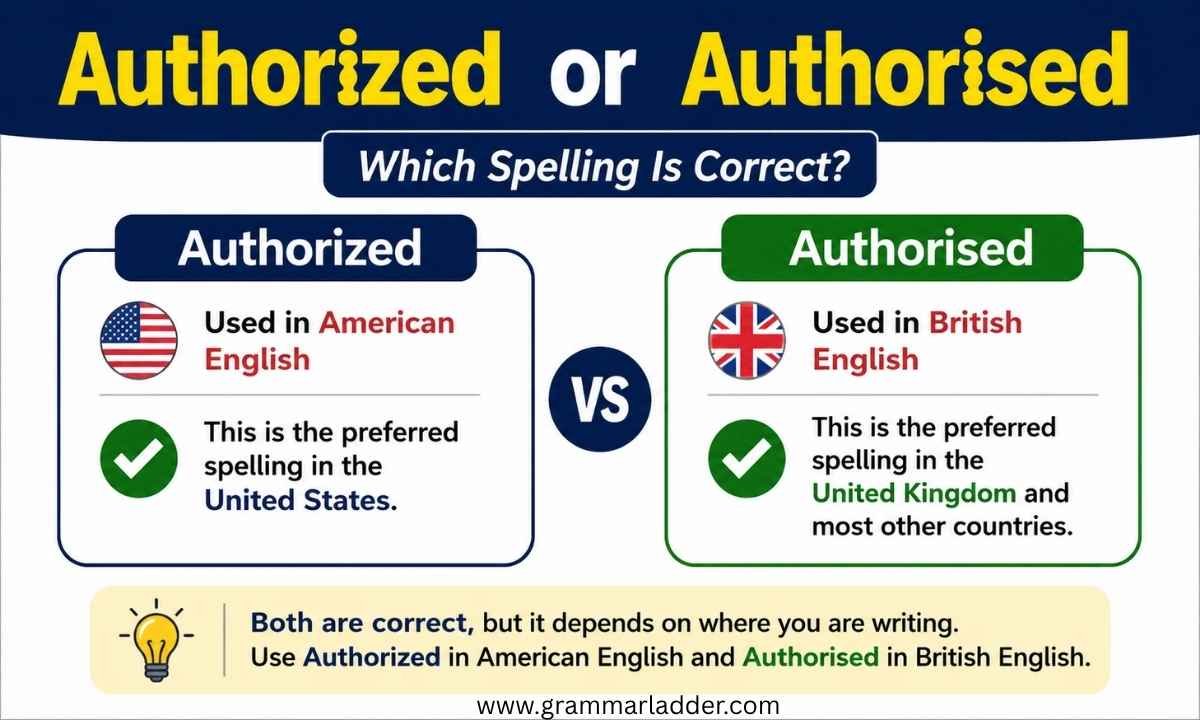
Authorized or Authorised – Quick Answer
Here’s the answer before we go any deeper:
- Authorized is the American English spelling.
- Authorised is the British English spelling.
Both words mean the same thing: to give official permission or approval for something. The only difference is regional spelling convention, not meaning, pronunciation, or grammar.
If you’re writing for a US audience, publication, or company, use “authorized.” If you’re writing for a UK, Australian, or broader Commonwealth audience, “authorised” is the standard choice.
The Origin of Authorized or Authorised
Both words trace back to the Latin term auctorizare, which passed into Old French as autoriser before entering English. The root idea has always centered on granting authority or official sanction to a person or action.
The spelling split happened much later, largely thanks to Noah Webster. In the early 1800s, Webster published his American dictionary and intentionally simplified many British spellings to create a distinct American identity in language. He replaced the “-ise” endings borrowed from French with “-ize,” aligning them more closely with their Greek origin (the suffix “-izo”).
Meanwhile, British English retained the French-influenced “-ise” spelling, which had already become standard practice across the UK. This single decision by Webster created a ripple effect across hundreds of English words, and “authorize/authorise” became one of them.
British English vs American English Spelling
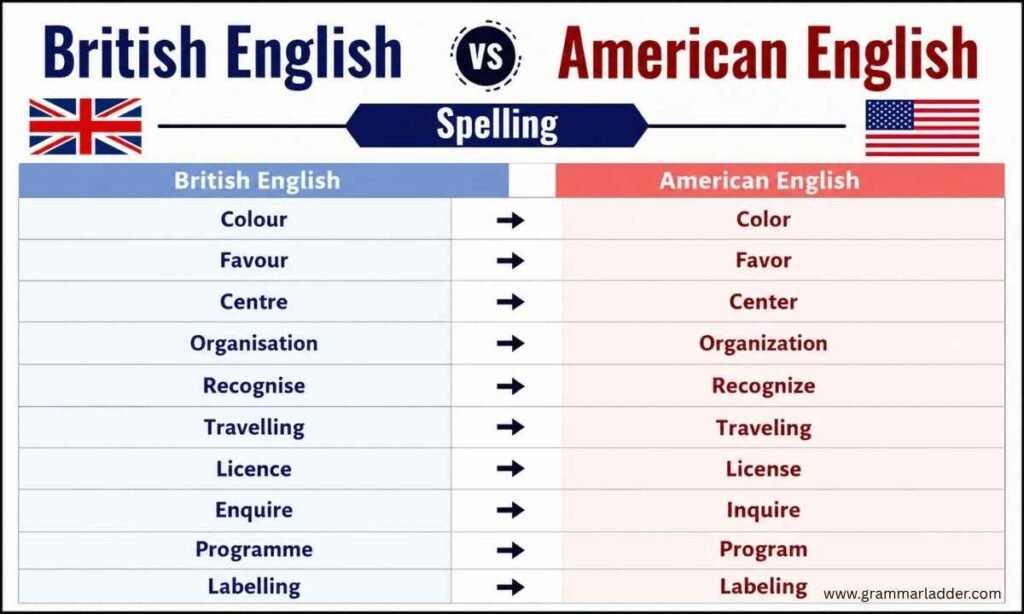
Understanding this rule isn’t just about one word — it reflects a broader spelling divide that runs throughout the English language. Once you see the pattern, you’ll recognize it in dozens of other everyday words.
Main Rule
The general rule is straightforward:
- Words ending in -ize are typically American English.
- Words ending in -ise are typically British English.
This pattern applies to a large family of verbs, not just “authorize.” However, there’s an important nuance: British English actually accepts both “-ize” and “-ise” for many words, following what’s called Oxford spelling (used by Oxford University Press and some formal British publications). Still, “-ise” remains far more common in everyday British writing, journalism, and business communication.
Examples
Here are other common word pairs that follow the same American vs. British pattern:
- Organize / Organise
- Recognize / Recognise
- Realize / Realise
- Apologize / Apologise
- Customize / Customise
- Specialize / Specialise
Notice the consistency? Once you memorize this rule for “authorized/authorised,” you can apply it to dozens of similar words instantly.
Comparison Table
| Feature | Authorized (American English) | Authorised (British English) |
| Spelling origin | Influenced by Noah Webster’s reforms | Retained French-based tradition |
| Common region | United States, Canada (mixed) | UK, Australia, India, New Zealand |
| Suffix | -ized | -ised |
| Meaning | Given official permission | Given official permission |
| Formal usage | US legal, business, tech documents | UK legal, business, government documents |
| Dictionary status | Standard in Merriam-Webster | Standard in Oxford/Cambridge Dictionary |
How To Use “Authorised” In A Sentence?
Since meaning and grammar are identical, you can substitute one spelling for the other based on region. Here are some natural examples:
- Only authorised personnel are allowed beyond this point.
- She was not authorised to sign the contract on the company’s behalf.
- The bank flagged the transaction as unauthorised.
- Please contact an authorised dealer for repairs.
- The manager authorised the refund after reviewing the complaint.
You’ll notice these sentences work perfectly well with “authorized” swapped in — the structure never changes, only the spelling.
Synonyms and Opposites
Understanding related words helps you use “authorized/authorised” more precisely in context.
Synonyms:
- Approved
- Sanctioned
- Certified
- Permitted
- Licensed
- Endorsed
Opposites (Antonyms):
- Unauthorized / Unauthorised
- Forbidden
- Prohibited
- Banned
- Denied
Interestingly, the negative form follows the same regional spelling rule: “unauthorized” in American English and “unauthorised” in British English.
Which Spelling Should You Use?
This depends entirely on your audience and context. Ask yourself these questions:
- Who is reading this? If your audience is primarily American, choose “authorized.” For UK, Australian, or Commonwealth readers, choose “authorised.”
- What style guide are you following? US-based style guides like AP or Chicago Manual of Style favor “authorized.” UK-based guides typically favor “authorised.”
- Is this for a global brand? Many international companies pick one spelling and apply it consistently across all content to maintain brand voice.
The golden rule of professional writing is consistency. Never mix both spellings within the same document, website, or piece of content.
Authorized or Authorised Biography
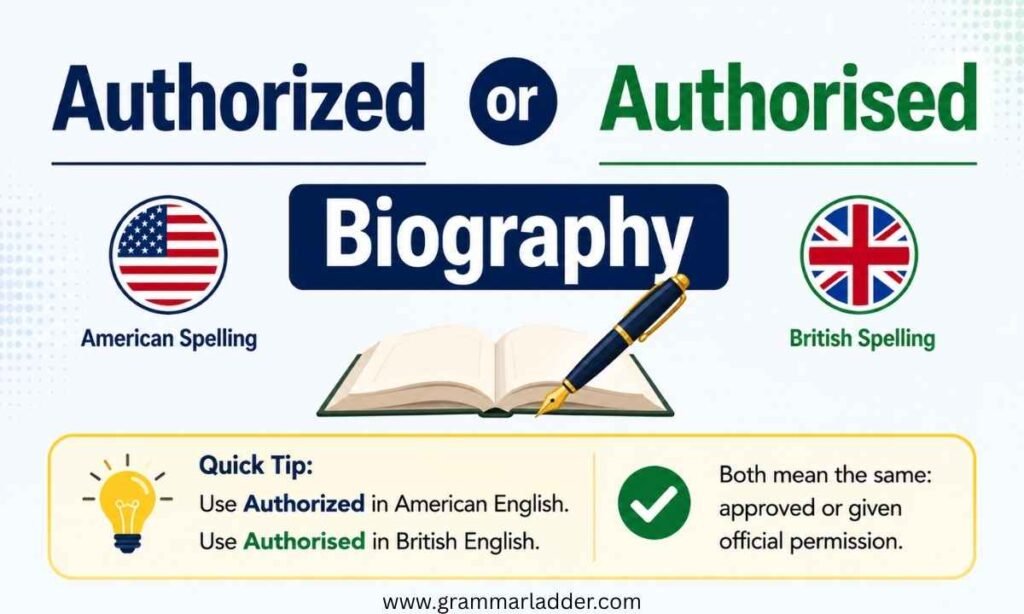
When writing about someone’s life story with their cooperation and approval, the term used is an “authorized biography” (US) or “authorised biography” (UK). This means the subject of the biography — or their estate — has reviewed and approved the content, distinguishing it from an unauthorized biography written without their consent or input.
This distinction matters in publishing and journalism because an authorized biography often includes exclusive interviews, personal documents, or direct quotes that wouldn’t otherwise be accessible. Readers and critics also treat authorized biographies differently, since the subject’s approval can shape how candid or filtered the content is.
Authorised Signatory or Authorized Signature
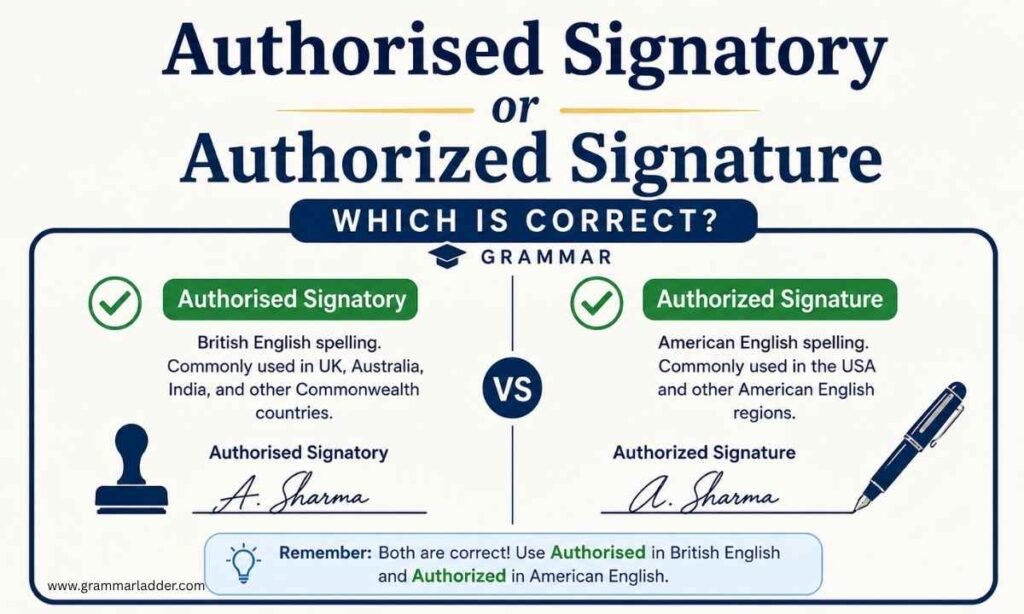
In business and legal contexts, you’ll frequently encounter the phrase “authorized signatory” (or “authorised signatory” in British English). This refers to a person who has official permission to sign documents, contracts, or financial paperwork on behalf of a company or organization.
Key points about authorized signatories:
- They are typically named in company bylaws or board resolutions.
- Banks require a list of authorized signatories before allowing account access.
- An authorized signature carries the same legal weight as if the company itself signed the document.
- Removing or adding an authorized signatory usually requires formal documentation.
Whether you write “authorized signatory” or “authorised signatory” depends purely on your regional audience — the legal function remains identical.
Common Mistakes with Authorized or Authorised
Even experienced writers slip up occasionally. Watch out for these frequent errors:
- Mixing spellings in one document — Using “authorized” in one paragraph and “authorised” in another looks inconsistent and unprofessional.
- Ignoring style guide requirements — Many companies and publications have a fixed preference; ignoring it can affect brand consistency.
- Misspelling as “authorizeed” or “authorisd” — Simple typos happen, especially when typing quickly.
- Assuming one spelling is “more correct” — Neither spelling is superior; they’re regional variants, not right-or-wrong answers.
- Forgetting the rule applies to related words — Writers often correctly use “authorized” but then inconsistently write “recognise” in the same document.
Authorized or Authorised in Everyday Examples
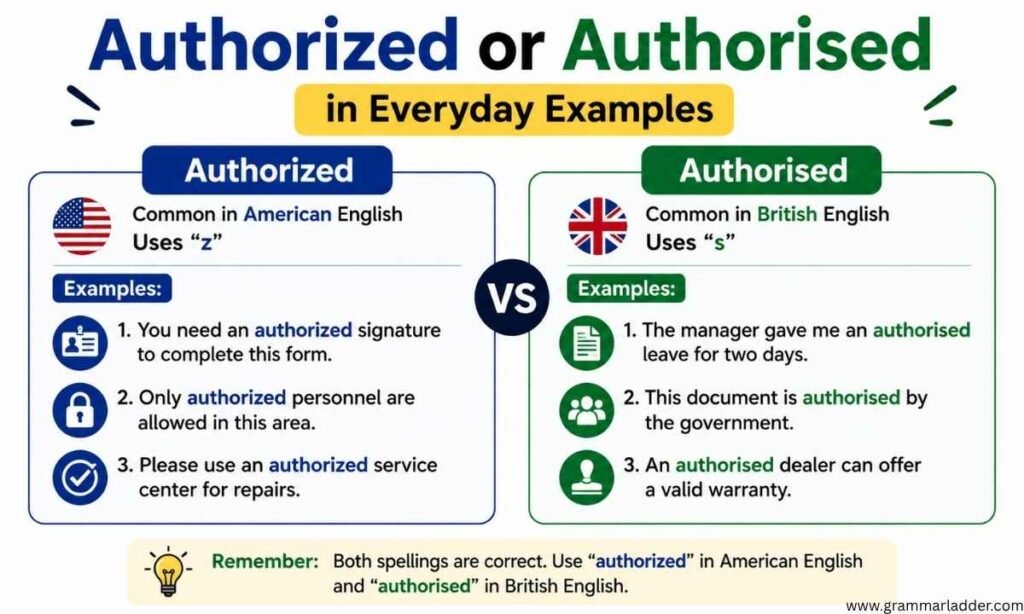
You’ll encounter these words constantly in daily life, often without noticing the spelling:
- Banking: “This transaction requires authorized access.”
- Travel: “Only authorised staff may enter the cockpit.”
- Retail: “Visit an authorized reseller for genuine products.”
- Technology: “The app requires authorised login credentials.”
- Government: “The authorised budget was released this quarter.”
These examples show how deeply embedded this word is across industries — from finance to travel to tech.
Authorized or Authorised – Google Trends & Usage Data
When you compare search interest globally, a clear geographic pattern emerges. Search data consistently shows that “authorized” dominates in the United States, Canada, and other countries that follow American English conventions, while “authorised” leads searches in the UK, Australia, India, and most Commonwealth nations.
This pattern mirrors what you’d expect from broader American vs. British spelling trends — think “color” vs. “colour” or “center” vs. “centre.” Global content platforms, SEO tools, and grammar checkers generally recommend matching your spelling to your target audience’s location rather than picking one universally.
Keyword Comparison Table
| Search Term | Primary Region | Typical Use Case |
| Authorized | USA, Canada | Legal, business, tech content |
| Authorised | UK, Australia, India | Legal, government, business content |
| Authorized signatory | US business documents | Banking, contracts |
| Authorised signatory | UK business documents | Banking, contracts |
| Unauthorized access | US tech/security | Cybersecurity, IT |
| Unauthorised access | UK tech/security | Cybersecurity, IT |
Frequently Asked Questions
Is “authorised” a real word?
Yes, it’s the standard British English spelling of “authorized” and is fully recognized in UK dictionaries.
Which spelling is used in official documents?
It depends on the country — US government and legal documents use “authorized,” while UK documents use “authorised.”
Can I use both spellings in the same article?
No, you should pick one spelling and use it consistently throughout a single piece of writing.
Does Microsoft Word flag one spelling as wrong?
Word flags whichever spelling doesn’t match your selected language setting (US English vs. UK English).
Is “authorized” more commonly used worldwide?
Yes, largely due to the global reach of American media, software, and business content, though “authorised” remains standard across the Commonwealth.
What is the noun form of authorize/authorise?
The noun form is “authorization” (American) or “authorisation” (British).
Is there a difference in pronunciation?
No, both spellings are pronounced identically.
Conclusion
At the end of the day, “authorized” and “authorised” are simply two correct spellings shaped by regional English traditions rather than grammar rules. Choose “authorized” for American audiences and “authorised” for British or Commonwealth audiences, and most importantly, stay consistent throughout your writing.
Once you understand this simple American vs. British spelling pattern, you’ll never second-guess yourself again — and you’ll be able to apply the same logic to dozens of other “-ize/-ise” word pairs with confidence.

I am an English writer with over four years of experience in grammar and language education.
Through Grammar Ladder, I share clear explanations, practical examples, and helpful English tips.
My goal is to share my knowledge so others can benefit and improve their language skills.
I believe anyone can master English with proper guidance and consistent practice.