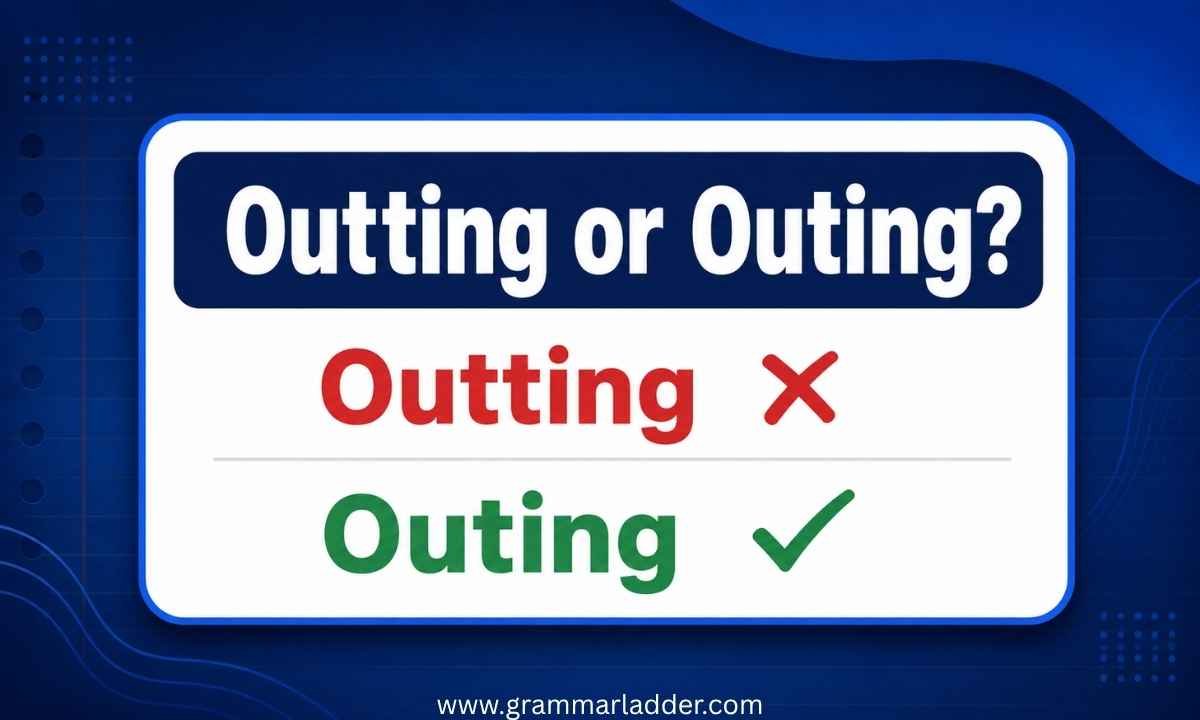
If you’ve ever paused mid-sentence wondering whether it’s “outting” or “outing,” you’re not alone. This is one of the most commonly misspelled words in English, and the confusion makes total sense once you understand why it happens.
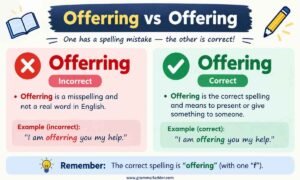
Here’s the short version: “Outing” is the correct spelling. “Outting” is a common misspelling that doesn’t exist in any standard English dictionary — American or British.
But knowing which one is correct is only half the story. In this guide, we’ll break down what “outing” actually means, why so many people mistakenly write “outting,” and how to make sure you never mix them up again.
What Does “Outting” Mean?
Nothing. “Outting” has no meaning in standard English. It’s not recognized by Merriam-Webster, Oxford English Dictionary, Cambridge Dictionary, or any other reputable grammar authority.
It’s a spelling error that happens when people double the letter “t” by mistake, likely influenced by other English words where consonant doubling is required (like “sitting” or “hopping”). We’ll explain the actual rule behind this later in the article.
For now, just remember: if you see “outting” in a sentence, it needs to be corrected to “outing.”
What Does “Outing” Mean?
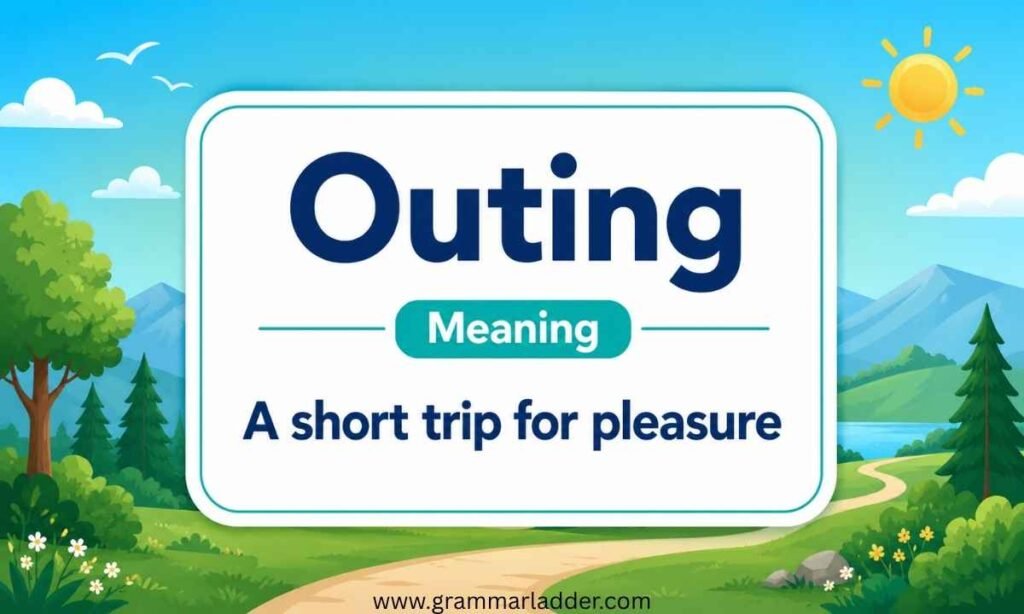
“Outing” is a real, dictionary-approved English word with two primary meanings depending on context.
1. A Short Trip or Excursion
The most common use of “outing” refers to a brief trip taken for pleasure, recreation, or a specific purpose — usually with a group of people such as family, friends, or coworkers.
Examples:
- “The office is planning a team outing to the beach next Friday.”
- “We had a lovely family outing at the local park.”
- “Her school organized an educational outing to the science museum.”
2. The Act of Publicly Disclosing Private Information
“Outing” also functions as a noun (and the gerund of the verb “to out”) describing the act of exposing someone’s private information without their consent — most commonly used in the context of revealing a person’s sexual orientation, gender identity, or a hidden fact about their life.
Examples:
- “The magazine faced backlash for the outing of a public figure.”
- “Outing someone against their will can have serious emotional consequences.”
- “The whistleblower’s outing of the company’s practices made headlines.”
This second meaning carries emotional and ethical weight, especially in discussions around privacy, journalism, and the LGBTQ+ community.
Outting or Outing – Quick Answer
| Spelling | Correct? | Why |
| Outing | ✅ Yes | Standard, dictionary-recognized spelling |
| Outting | ❌ No | Misspelling caused by incorrect consonant doubling |
Bookmark this section if you just need a fast answer — but keep reading to understand the reasoning so it sticks.
The Origin of “Outing”
The word “outing” traces back to the base word “out,” which has Old English roots (ūt), meaning “away from the inside” or “not within.” Over time, “out” evolved into a verb form — “to out” — meaning to bring something into the open or public view.
Adding the suffix “-ing” transforms it into a noun or gerund: “outing.” This pattern follows standard English morphology, where a short verb ending in a single consonant, preceded by a single vowel, typically doubles that consonant before adding “-ing” — but only under specific conditions we’ll explain shortly. “Out” doesn’t meet those conditions, which is exactly why “outing” keeps a single “t.”
The recreational meaning of “outing” (a short trip) emerged in the 18th century, evolving from the idea of “going out” for leisure. The privacy-related meaning became widely used much later, particularly from the late 20th century onward, tied to journalism and public discourse around identity disclosure.
Outting or Outing Synonym
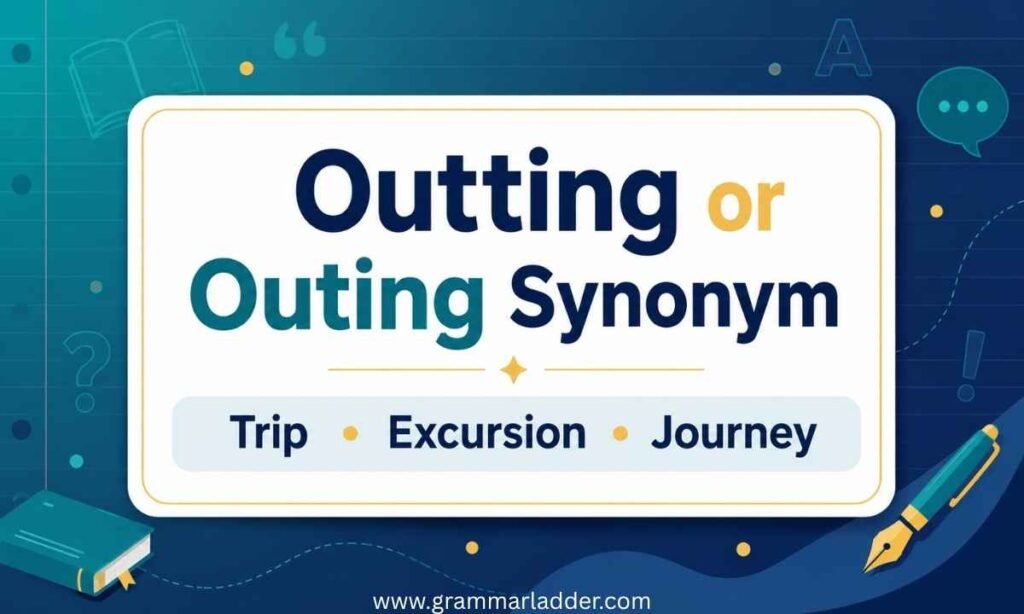
Depending on which meaning you’re using, “outing” has different synonyms:
Synonyms for “outing” (trip/excursion):
- Excursion
- Trip
- Jaunt
- Getaway
- Field trip
- Day trip
Synonyms for “outing” (disclosure):
- Exposure
- Revelation
- Disclosure
- Unmasking
- Exposé
Choosing the right synonym depends entirely on context, so always consider which meaning of “outing” you intend before swapping it out.
Outting or Outing Meaning in Business
In a professional or corporate setting, “outing” almost always refers to the first meaning — a company-sponsored trip or team-building activity.
Common business usage includes:
- Team outing – A recreational trip organized by an employer to boost morale and collaboration.
- Corporate outing – A planned event, often annual, combining networking with leisure activities.
- Client outing – An informal trip or event used to strengthen business relationships.
There is no correct business use of “outting” — if you see it written this way in a company memo or marketing material, it should be flagged and corrected immediately, as it can undermine professionalism and credibility.
British English vs. American English Spelling
Good news: this is one of the rare cases where spelling doesn’t change across dialects.
American English, British English, Australian English, and Canadian English all use the same spelling: “outing.” Unlike words such as “color/colour” or “organize/organise,” “outing” remains identical across all major English-speaking regions. There is no regional variant that supports “outting” as an acceptable alternative.
Which Spelling Should You Use?
Always use “outing.” There is no context — formal, informal, academic, business, or casual — where “outting” is grammatically acceptable.
If you’re ever unsure while typing quickly, a simple trick is to say the word aloud: “outing” rhymes with “routing” and “shouting,” both of which use a single “t.” This small mental check can help prevent the typo before it happens.
Why Do People Write “Outting”? The Double Consonant Rule Explained
This mistake almost always comes down to a misunderstanding of the doubling rule in English spelling.
Here’s the actual rule: you double the final consonant before adding “-ing” only when all three conditions are met:
- The word is one syllable, or the stress falls on the final syllable.
- The word ends in a single consonant.
- That consonant is preceded by a single vowel.
Examples where doubling applies:
- Sit → Sitting
- Run → Running
- Stop → Stopping
Why “out” doesn’t qualify: The word “out” ends in a consonant (“t”), but it’s preceded by two vowels (“ou”), not one. Since it fails condition three, the consonant should not be doubled.
That’s the entire explanation in a nutshell — “out” already has a vowel cluster before the final “t,” so no doubling is needed when forming “outing.”
Common Mistakes with “Outing”
Beyond the double-“t” error, here are a few other mistakes worth watching for:
- Confusing “outing” with “outting” – the most frequent error, discussed throughout this guide.
- Misusing “outing” as a verb – “outing” is a noun/gerund; the verb form is “to out” (e.g., “He was outed by a journalist,” not “He was outinged”).
- Overusing “outing” for serious disclosures – using the lighter, trip-related tone of “outing” when discussing sensitive personal disclosures can unintentionally minimize the seriousness of the topic.
- Autocorrect errors – some spell-checkers and predictive keyboards mistakenly suggest “outting,” especially on mobile devices, so it’s worth double-checking before hitting send.
“Outing” in Everyday Examples
To see how naturally “outing” fits into daily language, here are a few more real-world style examples:
- “The book club planned a fun outing to a local vineyard.”
- “It was meant to be a relaxing outing, but it started raining halfway through.”
- “The scandal centered around the unauthorized outing of confidential employee records.”
- “Their annual company outing includes games, food, and a talent show.”
Notice how context alone tells you which meaning applies — no ambiguity, as long as the spelling is correct.
Outting – Google Trends & Usage Data
Despite being grammatically incorrect, “outting” is searched online with surprising frequency, largely by people trying to confirm the correct spelling before writing it. Search interest for this specific misspelling tends to spike around back-to-school seasons and corporate event planning periods, when people are drafting emails, flyers, or itineraries and pause to double-check their spelling.
This pattern reinforces an important point: many searches for “outting” aren’t people who believe it’s correct — they’re people seeking clarification, which is exactly what this guide is designed to provide.
Keyword Comparison Table
| Term | Correct Spelling? | Part of Speech | Common Usage |
| Outing | ✅ Yes | Noun / Gerund | Trip, excursion, disclosure |
| Outting | ❌ No | N/A (misspelling) | N/A |
| Outed | ✅ Yes | Verb (past tense) | Disclosure of private info |
| Out | ✅ Yes | Verb / Adverb | Base word |
Frequently Asked Questions
Is it “outing” or “outting”?
“Outing” is correct. “Outting” is a misspelling with no dictionary recognition.
What does “outing” mean in slang?
In casual use, “outing” usually refers to a fun trip with friends, family, or coworkers.
Is “outting” used in British English?
No, British English also uses “outing” exclusively; there is no regional variant.
Why do people misspell “outing” as “outting”?
People incorrectly apply the double-consonant rule, which doesn’t apply here since “out” has two vowels before its final consonant.
What is the verb form of “outing”?
The verb is “to out,” as in “She was outed by a former colleague.”
Can “outing” be used in a business context?
Yes, it commonly refers to company-sponsored trips like team outings or client outings.
Is “outing” always about trips?
No, it can also mean publicly revealing private or personal information about someone.
Conclusion
The correct spelling is always “outing” — never “outting.” This single word carries two distinct meanings: a short, enjoyable trip and the act of revealing someone’s private information. Both uses are common in everyday and professional English, but neither justifies the double-“t” spelling.
Understanding the doubling rule behind English gerunds makes it easy to see why “outing” keeps its single “t” — the word “out” already contains two vowels before the final consonant, so no doubling is required. Keep this guide handy the next time you’re unsure, and you’ll never second-guess this spelling again.

I am an English writer with over four years of experience in grammar and language education.
Through Grammar Ladder, I share clear explanations, practical examples, and helpful English tips.
My goal is to share my knowledge so others can benefit and improve their language skills.
I believe anyone can master English with proper guidance and consistent practice.