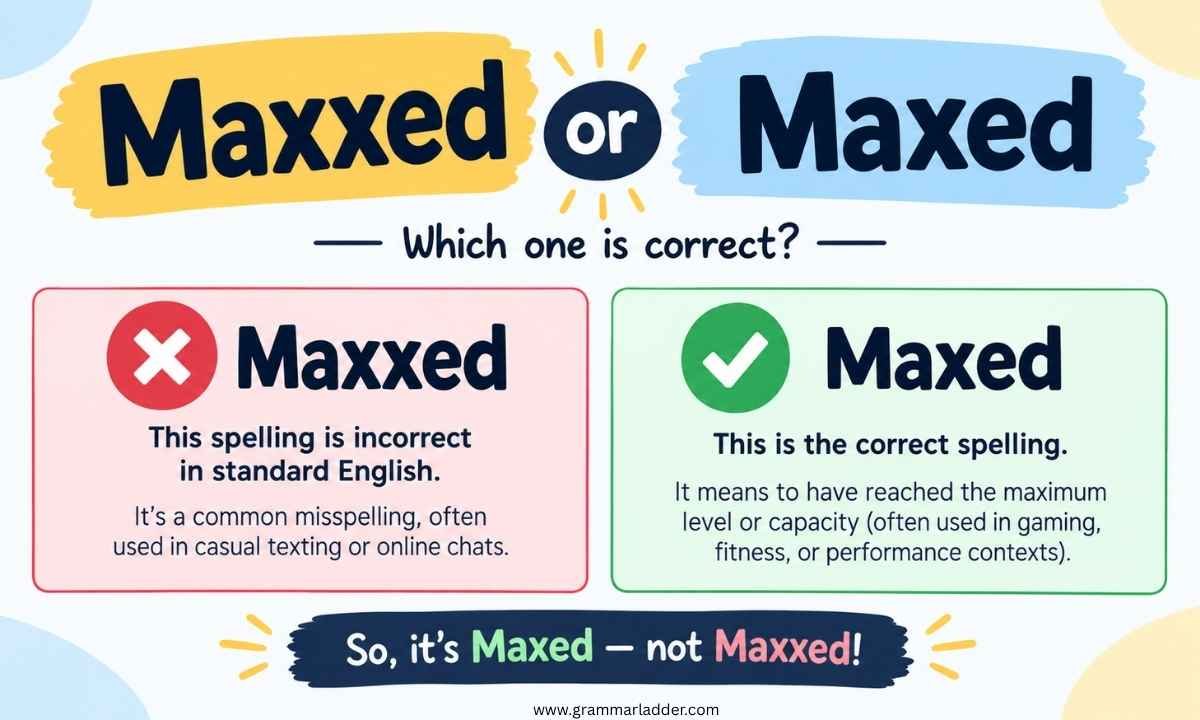
If you’ve ever typed “I’m totally maxxed out” and then paused, wondering if that second “x” belongs there, you’re not alone. This is one of the most common spelling mix-ups in casual English writing, especially online. The good news? The answer is straightforward once you understand where the confusion comes from.
Maxxed or Maxed – Quick Answer
“Maxed” is the correct spelling. It’s the standard past tense and past participle of the verb “max,” which itself comes from “maximum.” Every major dictionary — Merriam-Webster, Oxford, and Cambridge — recognizes “maxed” as the correct form. “Maxxed” (with two x’s) is an informal variant that shows up frequently online, but it isn’t recognized as standard English in any dictionary.
Examples
- I maxed out my gym membership benefits this year.
- She maxed her credit card during the holiday sales.
- The character has maxed all his skill points in the game.
- We’re maxed out on storage space for this project.
Notice that in each case, “maxed” fits naturally into formal and informal sentences alike. “Maxxed” would look out of place in any of these if you were writing for a resume, article, or business email.
The Origin of Maxxed and Maxed
The word “max” is a shortened form of “maximum,” which traces back to Latin. As English speakers do with many short verbs, “max” picked up the standard “-ed” ending to form its past tense: max → maxed. This follows the same pattern as other one-syllable verbs ending in a consonant, like “fix” → “fixed” or “box” → “boxed.”
Why the Confusion Exists
The confusion largely comes from consonant-doubling rules in English spelling. Many one-syllable verbs double their final consonant before adding “-ed,” such as:
- stop → stopped
- grab → grabbed
- plan → planned
Because “max” ends in a single consonant sound after a vowel, some writers assume it follows the same doubling pattern and add an extra “x,” producing “maxxed.”
Why?
The doubling rule only applies to certain consonants at the end of a stressed syllable, and it specifically excludes the letter “x.” That’s because “x” already represents two sounds (“ks”), so doubling it would be redundant. This is the same reason we don’t write “boxxed,” “fixxed,” or “taxxed.” The letter “x” simply never doubles in standard English spelling, no matter how tempting it looks.
British English vs American English Spelling
A common assumption is that “maxxed” might be a British spelling variant, similar to how “colour” and “color” differ across dialects. This isn’t the case.
Key Point
Both British and American English use “maxed” as the correct spelling. There is no regional dictionary — Oxford, Collins, or Merriam-Webster — that lists “maxxed” as an accepted alternative form. The double-x spelling is purely informal, driven by internet culture, branding, and stylized typing rather than any dialectal spelling rule.
Comparison Table
| Feature | Maxed | Maxxed |
| Dictionary status | Recognized standard word | Not in standard dictionaries |
| British English | Correct | Incorrect |
| American English | Correct | Incorrect |
| Common usage | Formal and informal writing | Slang, gaming, social media, branding |
| Grammar rule followed | Standard “-ed” past tense | Breaks consonant-doubling rules |
Which Spelling Should You Use?
For nearly all writing situations, “maxed” is the safer and more correct choice.
Use Maxed if:
- You’re writing an email, report, article, or academic paper
- You want your content to pass grammar and spell-check tools
- You’re targeting SEO rankings, since search engines favor dictionary-correct spelling
- You’re writing for a professional or international audience
- You want to appear credible and detail-oriented
Avoid Maxxed unless:
- You’re deliberately using stylized slang for branding (like a fitness or gaming brand name)
- You’re writing very casual social media captions where informal spelling is expected
- You’re quoting someone else’s exact wording, such as a username or hashtag
Audience-Based Advice
| Audience/Context | Recommended Spelling | Why |
| Business & corporate writing | Maxed | Reads as professional and grammatically correct |
| Academic & educational content | Maxed | Required for formal correctness and credibility |
| Journalism & news media | Maxed | Follows standard style guides and dictionaries |
| SEO & web content | Maxed | Matches dictionary spelling for better search visibility |
| Gaming communities | Maxxed (informal) | Common stylistic slang, works as a deliberate flex |
| Fitness/bodybuilding niches | Maxxed (informal) | Used as branded or stylized slang, not formal grammar |
| Social media captions | Either, context-dependent | “Maxxed” feels casual; “maxed” still safe and correct |
Maxxed or Maxed Meaning
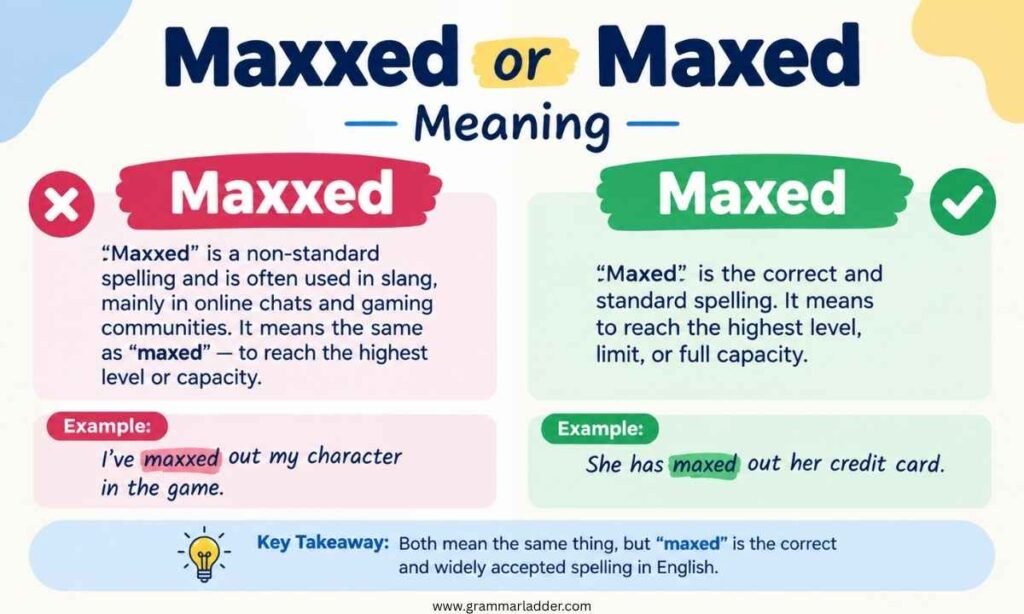
Both spellings, when used informally, share the same intended meaning: reaching the highest or maximum possible level of something. This could apply to:
- Physical limits (maxed out at the gym)
- Financial limits (maxed out a credit card)
- Digital or gaming limits (maxed out a character’s stats)
- Emotional or mental limits (maxed out on stress or patience)
The meaning doesn’t change between the two spellings — only the correctness does. “Maxxed” is simply a misspelled or stylized version carrying the identical intended meaning as “maxed.”
Maxxed or Maxed Synonym
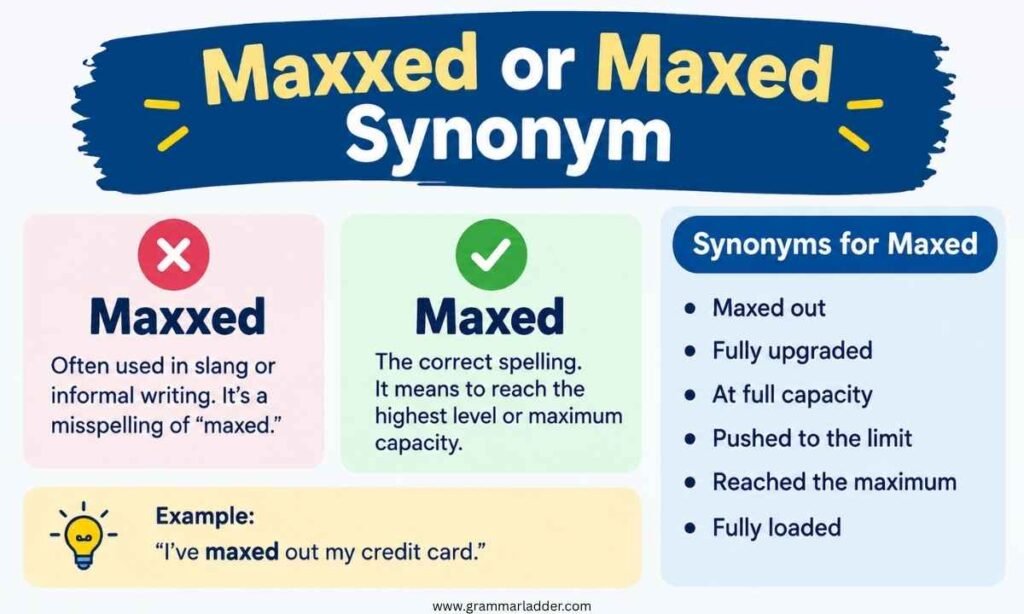
If you want to avoid the debate altogether, several synonyms convey the same idea:
- Exhausted (all resources or capacity)
- Depleted
- Fully utilized
- At capacity
- Topped out
- Reached the limit
- Filled to the brim
These alternatives work well in professional writing when you want to avoid any ambiguity about spelling.
Common Mistakes with Maxed or Maxxed
Mistake 1: Using maxxed in professional writing
Using “maxxed” in a resume, business proposal, or formal report can make writing look careless or unpolished, even if the meaning is clear.
Mistake 2: Thinking maxxed is British spelling
As covered earlier, neither British nor American English recognizes “maxxed” as a standard spelling variant.
Mistake 3: Overapplying consonant-doubling rules
Many writers double the final consonant out of habit, forgetting that words ending in “x” are an exception to this rule.
Mistake 4: Using maxxed for SEO content
Search engines and grammar checkers generally treat “maxed” as the searchable, dictionary-correct term. Using “maxxed” in web copy can hurt readability scores and may confuse readers who are unfamiliar with the slang usage.
Maxed and Maxxed in Everyday Examples
Here’s how each spelling tends to show up across different real-world contexts.
Emails
“I’ve maxed out my available leave days for this quarter.” (Correct, professional usage)
News & Media
“Retailers report that consumer credit cards are increasingly maxed during the holiday season.” (Standard journalistic spelling)
Social Media
“literally maxxed out on coffee today lol 😅” (Informal, stylized spelling common in casual posts)
Finance
“Once your credit utilization is maxed, your credit score can take a hit.” (Correct, standard spelling expected in financial writing)
Technology
“The device’s storage is maxed after the recent software update.” (Correct spelling used in tech reviews and manuals)
Formal Writing
“The committee’s budget was maxed before the fiscal year ended.” (Correct spelling required for formal documents)
Maxxed Vs Maxed – Google Trends & Usage Data
Search interest and usage patterns show a clear divide between the two spellings.
Popularity by Context
- “Maxed out” dominates in finance, fitness, gaming, and general conversational use.
- “Maxxed” appears mostly in gaming communities, meme culture, and certain branded slang phrases, where deliberate misspellings are part of the appeal.
Geographic Trends
Search behavior tends to be fairly consistent across English-speaking regions, including the US, UK, Canada, and Australia. “Maxed” remains the dominant, dictionary-supported spelling everywhere, while “maxxed” appears sporadically online regardless of country, suggesting it’s more of an internet-culture trend than a regional dialect difference.
Comparison Table: Maxed vs Maxxed
| Category | Maxed | Maxxed |
| Correct spelling | ✅ Yes | ❌ No |
| Found in dictionaries | ✅ Yes | ❌ No |
| Safe for SEO content | ✅ Yes | ❌ No |
| Safe for professional writing | ✅ Yes | ❌ No |
| Common in gaming/slang culture | Sometimes | ✅ Frequently |
| Passes spell-check | ✅ Yes | ❌ Usually flagged |
Frequently Asked Questions
Is “maxxed” a real word?
No, “maxxed” is not recognized in standard dictionaries. “Maxed” is the correct spelling.
Why do people spell it “maxxed” with two x’s?
It likely comes from confusion with consonant-doubling rules, plus its popularity as informal slang in gaming and social media.
Is “maxxed out” grammatically correct?
No, the grammatically correct phrase is “maxed out.”
Does British English use “maxxed”?
No, both British and American English use “maxed” as the standard spelling.
Can I use “maxxed” in casual texting or social media?
Yes, informally it’s understood, but it’s still not the dictionary-correct spelling.
What’s a good synonym for “maxed out”?
“Depleted,” “at capacity,” or “fully utilized” are strong alternatives.
Is “maxed” past tense or past participle?
It functions as both, similar to other regular verbs like “fixed” or “boxed.”
Conclusion
When it comes down to it, “maxed” is the spelling backed by grammar rules, dictionaries, and standard usage across English-speaking countries. “Maxxed” survives mainly as internet slang, useful in casual, stylized, or brand-specific contexts, but it has no place in formal, professional, or SEO-focused writing. If you want your content to read as polished, credible, and search-friendly, “maxed” is always the safer choice. When in doubt, stick to the version dictionaries agree on.

I am an English writer with over four years of experience in grammar and language education.
Through Grammar Ladder, I share clear explanations, practical examples, and helpful English tips.
My goal is to share my knowledge so others can benefit and improve their language skills.
I believe anyone can master English with proper guidance and consistent practice.