You’re typing a sentence, you reach for “in front,” and you hesitate. Is it one word or two? It’s a small question, but it shows up in emails, essays, captions, and job applications, and a wrong guess can make polished writing look careless.
This guide settles it. You’ll get the correct spelling, the grammar behind it, clear examples, and a few tricks to remember it for good.
Quick Answer
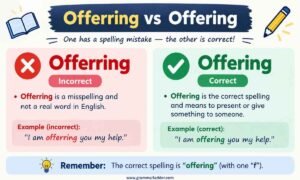
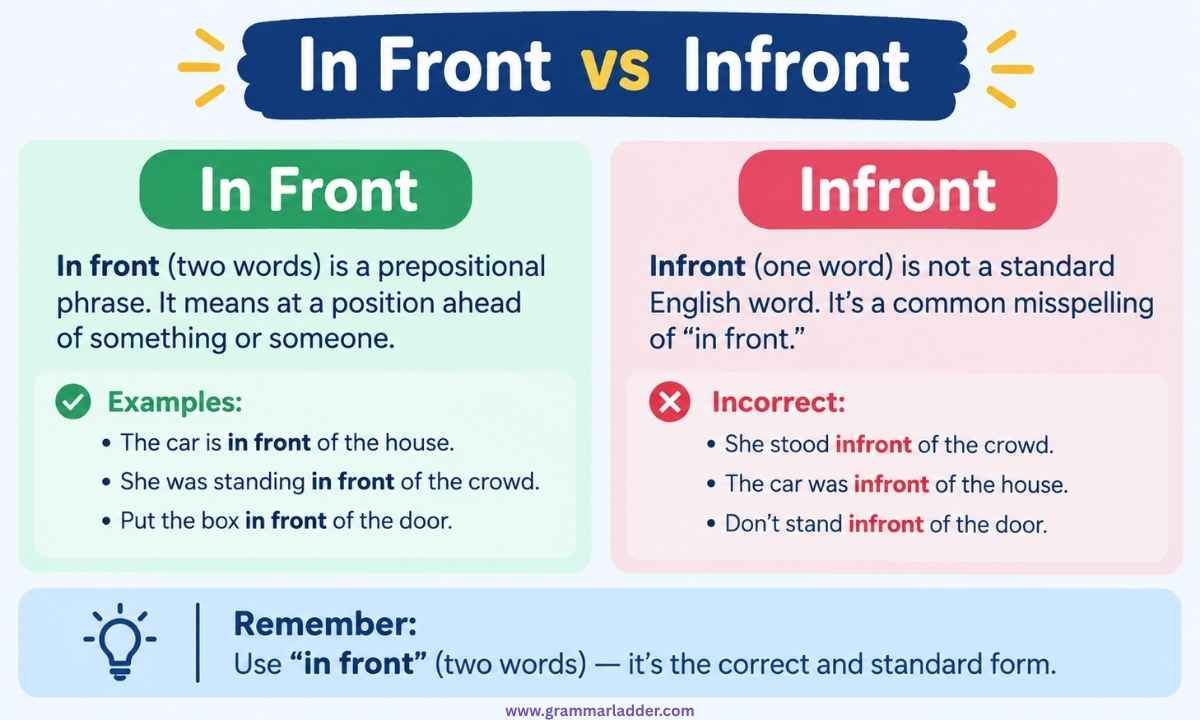
“In front” is correct. “Infront” is a misspelling.
Standard English always writes it as two separate words. No major dictionary lists “infront” as a valid term, and that holds in both American and British English.
- ✅ The taxi stopped in front of the hotel.
- ❌ The taxi stopped infront of the hotel.
If you only remember one thing, remember this: two words, always.
Why Do People Confuse It?
The mix-up is common, and there are good reasons for it.
- Similar words are written as one. English has many compounds, such as “inside,” “indoors,” “income,” and “intake.” It’s natural to assume “infront” belongs in that group. It doesn’t.
- Fast typing hides the space. Many people type quickly and skip the space bar, especially on a phone, and autocorrect doesn’t always catch it.
- We say it as one unit. In speech, “in front” runs together into a single smooth sound. Your brain then writes it as one word.
- Brand names add noise. A few companies use “Infront” as a stylized name. Seeing it in logos can make it look more legitimate than it is.
Understanding why the error happens makes it easier to stop making it.
The Two Words Inside “In Front”
Splitting the phrase into its parts shows why it can’t be one word.
First Word: “In”
“In” is a preposition. It usually describes position, direction, or state, as in “in the room,” “in a hurry,” or “in March.” Here, it works together with “front” to describe where something is.
Second Word: “Front”
“Front” is a noun meaning the forward-facing part or position of something. The front of a house is the side facing the street. The front of a line is where it starts.
Put together, “in front” literally means “in the forward position.” Since both pieces are independent words with their own meanings, English keeps them apart.
In Front or Infront Grammar
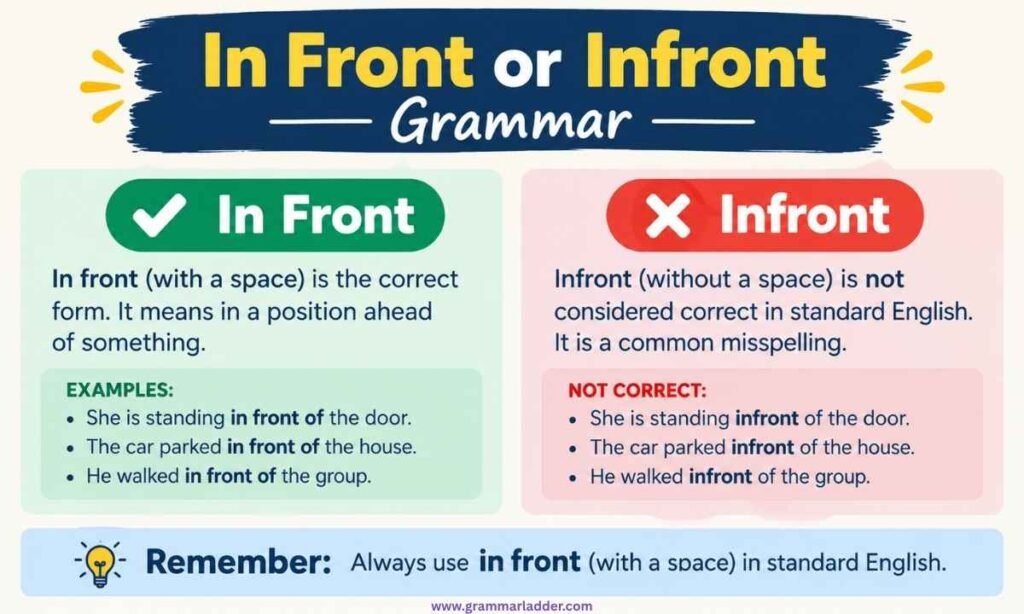
Grammatically, “in front” can play two roles.
1. Adverbial phrase. On its own, “in front” tells you where something is or happens.
- The runner in front never looked back.
- Let’s sit in front so we can see the screen.
2. Part of a prepositional phrase (“in front of”). When an object follows, you add “of.” Together, “in front of” works as a compound preposition.
- She parked in front of the library.
- He stood in front of the mirror.
Here is a simple way to tell which one you need:
- Is there a noun or pronoun right after the phrase?
- If yes, use in front of.
- If no, use in front.
“Infront” fits neither role. Because it isn’t a recognized word, it has no grammatical function, and spell-checkers will usually underline it in red.
In Front or Infront Meaning
“In front” has a few related meanings, depending on context.
- Position ahead. Located at the forward part of something: “The bus is in front of us.”
- Facing. Positioned directly opposite: “He sat in front of the judge.”
- Leading. Ahead in a race, contest, or score: “Our team is in front by two points.”
- Presence. Being seen or heard by others: “Don’t argue in front of the kids.”
“Infront” has no meaning in standard English, because it isn’t a word. If you see it in a text, treat it as a typo.
In Front vs Infront: Comparison Table
| Feature | In Front | Infront |
| Correct spelling | Yes | No |
| Number of words | Two | One (incorrect) |
| Part of speech | Adverb or preposition (with “of”) | None |
| Found in dictionaries | Yes | No |
| Accepted in US English | Yes | No |
| Accepted in UK English | Yes | No |
| Safe for formal writing | Yes | No |
| Example | “She stood in front of the class.” | “She stood infront of the class.” |
When Should You Use “In Front”?
Use it any time you describe a forward position, a lead, or someone’s presence. The main thing to decide is whether to add “of.”
Use “in Front of” for location
When you name the thing that something is ahead of, add “of.”
- The kids lined up in front of the ice cream truck.
- A tall man was standing in front of me at the concert.
- The statue sits in front of the main entrance.
The “of” connects the position to the object. Leaving it out sounds incomplete: “The kids lined up in front the truck” is wrong.
Use “in Front” without “of”
When no object follows, drop the “of.” The phrase then acts as an adverb.
- Take the seat in front; it has more legroom.
- The car in front suddenly braked.
- You go in front, and I’ll follow.
You can also use it to mean “leading”:
- Brazil is in front at halftime.
A quick test: if you can delete “of” and the sentence still makes sense, no “of” was needed.
In Front or Infront Examples
Here are sentences that show the correct form in different settings.
Everyday use
- Please wait in front of the office.
- I left my bag in front of the door.
Work and school
- She presented in front of the entire board.
- Students must not talk in front of the exam hall.
Sports and competition
- The cyclist moved in front with two laps to go.
- Our rivals are in front on points.
Casual conversation
- Don’t say that in front of Grandma!
- There’s a parking spot in front if you want it.
Notice that every example keeps “in” and “front” separate. Not one of them works as “infront.”
Common Mistakes
Even confident writers slip up here. Watch for these errors.
- Writing it as one word. “Infront” is the biggest one. Fix it by adding a space.
- Dropping “of” when an object follows. “Stand in front the door” should be “in front of the door.”
- Adding “of” when nothing follows. “The car in front of” is incomplete if the sentence ends there.
- Confusing it with “infront” brand names. A company’s logo isn’t a spelling guide.
- Mixing it up with “front of.” “In the front of the room” is also correct, but it means inside the front area, not outside and ahead of something.
Compare these two sentences:
- “He stood in front of the room.” (outside, facing it)
- “He stood in the front of the room.” (inside, at the forward end)
The meanings differ, so choose carefully.
Memory Trick
Try one of these.
The space trick. Picture a small gap between two people standing “in front” of each other. The gap is the space between the words. No gap, no good.
The pair test. Say the phrase aloud as “in” plus “front.” If you can imagine writing each one separately, you’ve got it. You’d never write “inback” or “inside of” as a single word in this sense, and “in front” works the same way.
The opposite rule. The opposite is “behind,” a single word. When you need the two-word phrase, remember that “in front” needs two words because it has more to say: where something is and what it faces.
If you use a word processor, you can also set a custom autocorrect rule that changes “infront” to “in front” every time.
American vs British English
This is an easy topic, because there is no difference.
- American English: “in front” is correct. “Infront” is not accepted.
- British English: “in front” is correct. “Infront” is not accepted.
- Canadian English: “in front” is correct. “Infront” is not accepted.
- Australian English: “in front” is correct. “Infront” is not accepted.
Many spelling pairs split between regions, like “color” and “colour” or “center” and “centre.” This one doesn’t. Whether you write for a US audience or a UK one, “in front” is the only standard form
In Front or Infront Synonym
Repeating “in front” too often can make writing feel flat. These alternatives help, but check the context first.
- Ahead of. “The finish line is ahead of us.” Good for position and progress.
- Before. “He appeared before the committee.” Works in formal settings.
- Facing. “She sat facing the window.” Useful for direction.
- Opposite. “The café is opposite the bank.” Common in British English.
- At the front of. “He stood at the front of the line.” Good for lines and groups.
- Leading. “She’s leading by ten points.” Fits contests.
- In the presence of. “He signed in the presence of a witness.” Best for formal language.
Not every synonym fits every sentence. “Before the house” sounds odd in casual speech, while “in front of the house” feels natural.
Frequently Asked Questions
Is “infront” a real word?
No. “Infront” is a common misspelling, and no standard dictionary recognizes it.
Is it “in front of” or “in front”?
Use “in front of” when a noun follows, and “in front” when nothing follows.
Is “infront” correct in British English?
No. British English also writes it as two words: “in front.”
What does “in front” mean?
It means ahead of, facing, or leading, depending on the sentence.
Can I say “in the front of”?
Yes, but it means inside the front section, not outside and ahead of something.
What is a good synonym for “in front of”?
“Ahead of,” “before,” “facing,” and “opposite” all work, depending on context.
Why do spell-checkers flag “infront”?
Because it isn’t a valid English word, so checkers mark it as an error.
Conclusion
You’re typing fast and stop at one small word. Is it “in front” or “infront”? Many people pause here, even in a simple email.
The right answer is “in front.” It is always two words. This guide explains why, shows easy examples, and gives you tricks to remember it.

I am an English writer with over four years of experience in grammar and language education.
Through Grammar Ladder, I share clear explanations, practical examples, and helpful English tips.
My goal is to share my knowledge so others can benefit and improve their language skills.
I believe anyone can master English with proper guidance and consistent practice.