You are writing an email. You want to say something caught your attention, and you stop. Is it “piqued my interest” or “peaked my interest”? Both look right, and both sound identical when spoken. Only one is correct.
This guide explains the difference between piqued and peaked, shows how to use each word, and gives you a trick to get it right every time.
Quick Answer: Piqued vs Peaked
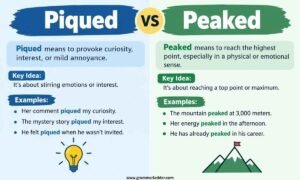
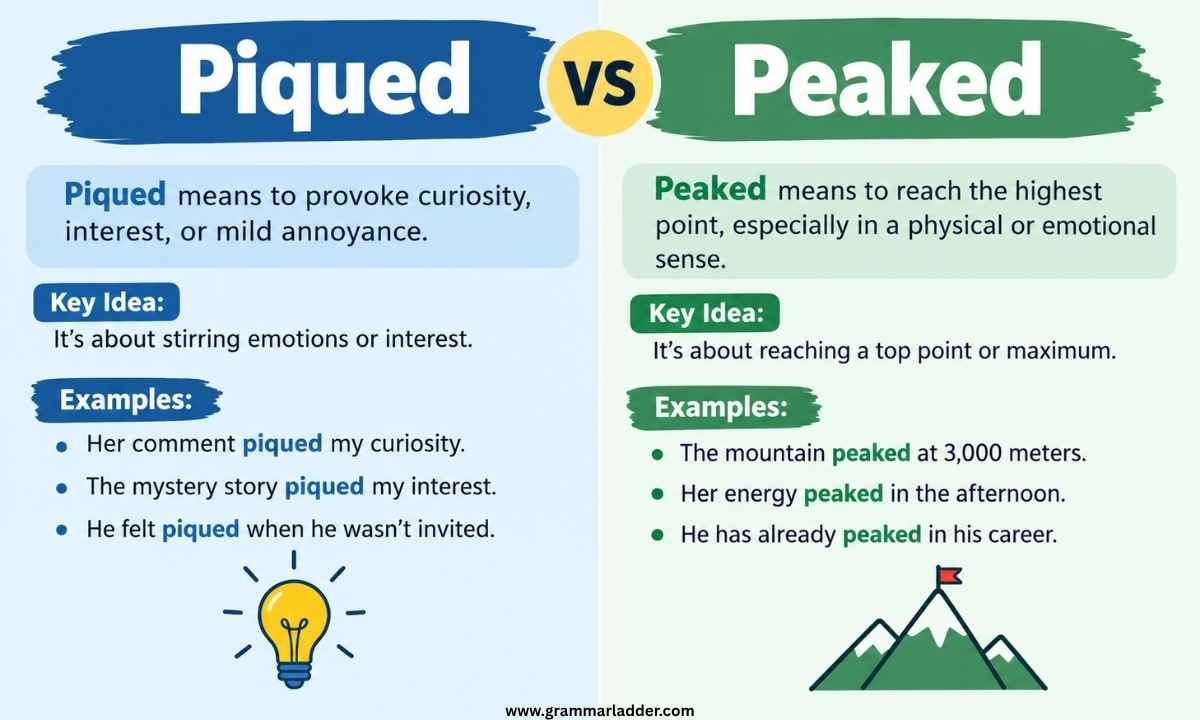
Piqued means stimulated or aroused, as in “piqued my interest.” Peaked means reached the highest point, as in “her career peaked in 2020.”
The correct phrase is “piqued my interest.” “Peaked my interest” is a common mistake.
| Word | Part of Speech | Core Meaning | Correct Example |
| Piqued | Verb (past tense) | Aroused or stimulated | The trailer piqued my curiosity. |
| Peaked | Verb (past tense) | Reached a maximum | Sales peaked in December. |
What Does “Piqued” Mean?
Piqued is the past tense of the verb pique. The word comes from the French piquer, meaning “to prick” or “to sting.” That origin explains the sense: something pricks your attention and wakes it up.
Pique has two main uses:
- To arouse or provoke: “The mystery piqued her curiosity.”
- To irritate or offend: “He was piqued by the comment.” (This sense is less common today.)
Pique can also be a noun meaning a feeling of resentment, as in “She left in a fit of pique.”
What Does “Peaked” Mean?
Peaked is the past tense of the verb peak, which means to reach the highest point or level. It has a few uses:
- To reach a maximum: “Interest rates peaked last spring.”
- To form a point: “The egg whites peaked after whisking.”
- As an adjective (pronounced PEE-kid): Looking pale or unwell, as in “You look a little peaked.”
Piqued vs Peaked: The Main Difference
The main difference is meaning. Piqued is about stirring a feeling. Peaked is about reaching a top.
A quick test: ask yourself whether something is awakening a feeling or hitting a high point.
- Awakening a feeling (interest, curiosity, attention) → piqued
- Hitting a high point (a number, a career, a mountain) → peaked
Why Do People Confuse Piqued and Peaked?
Three things cause the mix-up.
- They sound the same. Both are pronounced “peekt.” Homophones are easy to confuse in writing.
- “Peak” feels logical. A peak is a high point, so “peaking interest” seems to make sense. People imagine interest rising to a top.
- “Pique” is rarely used elsewhere. Most people see the word only in a handful of phrases, so the spelling never becomes familiar.
Autocorrect adds to the problem. Spellcheck accepts both words, so it won’t flag the error.
“Piqued My Interest” vs “Peaked My Interest”
This is the confusion people search for most.
- ✅ Piqued my interest: correct
- ❌ Peaked my interest: incorrect
Here is the reasoning. To pique means to stir up or provoke, so a headline, a book, or a strange noise can pique your interest. Interest does not “peak” an object. Interest itself can peak, though:
- “Her interest in painting peaked in her twenties.” ✅
- “That documentary piqued my interest in painting.” ✅
The second sentence is about something causing interest. The first is about interest reaching its highest point. The same noun works with either verb, but the meaning changes.
You can also use the pattern with other nouns: pique your curiosity, pique your appetite, pique someone’s attention.
Piqued vs Peaked Quiz
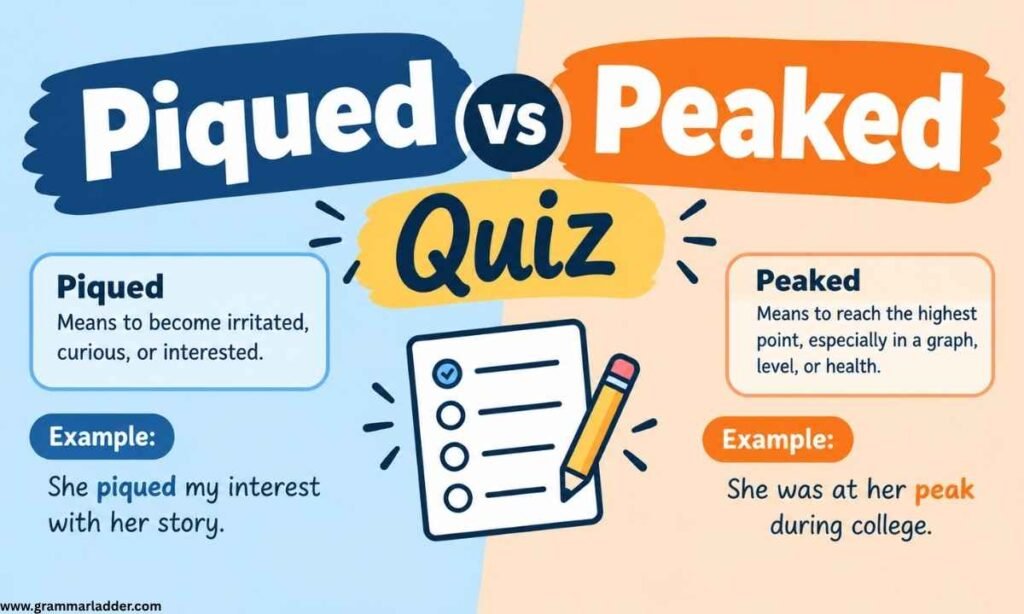
Test yourself. Choose the right word, then check the answers below.
- The strange sign on the door ______ my curiosity.
- Traffic ______ around 5 p.m. today.
- The scent of fresh bread ______ her appetite.
- After the flu, he looked pale and ______.
- Her fascination with space ______ when she visited NASA.
Answers:
- piqued
- peaked
- piqued
- peaked (the adjective meaning “sickly”)
- peaked (the fascination reached its highest point)
Got four or five right? You have this down. Three or fewer? Read on for the memory trick below.
Piqued vs Peaked Reddit
Language communities on Reddit, such as r/grammar and r/EnglishLearning, return to this pair again and again. The usual pattern is a user asking which is right, followed by replies pointing out that “peaked my interest” is an error. Some commenters also note that the mistake is so widespread that it often goes unnoticed.
The takeaway from these threads: even native speakers confuse the two. If you have made the mistake, you are in good company. Professional writing and formal contexts still expect “piqued.”
Peaked or Piqued in High School
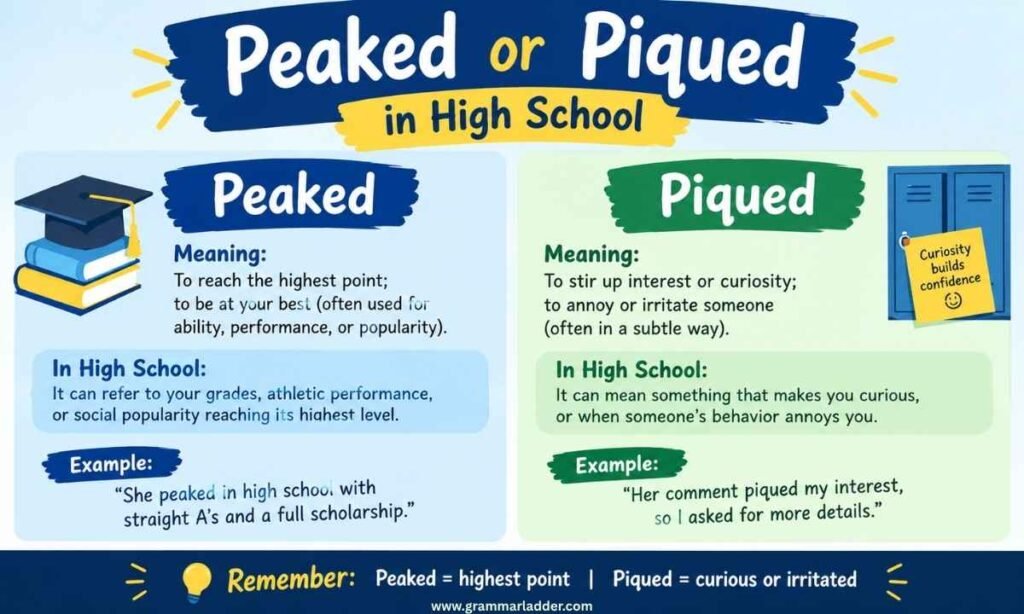
A related phrase you may hear is “peaked in high school.” This is always spelled with peaked, because it means someone reached the high point of their life during their teen years.
- “He peaked in high school and never matched that glory.”
Nobody says “piqued in high school.” The phrase is about reaching a top, so peaked is the only correct choice. Students writing essays about academic performance should use the same logic: grades or test scores peak, while a teacher’s lesson piques curiosity.
Piqued vs Peaked Examples
Examples of “Piqued”
- The headline piqued my interest, so I clicked.
- His odd behavior piqued the detective’s suspicion.
- The chef’s secret ingredient piqued our curiosity.
- A brief mention of the festival piqued their attention.
Examples of “Peaked”
- The temperature peaked at 42°C in July.
- The band’s popularity peaked in the late nineties.
- Her stress peaked the night before the exam.
- Whisk until the meringue has peaked stiffly.
Quick Comparison
- The lecture piqued her curiosity. (The lecture caused the curiosity.)
- Her curiosity peaked after the lecture. (The curiosity reached its highest point.)
Common Mistakes With Piqued and Peaked
Watch for these frequent errors.
- “Peaked my interest.” Should be “piqued my interest.”
- “Peeked my interest.” A third spelling error. Peek means a quick look.
- “Piqued” for reaching a high point. “Sales piqued in June” is wrong. Use “peaked.”
- “Sneak peak.” Should be “sneak peek,” since it means a quick glance.
- “Pique” and “peek” swapped. Remember that peek relates to the eyes.
Tip: If your sentence has a feeling or reaction as its object, such as curiosity, interest, or attention, use piqued.
Piqued, Peaked, and Peeked Compared
Three words sound the same, so here they are together.
| Word | Meaning | Example |
| Piqued | Aroused or irritated | The offer piqued my interest. |
| Peaked | Reached the top | Her fame peaked in 2015. |
| Peeked | Looked quickly or secretly | He peeked through the curtains. |
Notice that peeked is the only one tied to eyesight. If nobody is looking at anything, you probably don’t need it.
American vs British English: Is There a Difference?
No. Both American and British English use piqued for arousing interest and peaked for reaching a high point. The spelling and meanings are identical.
A few small regional notes:
- “Looking peaked” (sickly) is more common in American English, especially in the South and Northeast.
- “Peaked cap” is a British term for a cap with a visor.
- “Pique” as a noun for resentment appears in both varieties, though it sounds slightly formal in each.
So you never need to change your choice based on where your readers live.
How to Remember Piqued vs Peaked?
Try one of these memory aids.
- Pique has “qu,” like “question.” Something that piques your interest makes you ask questions.
- Peak has “ea,” like “sea level” or “ear.” A peak is a height above the sea, such as a mountain top.
- Swap in “stirred.” If “stirred” or “aroused” fits the sentence, use piqued. If “reached the top” fits, use peaked.
- Think “pick.” Pique shares its roots with words like pick and prick, so it pokes your attention awake.
As a writing habit, reread any sentence containing “interest” or “curiosity” before you publish it.
When Should You Use “Piqued My Interest”?
Use “piqued my interest” whenever something catches your attention or makes you want to know more. It works in:
- Cover letters: “Your mission statement piqued my interest in the role.”
- Emails: “Your proposal piqued my curiosity.”
- Reviews: “The opening chapter piqued my interest right away.”
- Marketing copy: “Let our newest feature pique your curiosity.”
It is a polished phrase suited to professional and academic writing. Just keep the subject clear: something piques someone’s interest.
When Should You Use “Peaked”?
Use peaked when the subject reaches its highest point. It works for:
- Data and trends: “Website traffic peaked on Black Friday.”
- Careers and popularity: “The singer’s fame peaked a decade ago.”
- Emotions and intensity: “Tension peaked during the final scene.”
- Geography: “The trail peaked at 3,000 meters.”
- Health, as an adjective: “She looked peaked after the long trip.”
The word fits any situation with a rise followed by a maximum.
Frequently Asked Questions
Is it “piqued my interest” or “peaked my interest”?
The correct phrase is “piqued my interest.” “Peaked my interest” is a common error.
What does “pique” mean?
Pique means to stimulate or provoke a feeling, such as curiosity. As a noun, it also means a flash of resentment.
Can you say “peaked my curiosity”?
No. Use “piqued my curiosity” because something is stirring curiosity.
Are piqued and peaked pronounced the same way?
Yes. Both are pronounced “peekt,” so context and spelling tell them apart.
Is “peaked interest” ever correct?
Yes, when interest reaches its highest point: “Public interest peaked in 2021.”
What is the difference between piqued and peeked?
Piqued means aroused, while peeked means glanced.
Is “peaked in high school” correct?
Yes. It means someone’s best years came during high school.
Do British and American English spell these words differently?
No. Both varieties use the same spellings and meanings.
Conclusion
The difference is simple once you see it. Piqued stirs a feeling, usually curiosity or interest. Peaked reaches a high point. When the object of the sentence is an emotion that something has awakened, choose piqued. When something has hit its maximum, choose peaked.
Keep the mnemonic in mind (“pique” has a qu like “question”) and run a quick check on any sentence with “interest” in it. With a little practice, you will never write “peaked my interest” again.

I am an English writer with over four years of experience in grammar and language education.
Through Grammar Ladder, I share clear explanations, practical examples, and helpful English tips.
My goal is to share my knowledge so others can benefit and improve their language skills.
I believe anyone can master English with proper guidance and consistent practice.