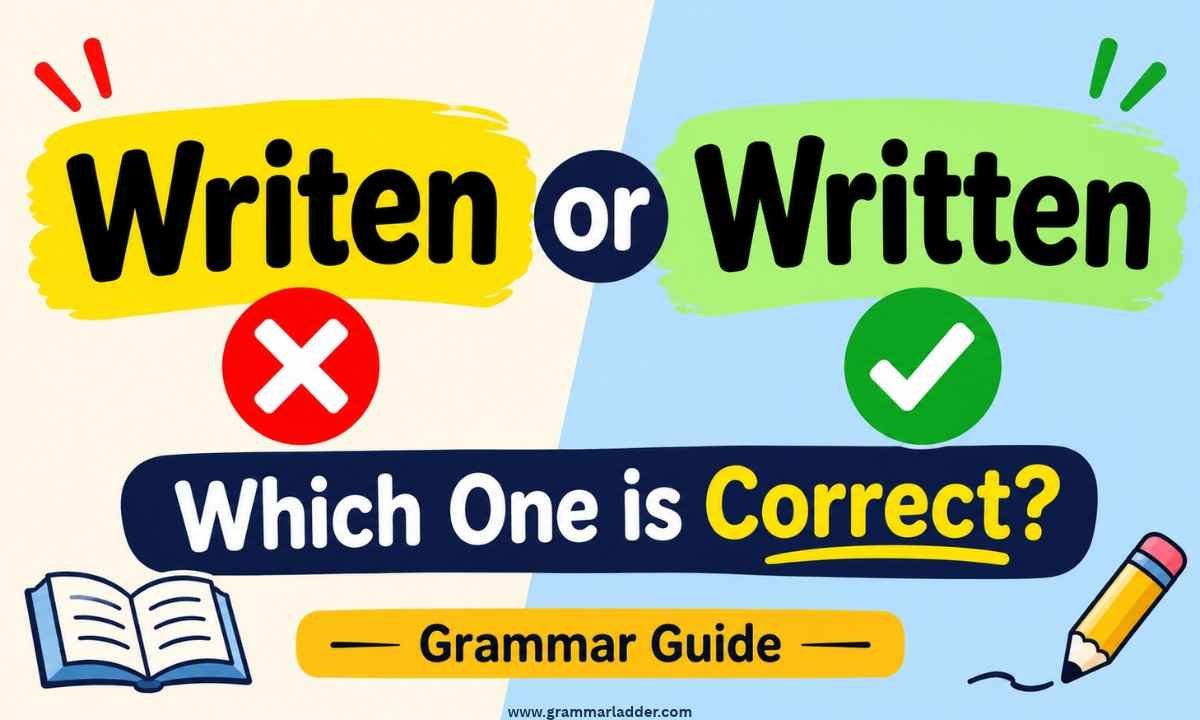
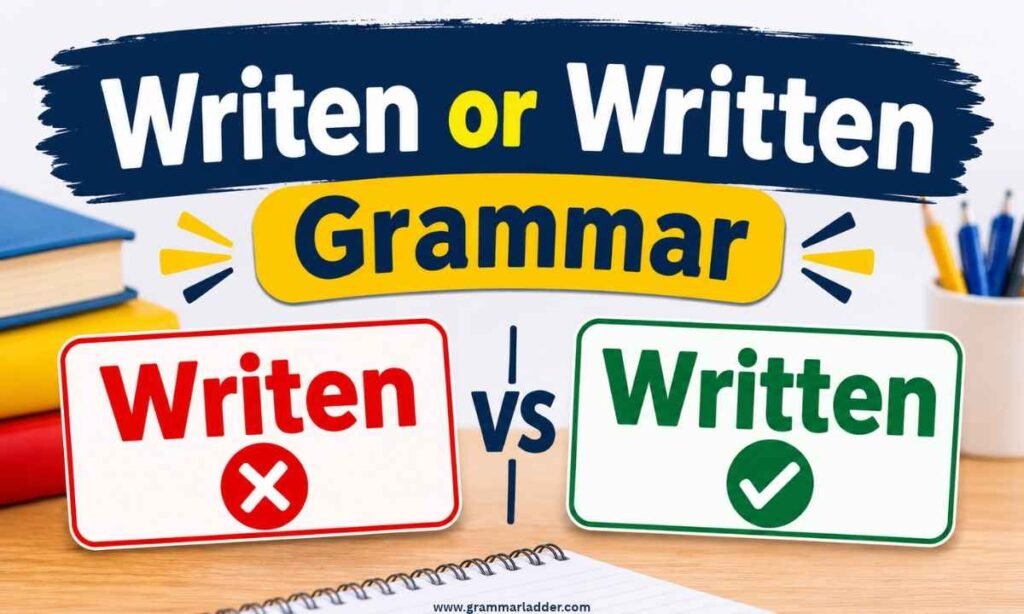
Short answer: “Written” is the correct spelling. “Writen” is a common typo and is not an accepted word in modern English.
You are typing an email, a school essay, or a work report. You reach the word and stop. Does it have one “t” or two? It is a fair question, because the base verb “write” has only one.
This guide settles the writen vs written question in plain language. You will find the meaning, the grammar rule, the word’s history, real examples, a comparison table, a short quiz, and quick FAQs.
Writen or Written Meaning
“Written” is the past participle of the verb “write.” It describes something that has been put into words on paper, a screen, or any other surface.
It works in two ways:
- As part of a verb phrase: “She has written three books.”
- As an adjective: “I need your written consent.”
“Writen” has no meaning in standard English. Spell checkers flag it for a reason: it is simply a misspelling of “written.”
Which Is Correct: Writen or Written?
The answer is written, with a double “t.” Every major dictionary, including Merriam-Webster, Oxford, and Cambridge, lists “written” and does not list “writen” as a valid variant.
Here is the quick check you can use anywhere:
- Say the word out loud: “WRIT-ten.”
- Hear the short “i” sound in the first syllable.
- Remember that a short vowel needs a double consonant to protect it.
If you spell it “writen,” the first syllable could be read as “WRY-ten,” which is a different sound. The double “t” prevents that.
Writen vs Written
The real difference is simple. One is a word, and the other is not.
- Correct in modern English: “Written” is correct. “Writen” is not.
- Part of speech: “Written” is a past participle and an adjective. “Writen” has none.
- Dictionaries: “Written” is listed. “Writen” is not.
- Formal writing: “Written” is safe to use. “Writen” is not.
- Example: “I have writen a letter.” (wrong) vs. “I have written a letter.” (right)
If you remember only one thing, remember this: when you need the past participle of “write,” use “written.”
Writen or Written in English: Why the Confusion Happens
Most spelling slips follow a pattern, and this one has three clear causes.
- The base verb is short. “Write” has one “t,” so people copy that into the participle.
- Silent “e” confusion. Learners often drop the “e” and add “-en” without doubling the consonant.
- Fast typing. On phones, a skipped letter is easy to miss, and autocorrect does not always catch it.
The verb is also irregular. It changes form completely: write, wrote, written. Irregular verbs do not follow the usual “-ed” pattern, so people guess, and guessing leads to errors.
Writen or Written Grammar
The Verb Forms of “Write”
| Form | Word | Example |
| Base form | write | I write every morning. |
| Past simple | wrote | She wrote a poem yesterday. |
| Past participle | written | He has written a poem. |
| Present participle | writing | They are writing a report. |
Where “Written” Is Used
“Written” appears in these structures:
- Present perfect: “I have written the email.”
- Past perfect: “She had written the draft before the meeting.”
- Future perfect: “By Friday, we will have written the final chapter.”
- Passive voice: “The report was written by our team.”
Wrote vs Written
This is a separate and very common mix-up. Use “wrote” when no helping verb is present. Use “written” when a helping verb like “have,” “has,” “had,” “was,” or “been” comes before it.
- Correct: “She wrote a letter.”
- Correct: “She has written a letter.”
- Incorrect: “She has wrote a letter.”
Writen or Written Examples
Seeing the word in context makes the spelling stick. Here are sentences for different situations.
Everyday use
- “Have you written your shopping list yet?”
- “The note was written in blue ink.”
Work and business
- “Please provide written confirmation by Monday.”
- “The contract must be written in clear language.”
School and study
- “The essay was written over two weekends.”
- “Students must submit a written summary of the lesson.”
As an adjective
- “A written warning was sent to the tenant.”
- “The written word can outlast the speaker.”
Common phrases
- Written exam
- Written notice
- Hand-written note
- Well-written article
- Written agreement
- Unwritten rule
Common Mistakes With Writen or Written
Writers trip over this word in several predictable ways. Here are the most frequent ones and the fixes.
- writen is wrong because it misses the second “t.” Write written.
- writtn is wrong because it misses the “e.” Write written.
- writting is a wrong spelling of “writing.” Write writing.
- has wrote uses the wrong verb form after “has.” Write has written.
- I have write uses the base form instead of the participle. Write I have written.
- ritten misses the silent “w.” Write written.
Quick tips to avoid errors:
- Proofread any sentence that has “have,” “has,” or “had” and a form of “write.”
- Turn on spell check, but do not rely on it alone.
- Read your text out loud. Your ear often catches what your eyes miss.
- Keep a short list of words you misspell and review it weekly.
Writen or Written Quiz
Test yourself. Pick the correct word for each sentence. Answers are at the end.
- She has (writen / written) a new song.
- The notice must be (writen / written) in plain English.
- He (wrote / written) the report last night.
- Please bring a (writen / written) request.
- Which spelling is correct: writting or writing?
- They have (wrote / written) to the manager twice.
- Is “writen” in any standard dictionary?
Answers: 1. written. 2. written. 3. wrote. 4. written. 5. writing. 6. written. 7. No.
Score 6 or 7 and you have this word mastered. Score lower, and re-read the grammar section above.
Writen vs Written Comparison With Similar Words
Several words look alike and cause the same doubt. This table puts them side by side.
| Word | Meaning | Correct? |
| written | Past participle or adjective | Yes |
| wrote | Past simple tense | Yes |
| writing | Present participle or noun | Yes |
| writer | A person who writes | Yes |
| writen | None | No |
| writting | None | No |
Notice the pattern: “written” doubles its “t,” but “writing” and “writer” keep a single “t.” That quirk explains many typos.
Etymology and Word Origin
- Old English: writan meant to scratch, carve, or score a surface. Its participle was writen.
- Germanic root: linked to tearing or scratching, and related to German reißen (to tear). It also gave us “writ.”
- Middle English: spellings like writen and ywriten appeared in manuscripts.
- Early Modern English: printing standardized the spelling as “written.” Today, “writen” counts only as an error.
Regional Usage of Writen or Written
There is no regional split on this one. American, British, Canadian, Australian, and Indian English all use written. Spelling differences like “color” and “colour” do not apply here.
Some small points do vary by region:
- British English often uses “written” in formal phrases such as “written evidence.”
- American English may say “in writing” more often in legal contexts.
- Learners of English in many countries make the “writen” error because their first language has simpler spelling rules.
Whatever region you write for, the correct form stays the same.
Writen or Written in Real Life
Spelling matters in real situations, not only in tests.
- Job applications: A typo in your CV can make an employer doubt your attention to detail. Writing “written communication skills” correctly is a basic expectation.
- Legal and business documents: Phrases like “written consent” and “written notice” appear in contracts. A wrong spelling looks careless in a formal paper.
- Social media and messaging: Casual posts are forgiving, but public brand accounts lose credibility with visible errors.
- SEO and blogging: Search engines can handle many typos, but readers judge quality fast. Clean spelling builds trust and keeps visitors on the page.
As a content writer, I have seen “writen” slip through more than once during editing. A final read-aloud pass catches it nearly every time.
Frequently Asked Questions
Is it “writen” or “written”?
The correct spelling is “written,” with two “t”s. “Writen” is a misspelling.
Is “writen” a real word?
No. It is not listed in modern dictionaries, although it appeared as a spelling in Middle English.
Why does “written” have two t’s?
The double “t” keeps the first vowel short, so it sounds like “WRIT-ten” and not “WRY-ten.”
What is the past participle of write?
The past participle of “write” is “written.” Use it after “have,” “has,” “had,” or “been.”
What is the difference between wrote and written?
“Wrote” is the simple past and stands alone. “Written” needs a helping verb, as in “has written.”
Is “written” an adjective?
Yes. It can describe nouns, as in “written test” or “written permission.”
Is “writting” correct?
No. The correct spelling is “writing,” with one “t.”
Do British and American English spell it differently?
No. Both use “written” in every context.
Conclusion
The debate is short. “Written” is correct, and “writen” is not. The word is the past participle of “write,” and its double “t” keeps the vowel sound short.
To remember it, say the word out loud, use the verb chart above, and proofread sentences that contain “have” or “has.” Add the common mistakes table to your own checklist, and the error will disappear from your writing.
Small details like this build trust with readers. Get the spelling right, and your message gets the attention it deserves.

I am an English writer with over four years of experience in grammar and language education.
Through Grammar Ladder, I share clear explanations, practical examples, and helpful English tips.
My goal is to share my knowledge so others can benefit and improve their language skills.
I believe anyone can master English with proper guidance and consistent practice.