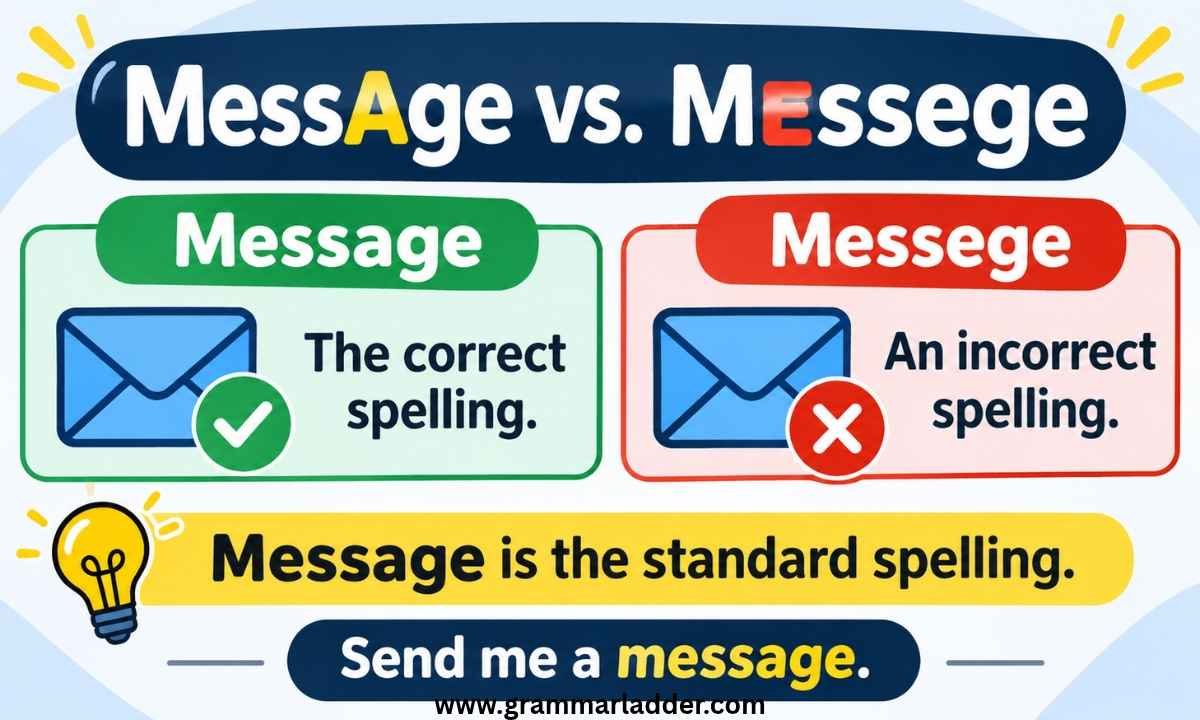
“Message” is the correct spelling. “Messege” is not an English word. It is a common misspelling.
If you have ever typed “messege” and seen a red line under it, you are not alone. This guide explains why the mistake happens, how to avoid it, and how to use “message” correctly in everyday writing.
Message or Messege: Meaning
Message is a noun. It means a piece of information sent from one person, group, or system to another.
A message can be:
- Written, such as an email, letter, or text
- Spoken, such as a voicemail
- Non-verbal, such as a gesture or signal
- An underlying idea, such as the message of a film or speech
Messege has no meaning. No major dictionary lists it. When you see it, someone meant to write “message.”
| Word | Correct? | Meaning |
| Message | Yes | Information or communication sent to someone |
| Messege | No | Misspelling with no meaning |
Example sentences:
- Please leave a message after the beep.
- She sent me a message about tomorrow’s meeting.
- The message of the story is simple: be kind.
Message or Messege Download
Many people search for “messege download” when they want a messaging app or a saved message file. Here is what to know:
- There is no official app or program called “Messege.” The spelling is simply wrong.
- Search for “message” or “messaging app” instead.
- Download apps only from official stores such as Google Play or the Apple App Store.
- Be careful with websites that use misspelled names. Some misspelled domains exist to catch careless typers.
If you need to save a conversation, look for an “export chat” or “download messages” option inside the app you already use.
Why People Make This Mistake
The error is easy to understand. Three things cause it.
- Sound-based spelling. The ending of “message” sounds like “ij,” so people guess it might be spelled “-ege.”
- Similar words. English has many words ending in “-age” that sound alike, so the ending is easy to mix up.
- Fast typing. On phones, one wrong tap on a small keyboard can put “e” in the place of “a.” Autocorrect does not always fix it.
The word came into English from Old French, which traces back to the Latin missaticum. Borrowed words often keep spellings that don’t match how they sound. That is part of why this one trips people up.
Common Mistakes Checklist
Use this list to proofread your writing.
- ✅ Message
- ❌ Messege
- ❌ Mesage (one “s”)
- ❌ Massege (wrong first vowel)
- ❌ Messeage (extra “e”)
- ❌ Massage when you mean message (a different word)
Quick check before you hit send:
- Count the letters: M-E-S-S-A-G-E has seven.
- Look for the double “s” in the middle.
- Confirm the ending is “-age,” not “-ege.”
- Make sure you did not mean “massage.”
Message in Real English
“Message” works as both a noun and a verb.
| Form | Example |
| Noun | I got your message. |
| Plural noun | She has three new messages. |
| Verb | I’ll message you tonight. |
| Past tense | He messaged me an hour ago. |
| -ing form | They are messaging each other. |
Common phrases:
- Text message
- Voice message
- Direct message (DM)
- Get the message
- Message received
- Take a message
- Mixed message
American vs. British English
There is no difference. Both American and British English spell it message.
| Feature | American English | British English |
| Spelling | message | message |
| Verb use | message someone | message someone |
| Common phrase | text message | text or text message |
The only differences are in related vocabulary, such as “cell phone” in the US and “mobile” in the UK. The spelling of “message” never changes. So “messege” is wrong in every English-speaking country.
Formal vs. Informal Usage
Formal writing. In emails to clients, reports, and academic papers, spelling mistakes can hurt your credibility. Always write “message” correctly.
- Thank you for your message.
- Please find my message below.
Informal writing. In chats and social media, people use shortcuts like “msg” or “DM.” These are casual abbreviations and are fine between friends. They are not misspellings in the same way.
- “msg me later”
- “Got ur message”
Even in casual writing, “messege” still looks like an error. Avoid it.
Message vs. Other Related Words
Some words look or sound close to “message.” Here is how they differ.
| Word | Meaning | Example |
| Message | Communication sent to someone | Leave me a message. |
| Messenger | A person or app that carries messages | The messenger delivered the note. |
| Massage | Rubbing muscles for relief | I booked a massage. |
| Missive | A formal or lengthy letter | He sent a long missive. |
| Mission | An assigned task or purpose | Their mission was clear. |
The most common mix-up is message vs. massage. They differ by one vowel but have nothing in common in meaning.
Memory Trick
Try one of these.
- “Message has an A for ‘Alert.'” A message alerts someone to something.
- Link it to “-age” words. Message, package, village, language, passage. They all end in “-age.”
- Say it in parts. Mess + age. Spell the first half like “mess” and the second like “age.”
- Remember the double S. Two S’s sit in the middle, like two people passing a note.
Pick the one that sticks and use it for a week. Spelling habits form quickly.
Real-Life Situations
At work. You write an email subject line: “Follow-up message from today’s call.” A typo here looks careless.
In school. A teacher marks “messege” wrong on a test. The mistake costs marks, and the fix takes seconds.
On social media. A brand posts “Send us a messege.” Followers notice, and some comment on it. That can weaken trust in the brand.
In coding. Developers sometimes name a variable “messege” by mistake. The code may still run if the spelling is used consistently, but it makes the code harder to read and maintain. Using “message” is the safer habit.
In customer service. A support team writes “We received your messege.” Customers may doubt the team’s attention to detail.
Frequently Asked Questions
Is “messege” a real word?
No. It is a misspelling of “message.”
How do you spell message correctly?
M-E-S-S-A-G-E.
What does message mean?
It is information or communication sent from one person or system to another.
Is “messege” correct in British English?
No. British and American English both use “message.”
What is the difference between message and massage?
A message is a communication. A massage is a body treatment that rubs muscles.
Can “message” be a verb?
Yes. For example, “I will message you later.”
Conclusion
“Message” is the only correct spelling. “Messege” is a mistake caused by sound-based guessing and fast typing. Remember the “-age” ending, watch for the double S, and avoid mixing it up with “massage.”
A quick proofread takes seconds and protects your credibility, whether you are writing an email, a school paper, or a social media post. Use the memory trick, run the checklist, and your next message will be spelled right.

I am an English writer with over four years of experience in grammar and language education.
Through Grammar Ladder, I share clear explanations, practical examples, and helpful English tips.
My goal is to share my knowledge so others can benefit and improve their language skills.
I believe anyone can master English with proper guidance and consistent practice.