You are about to text your manager that you are staying home sick. You type “I think I have the flue” and then pause. Does that look right?
It does not, and you are far from the only one who has stopped at this exact spot. “Flu” and “flue” sound identical, differ by a single letter, and both are real English words. That is why spellcheck rarely catches the mix-up.
This guide settles it. You will get the quick answer, the meaning of each word, where they came from, and easy ways to remember which one to use.
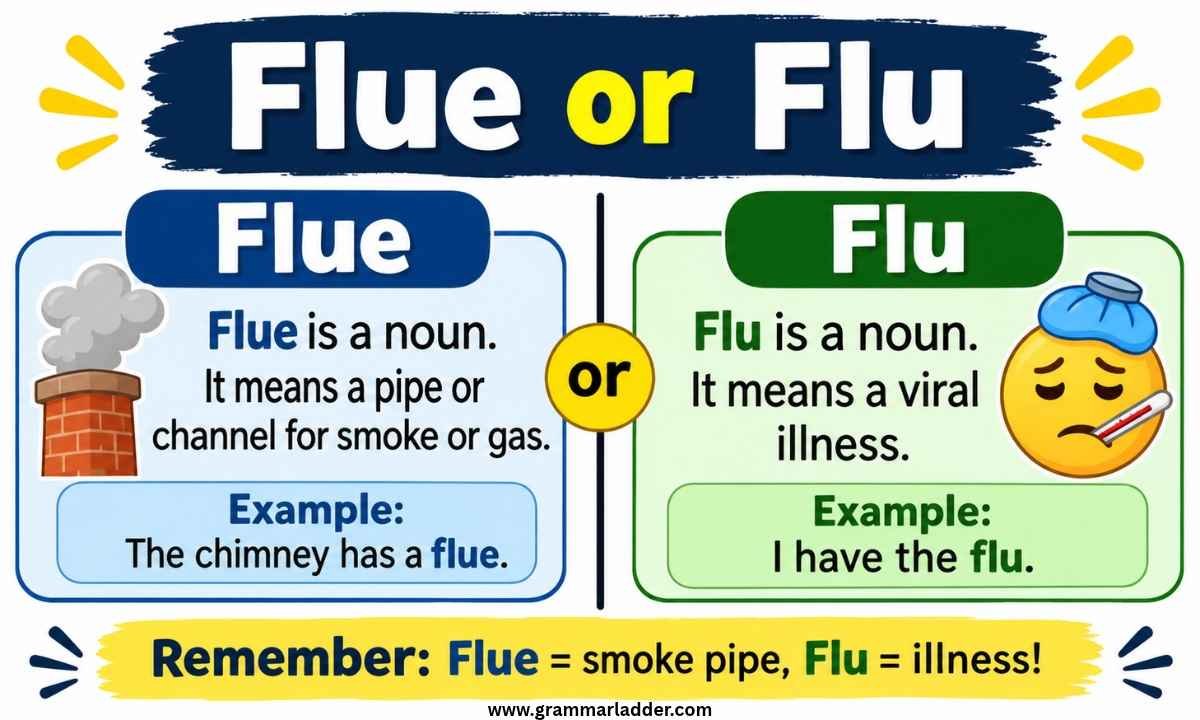
Quick Answer: Flue or Flu?
Use “flu” for the illness. It is the short form of influenza, a contagious respiratory infection.
Use “flue” for the pipe or duct. It carries smoke and gases out of a fireplace, furnace, boiler, or stove.
Both words are pronounced the same way (“floo”). Only the meaning tells you which spelling to choose.
| Word | Part of speech | Meaning | Example |
| Flu | Noun | Influenza, a viral illness | She missed work because of the flu. |
| Flue | Noun | A duct that vents smoke or gas | Soot had blocked the flue. |
Meaning of Flue
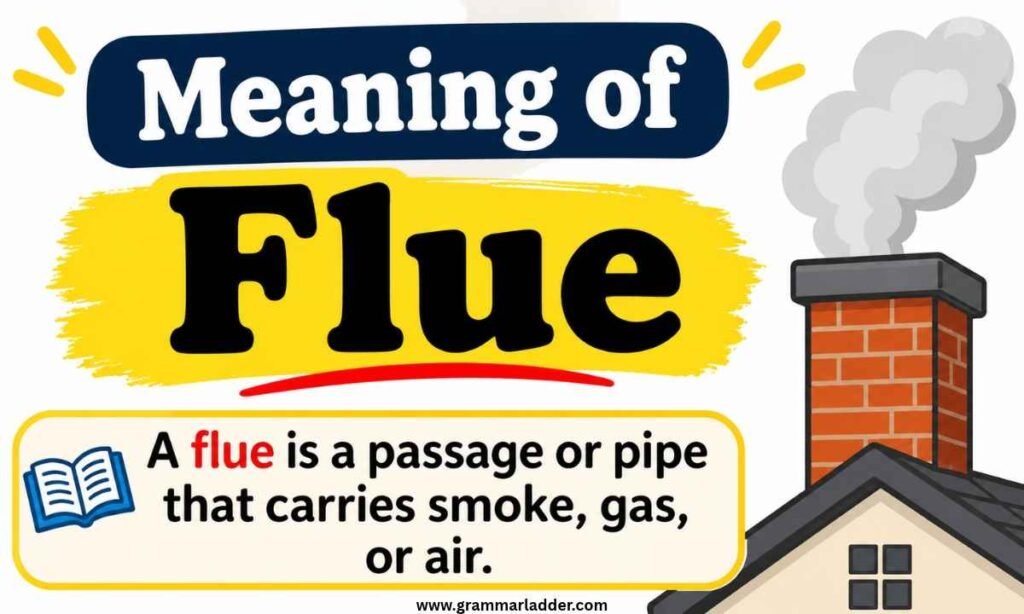
A flue is a channel, pipe, or passage that lets smoke, hot air, and combustion gases leave a building. You will find one in a chimney, a wood stove, a gas boiler, or an oil furnace.
In a fireplace, the flue sits inside the chimney. Many have a movable plate called a damper, which opens to let smoke out and closes to keep drafts from coming down.
The word also appears in a few other places:
- Flue gas: the exhaust that leaves a boiler or furnace
- Flue liner: a protective lining inside a chimney
- Flue pipe: the vent pipe on a gas appliance or wood burner
- Flue pipes in organs: the pipes that produce sound when air passes over an opening
In short, if the sentence is about heating, ventilation, or chimneys, “flue” is the word you want.
Meaning of Flu

Flu is the everyday word for influenza. According to the U.S. Centers for Disease Control and Prevention (CDC), influenza is a contagious respiratory illness caused by influenza viruses that infect the nose, throat, and sometimes the lungs.
People use it in many familiar phrases:
- flu season
- flu shot or flu vaccine
- flu virus
- flu outbreak
- flu-like symptoms
You may also hear “stomach flu.” That phrase is common in casual speech, but it usually describes a stomach bug such as gastroenteritis, not true influenza.
Flue or Flu Symptoms: What Does the Flu Actually Feel Like?
Only the flu has symptoms, since a flue is just a pipe. If you searched “flue or flu symptoms,” you almost certainly meant the illness.
Common flu symptoms include:
- Fever or feeling feverish, with chills
- Cough
- Sore throat
- Runny or stuffy nose
- Muscle or body aches
- Headache
- Fatigue
Flu tends to hit fast. A cold usually builds slowly and feels milder. Not everyone with flu gets a fever, and children sometimes have vomiting or diarrhea too.
Health note: This article explains spelling, not medical care. If you have trouble breathing, chest pain, or symptoms that keep getting worse, contact a doctor or local emergency service. Pregnant women, older adults, young children, and people with chronic conditions should seek advice early.
Key Differences Between Flue and Flu
These two words share a sound and little else.
| Feature | Flu | Flue |
| Meaning | Viral illness (influenza) | Chimney or vent duct |
| Origin | Clipped form of influenza | Uncertain; recorded since the 1500s |
| Related words | Cold, fever, vaccine, virus | Chimney, damper, smoke, furnace |
| Context | Health, medicine, school, work | Home heating, building, plumbing |
| Can it be capitalized? | Only at the start of a sentence | Only at the start of a sentence |
| Plural | Rarely used | Flues |
They are homophones: words that sound alike but differ in spelling and meaning. A third member of the family is flew, the past tense of fly. All three are pronounced “floo,” and writers mix them up often.
Origin and History
Where “flu” comes from
- “Influenza” comes from the Italian word for “influence.”
- Early Italian writers blamed epidemics on the influence of the stars, which is how the name came about.
- English picked up the word in the 1700s.
- People soon began shortening it to “flu” in casual speech.
- This clipping works like “phone” from telephone and “fridge” from refrigerator.
- Older texts sometimes show an apostrophe (“‘flu”) to mark the missing letters, but plain “flu” is standard today.
Where “flue” comes from
“Flue” has a murkier past. It has been in English for several centuries and referred to a passage for smoke or air. Dictionaries do not agree on its exact source, so it is safest to say its roots are uncertain.
British English vs American English Spelling
Here is some good news: there is no difference.
| Word | American English | British English |
| Illness | flu | flu |
| Chimney duct | flue | flue |
Unlike color/colour or center/centre, this pair does not change between regions. A British writer and an American writer both use “flu” for the illness and “flue” for the vent. If you see “flue” used for the illness, it is a mistake, not a regional spelling.
When to Use Flue
Choose “flue” when you are writing about:
- Chimneys and fireplaces
- Wood burners and gas fires
- Boilers, furnaces, and water heaters
- Ventilation and exhaust systems
- Home inspection or safety reports
Examples:
- The chimney sweep cleaned the flue before winter.
- Close the flue when the fire is out.
- A blocked flue can let carbon monoxide build up indoors.
That last point matters. Gas appliances need a clear flue to vent fumes safely, so annual servicing by a qualified technician is wise.
When to Use Flu
Choose “flu” when you are writing about:
- Illness and symptoms
- Vaccines and doctor visits
- Sick days at school or work
- Public health news
Examples:
- I got my flu shot at the pharmacy.
- Half the office is out with the flu.
- Flu season usually peaks in the colder months.
Common Mistakes
Most errors come from sound, not from not knowing the words. Watch for these:
- “I have the flue.” Wrong. The illness is spelled flu.
- “The flu needs cleaning.” Wrong. A chimney vent is a flue.
- “I flu to Karachi yesterday.” Wrong. You flew.
- Adding an apostrophe: “I caught the ‘flu.” This is outdated. Skip it.
- Over-trusting spellcheck: Every one of these words is valid, so software often stays silent. Reread the sentence and ask what it is about.
Easy Trick to Remember
Try one of these.
- Flu = ill. Both have three letters, and flu makes you feel ill.
- Flue = fire. The extra e can stand for exhaust, or think of a fire escape route for smoke.
- Ask one question: Is it about a person’s body or a building? Body means flu. Building means flue.
- Count the letters: The shorter word is the shorter-lived problem. Flu passes in a week or two.
Pick the one that sticks and use it every time.
Everyday Life Examples
Seeing the words in real situations helps them stay in your memory.
At work or school
- Hi team, I have the flu and will be offline today.
- Our school asks students to stay home until the flu symptoms are gone.
At home
- We lit the stove, but smoke came back because the flue was shut.
- The landlord arranged a flue inspection for the gas heater.
In the news
- Health officials urged residents to get a flu vaccine.
- Engineers replaced the flue on the factory boiler.
All three together
- After I flew home with the flu, I called someone to check the flue.
That last sentence is clumsy, but it shows how the three spellings split their jobs.
Frequently Asked Questions
Is it flue or flu when you are sick?
It is “flu.” That is the standard short form of influenza.
What does flue mean?
A flue is a duct or pipe that carries smoke and gases out of a fireplace, furnace, or boiler.
Is flue a British spelling of flu?
No. Both countries use “flu” for the illness and “flue” for the vent.
Do flu and flue sound the same?
Yes. They are homophones, both pronounced “floo.”
What is the difference between flu, flue, and flew?
Flu is an illness, flue is a vent pipe, and flew is the past tense of fly.
Should I capitalize flu?
No, only at the start of a sentence. Capitalize Influenza only in the same way as any other noun.
Is “stomach flu” really flu?
Usually not. It typically means a stomach infection, not influenza.
Conclusion
The rule is simple. Flu is the illness, and flue is the vent. Both sound the same, and the spelling is the same in British and American English, so only the meaning decides.
Before you write either one, ask whether the sentence is about someone’s health or a chimney. If it helps, remember that flu and ill both have three letters.

I am an English writer with over four years of experience in grammar and language education.
Through Grammar Ladder, I share clear explanations, practical examples, and helpful English tips.
My goal is to share my knowledge so others can benefit and improve their language skills.
I believe anyone can master English with proper guidance and consistent practice.