Ever typed “the heat was barely bareable” and wondered if it looked right? You’re not alone. Many writers stumble over this word because it sounds exactly like another word spelled differently.
This guide settles the question fast. You’ll get the correct spelling, the meaning, real examples, common mistakes, and a simple trick to remember it for good.
Quick Answer
“Bearable” is the correct spelling. “Bareable” is a misspelling.
Bearable means “able to be endured or tolerated.” It comes from the verb bear, which means to put up with something difficult.
| Spelling | Correct? | Verdict |
| Bearable | ✅ Yes | Standard English word |
| Bareable | ❌ No | Common spelling error |
Bareable or Bearable Meaning
Bearable is an adjective. It describes something unpleasant, painful, or difficult that you can still handle.
Think of it as the middle ground. It isn’t enjoyable, but it isn’t too much either.
Dictionaries define it as “capable of being borne” or “endurable.” Here’s how that plays out:
- A bearable pain is one you can live with.
- A bearable commute is annoying but manageable.
- A bearable winter is cold, but not miserable.
The opposite is unbearable, meaning too hard to endure.
Is “Bareable” a Real Word?
- No. “Bareable” does not appear in standard dictionaries such as Merriam-Webster or Dictionary.com.
- Spell checkers flag it for good reason.
- The confusion comes from homophones. The words bear (to endure) and bare (uncovered or empty) sound identical.
- When people write by ear, they pick the wrong spelling.
- “Bareable” would logically mean “able to be made bare,” and nobody uses it that way.
- In practice, it’s just a typo with no meaning of its own.
Bareable or Bearable Synonyms
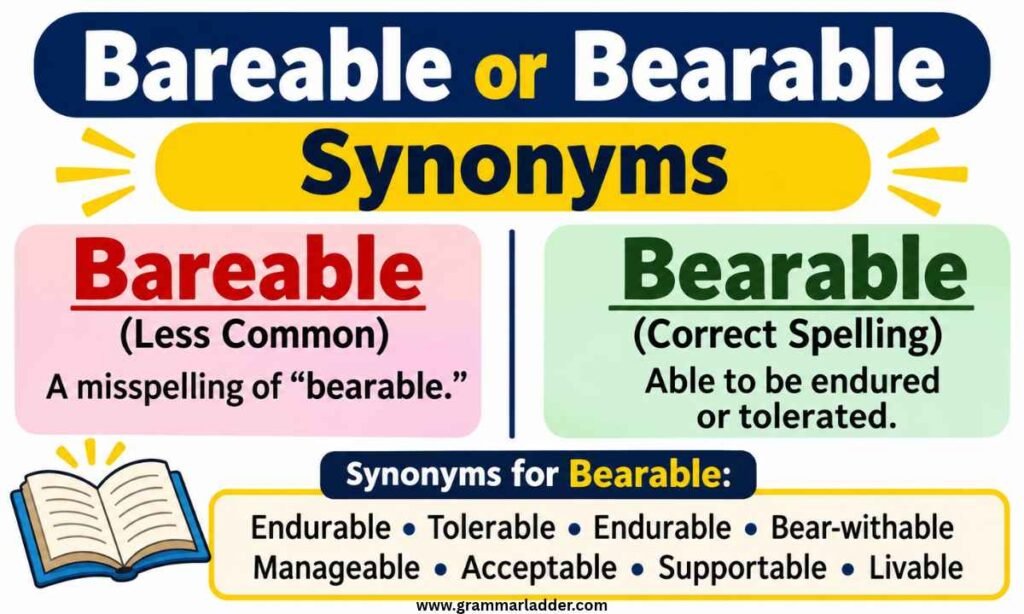
If you want to vary your writing, these words can replace bearable depending on context:
- Tolerable
- Endurable
- Manageable
- Acceptable
- Sufferable
- Passable
- Livable
Antonyms (opposites):
- Unbearable
- Intolerable
- Unendurable
- Insufferable
Tip: “Tolerable” and “endurable” are the closest matches. “Manageable” works best for tasks and workloads.
Bareable or Bearable Examples

Seeing the word in context helps it stick. Each pair below shows the wrong and right version.
- ❌ The heat was barely bareable. → ✅ The heat was barely bearable.
- ❌ Music makes my commute bareable. → ✅ Music makes my commute bearable.
- ❌ The pain became bareable after medicine. → ✅ The pain became bearable after medicine.
- ❌ Her kindness made the news more bareable. → ✅ Her kindness made the news more bearable.
More correct examples:
- The noise was just about bearable with headphones on.
- Good friends make long waits bearable.
- The workload is bearable this month.
- A warm coat makes the winter bearable.
Key Differences Between Bareable and Bearable
| Feature | Bearable | Bareable |
| Part of speech | Adjective | None (not a word) |
| Root word | Bear (to endure) | Bare (naked/empty) |
| In dictionaries? | Yes | No |
| Meaning | Tolerable, endurable | No accepted meaning |
| Safe to use? | Always | Never |
The key difference is the root. Bearable grows from bear (endure). The misspelling mistakenly borrows from bare (uncovered).
When to Use “Bearable”
Use bearable whenever you describe something you can tolerate. It fits both formal and casual writing.
Use it for:
- Physical discomfort: pain, heat, cold, hunger
- Emotional strain: stress, grief, loneliness
- Daily annoyances: traffic, noise, long meetings
- Situations: a tough job, a hard season, a tense week
Common patterns:
- Barely bearable (only just tolerable)
- Hardly bearable
- Make something bearable
- Find something bearable
- More bearable / most bearable
Related forms: bearably (adverb), bearability (noun), and unbearable (adjective).
When to Use “Bareable”
Never. There is no situation where “bareable” is the right choice in standard English.
If you want to say something is empty or uncovered, the right word is bare, as in:
- Bare feet
- Bare walls
- Bare minimum
- Lay bare the truth
And if you mean “endure,” you want bear:
- Bear the pain
- Bear with me
- Bear the cost
The “-able” ending always attaches to the verb bear. That gives you “bearable,” never “bareable.”
Bearable or Bareable UK
There is no spelling difference between British and American English here. “Bearable” is correct in both.
Pronunciation varies slightly. Americans say it as BAIR-uh-bul and British speakers say it nearly the same way, with a soft air sound in the first syllable.
So whether you write for readers in London, Lahore, or Los Angeles, the answer stays the same: bearable.
Common Mistakes
Here are the errors writers make most often with this word:
- Writing “bareable” because bear and bare sound alike.
- Writing “bearible” by swapping the a for an i. That’s also wrong.
- Mixing up “bear with me” and “bare with me.” The correct phrase is bear with me, meaning “be patient.”
- Using “bare” as a verb for endure. Bare means to uncover, as in “bare your teeth.”
- Trusting spell check blindly. “Bare” is a real word, so a tool may not flag it in some sentences.
Quick fix: reread the sentence and ask, “Am I talking about enduring something?” If yes, use bear.
Easy Trick to Remember
Use this simple memory aid:
Can you BEAR it? Then it’s BEARable.
Another handy way to remember it:
- Bear has an ea, like easy to endure.
- Bare ends in -are, like “no cover” or “empty.”
Also picture a bear carrying a heavy load on its back. Bears bear burdens, and anything you can carry is bearable.
If the pair confuses you often, think of the rule: the -able ending attaches to the verb. The verb is bear, so the word is bearable.
Frequently Asked Questions
Is it bareable or bearable?
The correct spelling is bearable. “Bareable” is a common misspelling.
What does bearable mean?
It means tolerable or able to be endured, usually describing something unpleasant.
Is “bareable” in the dictionary?
No. Major dictionaries do not list it.
Why do people confuse bareable and bearable?
Bear and bare are homophones, so they sound identical.
What is the opposite of bearable?
The opposite is unbearable, meaning too difficult to tolerate.
Is “bearable” used in British English?
Yes. British and American English both use the same spelling.
Conclusion
Bearable is the correct spelling. Bareable is not a real word. People mix them up because bear and bare sound the same. But the two words mean very different things.
Here is an easy trick to remember. If you can bear it, it is bearable. Use bare only for things that are empty or uncovered. Keep this in mind, and you will not make this mistake again.

I am an English writer with over four years of experience in grammar and language education.
Through Grammar Ladder, I share clear explanations, practical examples, and helpful English tips.
My goal is to share my knowledge so others can benefit and improve their language skills.
I believe anyone can master English with proper guidance and consistent practice.