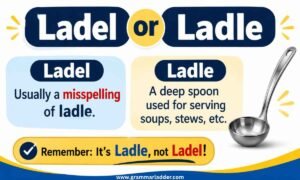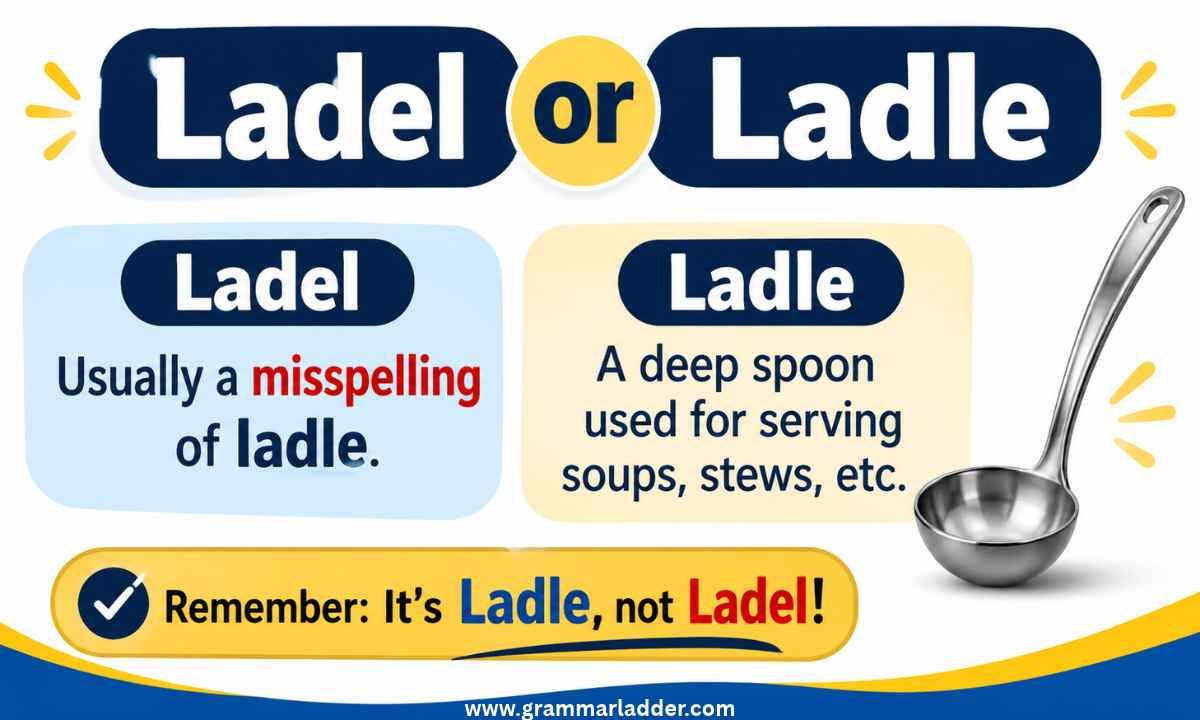
Ladel or ladle? The correct spelling is ladle. It is the long-handled spoon you use to serve soup. Many people write “ladel” by mistake, and it is easy to see why.
The end of the word sounds like “-ul,” so “-el” feels right. In this guide, you will learn the meaning, the sound, and the story behind the word. You will also get a simple trick to spell it right every time.
Ladel or Ladle Meaning
A ladle is a long-handled spoon with a deep bowl. Dictionaries define it as a tool used especially for dipping up and carrying liquids. It works as both a noun and a verb.
- Noun: “She grabbed the ladle.”
- Verb: “He ladled the soup into bowls.”
Correct Spelling Explained in Depth: Ladel vs Ladle
The standard spelling is L-A-D-L-E. Many kitchen guides explicitly flag “ladel” and “laddle” as common misspellings.
| Spelling | Status | Example |
| Ladle | Correct | Use a ladle to serve the stew. |
| Ladel | Incorrect | |
| Laddle | Incorrect |
Why “-le” wins: English has many words ending in a consonant plus “-le”: table, candle, handle, cradle, bridle. The word ladle follows this familiar pattern, and the “-el” ending does not.
Memory trick: A ladle lets you serve soup. Both words end in -le. You can also think of the “dle” in cradle and handle.
Ladel or Ladle in English
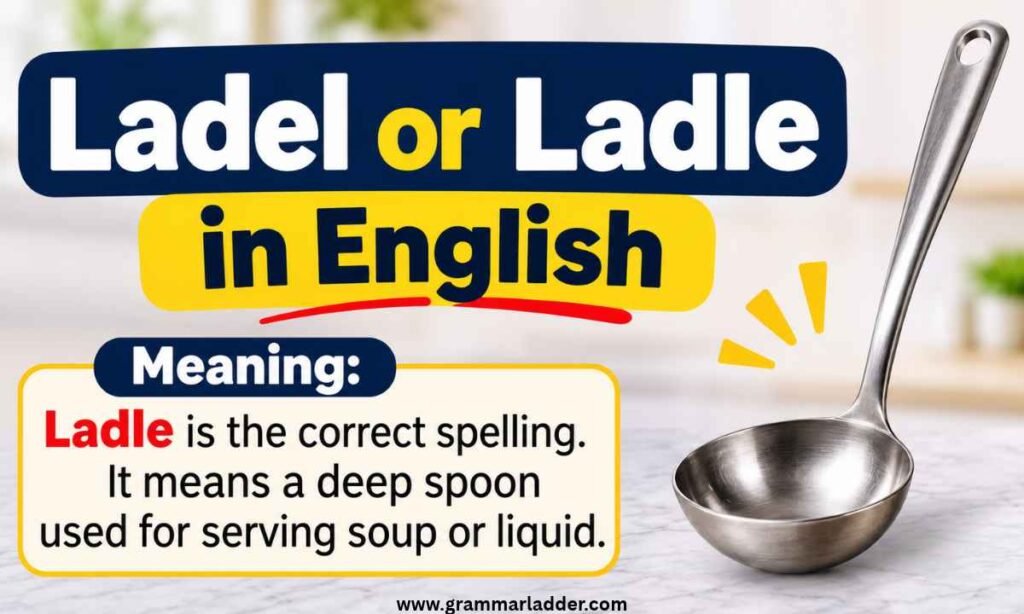
Every major English dictionary spells it ladle. The verb forms are regular:
- ladle → ladles → ladled → ladling
- The related noun ladleful means the amount one ladle holds.
Ladle in Cooking: Real Culinary Function and Importance
A ladle moves liquids from pot to bowl with control and little mess. It is a staple for:
- Soups, stews, and chili
- Gravy and sauces
- Stock and broth
- Punch and other batch drinks
- Skimming foam or fat (slotted types)
Compared with a regular spoon, a ladle holds a measured amount and keeps the drips in the pot. That makes portions more consistent, which matters both at home and in restaurants.
Pronunciation Breakdown: Ladle Pronunciation Explained Clearly
Ladle is pronounced /ˈleɪ.dəl/, with two syllables.
- LAY: starts with a long “a,” like lay or day.
- dul: a soft, unstressed ending, like the end of cradle.
It rhymes with cradle. The most common error is saying “LAD-el,” which mirrors the wrong spelling.
Why “Ladel” Happens: Cognitive and Language Error Analysis
Three things trip people up:
- Sound-based spelling: The final syllable sounds like “-ul,” and many English words end with that sound with “-el” (camel, level, travel).
- Visual guessing: “Ladel” looks like label and model, so the brain accepts it.
- Weak final vowel: In speech, the last vowel is nearly silent, so it gives no clue about the letter.
Spelling errors like this come from relying on sound over pattern. Once you notice that “-dle” appears in handle, candle, and bundle, the right spelling becomes automatic.
Ladel or Ladle in the UK
British and American English use the same spelling: ladle. There is no regional variant. The pronunciation is also essentially the same in both varieties, so this is one word you don’t need to localize.
Historical Origin and Evolution of Ladle
- The twist: “ladel” was once a real spelling.
- Origin: the word comes from Middle English ladel, which came from Old English hlædel, from the verb hladan (to load or draw up).
- Medieval use: records show many spellings, including Chaucer’s use of ladel in the Canterbury Tales.
- Settling on ladle: over the centuries, English spelling settled on ladle. “Ladel” is not random. It is an older form that never made it into modern standard English.
- Old English: hlædel
- Middle English: ladel, ladil, laddle
- Modern English: ladle
Grammar Usage: Noun and Verb Function of Ladle
As a noun:
- “Hand me the ladle.”
- “A ladle of broth was enough.”
As a verb (transitive):
- “She ladled gravy over the rice.”
- “He is ladling punch for the guests.”
Verbs take an object: you ladle something. A figurative use also exists, as in “ladling out praise,” meaning handing it out generously.
Types of Ladles in Culinary Practice
Different jobs call for different bowls:
| Type | Bowl Shape | Best For |
| Soup ladle | Deep and round | Soup, stew, chili |
| Sauce/gravy ladle | Small, with pour lip | Sauces, dressings |
| Skimming ladle | Slotted or perforated | Fat, foam |
| Punch ladle | Wide, often decorative | Parties, punch bowls |
Materials:
- Stainless steel: durable, dishwasher-friendly
- Silicone or nylon: gentler on nonstick pans
- Wood: classic, but needs hand washing
Size tip: Standard soup ladles hold about 4–6 oz. Smaller ones (1–2 oz) suit sauces.
Vocabulary Expansion: Synonyms and Related Terms
- Synonyms: dipper, scoop, serving spoon
- Related words: ladleful, soup spoon, skimmer, spoon, basting spoon
- Industrial meaning: in metalwork, a ladle is a large vessel for pouring molten metal.
Common Mistakes in Real Usage
- Writing “ladel” or “laddle.”
- Confusing it with “ladyl” or “laddie.”
- Pronouncing it “LAD-el.”
- Using ladle for solid foods, where a spoon or spatula fits better.
- Mixing it up with “label” because of the similar look.
Quick fix: If you can’t remember, type the word and run spellcheck. Or recall handle and candle.
Global Translation and Cultural Usage
The ladle shows up in nearly every cuisine under a different name:
- French: louche
- Spanish: cucharón
- German: Schöpfkelle
- Italian: mestolo
- Hindi/Urdu: karchi / karchha
In Asian kitchens, ladles are central to hot pot, ramen, and dal. In Western homes, the ladle is closely tied to soup, family dinners, and punch bowls.
How to Pronounce Ladle in American English
American speakers say /ˈleɪdəl/. Often the “d” is quick and the final “l” is light, almost “LAY-dl.”
Practice steps:
- Say “lay.”
- Add a quick “d” tap.
- Finish with a soft “ul.”
Say it five times slowly, then at normal speed.
Operational Efficiency in Professional Kitchens
Chefs choose ladles by capacity, not by looks. A marked 4 oz ladle means a cook can portion soup the same way every time.
Benefits in busy kitchens:
- Portion control: reduces waste and keeps costs predictable.
- Speed: one scoop equals one serving.
- Safety: long handles keep hands away from hot liquid.
- Consistency: every plate looks the same.
Complete Clarity on Ladel vs Ladle
- Ladle is correct in every English variety.
- Ladel is a misspelling, even though it has medieval roots.
- Pronounce it LAY-dul.
- It is both a noun (the tool) and a verb (the action).
Practice Session: Ladel vs Ladle
Choose the correct spelling:
- She used a (ladel / ladle) to serve the soup.
- The chef (ladeled / ladled) the sauce.
- A silver punch (ladle / laddle) sat on the table.
- He is (ladeling / ladling) stew into bowls.
Answers: 1. ladle · 2. ladled · 3. ladle · 4. ladling
Frequently Asked Questions
Is it ladel or ladle?
It is ladle. “Ladel” is a misspelling.
How do you pronounce ladle?
Say “LAY-dul,” with a long “a” and a soft ending.
Is ladle a verb?
Yes. To ladle means to scoop and pour with a ladle.
What is the past tense of ladle?
It is ladled, and the present participle is ladling.
Is the spelling different in British English?
No. UK and US English both use ladle.
What is a ladle used for?
It serves soups, stews, sauces, and punch.
Why do people write ladel?
The final sound resembles “-el” words, and the older medieval spelling was ladel.
What is another word for ladle?
Common alternatives are dipper, scoop, and serving spoon.
Conclusion
The answer is simple: ladle is correct, and “ladel” is not. The confusion is understandable, since the word was once spelled ladel in Middle English and its last syllable sounds like other “-el” words. Remember the “-dle” pattern from handle and candle, and the spelling will stick.
Next time you stir a pot of soup, you’ll know exactly how to spell the tool in your hand.

I am an English writer with over four years of experience in grammar and language education.
Through Grammar Ladder, I share clear explanations, practical examples, and helpful English tips.
My goal is to share my knowledge so others can benefit and improve their language skills.
I believe anyone can master English with proper guidance and consistent practice.