If you’ve ever paused mid-sentence wondering whether to write “check the phone specs” or “check the phone specks,” you’re not alone. These two words sound identical when spoken aloud, but they mean completely different things on paper — and mixing them up is one of the most common spelling slips in everyday English.
This guide breaks down exactly what each word means, when to use it, and how to avoid the mix-up for good, with real examples, a comparison table, and quick memory tricks you’ll actually remember.
Quick Answer
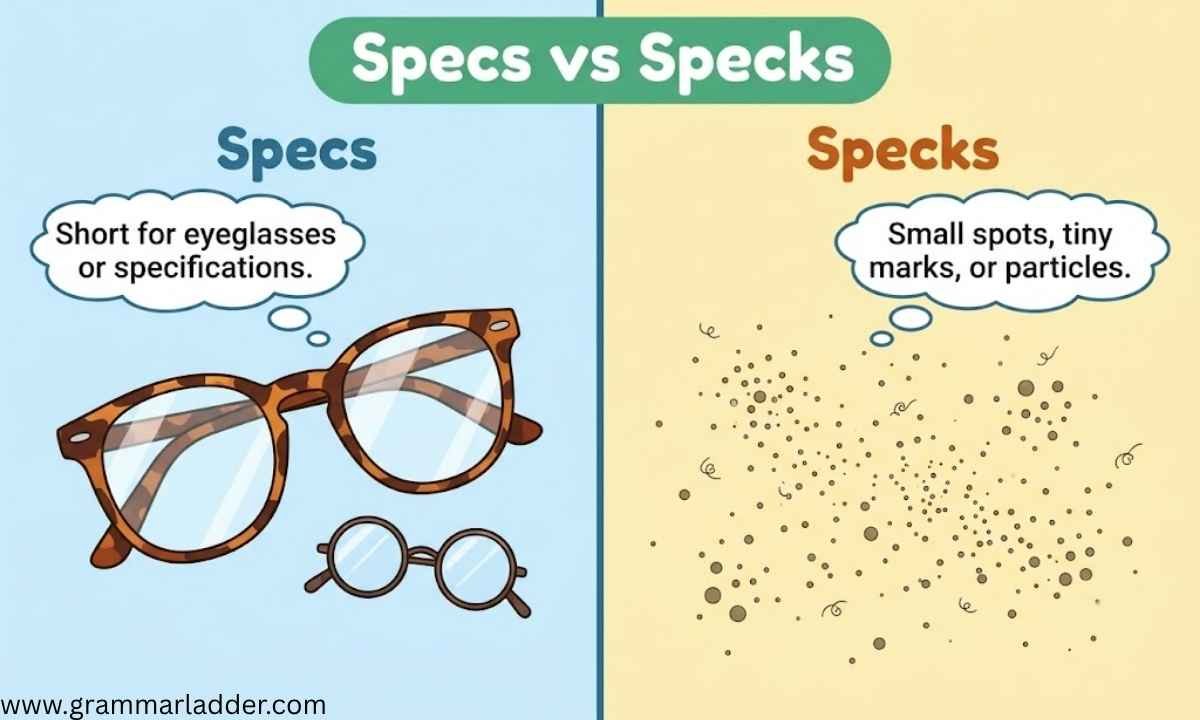
Specs is short for specifications (technical details, features, or requirements) and, informally, means eyeglasses. Specks are tiny particles, spots, or marks like dust, dirt, or paint splatters. They’re homophones, meaning they sound the same but are spelled differently and have different meanings.
Specs:
- Meaning: Specifications or eyeglasses
- Part of speech: Plural noun
- Common use: Tech, business, casual speech
- Example: “Check the laptop specs.”
Specks:
- Meaning: Tiny particles or spots
- Part of speech: Plural noun (from “speck”)
- Common use: Dust, dirt, paint, distant objects
- Example: “There are specks of dust on the shelf.”
What Does Specs Mean?
“Specs” is an informal, shortened form of the word “specifications.” It’s widely used in casual and professional writing alike, especially in technology, business, and product discussions. It also has a second, unrelated meaning: a nickname for eyeglasses.
Specifications or Technical Details
In this sense, specs refer to the detailed features, requirements, or measurements of a product, project, or system. You’ll see this usage constantly in tech reviews, business documents, and product listings.
- Compare the camera specs before you buy.
- The engineering team finalized the project specs.
- These laptop specs are more than enough for gaming.
Eyeglasses
In everyday conversation — especially in British English — “specs” is a casual, friendly term for eyeglasses or spectacles.
- He forgot his specs at home again.
- Her new specs suit her face shape perfectly.
- I can’t read the menu without my specs.
What Does Specks Mean?
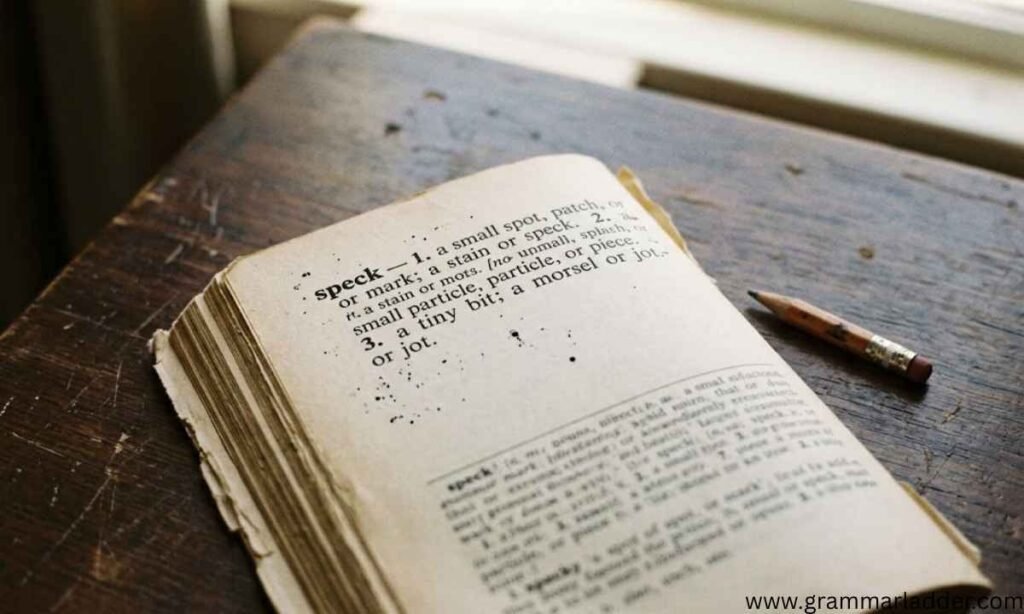
“Specks” is the plural of “speck,” a noun that describes a very small spot, mark, particle, or piece of something. It usually refers to something so tiny it’s barely noticeable, like a grain of dust or a tiny paint splatter. It comes from the Old English word specca, meaning a small stain or spot, and it has stayed close to that literal meaning ever since.
- Specks of dust covered the windowsill.
- There were specks of paint on the studio floor.
- From a distance, the birds looked like specks in the sky.
Specs vs Specks: Side-by-Side Comparison
Here’s a quick side-by-side breakdown to settle the confusion once and for all.
| Feature | Specs | Specks |
| Base word | Specification | Speck |
| Pronunciation | /speks/ | /speks/ |
| Meaning 1 | Technical details or requirements | Small particles or dots |
| Meaning 2 | Eyeglasses (informal) | — |
| Common fields | Tech, business, engineering | Cleaning, art, nature writing |
| Formality | Informal to semi-formal | Neutral, descriptive |
| Example sentence | “Send me the product specs.” | “Wipe the specks off the mirror.” |
How to Use Specs Correctly?
Since “specs” covers more than one meaning, context is everything. Here’s how it plays out across common situations.
Technology and Products
This is the most frequent use of the word today. Whenever someone talks about a device’s features, capabilities, or measurements, “specs” is the natural choice.
- Check the phone specs before you upgrade.
- The gaming console’s specs impressed every reviewer.
- These headphones have solid specs for the price.
Business and Projects
In professional settings, “specs” often refers to a formal document outlining requirements for a build, design, or deliverable.
- The contractor followed the design specs closely.
- Project specs were shared with the entire development team.
- We need updated specs before construction begins.
Eyeglasses
- I need stronger reading specs these days.
- She left her specs on the kitchen table.
- His new specs give him a whole new look.
A few related search terms worth clarifying while we’re here: “spec or speck meat” usually points people toward speck, the cured, smoked meat popular in parts of Italy and Central Europe — not “spec.” If you’re wondering about “how to spell speck,” it’s always s-p-e-c-k, whether you mean the meat or a tiny particle. As for “speck pronunciation,” it rhymes with “deck” and sounds identical to “spec.” Understanding this “specs vs specks meaning” split early on will save you from repeated errors in both casual and professional writing.
How to Use Specks Correctly?
“Specks” almost always describes something physically small and visible: dust, dirt, paint, or objects seen from far away.
Dust and Dirt
- Specks of dust floated in the sunlight.
- The shirt had a few specks of mud after the hike.
- Clean the specks off the countertop before dinner.
Paint and Ink
- Specks of paint splattered across the drop cloth.
- There are tiny ink specks on the printed page.
- The wall had faint specks left from the last renovation.
Distant Objects
- The ships looked like specks on the horizon.
- From the plane window, the houses below were just specks.
- A few dark specks in the sky turned out to be geese.
Common Mistakes With Specs and Specks
Because the two words are pronounced the same, mistakes usually happen in writing rather than speech. Here are the slip-ups people make most often:
- Writing “specks” when referring to technical features — for example, “the phone specks” instead of “the phone specs.”
- Writing “specs” when describing dust or dirt — for example, “specs of dust” instead of “specks of dust.”
- Assuming both words are interchangeable simply because they sound alike.
- Forgetting that “specs” can also mean eyeglasses, which adds a layer of context-dependency to the word.
- Overlooking regional usage — “speck” (singular, no S) can also refer to smoked ham in some culinary contexts, which is unrelated to either meaning discussed here.
Easy Memory Tricks
If the spelling still trips you up, these simple associations should help it stick.
Specs = Specifications
Think: Specs and Specifications both start the same way. If you’re talking about details, features, requirements, or glasses, drop the extra letters and use “specs.”
Specks = Small Spots
Think: Specks rhymes with flecks, and both describe tiny marks or particles. If you can picture dust, dirt, or a distant dot, you need “specks.”
Examples in Everyday Sentences
Specs
- The software specs were updated last week.
- Review the design specs before construction begins.
- Her specs make reading much easier.
- Compare the specs of both models before deciding.
- I misplaced my specs again this morning.
Specks
- Specks of snow gathered on the windowsill.
- The old photograph had faint specks of damage.
- Specks appeared under the microscope.
- Specks of sand stuck to our shoes after the beach.
- A few specks of pepper stood out on the white plate.
If you’re curious about “speck in German, the word Speck actually exists in German too — it refers to bacon or pork fat, which is a different but related culinary term from the Italian-style cured speck ham mentioned earlier.
American vs British English
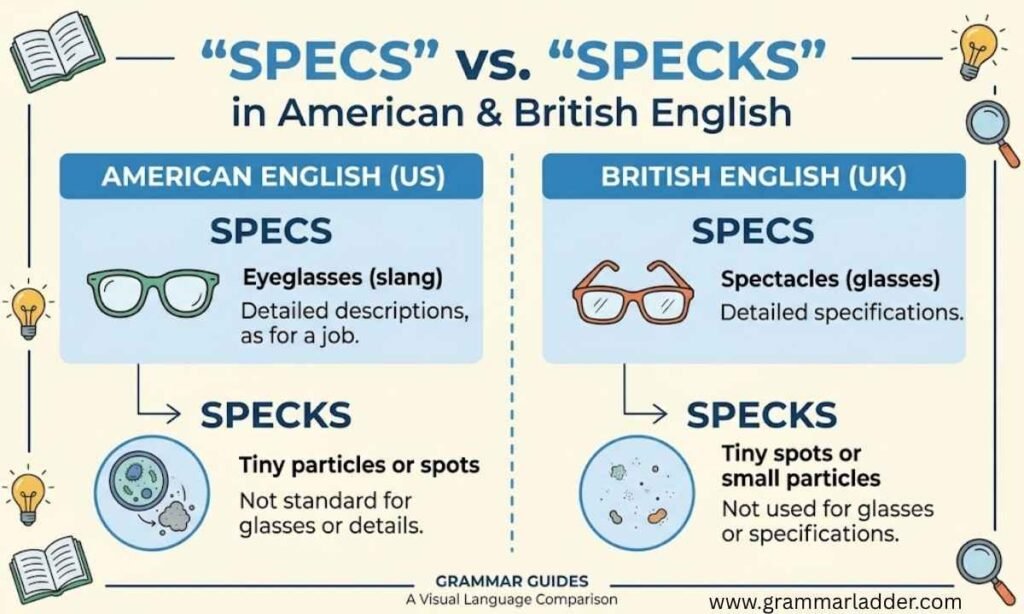
The core meanings of “specs” and “specks” stay consistent across American and British English. There’s really only one notable regional difference.
Specs as Eyeglasses
In British English, “specs” as a casual word for eyeglasses is extremely common in daily conversation. In American English, people are more likely to say “glasses,” though “specs” is still understood and occasionally used informally. The “specifications” meaning of specs, on the other hand, is used the same way on both sides of the Atlantic.
Frequently Asked Questions
Are specs and specks pronounced the same?
Yes, they’re homophones — both are pronounced /speks/, even though they’re spelled and defined differently.
What does specs mean in texting or casual chat?
It usually refers to a product’s features or, informally, to eyeglasses, depending on context.
Can specs and specks ever mean the same thing?
No, their meanings never overlap — one refers to details or glasses, the other to tiny particles.
Is “speck” always used in plural form?
No, “speck” can be singular (“a speck of dust”), while “specks” is used for more than one particle.
Which word is more common in technical writing?
“Specs” is far more common in technical, business, and product contexts.
Is “specs” an informal word?
Yes, it’s an informal shortening of “specifications,” though it’s widely accepted in both casual and professional writing.
Conclusion
“Specs” and “specks” may sound identical, but they belong to two completely different worlds — one lives in technology, business, and eyewear, while the other describes the tiniest visible particles around us. Once you connect “specs” with “specifications” and “specks” with “small spots,” the confusion disappears for good. The next time you’re writing about a new phone’s features or wiping dust off a shelf, you’ll know exactly which word belongs where.

I am an English writer with over four years of experience in grammar and language education.
Through Grammar Ladder, I share clear explanations, practical examples, and helpful English tips.
My goal is to share my knowledge so others can benefit and improve their language skills.
I believe anyone can master English with proper guidance and consistent practice.