If you’ve ever typed “volumn” into a search bar and paused, wondering whether you spelled it right, you’re not alone. Thousands of people search for this exact comparison every month, usually right after typing the word too fast or trusting the wrong autocorrect suggestion. The good news is that the answer is simple, and once you understand why the confusion happens, you’ll never second-guess it again.
This guide breaks down the correct spelling, where the mix-up comes from, how the word is used across different types of writing, and the small grammar details that trip people up most often.
Volumn or Volume – Quick Answer
Before going into the details, here’s the short version.
Volumn
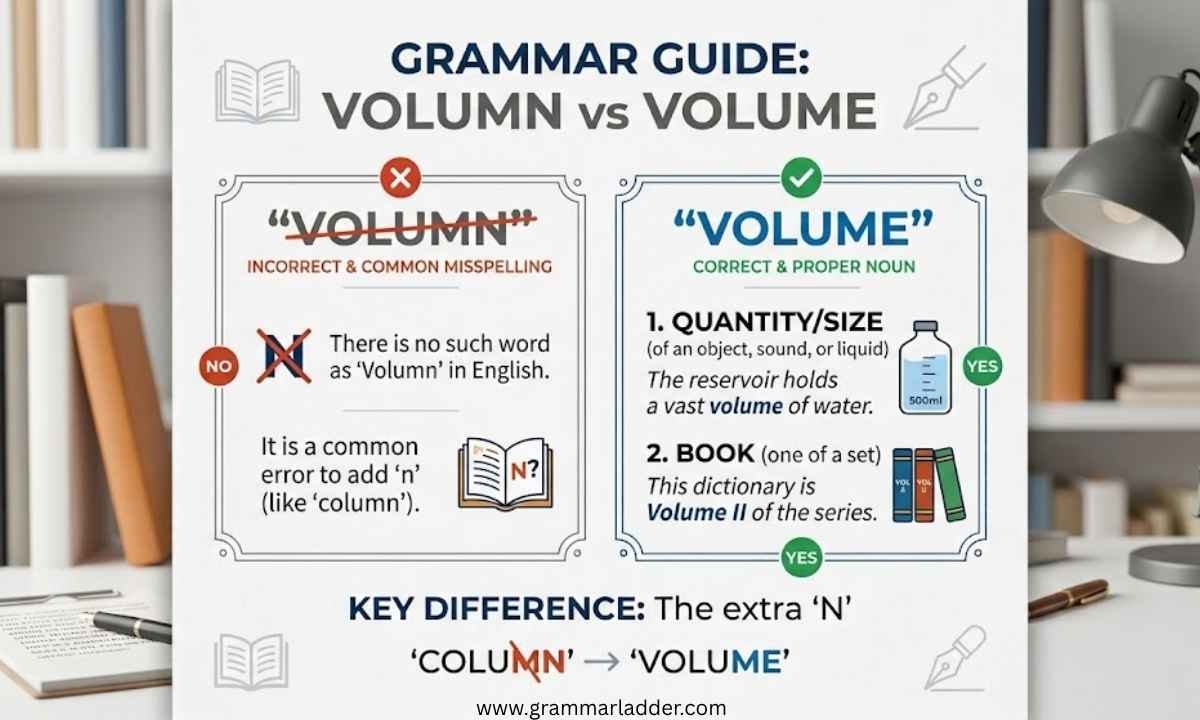
“Volumn” is not a real word. It doesn’t appear in any standard English dictionary, and it has no accepted grammatical function. It’s simply a misspelling that happens because of how the word “volume” sounds when spoken quickly.
Volume
“Volume” is the correct spelling in every context — whether you’re talking about the loudness of a sound, the amount of space inside an object, or a single book in a series. It’s the only version recognized by Merriam-Webster, Oxford, Cambridge, and every other major dictionary.
The Origin of Volumn or Volume

The word “volume” has a long history that traces back to Latin. It comes from volumen, meaning “a roll” or “something rolled up.” This makes sense once you know that ancient texts were written on scrolls, which were literally rolled sheets of material. A single scroll was referred to as a volumen, and that’s the root of why we still call a single book in a series a “volume” today.
From Latin, the word passed into Old French as volume and later into Middle English with the same spelling. Over hundreds of years, the meaning expanded to include physical space (like the volume of a container) and loudness (like the volume on a speaker), but the spelling itself never changed.
So where does “volumn” come from? It’s almost always a phonetic error. When people say “volume” out loud, especially quickly, the final syllable can sound like it ends in an “n” sound rather than a soft “e.” Writers who rely on how a word sounds rather than how it’s spelled sometimes make this swap, similar to how some people misspell “column” or “autumn,” both of which genuinely do end in a silent “n.” That silent “n” pattern likely reinforces the mistake, even though “volume” was never part of that spelling family.
British English vs American English Spelling
One common question is whether “volumn” might be a regional variation, similar to how “colour” is British and “color” is American. It isn’t.
Key Point
Both British English and American English use the same spelling: volume. There is no dialectal version of this word that includes an “n” at the end. Regardless of where you’re writing from — the UK, the US, Canada, Australia, or anywhere else — “volume” is the only accepted form.
Comparison Table
| Region | Correct Spelling | Alternate Spelling Accepted? |
| American English | Volume | No |
| British English | Volume | No |
| Canadian English | Volume | No |
| Australian English | Volume | No |
This consistency makes “volume” easier to remember than many other words that do shift between dialects.
Which Spelling Should You Use?
The answer is always “volume.” There is no situation — casual, professional, academic, or creative — where “volumn” is appropriate. It’s not an outdated or archaic spelling either; it has simply never been a real word.
Audience-Based Advice
Different audiences have different tolerance for spelling errors, so here’s how to think about it:
- Students and academics: Always use “volume.” Spelling errors in essays or research papers can affect grades and credibility.
- Business professionals: Use “volume” in reports, emails, and presentations. A typo like “volumn” can undercut an otherwise polished document.
- Content writers and marketers: Search engines and readers both expect the correct spelling. Using “volumn” by mistake can hurt readability and trust.
- Casual writers and social media users: Even in informal settings, “volume” is quick to type correctly once you’re aware of the common slip.
Volume or Volumn Meaning
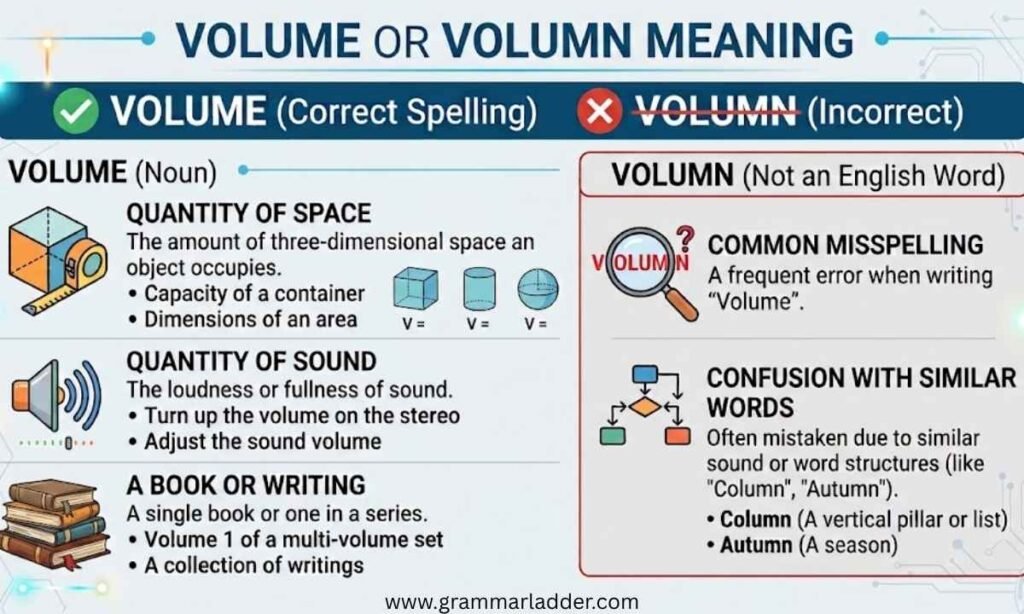
Since “volumn” carries no real definition, all meaning belongs to “volume.” The word covers three primary uses:
- Loudness – the intensity of sound, such as turning up the volume on a phone or television.
- Space or capacity – the three-dimensional amount of space an object occupies, often calculated in math and science using length, width, and height.
- A book or section of a series – as in “the second volume of an encyclopedia” or “a three-volume novel.”
There’s also a figurative use, seen in the idiom “speaks volumes,” meaning something reveals a lot about a person or situation without needing further explanation.
Volumn or Volume Grammar
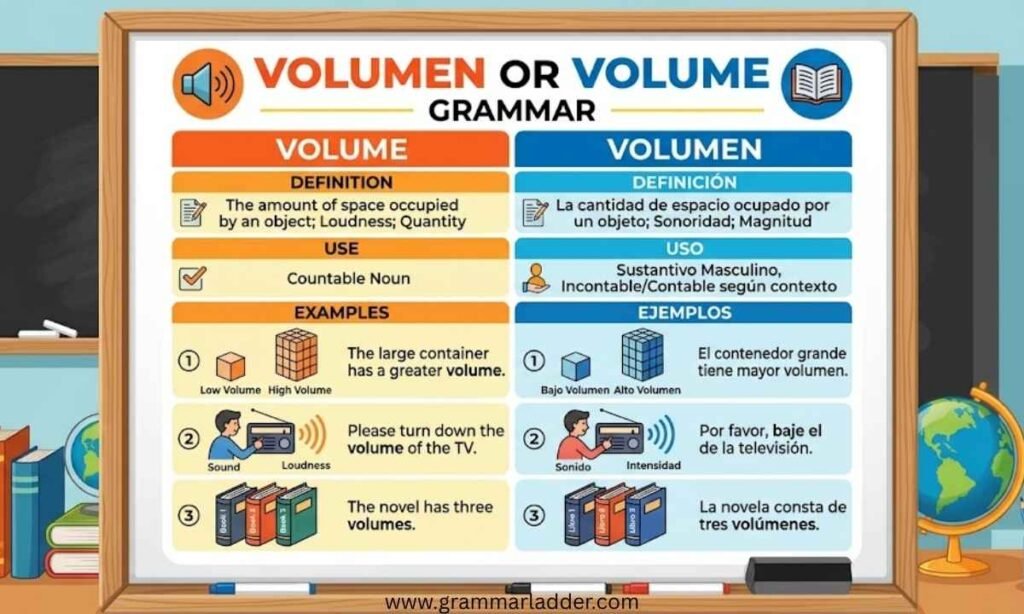
Grammatically, “volume” functions as a noun in nearly all its uses. It can also act as part of a verb phrase, such as “to volume up” in informal tech speech, though this isn’t standard usage.
A few grammar notes worth remembering:
- The plural form is volumes, not “volumns.”
- The adjective form is voluminous, meaning large in size or quantity (for example, “a voluminous skirt”).
- “Volume” pairs naturally with verbs like increase, decrease, adjust, raise, and lower.
Because “volumn” isn’t a recognized word, it has no accepted grammatical forms of its own — no plural, no adjective, and no verb usage.
Volumn or Volume Sound
When it comes to pronunciation, “volume” is typically pronounced as VOL-yoom or VOL-yəm, depending on the accent. The ending is soft and vowel-based, which is exactly why so many people mishear it and assume it ends in “n.” Words like “column” and “autumn” end with a genuine silent “n,” and that pattern can subconsciously bleed into how people spell “volume” as well — even though the sounds aren’t actually the same.
Volume or Volumn Destiny 2

Gamers sometimes search this exact phrase while adjusting in-game audio or graphics settings. Whether you’re playing Destiny 2 or any other title, the settings menu will always use the correct spelling: volume. This applies to music volume, sound effects volume, and voice chat volume sliders found in nearly every modern game’s options menu. There is no in-game term, weapon, or setting spelled “volumn” — if you see that spelling anywhere, it’s a typo, not an official term.
Common Mistakes with Volumn or Volume
Here are the most frequent errors people make, along with quick fixes:
- Volumn – Happens because the word sounds like it ends in “n.” Correct spelling: volume.
- Volumne – An extra letter gets added by mistake. Correct spelling: volume.
- Volum – The final “e” gets dropped. Correct spelling: volume.
- Volumns – A mix-up with the plural of the misspelled word. Correct spelling: volumes.
- Confusing with “column” – The two words sound similar and share a rhythm, but they aren’t interchangeable. A column is vertical, while a volume refers to a book or a measurement.
Volumn or Volume in Everyday Examples
Seeing the word in real contexts makes the correct usage easier to remember.
Emails
“Please note that our order volume has increased by 20% this quarter.”
News
“The report highlighted a sharp rise in trading volume across major markets.”
Social Media
“Can someone tell me why my phone volume keeps resetting?”
Formal Writing
“This dissertation is presented as the first volume in a two-part academic study.”
In every one of these examples, “volume” is the only correct choice — there’s no context where “volumn” would work instead.
Volumn or Volume – Google Trends & Usage Data
Search data consistently shows that “volume” is used far more often than “volumn,” which appears almost exclusively as a typo rather than an intentional word choice. Interest in the misspelling tends to spike when people are actively trying to confirm the correct form, rather than using it in finished writing. This pattern is common with other frequently misspelled words, where the incorrect version shows up mostly in search queries rather than in published content, books, or professional documents.
Comparison Table: Volumn vs Volume
| Feature | Volumn | Volume |
| Dictionary recognized | No | Yes |
| Correct in British English | No | Yes |
| Correct in American English | No | Yes |
| Has a plural form | No | Yes (volumes) |
| Has an adjective form | No | Yes (voluminous) |
| Appropriate for formal writing | Never | Always |
| Common origin | Mishearing/typo | Latin volumen |
Frequently Asked Questions
Is “volumn” ever correct?
No, it is always a misspelling of “volume” and is not recognized in any dictionary.
Why do people write “volumn” instead of “volume”?
It usually happens because of how the word sounds when spoken quickly, plus confusion with words like “column” that genuinely end in “n.”
Does British English spell it differently?
No, both British and American English use “volume” with no regional variation.
What is the plural of volume?
The plural is “volumes.”
Is “voluminous” related to “volume”?
Yes, it’s the adjective form, meaning large in size or quantity.
Can “volumn” be used in casual texting?
No, even in informal writing, “volume” is the only correct spelling.
Conclusion
The comparison between “volumn” and “volume” isn’t really a debate — it’s a simple case of one correct word and one common typo. “Volume” has remained consistent for centuries, tracing back to its Latin root volumen, and it works the same way across British and American English alike. Whether you’re writing an email, adjusting a game’s audio settings, or describing a set of encyclopedias, “volume” is always the spelling to use. Once you remember that the word ends softly in “-ume” rather than “-umn,” the mistake becomes easy to avoid for good.

I am an English writer with over four years of experience in grammar and language education.
Through Grammar Ladder, I share clear explanations, practical examples, and helpful English tips.
My goal is to share my knowledge so others can benefit and improve their language skills.
I believe anyone can master English with proper guidance and consistent practice.